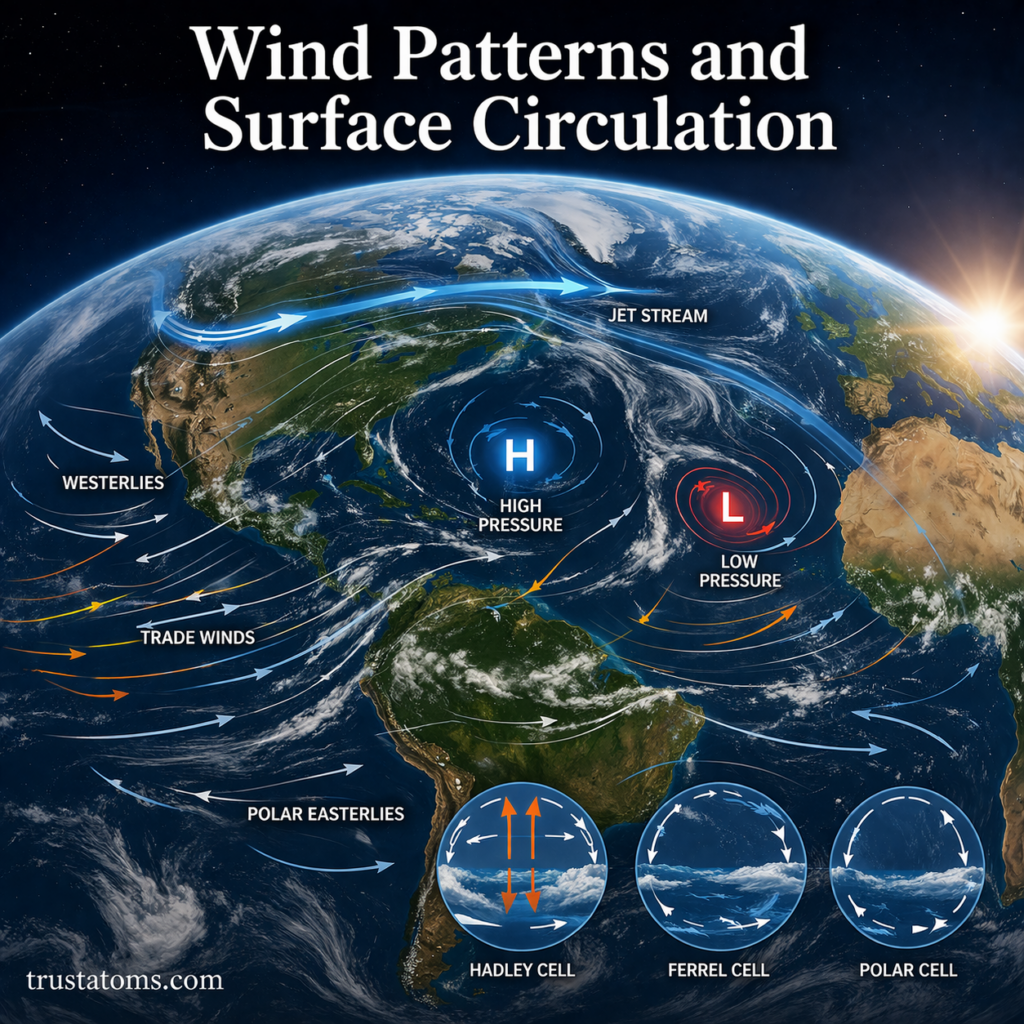
Wind is the movement of air across Earth’s surface, driven by differences in temperature and pressure. These movements create recognizable global wind patterns and surface circulation systems that influence weather, climate, and ocean currents.
Understanding wind patterns helps explain everything from daily weather changes to long-term climate zones across the planet.
What Causes Wind?
Wind forms due to differences in air pressure.
Key Driving Factors
- Uneven heating of Earth’s surface by the Sun
- Temperature differences between land and water
- Pressure gradients (high to low pressure movement)
- Earth’s rotation
Air naturally moves from areas of high pressure to low pressure, creating wind.
The Role of Pressure Gradients
A pressure gradient is the difference in air pressure between two locations.
How It Works
- Strong pressure difference → stronger winds
- Weak pressure difference → lighter winds
The greater the gradient, the faster the air moves.
The Coriolis Effect
Earth’s rotation influences wind direction through the Coriolis effect.
Key Points
- Winds are deflected to the right in the Northern Hemisphere
- Winds are deflected to the left in the Southern Hemisphere
- The effect increases with latitude and is weakest near the equator
This deflection is responsible for large-scale wind circulation patterns.
Global Wind Patterns
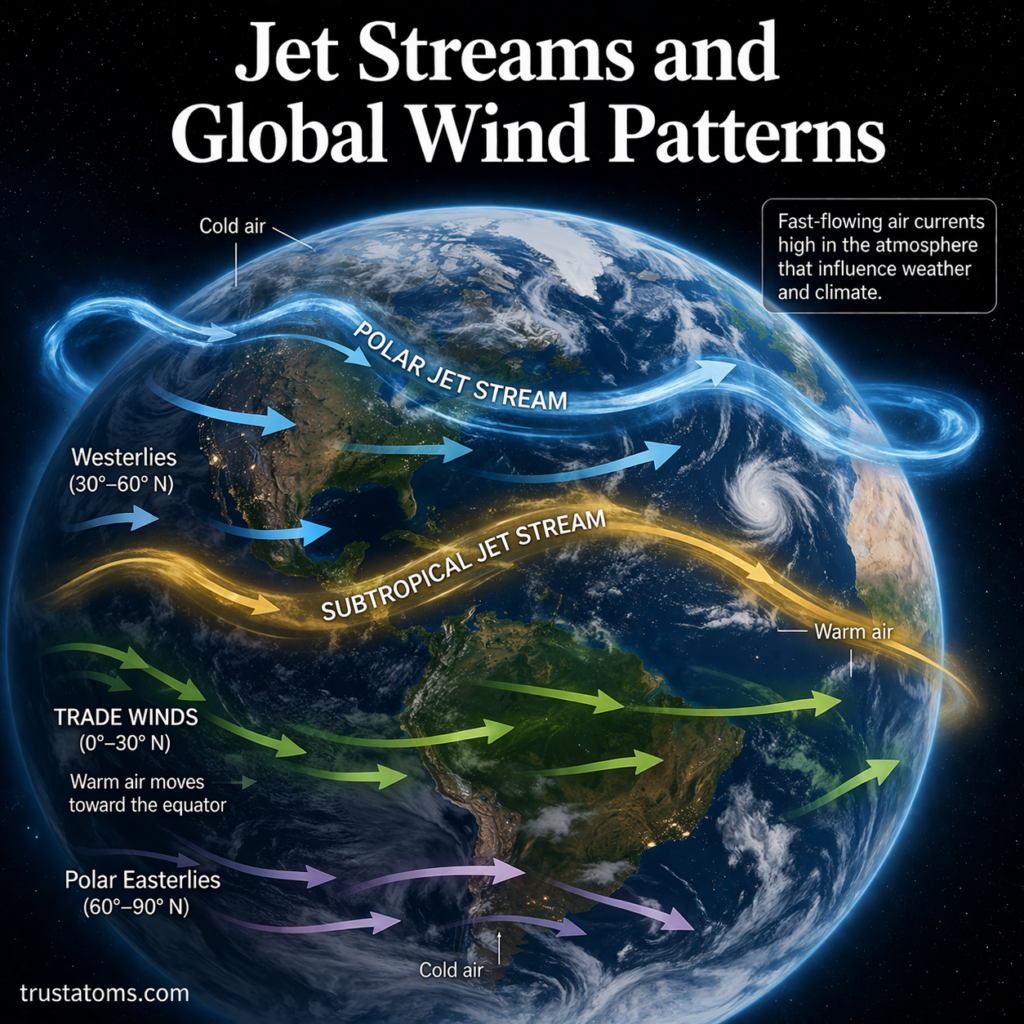
Earth’s atmosphere is divided into three major circulation cells in each hemisphere.
1. Hadley Cell (0°–30° latitude)
- Warm air rises near the equator
- Air moves poleward and cools
- Sinks around 30° latitude
Resulting Winds
- Trade winds (blow toward the equator)
2. Ferrel Cell (30°–60° latitude)
- Air flows between the Hadley and Polar cells
- Driven by interactions between neighboring cells
Resulting Winds
- Westerlies (blow from west to east)
3. Polar Cell (60°–90° latitude)
- Cold, dense air sinks at the poles
- Moves toward lower latitudes
Resulting Winds
- Polar easterlies (blow from east to west)
Surface Wind Patterns
At Earth’s surface, wind patterns are influenced by friction and terrain.
Effects of Surface Friction
- Slows wind speed
- Alters wind direction slightly
- Creates turbulence
Surface winds are more irregular than upper-atmosphere winds due to these interactions.
High and Low Pressure Systems
Pressure systems play a major role in surface circulation.
High Pressure Systems
- Air sinks and spreads outward
- Typically associated with clear skies
- Winds move away from the center
Low Pressure Systems
- Air rises and converges inward
- Associated with clouds and storms
- Winds move toward the center
Local Wind Patterns
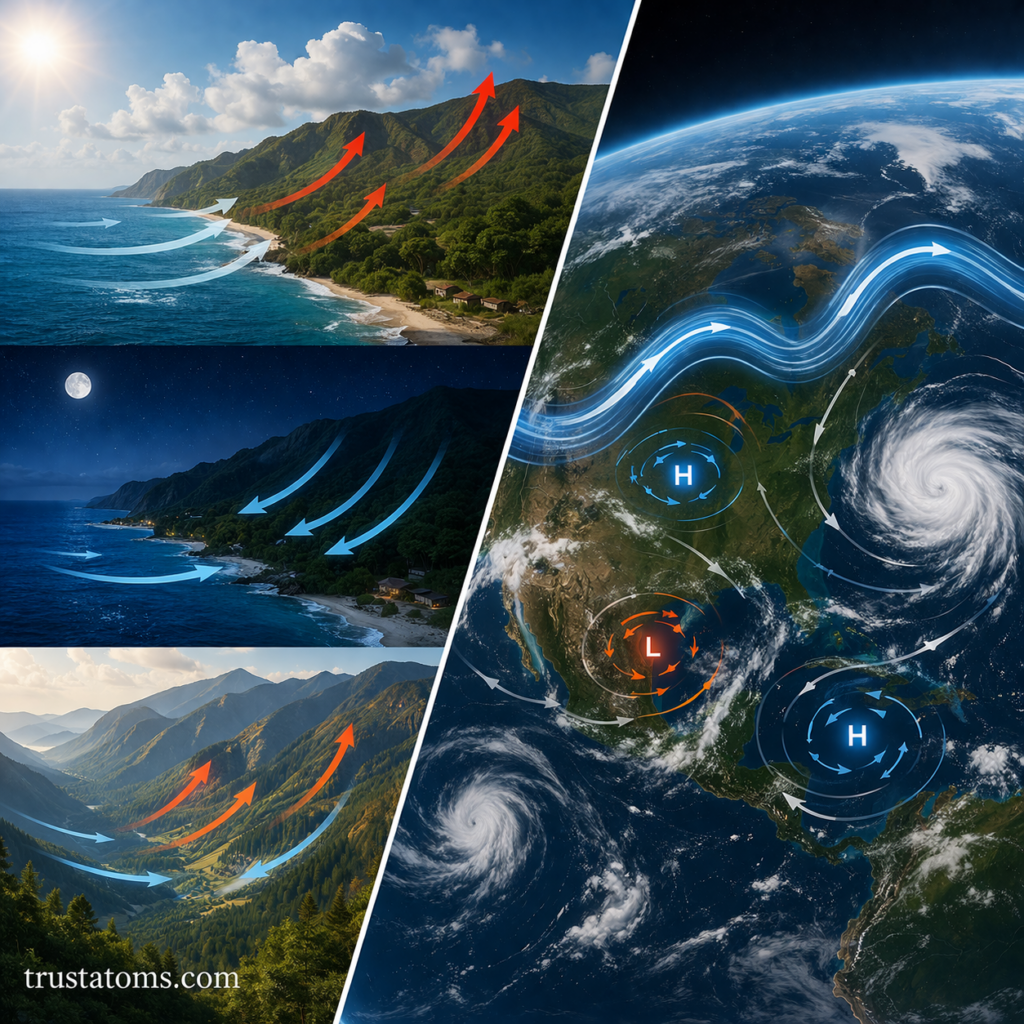
In addition to global systems, smaller-scale winds occur due to local conditions.
Sea Breezes
- Occur during the day
- Land heats faster than water
- Cool air moves from sea to land
Land Breezes
- Occur at night
- Land cools faster than water
- Air moves from land to sea
Mountain and Valley Breezes
- Valley breeze: warm air rises up slopes during the day
- Mountain breeze: cool air flows down slopes at night
Jet Streams
Jet streams are fast-moving air currents in the upper atmosphere.
Key Features
- Located near boundaries of air masses
- Flow from west to east
- Can influence storm paths and weather systems
Jet streams help steer weather patterns across continents.
Ocean and Atmospheric Interaction
Wind patterns also drive ocean circulation.
Key Impacts
- Create surface ocean currents
- Influence climate patterns (e.g., El Niño and La Niña)
- Transfer heat around the globe
This interaction connects atmospheric and ocean systems.
Why Wind Patterns Matter
Understanding wind patterns is essential for predicting weather and climate.
Key Applications
- Weather forecasting
- Aviation and navigation
- Renewable energy (wind power)
- Climate science
Key Takeaways
- Wind is driven by pressure differences and temperature variations
- The Coriolis effect influences wind direction
- Global circulation cells create major wind belts
- Surface conditions modify wind behavior
- Wind patterns affect weather, oceans, and climate
Final Thoughts
Wind patterns and surface circulation are fundamental to Earth’s atmospheric system. From gentle breezes to powerful global currents, these movements shape weather, influence climate zones, and connect different parts of the planet.
By understanding how winds form and behave, we gain deeper insight into the complex and dynamic processes that drive Earth’s environment.