Temperature in the atmosphere does not remain constant—it changes with altitude, location, and time. These changes, known as temperature gradients, play a critical role in weather patterns, atmospheric stability, and energy transfer across the planet.
Understanding temperature gradients helps explain why storms form, how air moves, and why different layers of the atmosphere behave the way they do.
What Is a Temperature Gradient?
A temperature gradient refers to the rate at which temperature changes over a certain distance.
In atmospheric science, it usually describes how temperature changes with height (altitude).
Key Concept
- A steep gradient → rapid temperature change
- A weak gradient → gradual temperature change
These differences influence how air moves and how weather develops.
Vertical Temperature Gradient
The most important type of temperature gradient in meteorology is the vertical temperature gradient.
How It Works
- As altitude increases, temperature usually decreases
- This rate of decrease is known as the lapse rate
This gradient affects whether air rises, sinks, or remains stable.
Lapse Rates Explained
Lapse rates describe how quickly temperature changes with altitude.
Types of Lapse Rates
1. Environmental Lapse Rate (ELR)
- The actual temperature change in the atmosphere at a given time
- Varies depending on weather conditions
2. Dry Adiabatic Lapse Rate (DALR)
- Applies to unsaturated (dry) air
- Approximately 10°C per kilometer
3. Moist Adiabatic Lapse Rate (MALR)
- Applies to saturated (moist) air
- Approximately 5–6°C per kilometer
Why Temperature Gradients Matter
Temperature gradients are essential for understanding atmospheric motion.
Key Effects
- Control vertical air movement
- Influence cloud formation
- Determine atmospheric stability
- Drive convection and storms
A strong temperature gradient often leads to more active weather.
Temperature Inversions
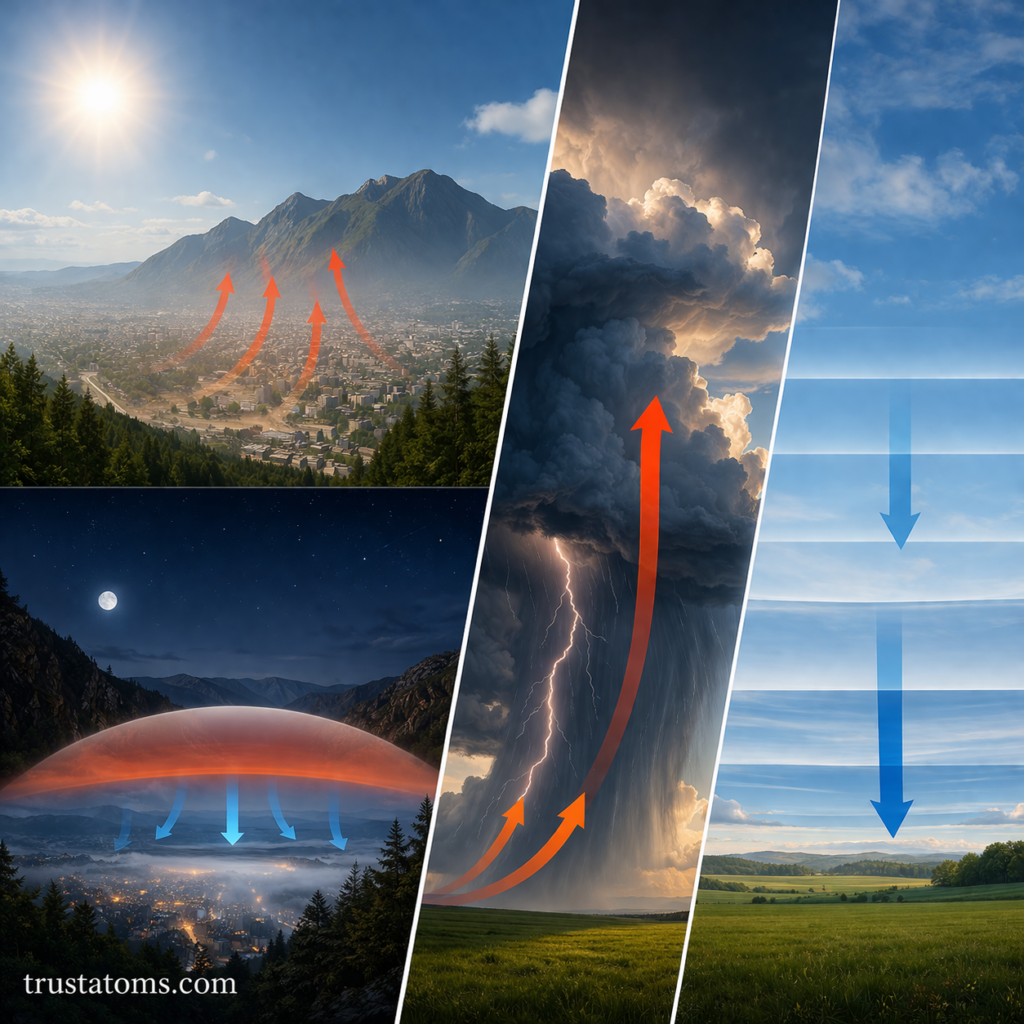
A temperature inversion occurs when the normal temperature pattern is reversed.
What Happens During an Inversion
- Temperature increases with height instead of decreasing
- Warm air sits above cooler air
Effects of Inversions
- Traps pollutants near the surface
- Reduces vertical air mixing
- Leads to fog and smog formation
Inversions are common in valleys and during calm, clear nights.
Horizontal Temperature Gradients
Temperature gradients also occur across Earth’s surface.
Causes
- Differences in solar heating
- Land vs. water temperature variations
- Seasonal changes
Impact
- Create pressure differences
- Drive wind patterns
- Influence weather fronts
Temperature Gradients and Weather Fronts
Weather fronts form where different air masses meet.
Types of Fronts
- Cold front – cold air replaces warm air
- Warm front – warm air moves over cold air
- Stationary front – boundary remains in place
- Occluded front – complex interaction of air masses
These fronts are directly linked to temperature gradients.
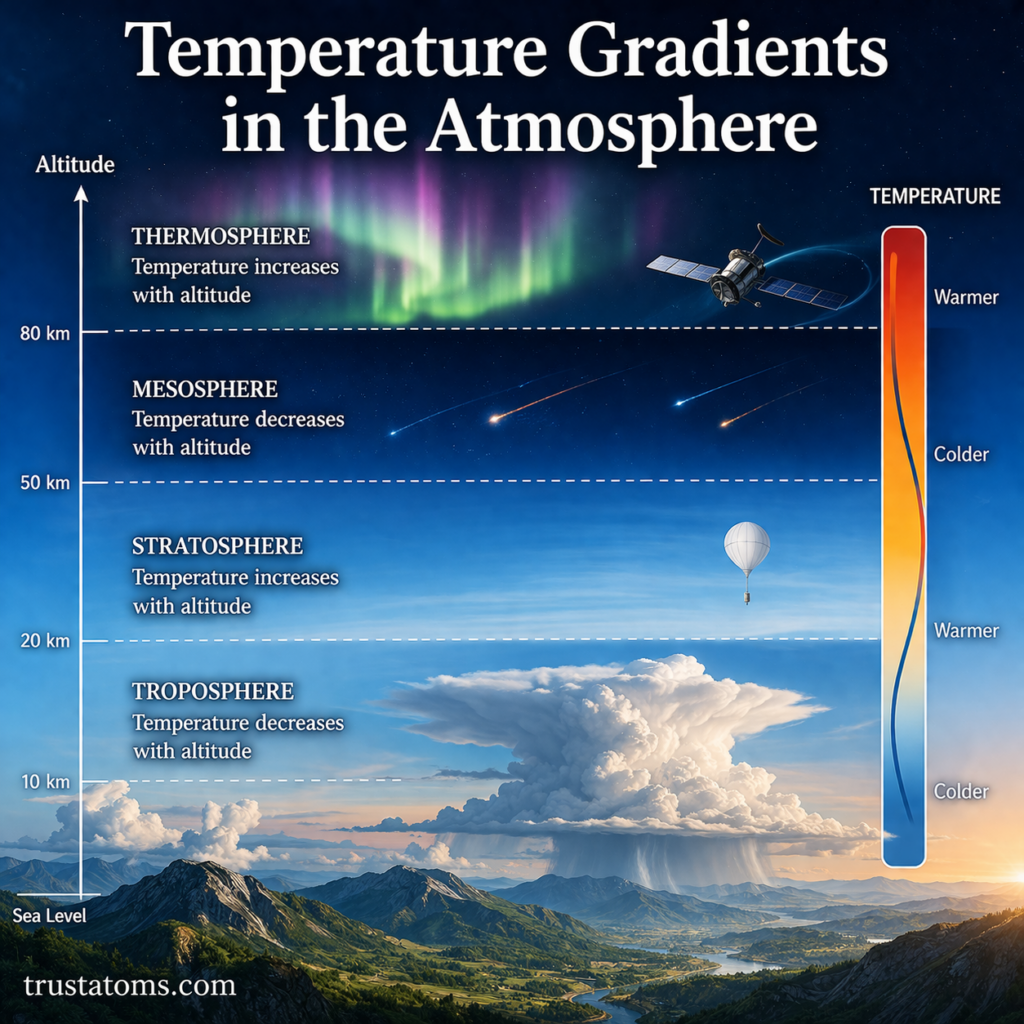
Atmospheric Layers and Temperature Changes
The atmosphere is divided into layers, each with unique temperature patterns.
Troposphere
- Temperature decreases with height
- Most weather occurs here
Stratosphere
- Temperature increases with height due to ozone absorption of sunlight
Mesosphere
- Temperature decreases again with altitude
Thermosphere
- Temperature increases significantly due to solar radiation
Real-World Examples
Strong Temperature Gradient
- Leads to storm development
- Creates rising air and convection
Weak Temperature Gradient
- Results in calm, stable conditions
- Less vertical air movement
Applications of Temperature Gradient Knowledge
1. Weather Forecasting
- Predicting storms and cloud formation
- Understanding atmospheric stability
2. Aviation
- Identifying turbulence zones
- Planning safe flight paths
3. Environmental Science
- Studying air pollution behavior
- Monitoring climate patterns
Key Takeaways
- Temperature gradients describe how temperature changes with distance or altitude
- Vertical gradients (lapse rates) are crucial for weather formation
- Temperature inversions can trap air and pollutants
- Horizontal gradients drive wind and weather systems
- Atmospheric layers each have unique temperature patterns
Final Thoughts
Temperature gradients are a fundamental part of Earth’s atmospheric system. They influence how air moves, how storms form, and how energy is distributed across the planet.
By understanding these gradients, we gain deeper insight into the processes that shape our weather and climate—revealing the dynamic balance that keeps Earth’s atmosphere in motion.