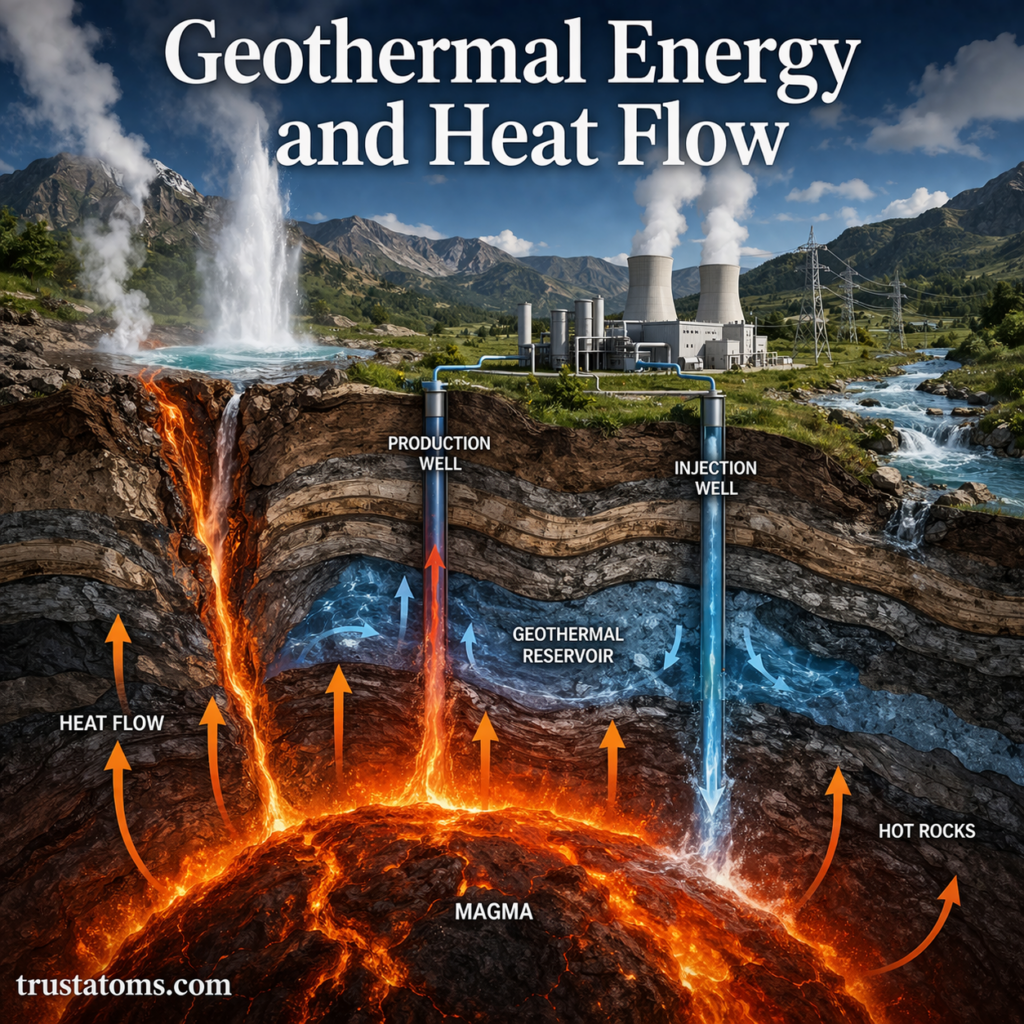
Geothermal energy is heat stored inside Earth that can be used to generate electricity, heat buildings, and support industrial processes. Heat flow is the transfer of thermal energy from Earth’s hotter interior toward its cooler surface, driven by temperature differences and geological activity.
Unlike solar or wind energy, geothermal energy originates beneath the ground and can provide a steady source of heat regardless of weather conditions. Studying this energy is part of Earth science, which examines how the planet’s interior, surface, and interacting systems operate.
What Is Geothermal Energy?
Geothermal energy comes from the Greek words for Earth and heat. It refers to thermal energy stored in underground rocks, fluids, and other materials, from shallow soil to the deep interior.
Earth’s internal heat has two major origins: energy remaining from the planet’s formation and heat continuously produced by the radioactive decay of naturally occurring elements, including uranium, thorium, and potassium. This energy moves through Earth’s interior and eventually escapes at the surface.
Although underground temperatures generally increase with depth, useful geothermal resources depend on more than temperature alone. Water availability, rock permeability, and drilling accessibility determine whether underground heat can be recovered economically.
Understanding Heat Flow in Earth
Heat naturally transfers from warmer regions to cooler ones. Within Earth, this movement occurs primarily through conduction and convection, although the processes operate differently across the planet’s layers.
Conduction and Convection
- Conduction: Heat passes through solid rock without large-scale movement of the material. It is especially important in Earth’s crust.
- Convection: Heat is transported through moving material, including circulating underground water and the extremely slow flow of solid mantle rock.
- Radiation: Thermal energy travels as electromagnetic waves, but this mechanism contributes relatively little to heat transfer through Earth’s interior.
The geothermal gradient describes how temperature increases with depth. In many continental crustal settings, a typical gradient is approximately 25–30°C per kilometer, although local values vary considerably.
For example, assuming a surface temperature of 15°C and a gradient of 30°C per kilometer, rock at a depth of 2 kilometers would reach approximately 75°C. This simplified calculation illustrates why deeper drilling often encounters hotter conditions, but actual temperatures depend on local geology.
For more context, Earth’s Internal Heat and Energy Sources explains where this energy originates, while Earth’s Density and Interior Structure examines the layers through which heat travels. The connection between underground heat and surface features is explored in Geothermal Regions and Volcanic Activity.
Types of Geothermal Systems
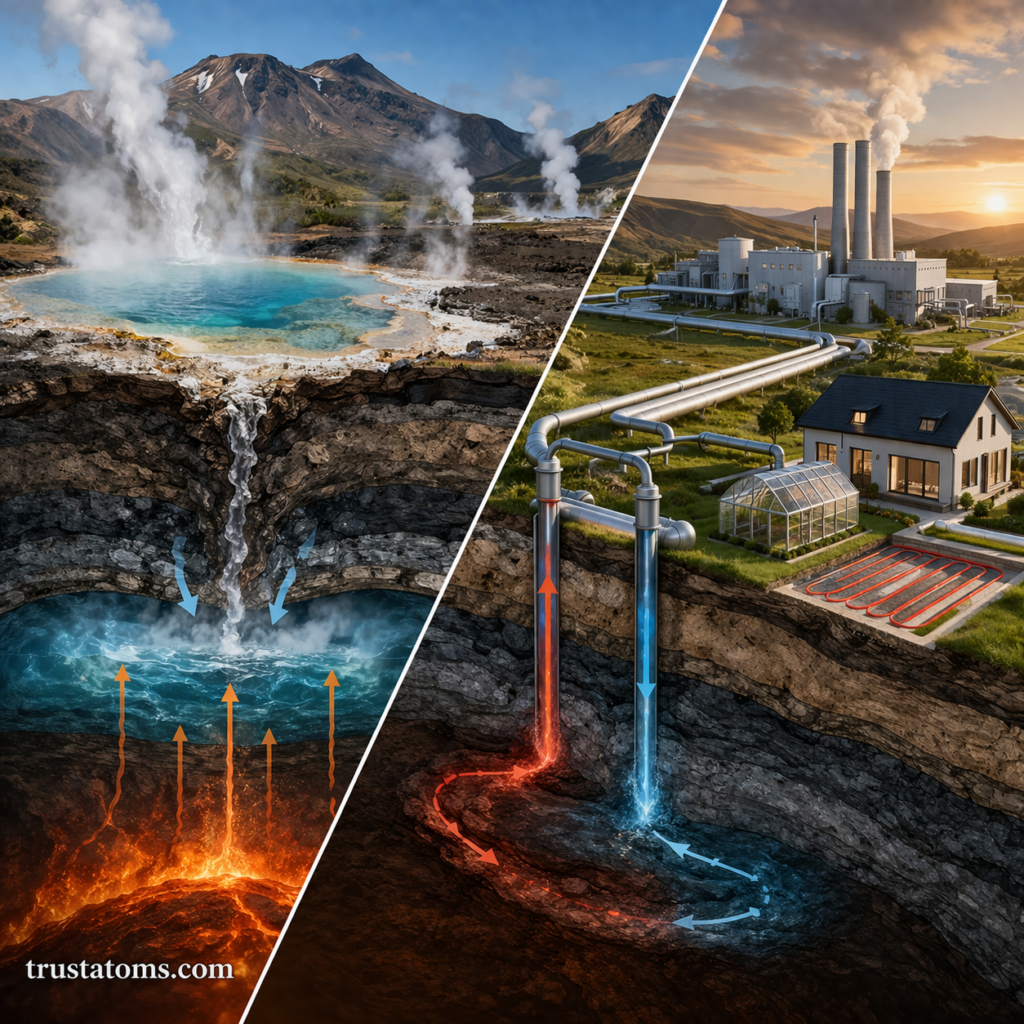
Geothermal systems differ according to underground temperature, fluid availability, and the technology used to recover heat.
Hydrothermal Systems
Hydrothermal systems contain naturally heated groundwater or steam within permeable rocks. Wells can bring these fluids to the surface for electricity production or direct heating. Such systems are particularly common in tectonically active regions.
Enhanced Geothermal Systems
Enhanced geothermal systems (EGS) target hot rock where natural fluid circulation is insufficient. Engineers improve underground permeability so injected water can circulate, absorb heat, and return through production wells. This technology could expand geothermal development beyond naturally productive reservoirs.
Ground-Source Heat Pumps
Ground-source heat pumps use the relatively stable temperatures of shallow soil or groundwater to heat and cool buildings. Unlike geothermal power plants, they do not require extremely hot underground rock. They transfer heat into buildings during colder weather and move heat into the ground during warmer weather.
How Geothermal Energy Produces Electricity and Heat
Geothermal power plants convert underground thermal energy into electricity. Depending on resource temperature, steam may come directly from a reservoir, form when hot water experiences a pressure drop, or be produced indirectly through a separate working fluid in a binary-cycle plant.
The resulting vapor drives a turbine connected to an electrical generator. Cooled geothermal fluids are commonly reinjected underground to help maintain reservoir pressure and support continued operation.
Lower-temperature geothermal resources can supply direct heating without generating electricity. Applications include district heating networks, greenhouses, aquaculture facilities, and industrial processes requiring moderate temperatures.
Geological Controls on Geothermal Energy
A productive geothermal reservoir generally requires sufficient heat, a means of transferring that heat, and geological conditions that allow energy recovery. Faults and fractures can provide pathways for underground fluids, while impermeable layers may help confine hot water.
Volcanic regions often have elevated geothermal gradients because magma or recently heated rocks occur relatively close to the surface. However, useful geothermal resources also exist away from active volcanoes, particularly in sedimentary basins and regions with favorable subsurface temperatures.
Geological exploration for geothermal resources shares techniques with investigations of Mineral Resources, including geological mapping, geophysical surveys, and drilling to evaluate underground conditions.
Where Geothermal Resources Are Found
Geothermal resources occur worldwide, but high-temperature systems suitable for conventional electricity generation are concentrated in particular geological environments.
- Iceland: Its position along the Mid-Atlantic Ridge supports extensive geothermal heating and electricity production.
- Japan: Volcanic activity associated with subduction creates numerous hot springs and geothermal resources.
- Indonesia: Its location along active plate boundaries provides substantial geothermal potential.
- Western United States: Tectonic activity and elevated heat flow support geothermal development, including major facilities in California.
Shallow ground-source heat pumps have a much broader geographic range because they rely on moderate, relatively stable ground temperatures rather than volcanic heat.
Benefits and Limitations of Geothermal Energy
Geothermal power plants can produce electricity continuously rather than depending on daily sunlight or changing wind conditions. Their operational greenhouse gas emissions are generally low compared with fossil-fuel power generation, although emissions vary by reservoir and technology.
Challenges include expensive exploration and drilling, limited access to suitable reservoirs, mineral scaling, and potential induced earthquakes associated with underground fluid injection or extraction. Some geothermal fluids also contain dissolved gases or minerals requiring careful handling.
Long-term sustainability depends on managing heat extraction, fluid circulation, and reservoir pressure. Reinjection and continuous monitoring can help maintain production, but extracting heat faster than it is replenished may reduce reservoir temperatures over time.
Frequently Asked Questions
Is geothermal energy renewable?
Geothermal energy is generally classified as renewable because Earth’s interior continually supplies heat. However, individual reservoirs can cool or lose pressure if energy and fluids are extracted faster than the system can recover.
How deep must geothermal wells be?
Depth depends on the application and local geology. Ground-source heat pump installations may use shallow buried loops or boreholes tens to hundreds of meters deep, while electricity-producing geothermal wells often extend several kilometers underground.
Does geothermal energy require volcanoes?
No. Volcanic regions often provide accessible high-temperature resources, but geothermal energy can also be recovered from deep hot rocks and sedimentary basins. Ground-source heat pumps can operate in many areas without volcanic activity.
Geothermal energy connects Earth’s internal heat flow with practical technologies for electricity generation and temperature control. Its usefulness depends on underground temperature, rock properties, and careful reservoir management, making geological understanding essential to developing reliable geothermal systems.
Sources: U.S. Geological Survey (USGS), geothermal energy and Earth’s internal heat resources; U.S. Department of Energy, Geothermal Technologies Office; National Renewable Energy Laboratory (NREL), geothermal energy research.