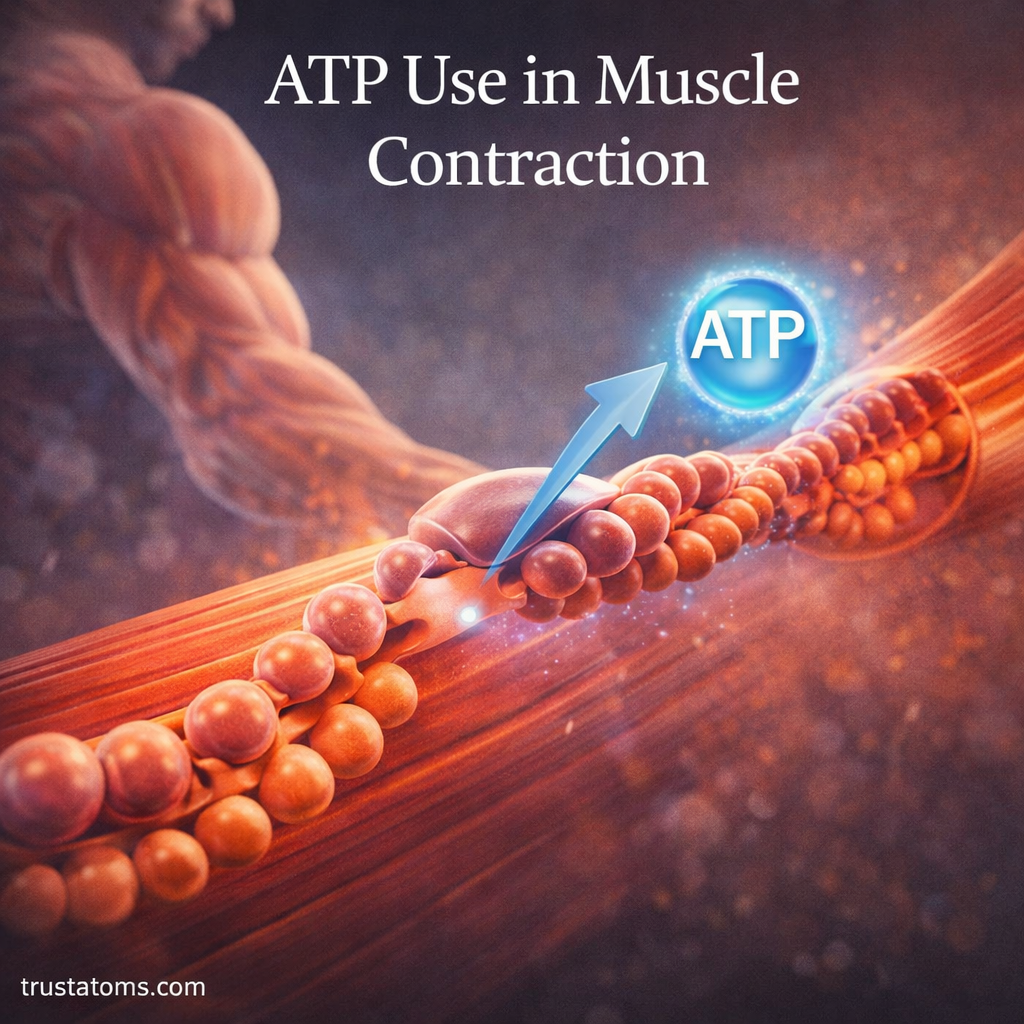
Every time you move—whether lifting a weight, walking, or even blinking—your muscles rely on a single molecule for energy: ATP (adenosine triphosphate).
ATP is often called the “energy currency” of the cell, and in muscle contraction, it plays a direct and essential role. Without ATP, muscles cannot contract—or relax.
What Is ATP?
ATP (adenosine triphosphate) is a molecule that stores and releases energy in cells.
Structure of ATP
ATP consists of:
- Adenine (a nitrogenous base)
- Ribose (a sugar)
- Three phosphate groups
The energy stored in ATP comes from the bonds between phosphate groups.
How ATP Releases Energy
- When one phosphate is removed → ATP becomes ADP (adenosine diphosphate)
- This reaction releases energy used for muscle contraction
Why ATP Is Essential for Muscle Contraction
ATP is required at multiple stages of the contraction process, not just for generating force.
Key Roles of ATP
- Powers the interaction between muscle proteins
- Enables muscle fibers to contract
- Allows muscles to relax after contraction
Without ATP, muscles would remain stuck in a contracted state.
The Sliding Filament Theory Overview
Muscle contraction occurs through the sliding filament mechanism, involving two key proteins:
- Actin (thin filament)
- Myosin (thick filament)
Myosin heads bind to actin and pull, shortening the muscle.
ATP is required for each step of this cycle.
The Cross-Bridge Cycle (Step-by-Step)
The cross-bridge cycle explains how muscles contract at the molecular level.
1. ATP Binds to Myosin
- ATP attaches to the myosin head
- This causes myosin to detach from actin
2. ATP Is Broken Down
- ATP → ADP + phosphate
- This provides energy to “cock” the myosin head into a high-energy position
3. Cross-Bridge Formation
- Myosin binds to actin again
- A cross-bridge is formed
4. Power Stroke
- Myosin pulls actin inward
- ADP and phosphate are released
- Muscle shortens
5. Cycle Repeats
- A new ATP molecule binds
- Process continues as long as ATP is available
ATP and Muscle Relaxation
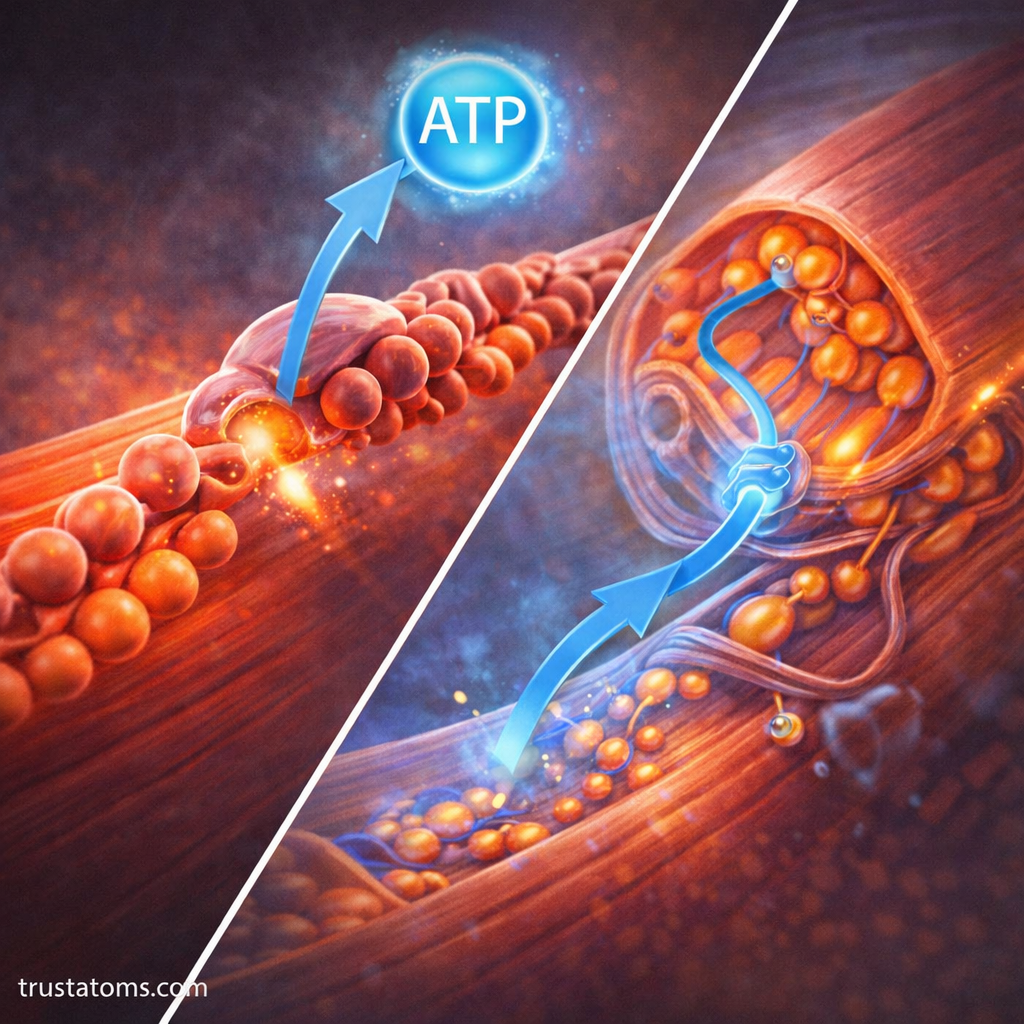
ATP is also required for muscles to relax, not just contract.
How Relaxation Works
- Calcium ions must be pumped back into storage inside the muscle cell
- This process requires ATP
Without ATP
- Calcium remains in the muscle
- Contraction continues
- Muscle becomes rigid
This is why rigor mortis occurs after death—ATP production stops.
Limited ATP Storage in Muscles
Muscles store only a small amount of ATP, enough for a few seconds of activity.
What Happens Next?
The body must continuously regenerate ATP using:
- Phosphocreatine (ATP-PC system)
- Glycolysis
- Aerobic metabolism
This ensures a constant energy supply for ongoing movement.
ATP Use in Different Types of Movement
Different activities require ATP at different rates.
High-Intensity Movements
- Rapid ATP use
- Examples:
- Sprinting
- Heavy lifting
Low-Intensity Movements
- Slower ATP use
- Examples:
- Walking
- Posture maintenance
Efficiency of ATP in Muscle Function
ATP is extremely efficient because:
- It provides immediate energy
- It supports rapid, repeated contractions
- It allows precise control of muscle force
However, because it is used quickly, the body must constantly produce more.
What Happens When ATP Runs Out?
When ATP supply cannot meet demand:
- Muscle force decreases
- Fatigue sets in
- Movement becomes less efficient
In Extreme Cases
- Muscles may cramp
- Contraction-relaxation cycle is disrupted
ATP and Athletic Performance
ATP availability plays a major role in performance.
Training Effects
- Improves ATP production efficiency
- Enhances energy system capacity
- Delays fatigue
Practical Implications
- Short bursts → rely on immediate ATP and phosphocreatine
- Endurance → depends on sustained ATP production
Common Misconceptions
“ATP is stored in large amounts”
False.
- ATP is stored in very small quantities
- The body must constantly regenerate it
“ATP is only used for contraction”
Incorrect.
- ATP is also required for relaxation and recovery processes
Why ATP Matters in Human Anatomy
ATP is fundamental to:
- Muscle contraction and relaxation
- Movement and physical activity
- Cellular energy processes
Without ATP, even the simplest movements would be impossible.
Final Thoughts
ATP is the driving force behind every muscle contraction. From the microscopic interactions between actin and myosin to full-body movement, ATP provides the energy needed to keep muscles functioning smoothly.
Understanding how ATP works gives deeper insight into strength, endurance, fatigue, and overall human performance.