Balance is something most people take for granted—until it’s disrupted. Whether you’re walking, turning your head, or simply standing still, your body is constantly making small adjustments to keep you stable.
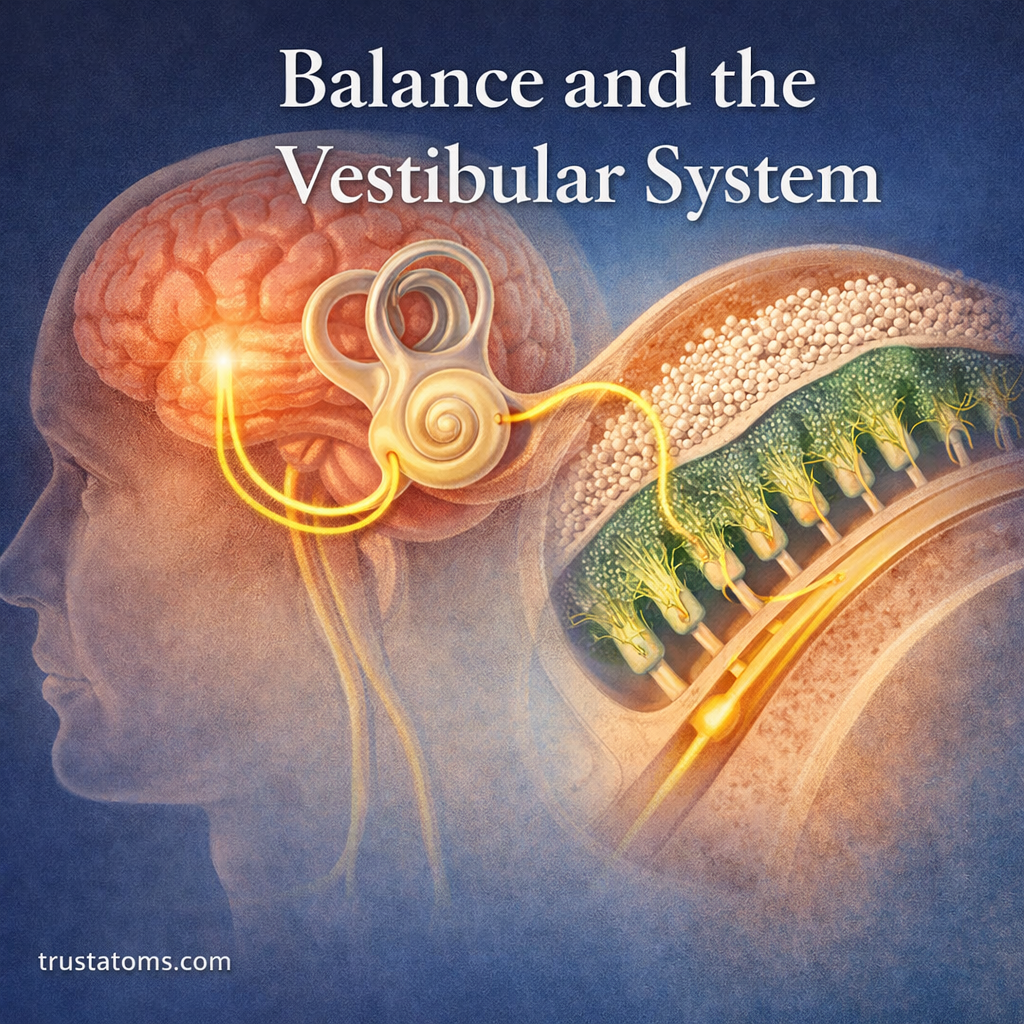
At the center of this process is the vestibular system, a specialized sensory system located in the inner ear. It works continuously with your brain, eyes, and body to maintain equilibrium, orientation, and coordinated movement.
What Is the Vestibular System?
The vestibular system is responsible for detecting:
- Head movement
- Spatial orientation
- Acceleration and gravity
It plays a critical role in:
- Maintaining posture
- Stabilizing vision
- Coordinating movement
- Preventing dizziness and falls
This system is part of the inner ear and works closely with the nervous system to keep you balanced.
Where Is the Vestibular System Located?
The vestibular system is housed within the inner ear, alongside the cochlea (which is responsible for hearing).
It consists of two main components:
- Semicircular canals – detect rotational movement
- Otolith organs – detect linear movement and gravity
Semicircular Canals: Detecting Rotation
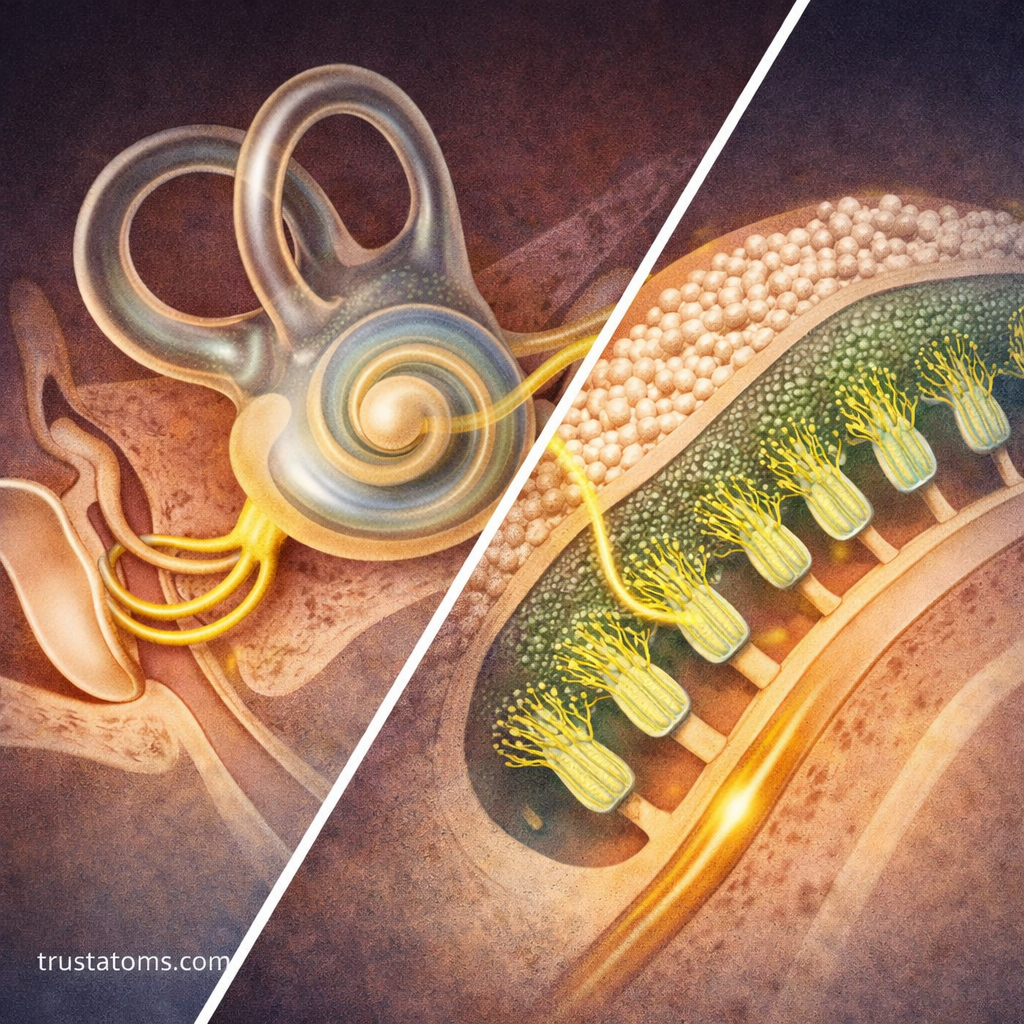
The semicircular canals are three curved, fluid-filled tubes arranged in different orientations.
Key Functions
- Detect head rotation in three dimensions
- Help track angular motion
How They Work
- Each canal contains a fluid called endolymph
- When the head rotates, the fluid lags behind due to inertia
- This movement bends tiny hair cells
- Hair cells generate electrical signals sent to the brain
Example
- Shaking your head “no”
- Nodding “yes”
- Tilting your head side to side
Otolith Organs: Detecting Linear Movement and Gravity
The otolith organs include:
- Utricle
- Saccule
Key Functions
- Detect straight-line motion (linear acceleration)
- Sense head position relative to gravity
How They Work
- Contain small calcium crystals called otoliths
- Movement causes these crystals to shift
- This shift bends hair cells beneath them
- Signals are sent to the brain about position and motion
Example
- Moving forward in a car
- Riding an elevator
- Leaning your head
Hair Cells: The Sensory Core of Balance
Hair cells are the key receptors in the vestibular system.
What They Do
- Detect mechanical movement (fluid or crystal shifts)
- Convert movement into electrical signals
- Send signals through the vestibular nerve
These cells are extremely sensitive and play a crucial role in maintaining balance.
How the Brain Processes Balance
The vestibular system doesn’t work alone—it sends information to the brain, where it’s integrated with other sensory inputs.
Signal Pathway
- Signals travel through the vestibular nerve
- Reach the brainstem
- Processed by the cerebellum
- Integrated with visual and body signals
Integration with Vision and Body Awareness
Balance depends on multiple systems working together.
Visual System
- Provides information about surroundings
- Helps maintain orientation
Proprioceptive System
- Sensors in muscles and joints
- Provide awareness of body position
Combined Effect
The brain merges all inputs to:
- Maintain posture
- Adjust movement
- Keep you stable in changing environments
Vestibulo-Ocular Reflex (VOR)
The vestibulo-ocular reflex (VOR) is essential for keeping vision stable during movement.
How It Works
- When your head moves, your eyes move in the opposite direction
- This keeps your focus steady
Example
- Turn your head while reading → text stays clear
Without VOR, your vision would blur every time you moved.
Everyday Importance of the Vestibular System
The vestibular system is constantly active, even when you’re unaware of it.
Daily Activities It Supports
- Walking and running
- Standing upright
- Turning your head while focusing
- Driving or riding in a vehicle
- Maintaining coordination during sports
Common Vestibular Disorders
Problems with the vestibular system can lead to balance issues and dizziness.
Benign Paroxysmal Positional Vertigo (BPPV)
- Caused by displaced otolith crystals
- Leads to brief episodes of spinning sensation
Vestibular Neuritis
- Inflammation of the vestibular nerve
- Causes sudden dizziness and imbalance
Ménière’s Disease
- Fluid buildup in the inner ear
- Symptoms include vertigo, hearing loss, and ringing
Common Symptoms
- Dizziness
- Vertigo (spinning feeling)
- Loss of balance
- Nausea
Why Balance Matters
Balance is essential for safety, mobility, and independence.
Key takeaways:
- The vestibular system detects motion and orientation
- Hair cells convert movement into signals
- The brain integrates multiple systems for stability
- Even small disruptions can affect daily life
Final Thoughts
The vestibular system is a remarkable part of human anatomy that allows you to move through the world with stability and confidence. By constantly detecting motion and coordinating with the brain, it ensures smooth movement and clear vision.
Understanding how balance works not only highlights the complexity of the human body but also emphasizes the importance of maintaining inner ear health.