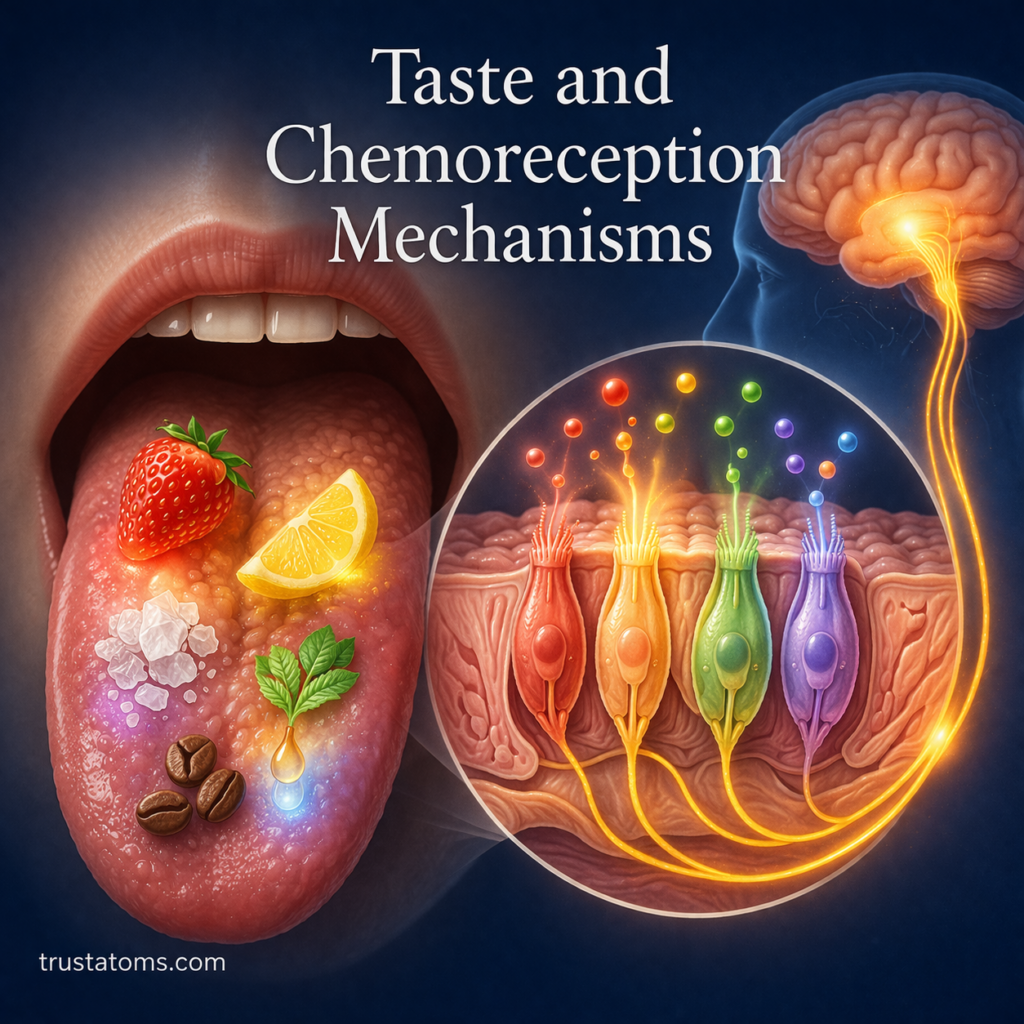
Taste is a form of chemoreception in which specialized cells detect chemicals dissolved in saliva and initiate signals that the brain interprets as taste. These signals travel through sensory nerves to the brain, where they combine with smell and other sensations to produce the experience of flavor.
As part of human anatomy, the taste system connects structures in the mouth with the nervous system. It helps us recognize nutrients, respond to potentially harmful substances, and distinguish foods through five basic taste qualities: sweet, salty, sour, bitter, and umami.
What Is Chemoreception?
Chemoreception is the detection of chemical substances by specialized sensory cells. These cells respond to particular molecules or ions and convert chemical information into signals that the nervous system can process.
Two familiar forms of chemoreception are:
- Gustation (taste) – detects chemicals dissolved in saliva.
- Olfaction (smell) – detects airborne chemicals.
Both systems depend on sensory cells that respond to chemical stimuli. The relationship between chemical detection and nerve signaling is explored further in Sensory Neurons and Signal Detection.
Overview of the Taste System
The taste system consists of taste buds, sensory nerve pathways, and brain regions that interpret incoming information. Taste begins when substances from food or drinks dissolve in saliva and reach receptor cells in the mouth.
The tongue contains many taste buds, but taste receptors also occur in parts of the soft palate, throat, and epiglottis. Taste works alongside other senses, as described in Sensory Systems Overview in Human Biology.
Tongue Structure and Taste Buds
The tongue has small surface projections called papillae. Several types contain taste buds, while others primarily help manipulate food.
- Fungiform papillae: Mushroom-shaped structures concentrated near the tip and front of the tongue, many containing taste buds.
- Foliate papillae: Folds along the sides of the tongue that contain taste buds.
- Circumvallate papillae: Large papillae arranged near the back of the tongue, with numerous taste buds along their walls.
- Filiform papillae: Numerous projections that provide friction for handling food but do not contain taste buds.
Each taste bud typically contains approximately 50–100 specialized cells, including receptor cells and supporting cells. Tiny openings called taste pores allow dissolved substances to contact the sensory surfaces of these cells.
The Five Basic Tastes
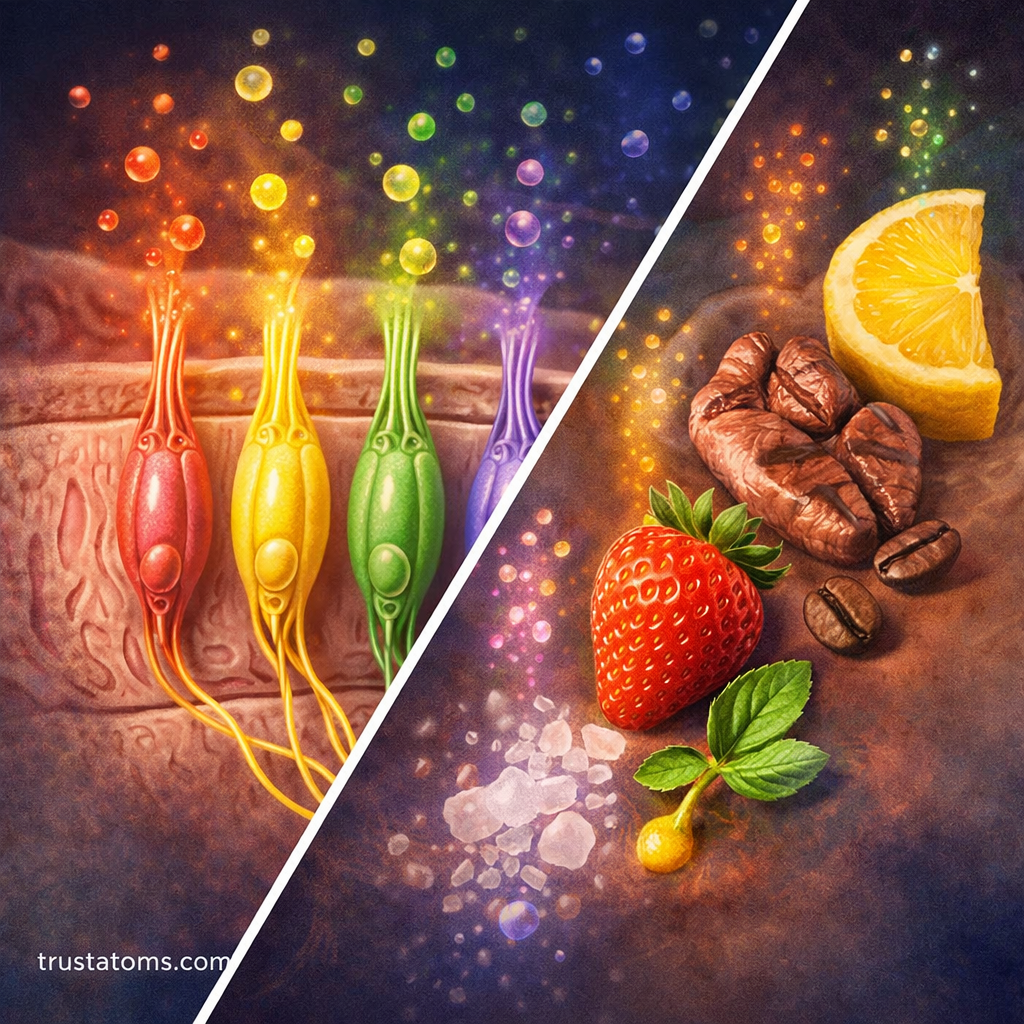
Humans recognize five established basic taste qualities, each associated with particular chemical stimuli.
- Sweet: Commonly triggered by sugars, such as those in fruit and honey, and associated with energy-containing foods.
- Salty: Primarily associated with sodium ions, which are essential for normal nerve and muscle function.
- Sour: Detects acidity through hydrogen ions, as experienced when tasting lemon juice.
- Bitter: Responds to many different compounds, including some potentially toxic substances and harmless compounds in coffee or vegetables.
- Umami: A savory sensation associated particularly with glutamate, found in foods such as mushrooms, tomatoes, and aged cheese.
Contrary to the traditional tongue map, these tastes are not restricted to separate regions of the tongue. Areas containing appropriate taste receptors can detect multiple taste qualities.
How Taste Transduction Works
Taste transduction converts chemical stimulation into changes in receptor-cell activity that ultimately produce nerve signals. Different taste qualities use different molecular mechanisms, illustrating the broader principles of Sensory Receptors and Transduction Mechanisms.
- Chemicals dissolve: Saliva carries soluble food compounds to taste receptor cells.
- Receptors respond: Sweet, bitter, and umami compounds activate specialized receptor proteins, while salty and sour stimuli involve ion-dependent detection mechanisms.
- Cells become activated: Chemical detection changes electrical activity inside the receptor cells.
- Signals reach nerves: Activated cells communicate with sensory nerve fibers, which transmit information toward the brain.
For example, when you eat a strawberry, dissolved sugars stimulate sweet-sensitive receptor cells. At the same time, acidic compounds contribute sourness, while aroma molecules provide the recognizable strawberry smell.
Neural Pathways of Taste
Three cranial nerves carry taste information from different regions of the mouth and throat:
- Facial nerve (VII): Carries taste signals from the anterior two-thirds of the tongue, mainly through the chorda tympani branch.
- Glossopharyngeal nerve (IX): Carries taste information from the posterior third of the tongue.
- Vagus nerve (X): Transmits taste information from areas including the epiglottis and lower throat.
These signals reach the nucleus of the solitary tract in the brainstem. Taste information then travels through the thalamus to the gustatory cortex, primarily involving the insula and frontal operculum.
The organization of these connections reflects the processes described in Neural Pathways in Sensory Processing.
How Smell and Other Senses Shape Flavor
Flavor is more complex than taste alone. During chewing, volatile molecules travel from the mouth toward olfactory receptors in the nasal cavity through a process called retronasal olfaction.
This explains why food may seem bland during a cold. The taste buds can still detect sweetness or saltiness, but reduced access to aroma molecules makes individual foods harder to distinguish.
Temperature, texture, appearance, and chemical sensations also influence flavor. For example, chili peppers activate pain- and temperature-sensitive pathways rather than producing a sixth basic taste. Genetics can also affect sensitivity to certain bitter compounds.
Taste Protection and Common Disorders
Taste helps guide food selection. Sweetness can indicate available carbohydrates, while bitterness may encourage caution around unfamiliar substances. However, taste cannot reliably determine whether food is safe: some dangerous substances are tasteless, and many bitter foods are harmless.
Disorders of taste include:
- Ageusia: Complete loss of taste.
- Hypogeusia: Reduced ability to detect tastes.
- Dysgeusia: Distorted taste perception, sometimes involving persistent metallic or unpleasant sensations.
Possible causes include infections, certain medications, oral conditions, nerve injuries, and some medical treatments. Because smell contributes heavily to flavor, an apparent loss of taste may actually involve impaired olfaction.
Frequently Asked Questions
Can every part of the tongue detect all five tastes?
Most tongue regions containing taste buds can detect all five basic taste qualities. Sensitivity may vary between locations, but individual tastes are not confined to separate tongue zones.
Is spicy food considered a basic taste?
No. The burning sensation from chili peppers results mainly from capsaicin activating TRPV1 receptors on sensory nerve endings. This is a chemical irritation sensation, not one of the five basic tastes.
Do taste buds regenerate?
Yes. Taste receptor cells are continually replaced, with many turning over within approximately one to two weeks. Replacement rates vary among cell types, and illness or injury can interfere with normal renewal.
Taste begins with chemical detection in specialized cells, but the complete experience depends on nerve pathways, brain processing, and information from other senses. Understanding these mechanisms explains why the same food can taste different when its aroma, temperature, or texture changes.
This article is for general education and is not medical advice. Talk to a qualified health professional about any medical concern.
Sources: National Institute on Deafness and Other Communication Disorders (NIDCD), Taste Disorders; Guyton and Hall Textbook of Medical Physiology; Principles of Neural Science, Kandel and colleagues.