Electrochemical Cells in Energy Systems

Illustration diagram showing how electrochemical cells power energy systems including renewable energy storage, batteries, and electric vehicles.
Illustration showing how electrochemical cells store and deliver energy in modern systems such as renewable grids, batteries, and electric vehicles. trustatoms.com

Electrochemical cells are a cornerstone of modern energy technology. From powering smartphones and laptops to supporting renewable energy storage and electric vehicles, these systems convert chemical energy into electrical energy through controlled chemical reactions.

As the global energy landscape shifts toward cleaner and more sustainable solutions, electrochemical cells are becoming increasingly important. Understanding how they work helps explain many of the technologies that support modern power systems, portable electronics, and large-scale energy storage.

Continue reading “Electrochemical Cells in Energy Systems”
Catalysis in Reaction Dynamics

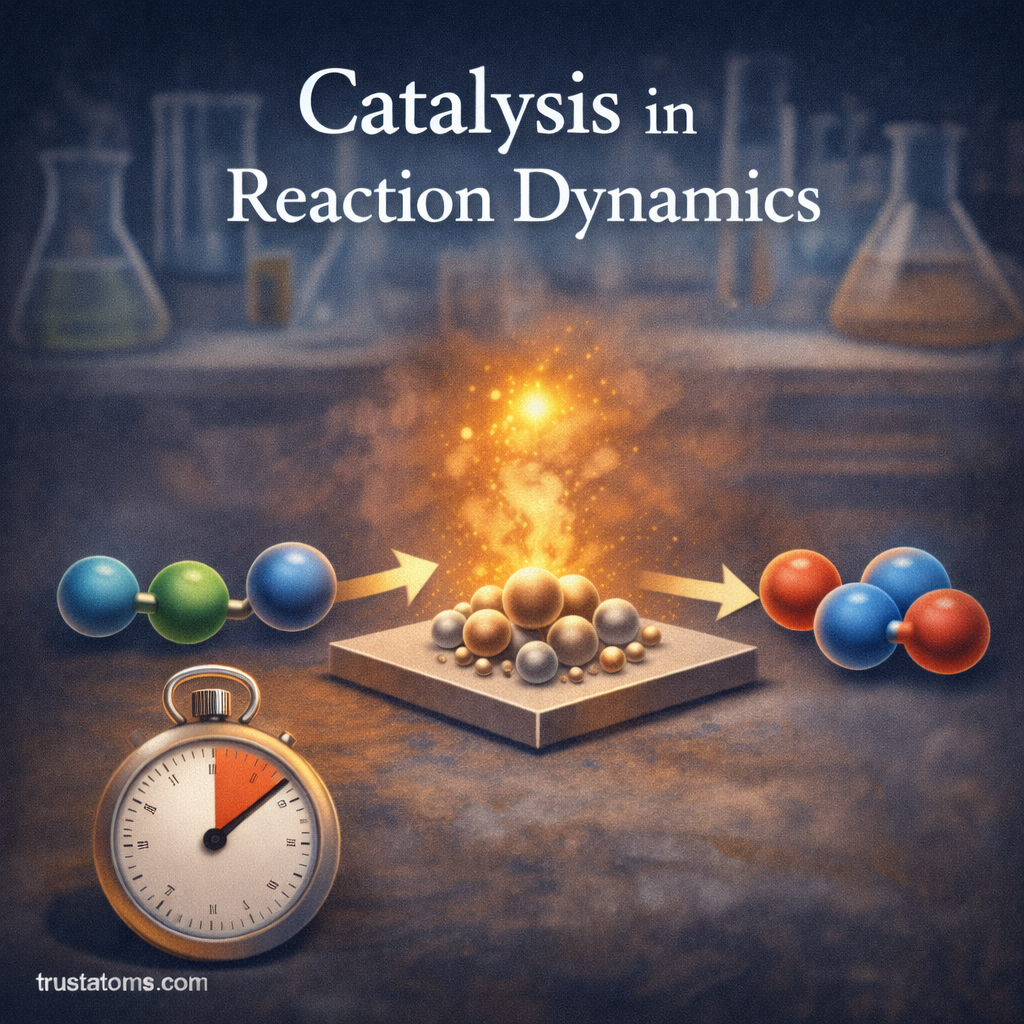
Illustration showing molecules reacting on a catalyst surface to speed up a chemical reaction in reaction dynamics.
Illustration depicting molecules interacting with a catalyst surface that accelerates a chemical reaction. trustatoms.com.

Many chemical reactions occur very slowly under normal conditions. In both natural systems and industrial processes, reactions often need to happen faster or more efficiently. This is where catalysis becomes important.

Catalysis refers to the process in which a substance called a catalyst speeds up a chemical reaction without being permanently consumed. By lowering the energy barrier of a reaction, catalysts help reactions occur more quickly and efficiently while maintaining the same overall chemical outcome.

Understanding catalysis is a key part of reaction dynamics, which studies how chemical reactions proceed and what factors influence their speed and pathways.

Continue reading “Catalysis in Reaction Dynamics”

Activation Energy in Reaction Pathways

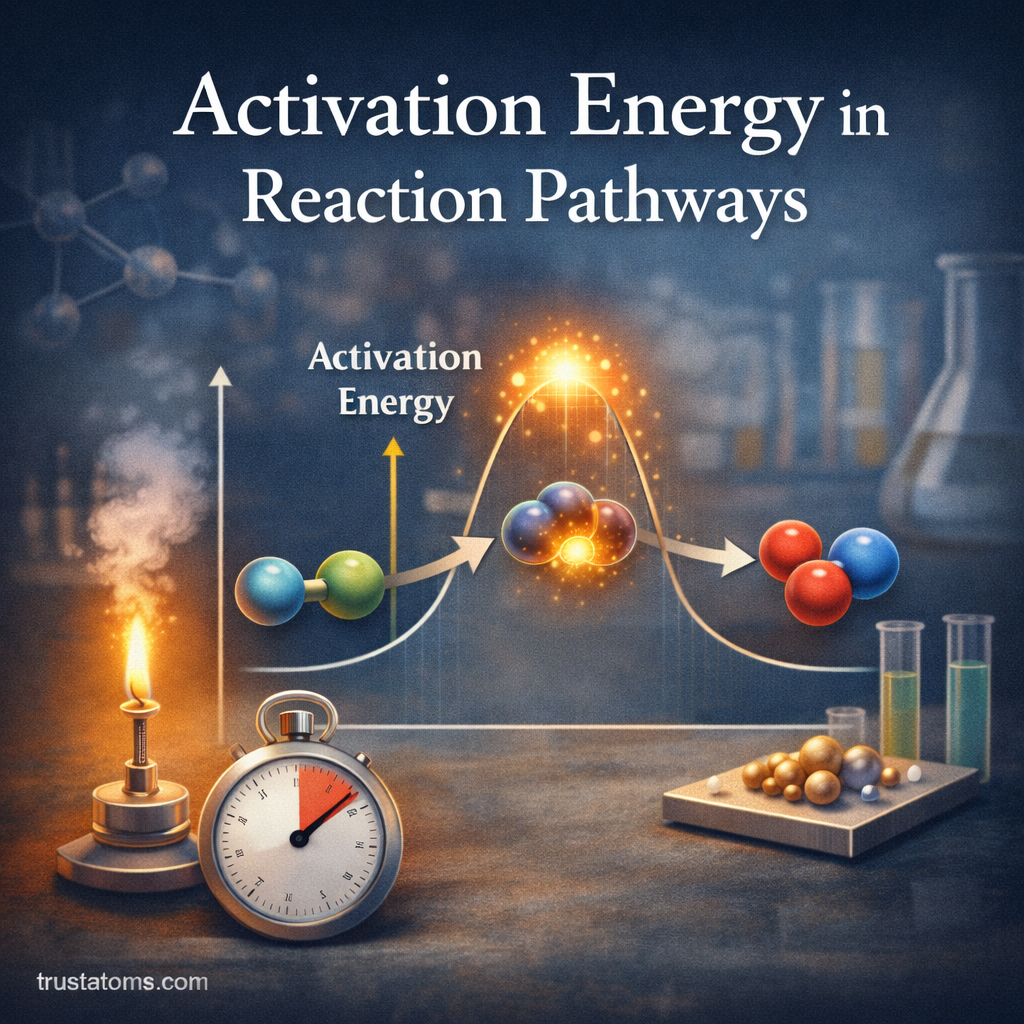
Illustration showing molecules crossing an energy barrier during a chemical reaction pathway to explain activation energy.
Illustration showing molecules overcoming an energy barrier during a reaction pathway, representing activation energy in chemistry. trustatoms.com.

Chemical reactions occur when atoms and molecules rearrange to form new substances. However, not every molecular collision results in a reaction. For a reaction to proceed, molecules must first overcome a specific energy barrier known as activation energy.

Activation energy plays a crucial role in determining how quickly a chemical reaction occurs and which pathway a reaction follows. By understanding activation energy, chemists can better predict reaction rates, control chemical processes, and design more efficient reactions.

Continue reading “Activation Energy in Reaction Pathways”

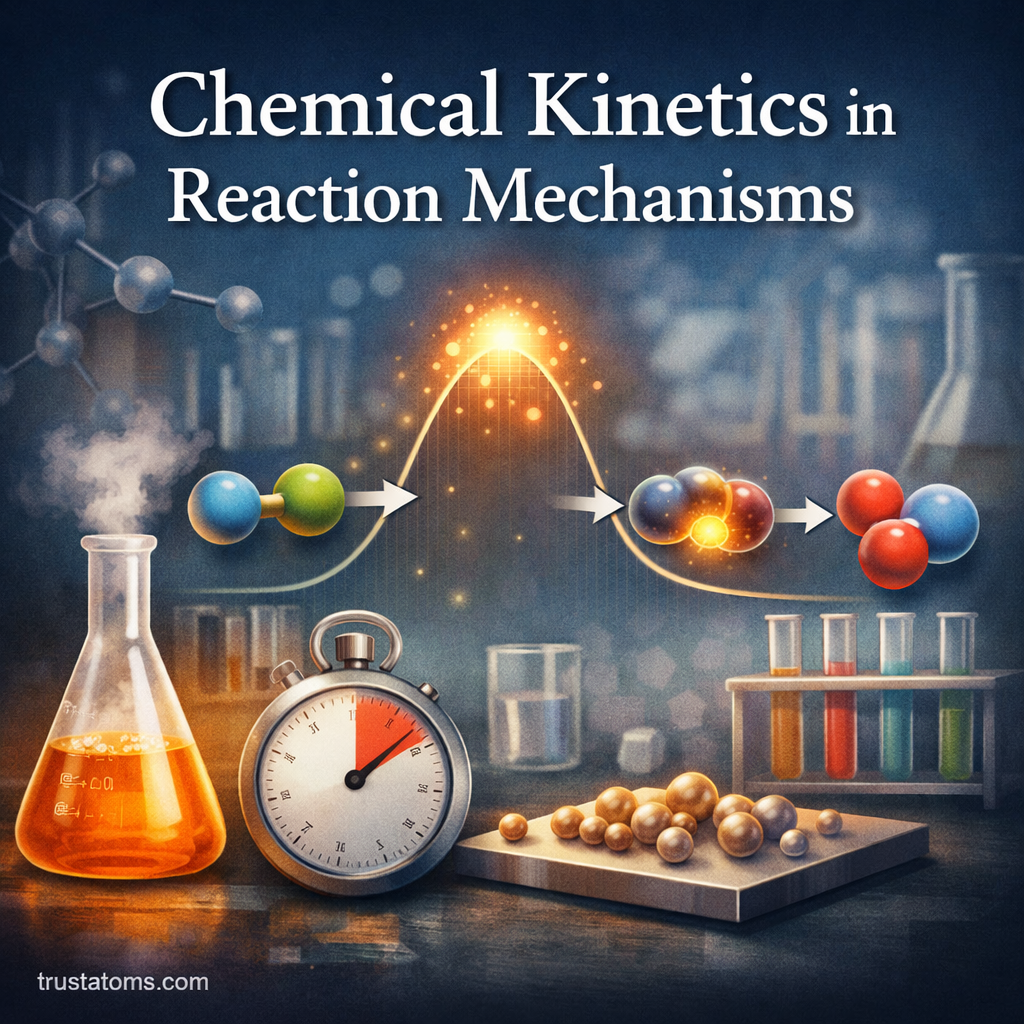
Chemical Kinetics in Reaction Mechanisms

Illustration showing molecules reacting along an energy pathway to explain chemical kinetics in reaction mechanisms.
Illustration representing how molecules interact through multiple steps in a chemical reaction mechanism. trustatoms.com.

Chemical reactions often appear simple on the surface—reactants transform into products. However, most reactions actually occur through a sequence of smaller steps called reaction mechanisms. Understanding how fast these steps occur and how they interact is the focus of chemical kinetics.

Chemical kinetics in reaction mechanisms helps scientists explain why reactions occur at certain speeds, how intermediate compounds form, and what factors influence the overall reaction pathway.

Continue reading “Chemical Kinetics in Reaction Mechanisms”

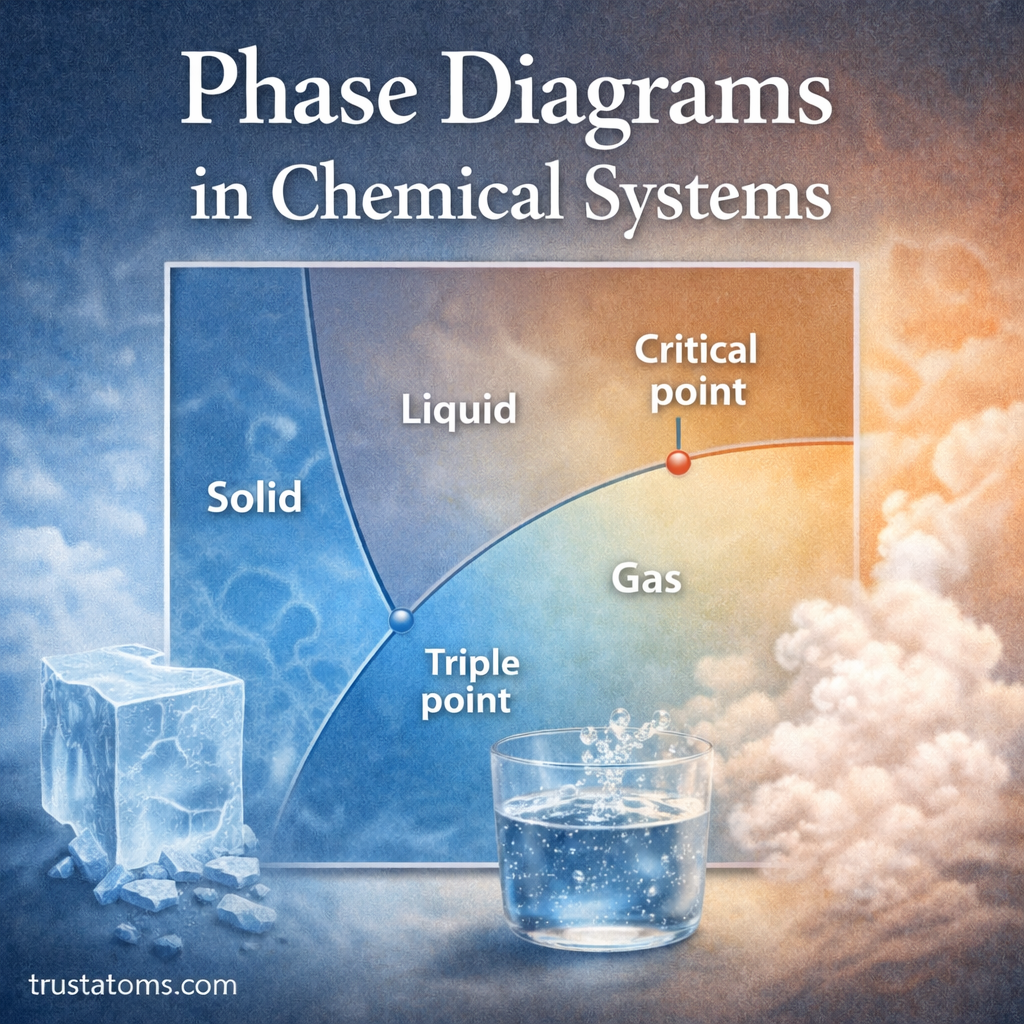
Phase Diagrams in Chemical Systems

Educational illustration showing solid, liquid, and gas phases on a phase diagram with examples of ice, water, and vapor representing phase transitions in chemical systems.
Illustration of a phase diagram showing how temperature and pressure influence transitions between solid, liquid, and gas phases. trustatoms.com

Phase diagrams are essential tools in chemistry and thermodynamics. They visually represent how a substance changes between solid, liquid, and gas phases under different conditions such as temperature and pressure.

Scientists and engineers use phase diagrams to understand how materials behave, predict phase changes, and design industrial processes. These diagrams help explain everyday phenomena such as melting ice, boiling water, and the formation of crystals, while also guiding complex systems used in chemical manufacturing and materials science.

Understanding phase diagrams allows chemists to analyze how substances transition between states of matter and how environmental conditions influence these changes.

Continue reading “Phase Diagrams in Chemical Systems”

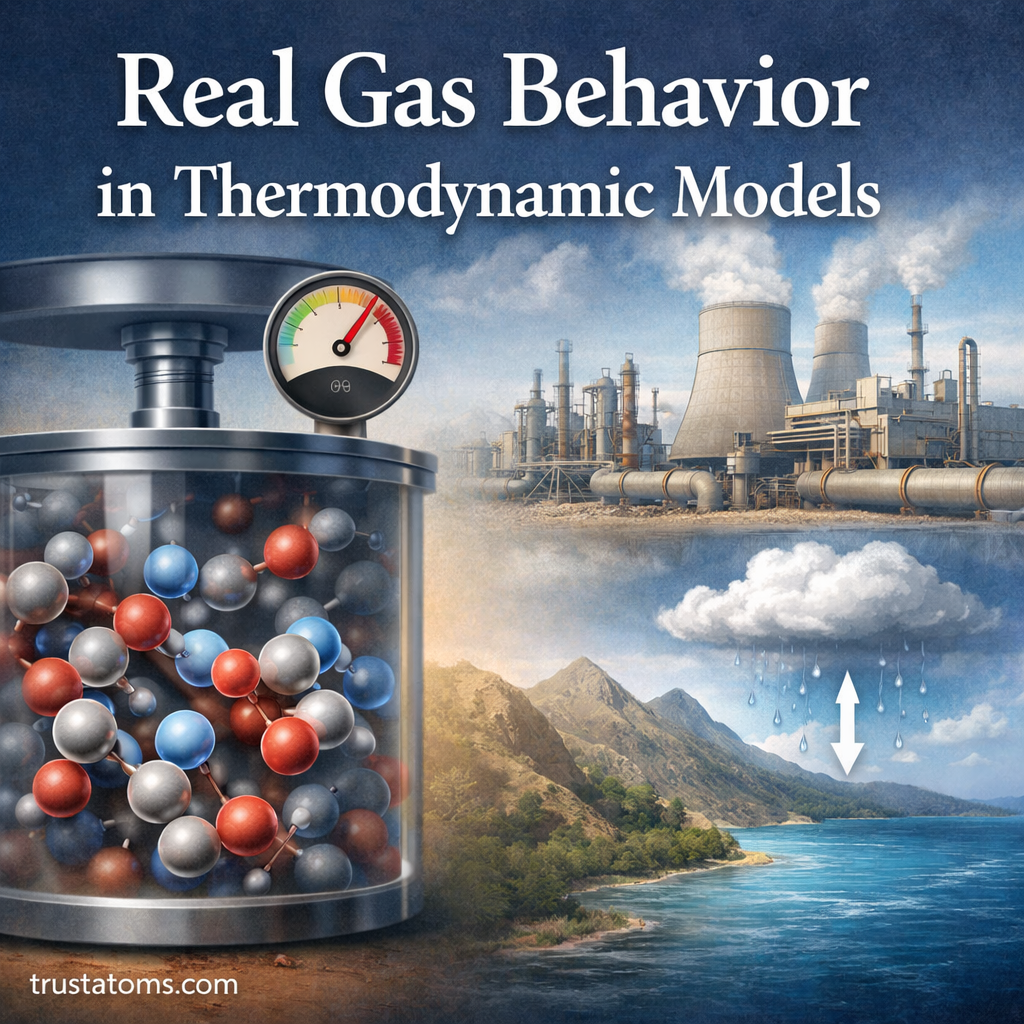
Real Gas Behavior in Thermodynamic Models

Illustration showing compressed gas molecules in a container with industrial and atmospheric environments representing real gas behavior in thermodynamic models.
Conceptual illustration of how real gases behave under pressure and temperature changes in thermodynamic systems. trustatoms.com

In introductory chemistry and physics, gases are often described using the ideal gas law, which assumes gas particles have no volume and experience no intermolecular forces. While this model works well under many conditions, real gases behave differently when pressure becomes high or temperature becomes low.

Understanding real gas behavior is essential in thermodynamics, chemical engineering, atmospheric science, and industrial chemistry. Real gas models help scientists predict how gases behave in practical systems such as engines, refrigeration cycles, pipelines, and chemical reactors.

This article explains how real gases differ from ideal gases and how thermodynamic models account for these differences.

Continue reading “Real Gas Behavior in Thermodynamic Models”

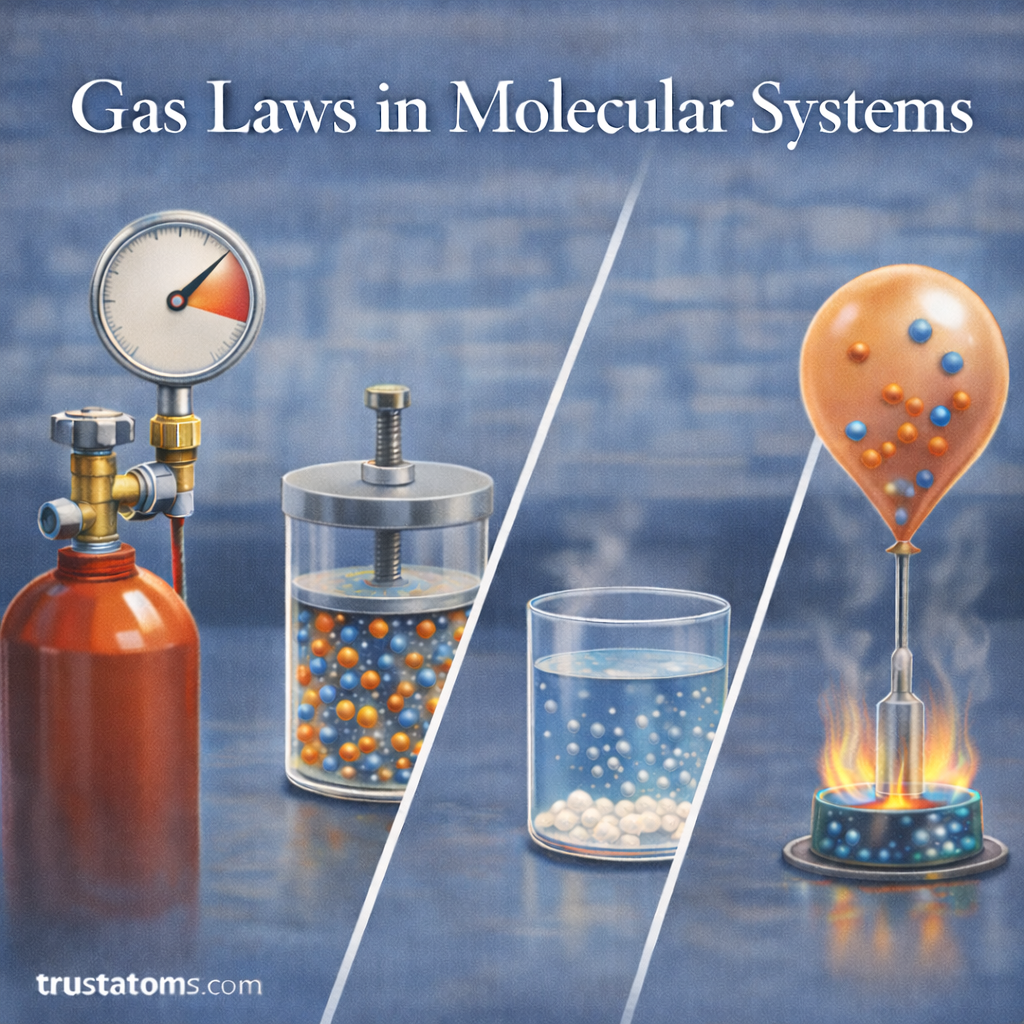
Gas Laws in Molecular Systems

Illustration showing gas behavior with pressure gauges, piston compression, and heated balloon demonstrating gas law principles.
Illustration demonstrating molecular gas behavior including pressure changes, compression, and temperature effects in gas systems. trustatoms.com.

Gases behave in predictable ways when temperature, pressure, and volume change. In chemistry, these relationships are described by gas laws, which help scientists understand how gases behave at the molecular level.

Gas laws explain many everyday phenomena—from how air fills a balloon to how engines operate and how weather systems form. By studying the interactions of gas molecules in controlled conditions, chemists developed mathematical relationships that describe how gases respond to changes in their environment.

Understanding gas laws provides important insight into molecular motion, energy transfer, and the physical behavior of gases in both natural and industrial systems.

Continue reading “Gas Laws in Molecular Systems”

Colligative Properties in Solution Chemistry

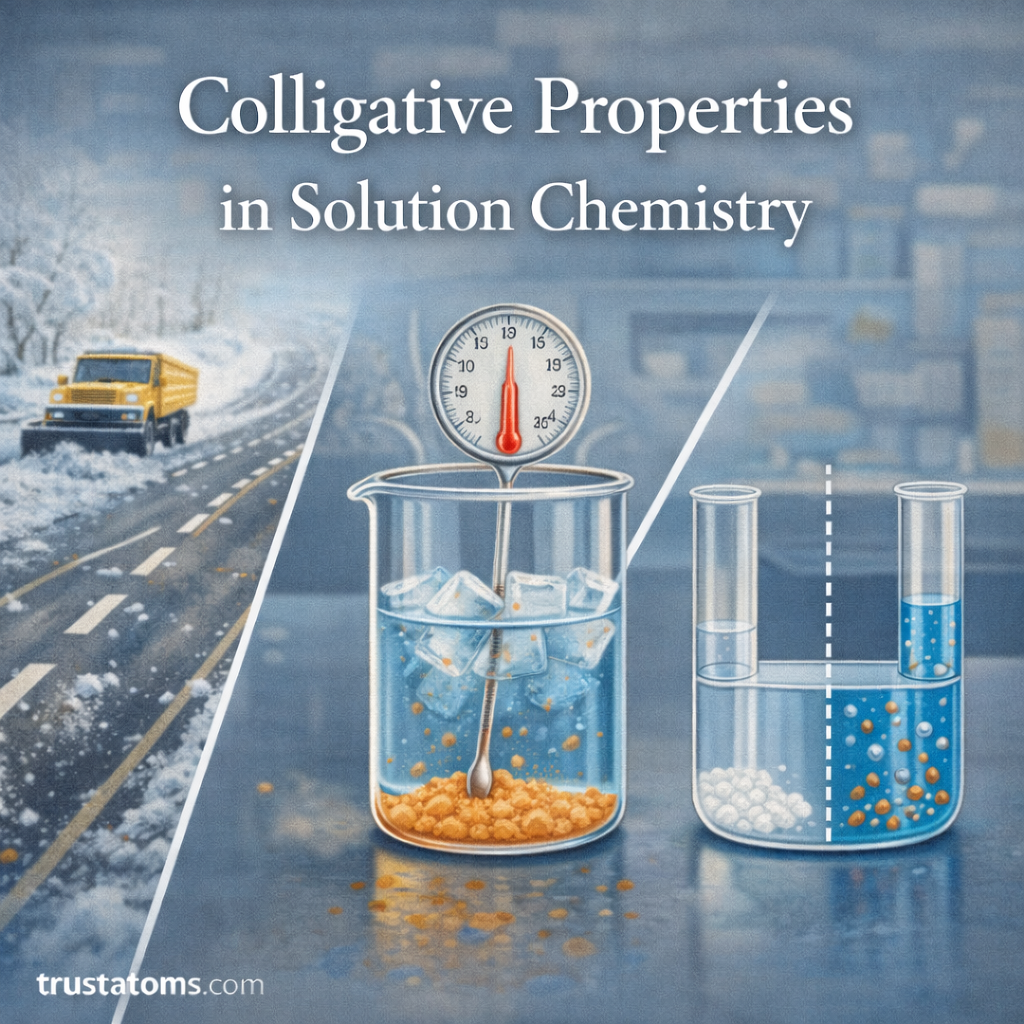
Illustration showing examples of colligative properties including freezing point depression, boiling point elevation, and osmosis in solution chemistry.
Educational illustration demonstrating colligative properties such as freezing point depression, boiling point elevation, and osmotic pressure in solutions. trustatoms.com.

In solution chemistry, certain properties depend not on the type of solute dissolved, but on the number of particles present in the solution. These characteristics are known as colligative properties.

Colligative properties play an important role in chemistry, biology, environmental science, and industry. They explain phenomena such as why salt melts ice on roads, how antifreeze works in car engines, and how scientists measure the molecular mass of unknown substances.

Understanding these properties helps chemists predict how solutions behave under different conditions and how solutes influence physical characteristics like temperature and pressure.

Continue reading “Colligative Properties in Solution Chemistry”

Solubility Product Constants in Solutions

Illustration showing dissolved ions and solid precipitate demonstrating solubility equilibrium in a chemistry solution.
Educational illustration showing how slightly soluble compounds form dissolved ions and solid precipitate in solution equilibrium. trustatoms.com.

In chemistry, many compounds dissolve easily in water, while others dissolve only slightly or not at all. Understanding how and why substances dissolve is a key part of studying chemical solutions.

One important concept used to describe this behavior is the solubility product constant, commonly abbreviated as Ksp. This value helps chemists predict how much of a slightly soluble compound can dissolve in a solution before equilibrium is reached.

Solubility product constants are widely used in analytical chemistry, environmental science, water treatment, and chemical manufacturing to understand precipitation reactions and solution behavior.

Continue reading “Solubility Product Constants in Solutions”

Buffer Systems in Chemical Regulation

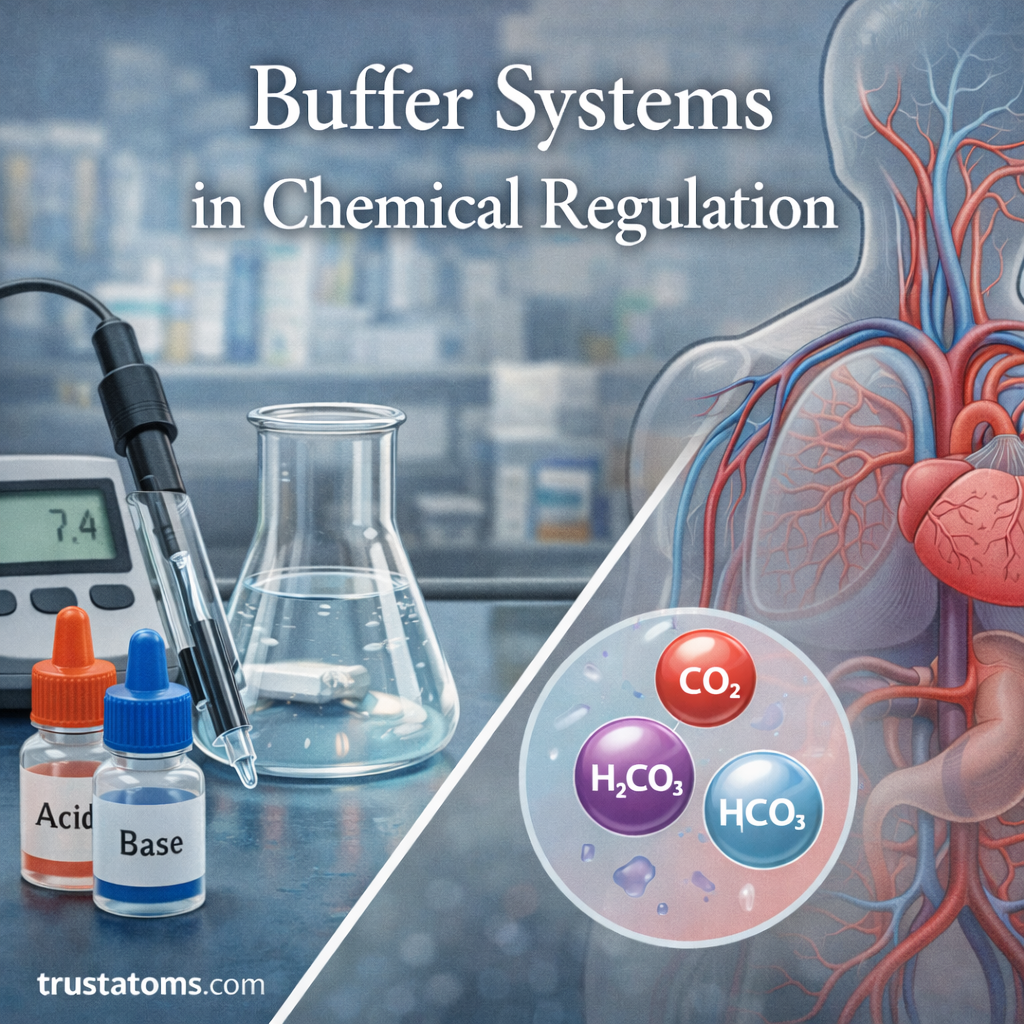
Illustration showing buffer systems maintaining stable pH in chemistry with laboratory equipment and a biological buffering example.
Illustration representing how buffer systems regulate pH in chemical and biological environments. trustatoms.com.

Buffer systems play a crucial role in maintaining chemical stability in many natural and industrial environments. In chemistry, buffers help resist sudden changes in pH when acids or bases are added to a solution.

This ability to regulate pH is essential in biological systems, environmental chemistry, pharmaceuticals, and laboratory experiments. Without buffer systems, many chemical reactions would become unstable or unpredictable due to rapid shifts in acidity or alkalinity.

Understanding how buffer systems work helps explain how living organisms regulate internal chemistry and how scientists maintain controlled conditions in chemical processes.

Continue reading “Buffer Systems in Chemical Regulation”