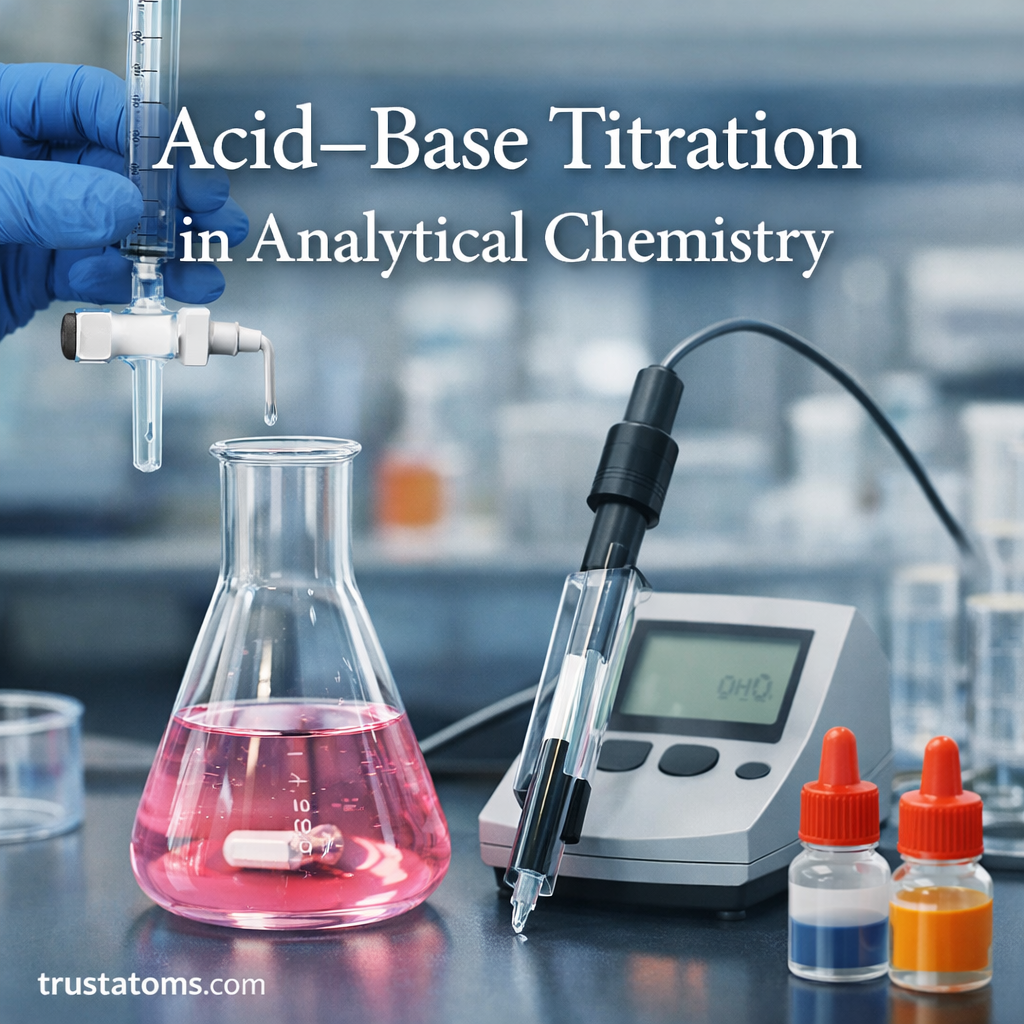
Acid–Base Titration in Analytical Chemistry

Illustration of an acid–base titration setup with burette dripping into a flask in an analytical chemistry laboratory.
Simple diagram-style illustration showing an acid–base titration setup used in analytical chemistry. trustatoms.com.

Acid–base titration is one of the most widely used techniques in analytical chemistry. It allows scientists, students, and laboratory technicians to determine the concentration of an unknown acid or base by reacting it with a solution of known concentration.

This method relies on neutralization reactions—where acids and bases react to form water and a salt. Because the chemistry behind these reactions is predictable and measurable, titration provides a reliable way to quantify chemical solutions in fields ranging from pharmaceuticals and environmental testing to food science and water quality monitoring.

Understanding acid–base titration helps explain how chemists measure chemical composition with precision using relatively simple laboratory tools.

Continue reading “Acid–Base Titration in Analytical Chemistry”
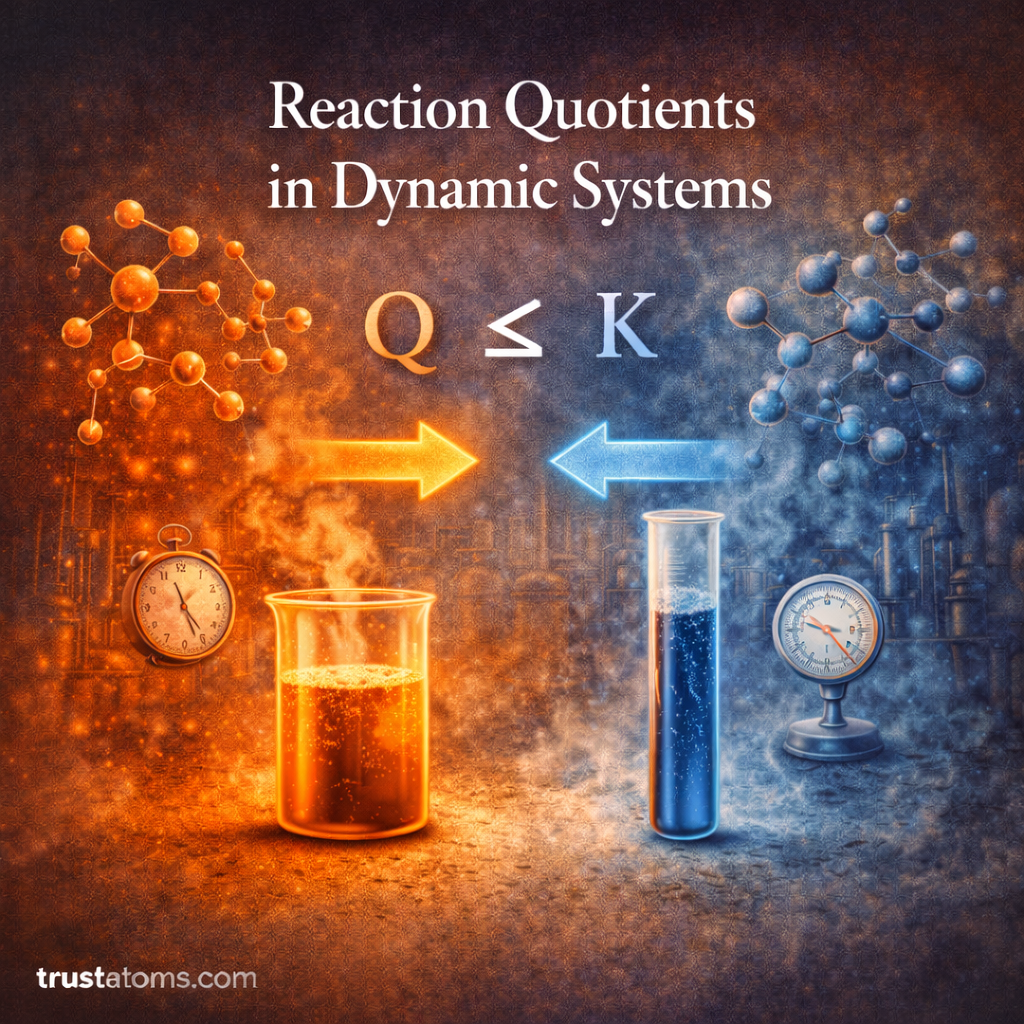
Reaction Quotients in Dynamic Systems

Illustration representing reaction quotients in dynamic chemical systems with reversible arrows, laboratory glassware, and changing reactant and product concentrations.
Conceptual illustration showing how reaction quotients help predict the direction of chemical reactions in dynamic systems. trustatoms.com.

Chemical reactions rarely occur in completely static environments. Instead, they often operate in dynamic systems, where substances continuously react, transform, and interact. Understanding how these systems behave before equilibrium is reached is an important part of chemical thermodynamics.

One tool chemists use to analyze these changing systems is the reaction quotient, commonly represented by the symbol Q. The reaction quotient helps determine the current state of a reaction and predicts the direction the reaction will move in order to reach equilibrium.

By comparing the reaction quotient with the equilibrium constant, chemists can understand how far a reaction is from equilibrium and how the system will respond.

Continue reading “Reaction Quotients in Dynamic Systems”

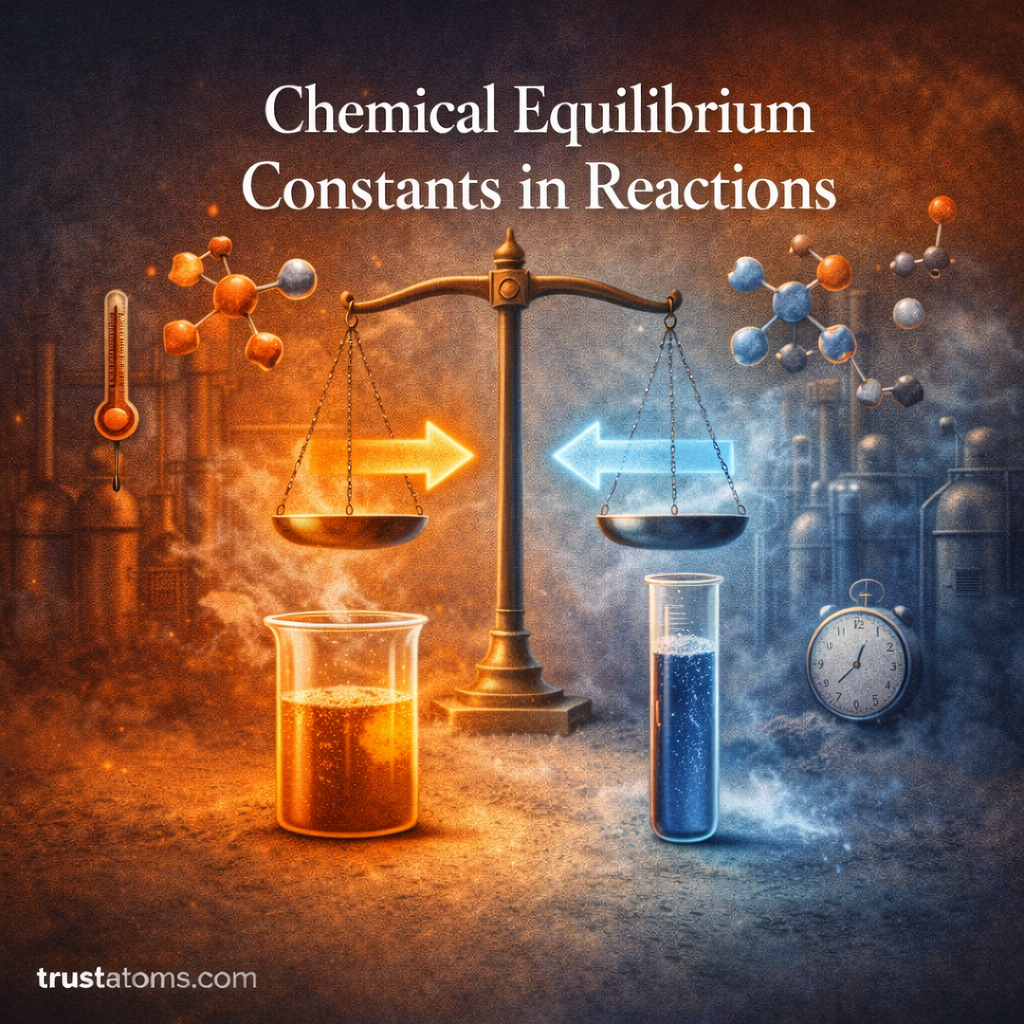
Chemical Equilibrium Constants in Reactions

Illustration showing chemical equilibrium in reactions with a balanced scale, reversible arrows, and laboratory glassware representing reactants and products.
Conceptual illustration representing chemical equilibrium and the balance between reactants and products in reversible reactions. trustatoms.com.

Many chemical reactions do not proceed in just one direction. Instead, they reach a balance where reactants and products are continuously forming at the same rate. This balanced state is known as chemical equilibrium.

To understand how far a reaction proceeds and how much product forms, chemists use a value called the equilibrium constant. The equilibrium constant provides a numerical measure of the relative amounts of reactants and products in a system at equilibrium.

By studying equilibrium constants, scientists can predict reaction behavior, optimize industrial processes, and understand complex chemical systems.

Continue reading “Chemical Equilibrium Constants in Reactions”

Free Energy and Reaction Feasibility

Illustration representing free energy and reaction feasibility with melting ice, heat energy, molecular structures, and energy flow concepts.
Conceptual illustration showing how free energy influences whether chemical reactions occur naturally. trustatoms.com.

Chemical reactions occur constantly in nature—from the metabolism in living cells to industrial chemical production. However, not every possible reaction happens naturally. Some reactions proceed on their own, while others require continuous energy input.

To understand why certain reactions occur and others do not, chemists use the concept of free energy, specifically Gibbs free energy. This thermodynamic quantity helps determine whether a reaction is feasible under specific conditions.

Free energy combines the effects of energy changes and entropy to predict whether a chemical reaction will occur spontaneously.

Continue reading “Free Energy and Reaction Feasibility”

Entropy and Spontaneity in Reactions

Illustration showing entropy and spontaneity in chemical reactions with melting ice, heat, molecules spreading, and energy flow concepts.
Conceptual illustration representing entropy and spontaneity in chemical reactions. trustatoms.com.

Chemical reactions do not occur randomly. Some reactions happen naturally without any outside influence, while others require constant energy input. One of the key principles that helps scientists understand why reactions occur is entropy.

Entropy is a fundamental concept in thermodynamics and chemistry that describes the level of disorder or randomness in a system. When combined with energy considerations, entropy helps determine whether a chemical reaction will occur spontaneously.

Understanding entropy and spontaneity allows chemists to predict reaction behavior, explain natural processes, and design chemical systems used in industry, biology, and environmental science.

Continue reading “Entropy and Spontaneity in Reactions”

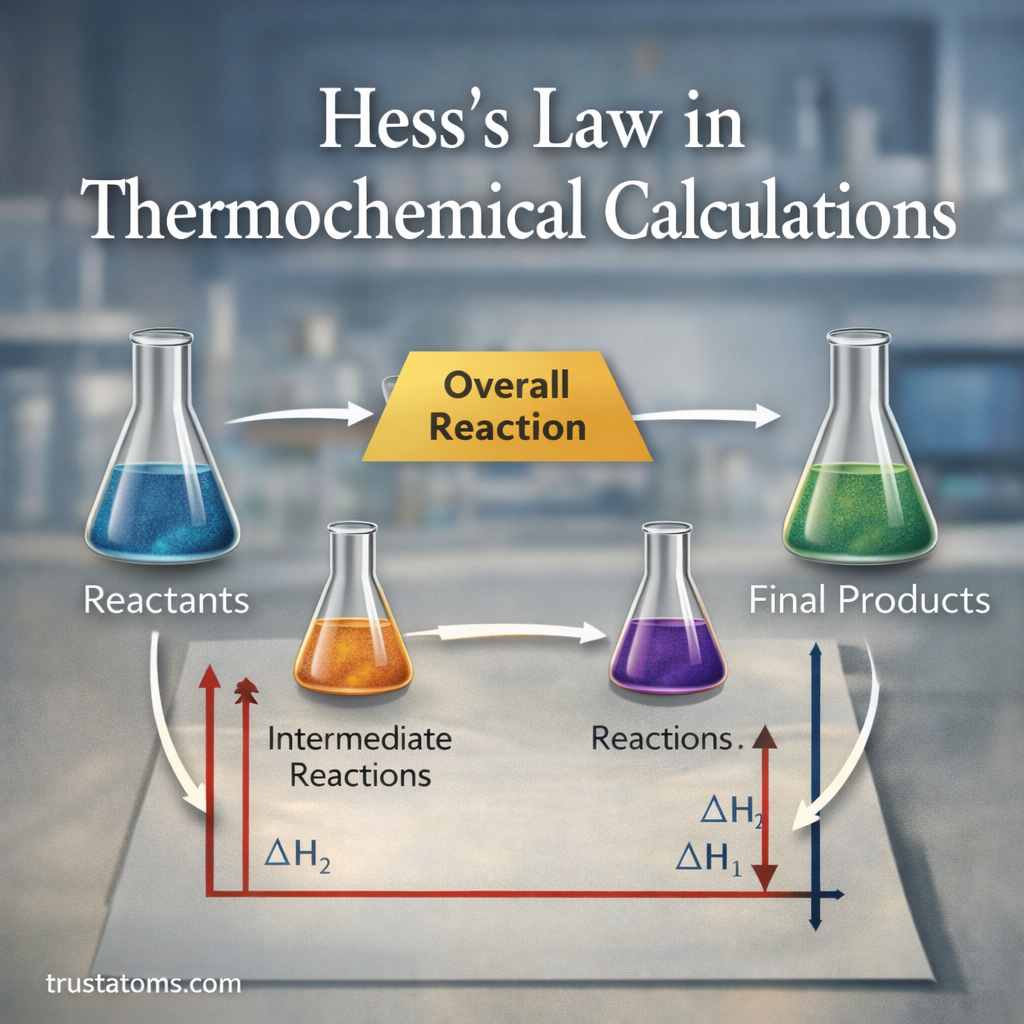
Hess’s Law in Thermochemical Calculations

Illustration explaining Hess’s Law in thermochemical calculations showing reactants, intermediate reactions, and final products to demonstrate overall energy change.
Illustration demonstrating Hess’s Law, where the total heat change of a reaction remains the same regardless of the reaction pathway. trustatoms.com

Understanding how energy changes during chemical reactions is a central part of thermochemistry. One of the most important principles used to analyze these energy changes is Hess’s Law. This law allows scientists to calculate the heat change of a reaction even when it cannot be measured directly.

Hess’s Law plays a critical role in thermochemical calculations, helping researchers determine enthalpy changes, analyze reaction pathways, and understand energy conservation in chemical systems.

Continue reading “Hess’s Law in Thermochemical Calculations”

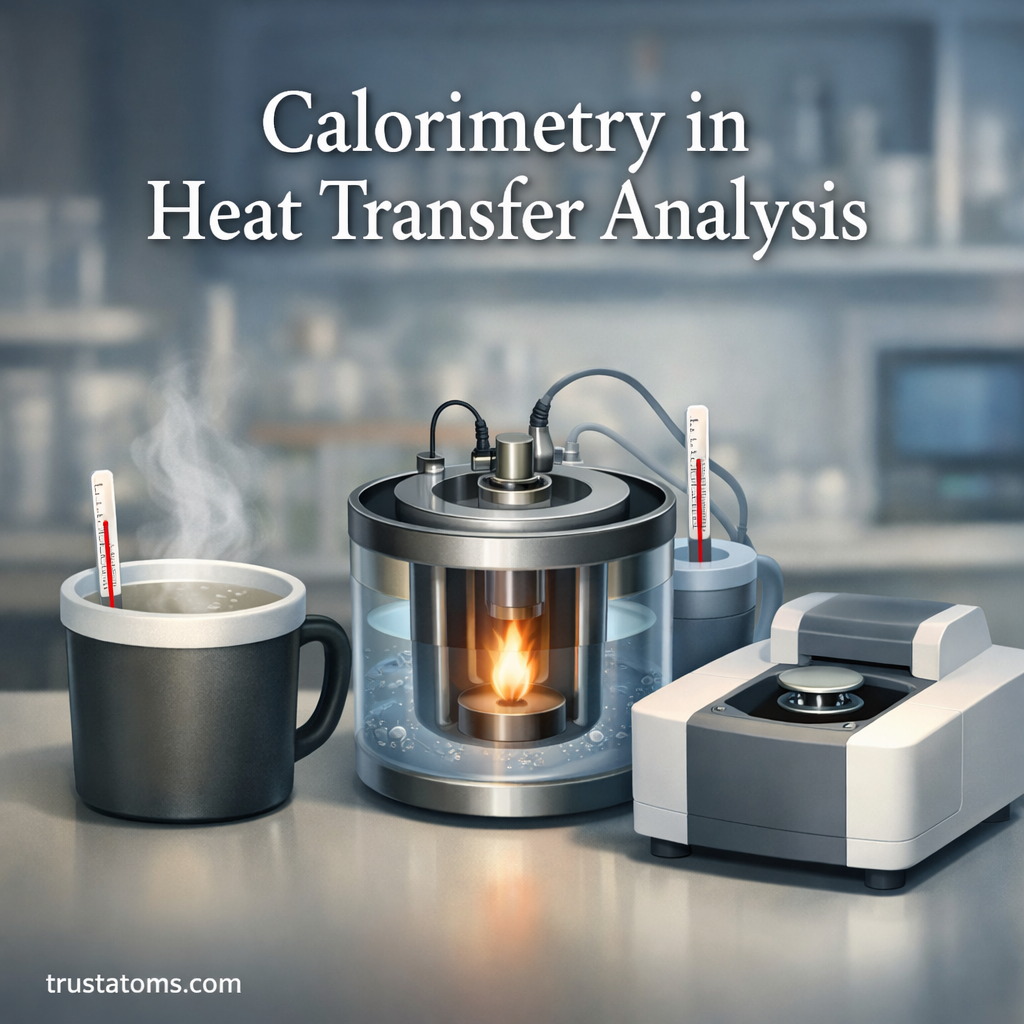
Calorimetry in Heat Transfer Analysis

Illustration showing calorimetry in heat transfer analysis with simple laboratory calorimeter examples used to measure heat energy changes.
Illustration of calorimetry used to measure heat transfer in chemical reactions and thermal processes. trustatoms.com

Calorimetry is a fundamental technique used in chemistry and physics to measure heat transfer during chemical reactions, physical changes, and biological processes. By carefully tracking temperature changes in a controlled environment, scientists can determine how much heat energy is absorbed or released in a system.

Understanding calorimetry is essential for analyzing energy flow in reactions, evaluating fuel efficiency, studying metabolic processes, and designing industrial chemical systems.

Continue reading “Calorimetry in Heat Transfer Analysis”

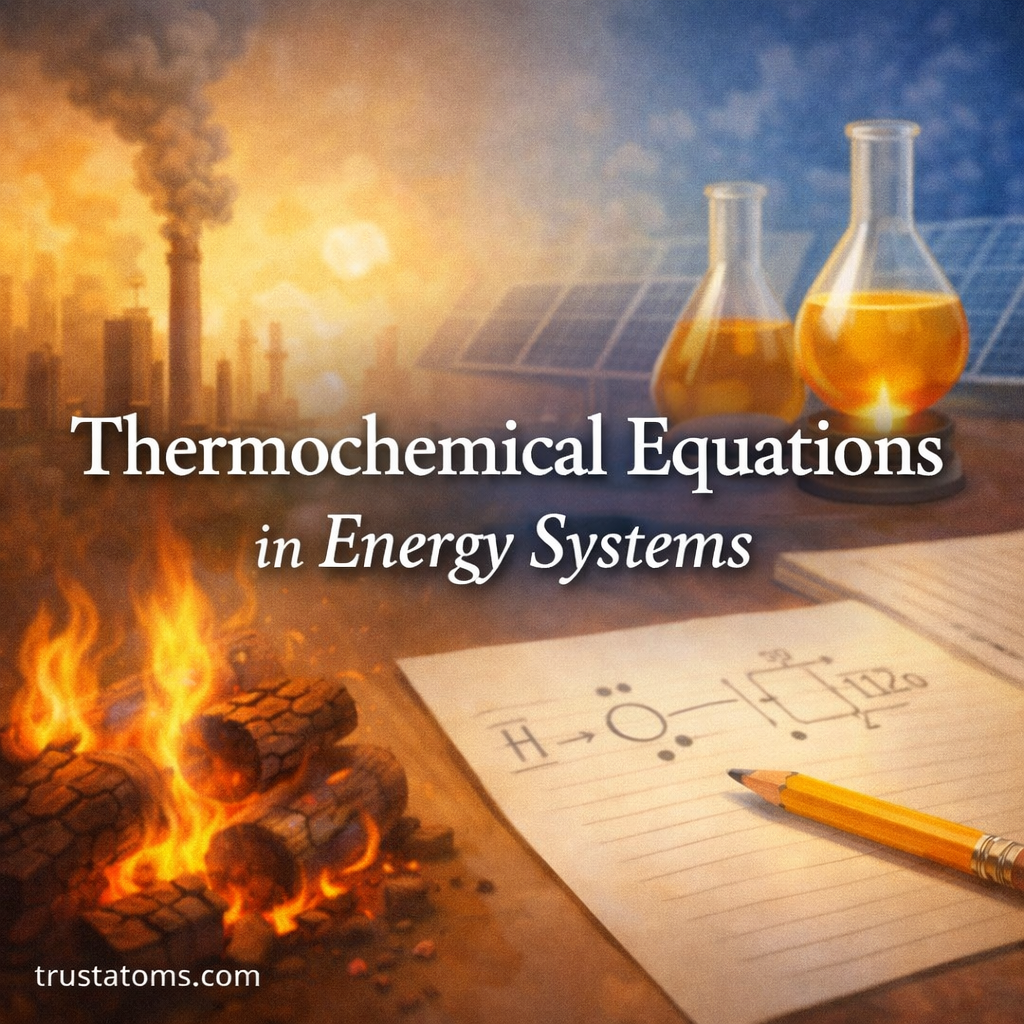
Thermochemical Equations in Energy Systems

Illustration showing combustion, laboratory glassware, and renewable energy elements representing thermochemical equations and energy systems in chemistry.
Illustration representing energy changes in chemical reactions, including combustion and laboratory thermochemistry concepts. trustatoms.com

Thermochemical equations describe the relationship between chemical reactions and energy changes. These equations show how much heat is released or absorbed during a reaction, making them essential for understanding energy systems in chemistry, engineering, and environmental science.

From fuel combustion in power plants to biochemical reactions in living organisms, thermochemical equations help scientists track energy flow. By combining chemical formulas with heat values, these equations provide insight into how energy is stored, transferred, and transformed during chemical reactions.

Continue reading “Thermochemical Equations in Energy Systems”

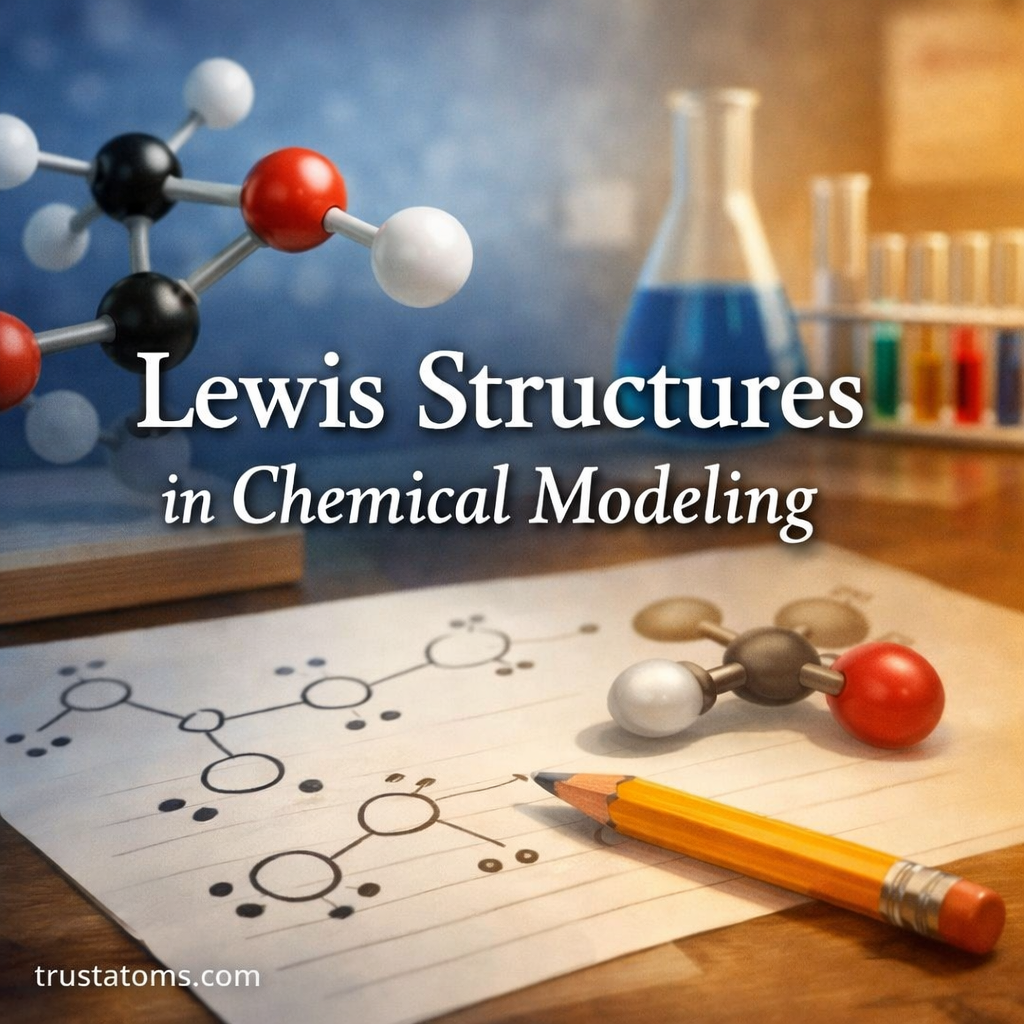
Lewis Structures in Chemical Modeling

Illustration showing a molecular model, laboratory glassware, and a notebook with simple bonding diagrams representing Lewis structures in chemical modeling.
Illustration representing Lewis structures and molecular modeling concepts in chemistry. trustatoms.com

Lewis structures are one of the most widely used tools in chemistry for visualizing how atoms bond and interact within molecules. By representing valence electrons as dots and bonds as lines, Lewis structures help chemists understand molecular shape, reactivity, and stability.

From introductory chemistry courses to advanced molecular modeling, Lewis structures provide a foundation for predicting chemical behavior. They allow scientists to quickly interpret bonding patterns, determine formal charges, and analyze how molecules participate in chemical reactions.

Continue reading “Lewis Structures in Chemical Modeling”

Metallic Bonding in Solid Materials

Illustration showing metallic bonding with metal atoms arranged in a lattice surrounded by a sea of free-moving electrons.
Conceptual illustration of metallic bonding showing metal atoms connected by freely moving electrons in a solid lattice. trustatoms.com

Metallic bonding is the force that holds metal atoms together in solid materials. It is responsible for many of the unique properties that metals display, such as electrical conductivity, malleability, ductility, and high thermal conductivity.

Unlike ionic or covalent bonding, metallic bonding involves a shared pool of electrons that move freely throughout the structure. This special bonding system allows metals to behave differently from other types of materials and explains why metals are widely used in construction, electronics, transportation, and manufacturing.

Understanding metallic bonding helps explain how metals form stable structures and why they are so useful in everyday technology.

Continue reading “Metallic Bonding in Solid Materials”