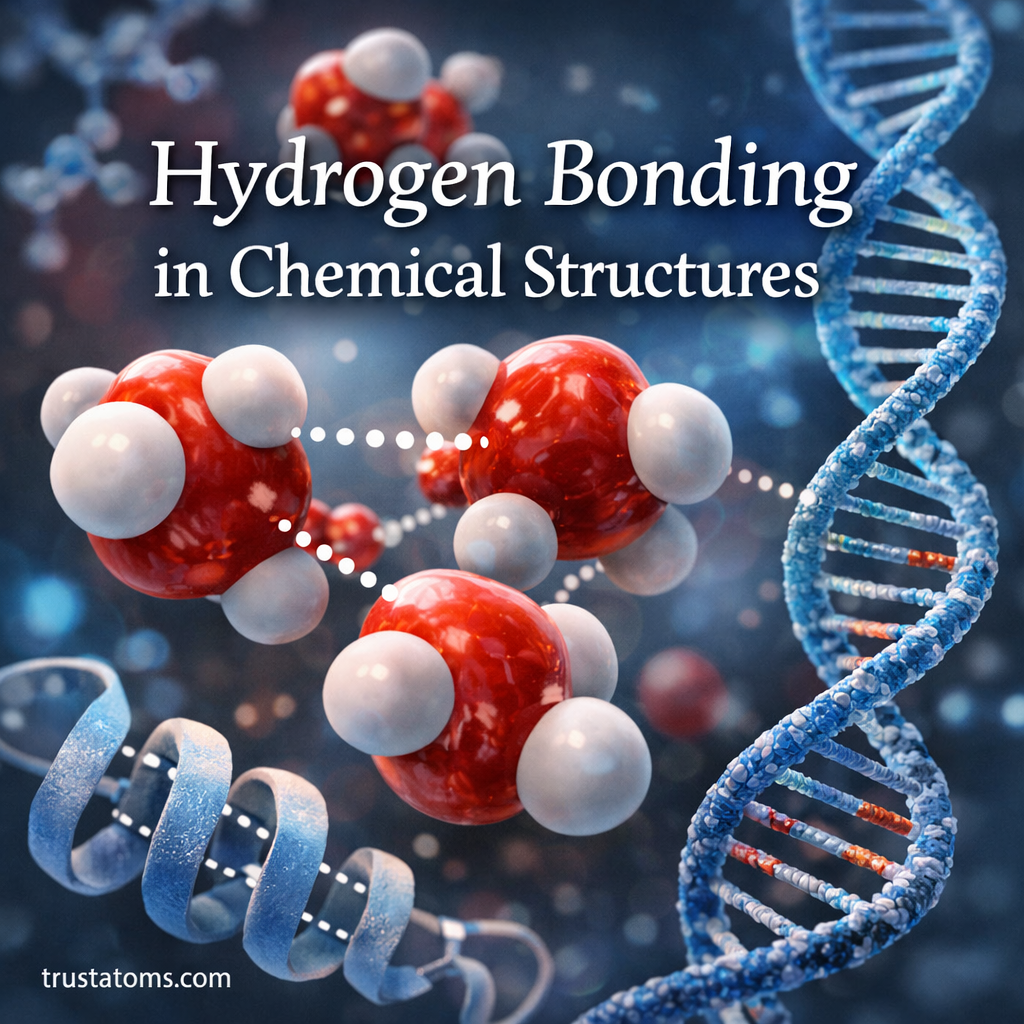
Hydrogen Bonding in Chemical Structures

Illustration showing hydrogen bonding between water molecules and biological structures representing hydrogen bonding in chemical structures.
Conceptual illustration showing hydrogen bonding interactions between molecules and biological structures. trustatoms.com

Hydrogen bonding is one of the most important intermolecular forces in chemistry. Although it is weaker than a covalent bond, hydrogen bonding has a major influence on how molecules behave, interact, and organize themselves.

From the structure of water to the shape of DNA, hydrogen bonds help determine the physical properties and stability of many chemical systems. Understanding hydrogen bonding is essential for studying molecular chemistry, biology, and materials science.

Continue reading “Hydrogen Bonding in Chemical Structures”
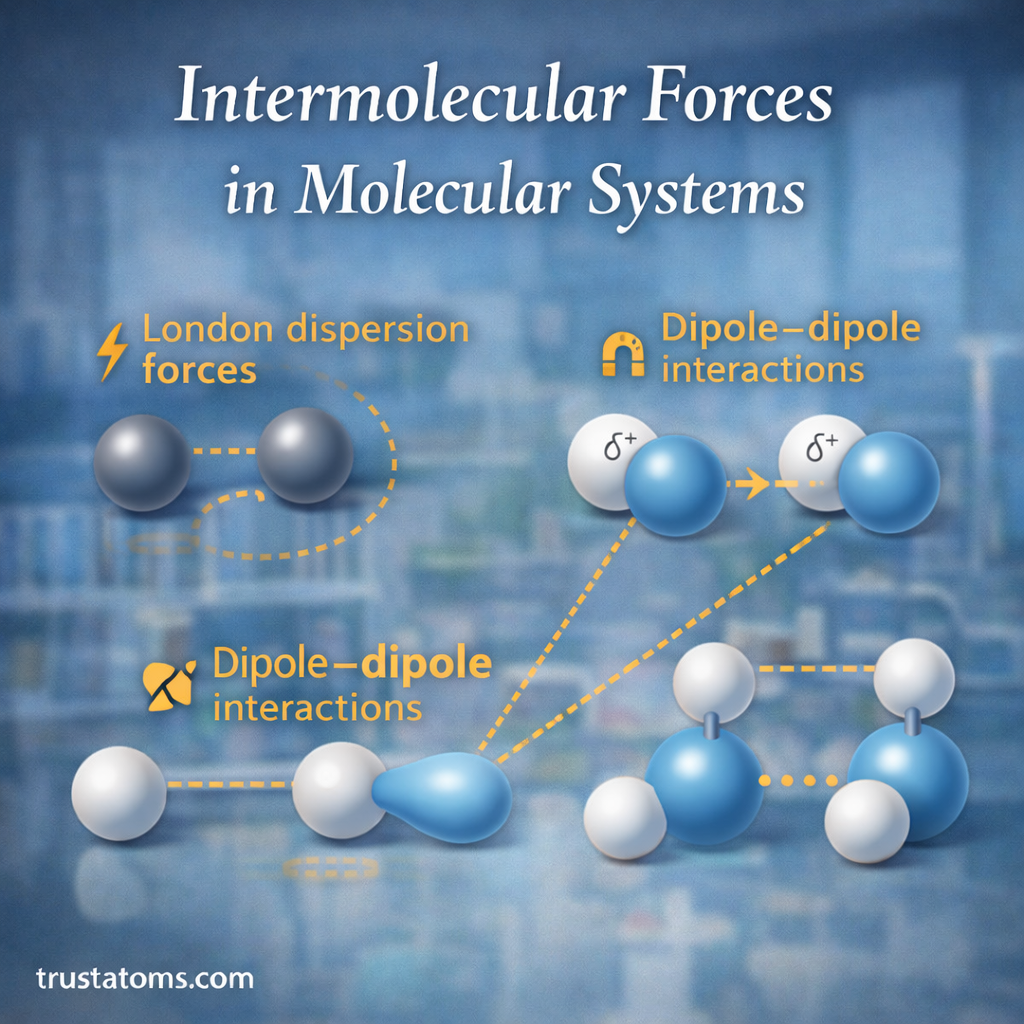
Intermolecular Forces in Molecular Systems

Illustration explaining intermolecular forces in molecular systems including dispersion forces, dipole–dipole interactions, and hydrogen bonding.
Educational diagram illustrating common intermolecular forces that influence how molecules interact in liquids and solids. trustatoms.com

Intermolecular forces are the attractions that occur between molecules. While these forces are generally weaker than the chemical bonds that hold atoms together within a molecule, they play a crucial role in determining the physical properties of substances.

Intermolecular forces influence how molecules interact with one another in liquids, solids, and gases. They help explain properties such as boiling point, melting point, viscosity, solubility, and surface tension.

Understanding these forces allows chemists to predict how substances behave in different environments and why certain materials interact the way they do.

Continue reading “Intermolecular Forces in Molecular Systems”

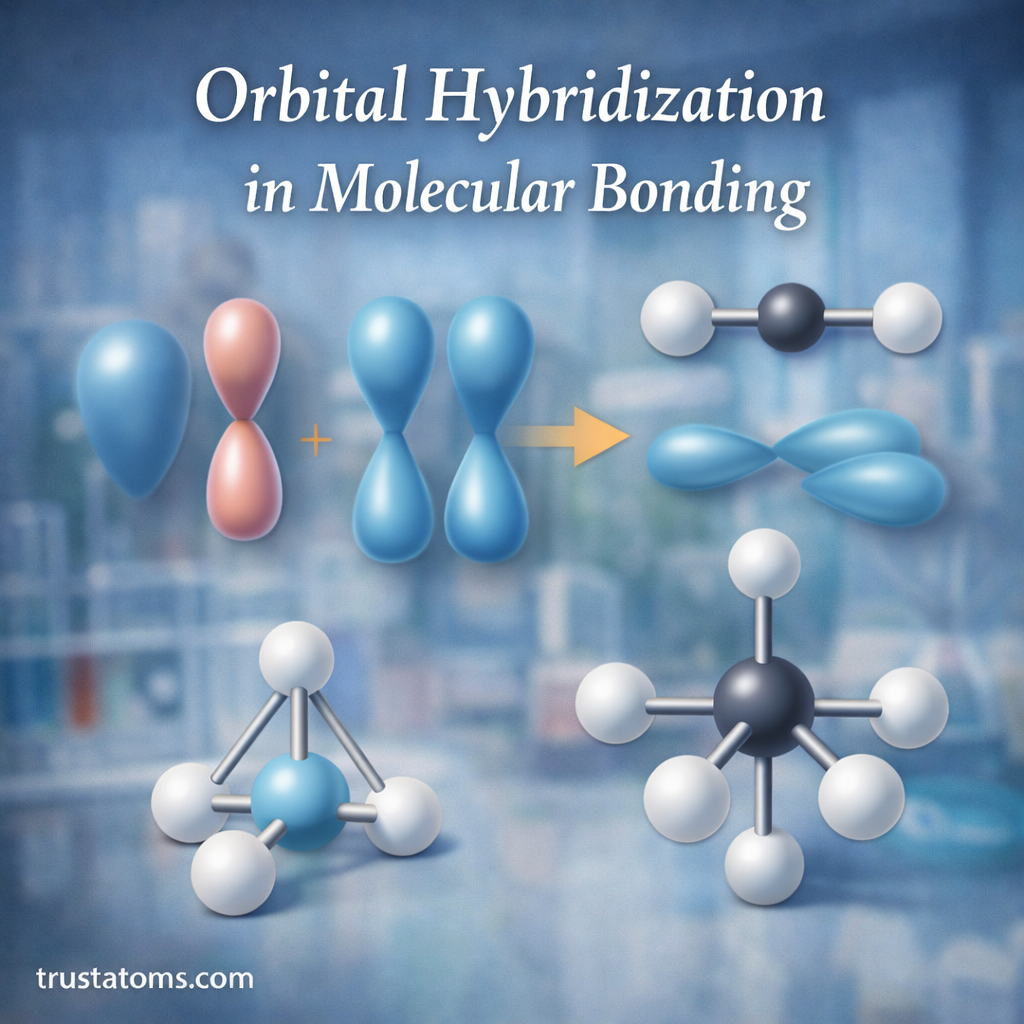
Orbital Hybridization in Molecular Bonding

Illustration explaining orbital hybridization in molecular bonding showing hybrid orbitals and molecular shapes formed from orbital mixing.
Illustration demonstrating how atomic orbitals combine to form hybrid orbitals used in molecular bonding. trustatoms.com

Understanding how atoms form chemical bonds requires more than simply knowing how many electrons they have. In many molecules, atoms rearrange their orbitals to form stronger and more stable bonds. This process is known as orbital hybridization.

Orbital hybridization explains how atoms combine atomic orbitals to create new hybrid orbitals that are better suited for bonding. These hybrid orbitals help explain molecular shapes, bond angles, and the strength of chemical bonds.

In this article, we’ll explore what orbital hybridization is, why it occurs, and how different hybridization types influence molecular bonding.

Continue reading “Orbital Hybridization in Molecular Bonding”

Molecular Geometry in VSEPR Theory

Illustration of molecular geometry in VSEPR theory showing simple 3D molecular shapes used to explain how atoms arrange around a central atom.
Illustration showing common molecular shapes explained by VSEPR theory. trustatoms.com

Understanding how atoms arrange themselves in molecules is a key part of chemistry. One of the most widely used models for predicting molecular shape is VSEPR theory, which stands for Valence Shell Electron Pair Repulsion.

VSEPR theory helps chemists predict how atoms bond and how molecules take shape in three-dimensional space. These shapes influence physical properties, chemical reactivity, polarity, and even biological interactions.

In this article, we’ll explore what VSEPR theory is, how molecular geometry is determined, and why molecular shapes matter in chemistry.

Continue reading “Molecular Geometry in VSEPR Theory”

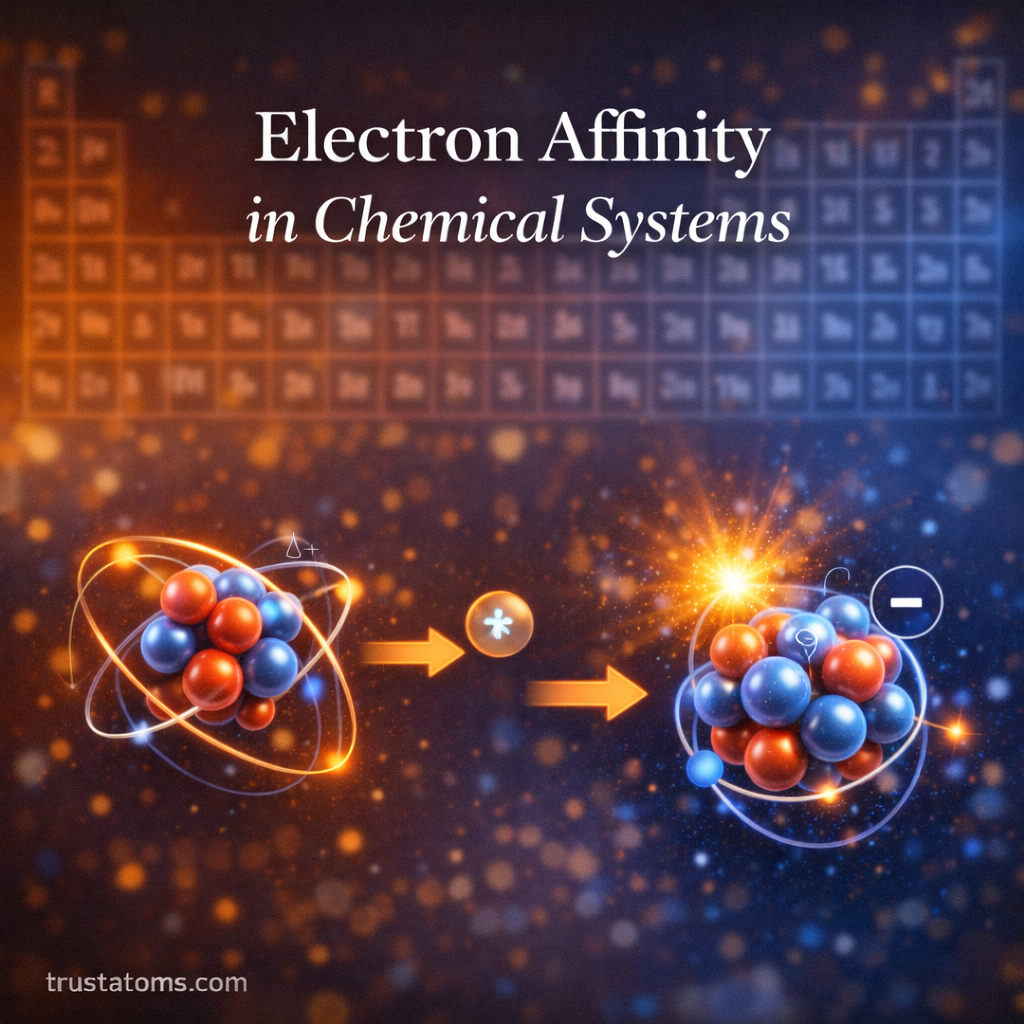
Electron Affinity in Chemical Systems

Illustration showing an atom gaining an electron to form a negative ion representing electron affinity in chemical systems.
Educational illustration showing how an atom gains an electron and releases energy, demonstrating electron affinity in chemistry. trustatoms.com

Electron affinity is an important concept in chemistry that explains how atoms interact during chemical reactions. It describes how much energy is released or required when an atom gains an electron. This property plays a major role in chemical bonding, periodic trends, and the formation of ions.

Atoms differ widely in how strongly they attract additional electrons. Some atoms readily accept electrons and release energy, while others resist gaining electrons. Understanding electron affinity helps explain why certain elements form stable ions, reactive compounds, and predictable chemical structures.

In this guide, we explore what electron affinity is, how it works, and why it matters in chemical systems.

Continue reading “Electron Affinity in Chemical Systems”

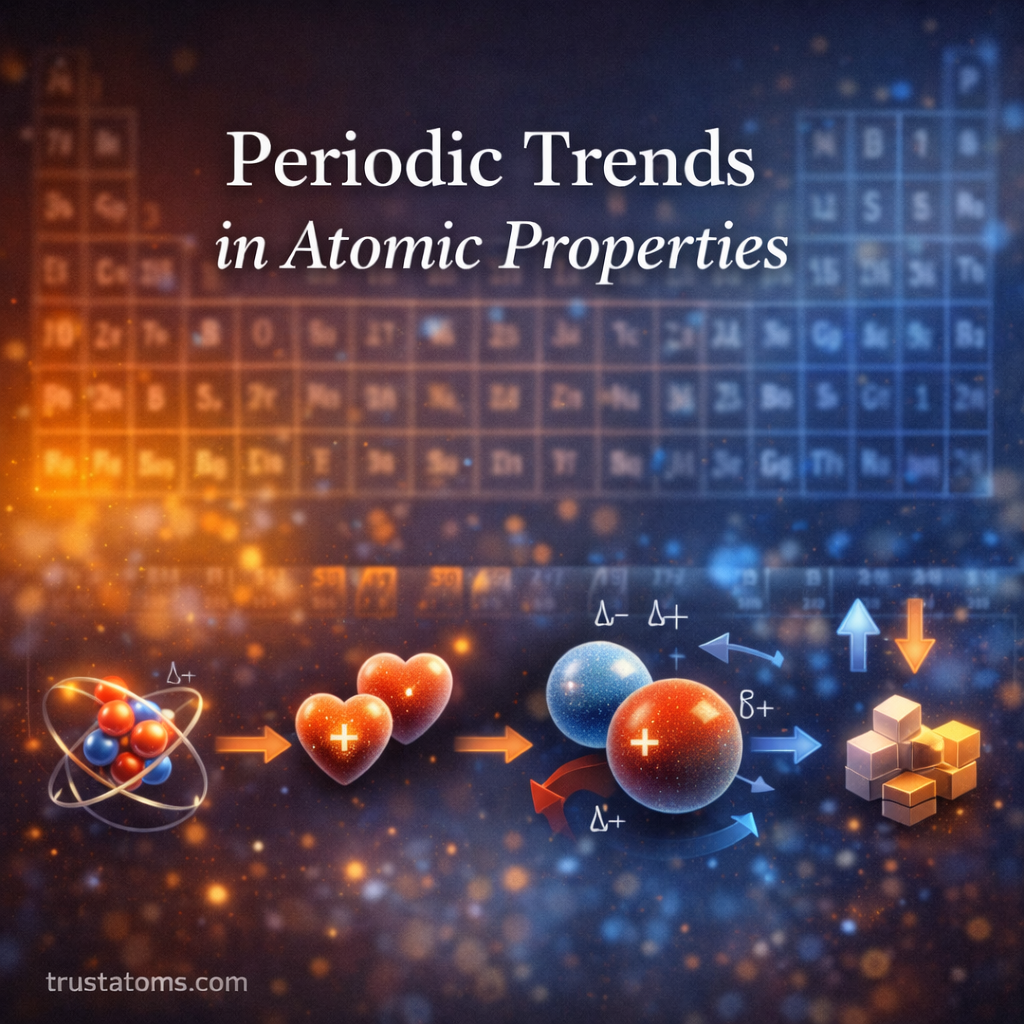
Periodic Trends in Atomic Properties

Illustration of periodic table trends showing atomic size, ionization energy, and electronegativity patterns across elements.
Educational illustration showing periodic trends in atomic properties across the periodic table. trustatoms.com

The periodic table is more than just a list of chemical elements. It reveals important patterns and trends in atomic properties that help scientists predict how elements behave in chemical reactions.

These patterns, known as periodic trends, occur because elements are arranged according to increasing atomic number and repeating electron configurations. As you move across periods (rows) or down groups (columns), properties such as atomic size, ionization energy, electronegativity, and electron affinity change in predictable ways.

Understanding periodic trends helps explain chemical bonding, reactivity, and the behavior of elements in compounds. In this guide, we explore the most important periodic trends in atomic properties and why they occur.

Continue reading “Periodic Trends in Atomic Properties”

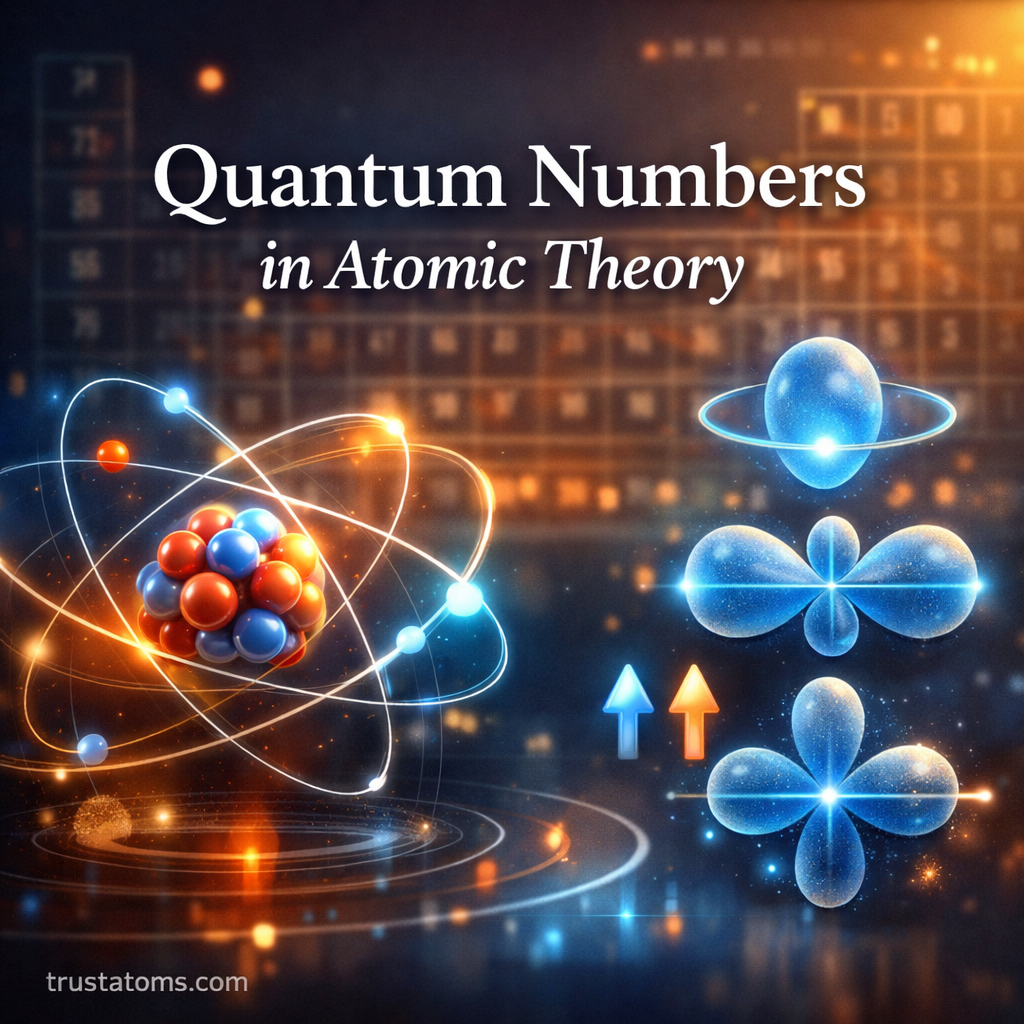
Quantum Numbers in Atomic Theory

Illustration of an atom with electron orbitals and orbital shapes representing quantum numbers in atomic theory.
Illustration showing electron orbitals and atomic structure used to explain quantum numbers in atomic theory. trustatoms.com

Understanding atoms requires more than simply knowing how many electrons they contain. In quantum mechanics, quantum numbers are used to describe the exact state and position of electrons within an atom. These numbers determine how electrons behave, where they are likely to be found, and how atoms interact with each other.

Quantum numbers are essential for understanding atomic structure, chemical bonding, spectroscopy, and modern chemistry. Every electron in an atom is described by a unique set of four quantum numbers.

This guide explains what quantum numbers are, what each number represents, and why they are critical in atomic theory.

Continue reading “Quantum Numbers in Atomic Theory”

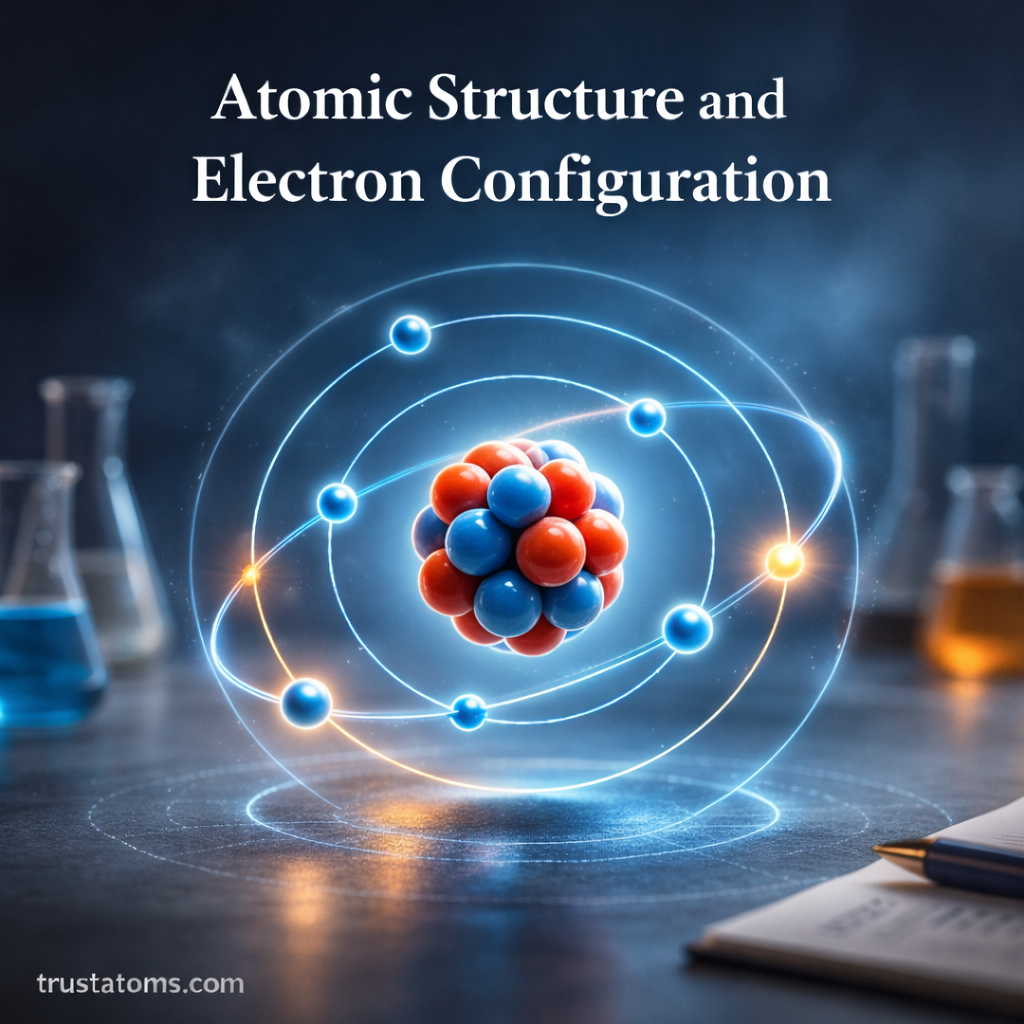
Atomic Structure and Electron Configuration

Illustration showing an atom with a nucleus of protons and neutrons surrounded by electrons in energy levels.
Illustration of atomic structure showing a nucleus with protons and neutrons and electrons arranged in energy levels. trustatoms.com

Atomic structure describes how atoms are organized and how their particles are arranged. Every atom contains a nucleus made of protons and neutrons, surrounded by electrons that move in regions called energy levels.

Electron configuration refers to the way electrons are arranged around the nucleus of an atom. This arrangement determines many chemical properties, including how atoms bond and interact with other elements.

Understanding atomic structure and electron configuration is essential in chemistry because it explains why elements behave differently and how chemical reactions occur.

Continue reading “Atomic Structure and Electron Configuration”

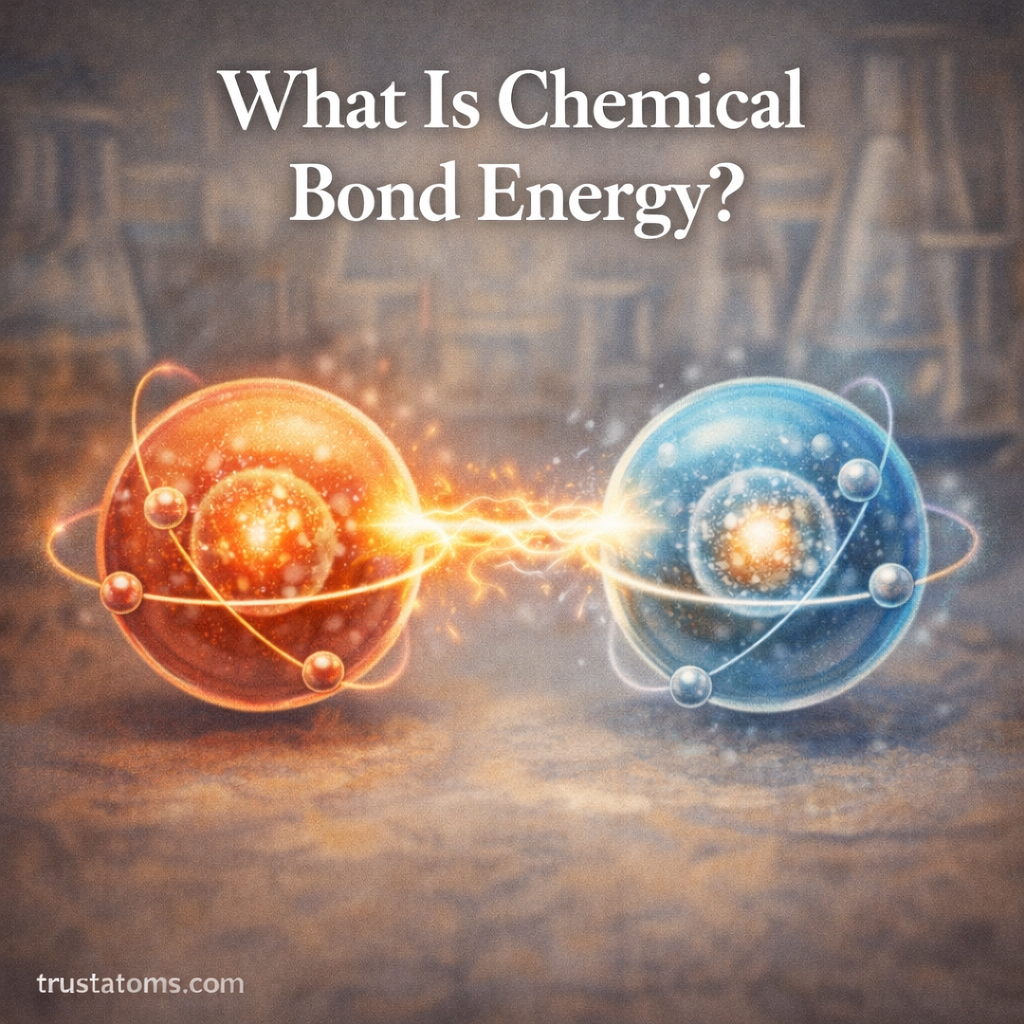
What Is Chemical Bond Energy?

Illustration showing two atoms connected by a glowing bond representing chemical bond energy in molecular chemistry.
Illustration showing two atoms connected by a bond to explain the concept of chemical bond energy. trustatoms.com

Chemical bond energy is the amount of energy required to break a chemical bond between atoms in a molecule. It represents how strong a bond is and how much energy is needed to separate the bonded atoms.

In chemistry, bond energy is an important concept because it helps scientists understand how molecules form, break apart, and participate in chemical reactions. Reactions often involve breaking existing bonds and forming new ones, and the energy involved in these processes determines whether a reaction releases energy or absorbs it.

Understanding chemical bond energy provides insight into the stability of molecules and the behavior of chemical reactions.

Continue reading “What Is Chemical Bond Energy?”

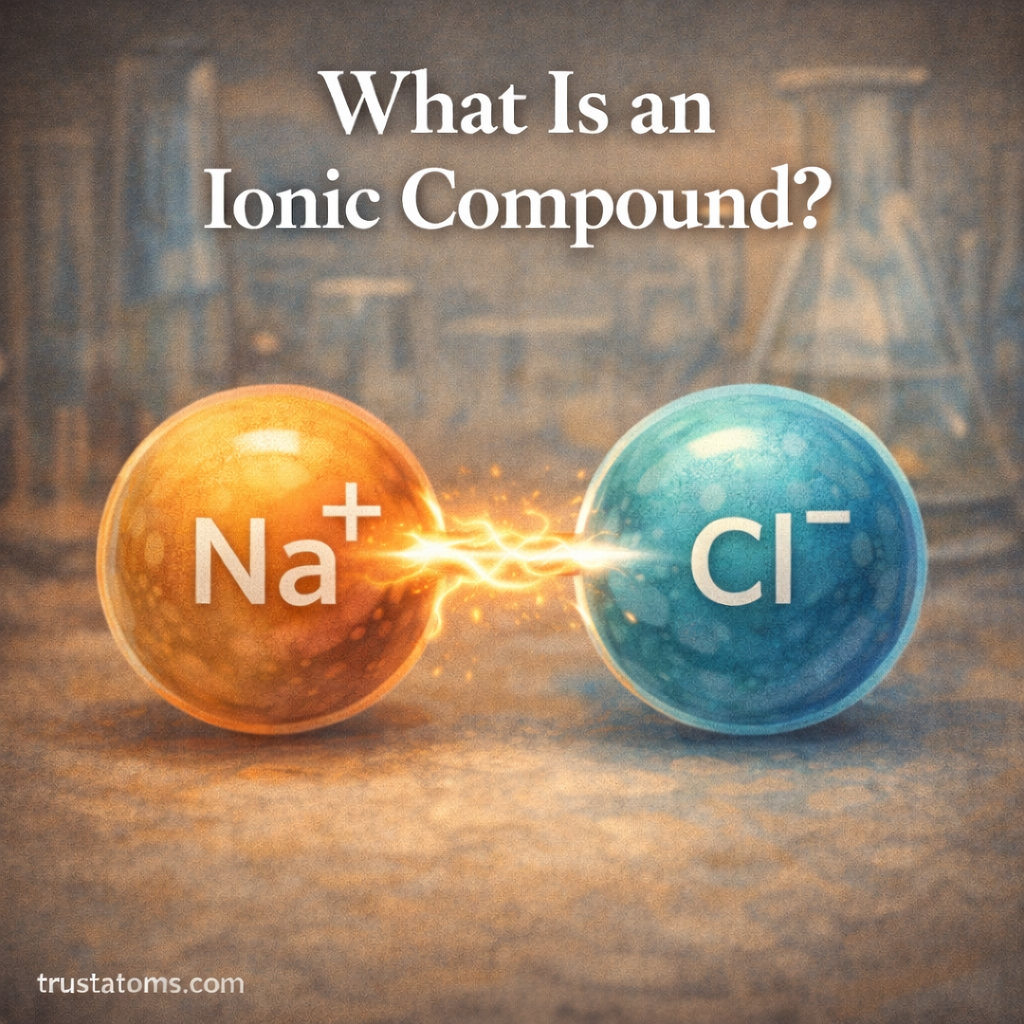
What Is an Ionic Compound?

Illustration showing positively and negatively charged ions attracting to form an ionic compound.
Simple chemistry illustration showing how opposite ions attract to form an ionic compound. trustatoms.com

An ionic compound is a chemical compound formed when atoms transfer electrons from one atom to another. This transfer creates charged particles called ions, which attract each other through strong electrostatic forces.

Ionic compounds are common in chemistry and everyday life. Substances such as table salt, baking soda, and many minerals are examples of ionic compounds. These compounds play important roles in biological systems, industrial processes, and environmental chemistry.

Understanding ionic compounds helps explain how atoms interact and how many common materials form.

Continue reading “What Is an Ionic Compound?”