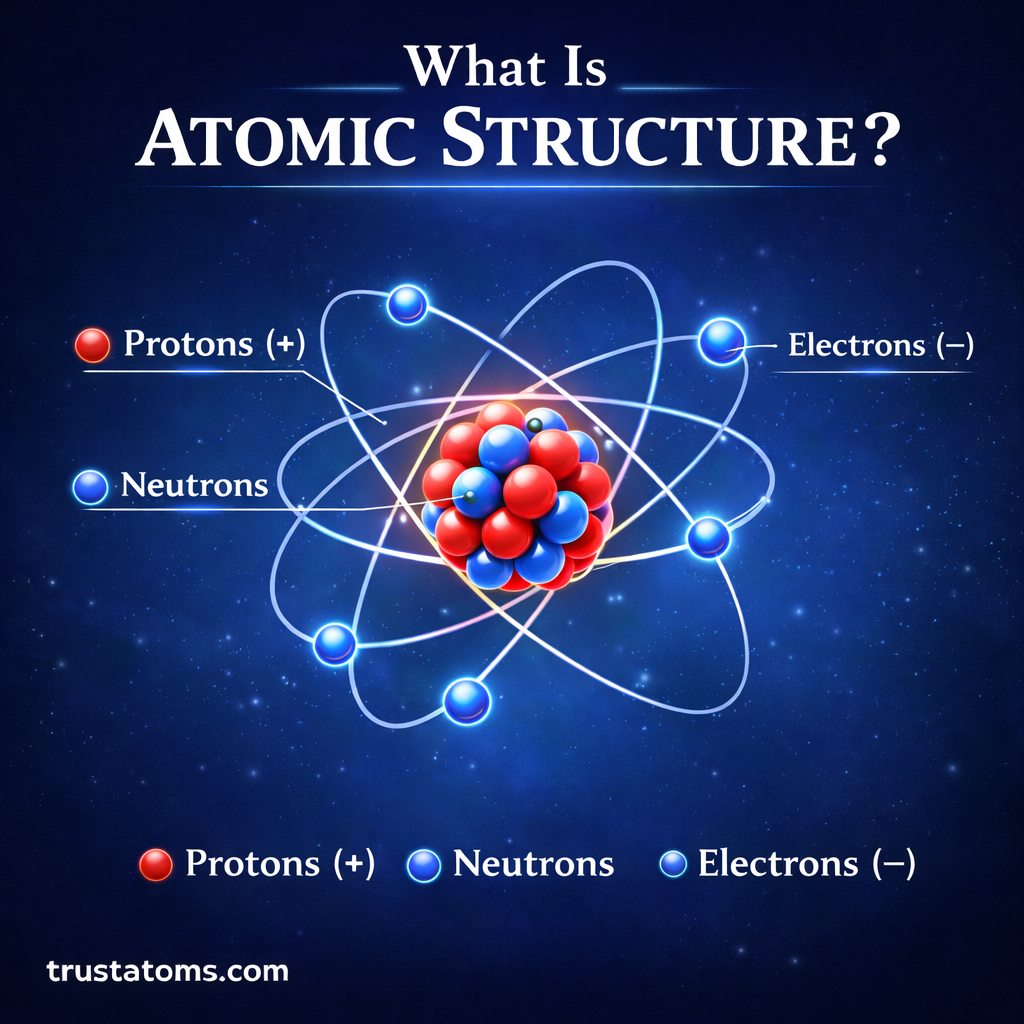
What Is Atomic Structure?

Simple atomic structure diagram showing a nucleus with protons and neutrons and electrons orbiting around it on a dark blue background.
Simple diagram illustrating the basic structure of an atom with protons, neutrons, and electrons. trustatoms.com

Atomic structure refers to the arrangement of particles inside an atom. It explains how protons, neutrons, and electrons are organized and how they determine the properties of elements.

Everything around you — air, water, metals, living organisms — is made of atoms. Understanding atomic structure is key to understanding chemistry, electricity, radiation, and even modern technology.

Atomic structure forms one of the foundations of physics.

Continue reading “What Is Atomic Structure?”
What Is the Speed of Light?

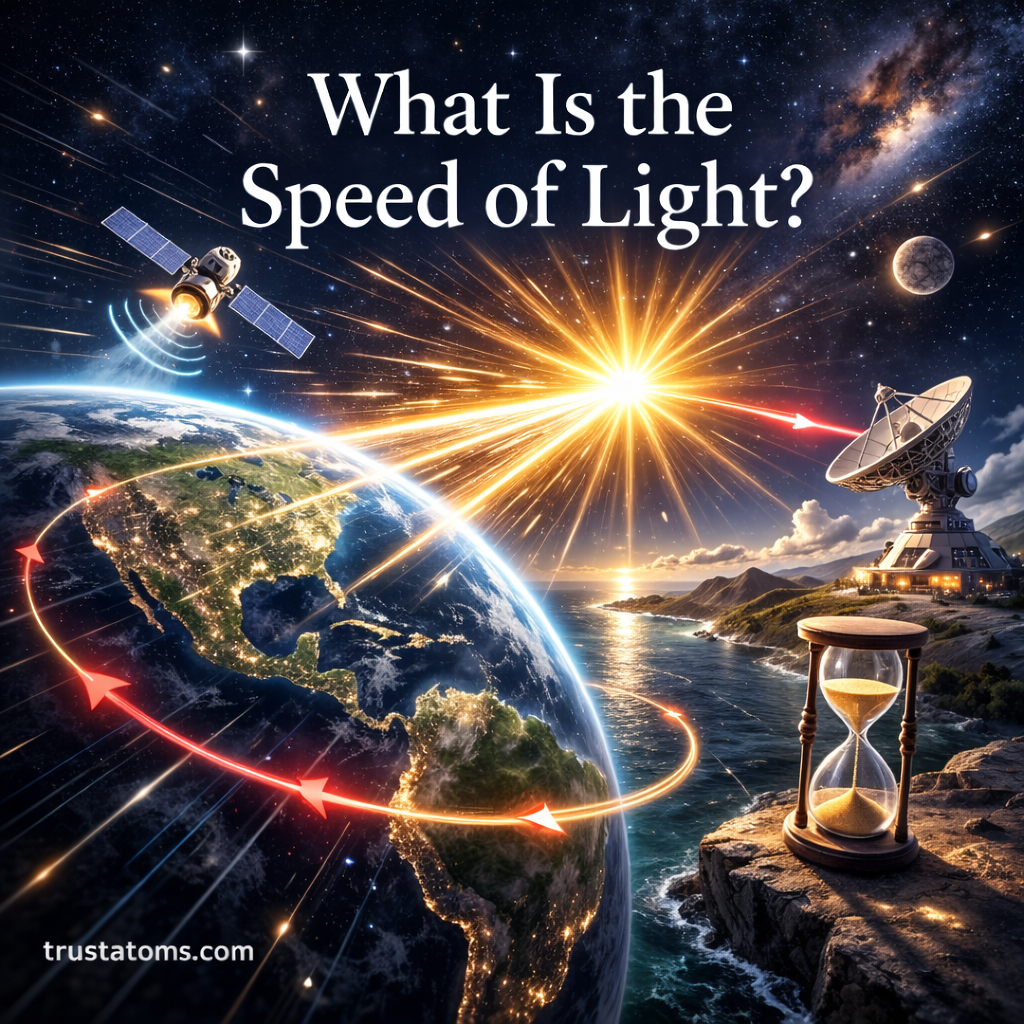
Illustration showing a bright beam of light traveling through space past Earth, satellites, and a radio telescope representing the speed of light.
Conceptual visualization of the speed of light traveling through space and connecting Earth with distant objects. trustatoms.com

The speed of light is one of the most important constants in physics. It represents the maximum speed at which energy, information, and matter can travel in the universe.

In a vacuum, light travels at approximately:

299,792,458 meters per second

That’s about 300,000 kilometers per second or 186,282 miles per second.

To put that into perspective, light can travel around the Earth more than seven times in just one second.

Continue reading “What Is the Speed of Light?”

What Is Time Dilation?

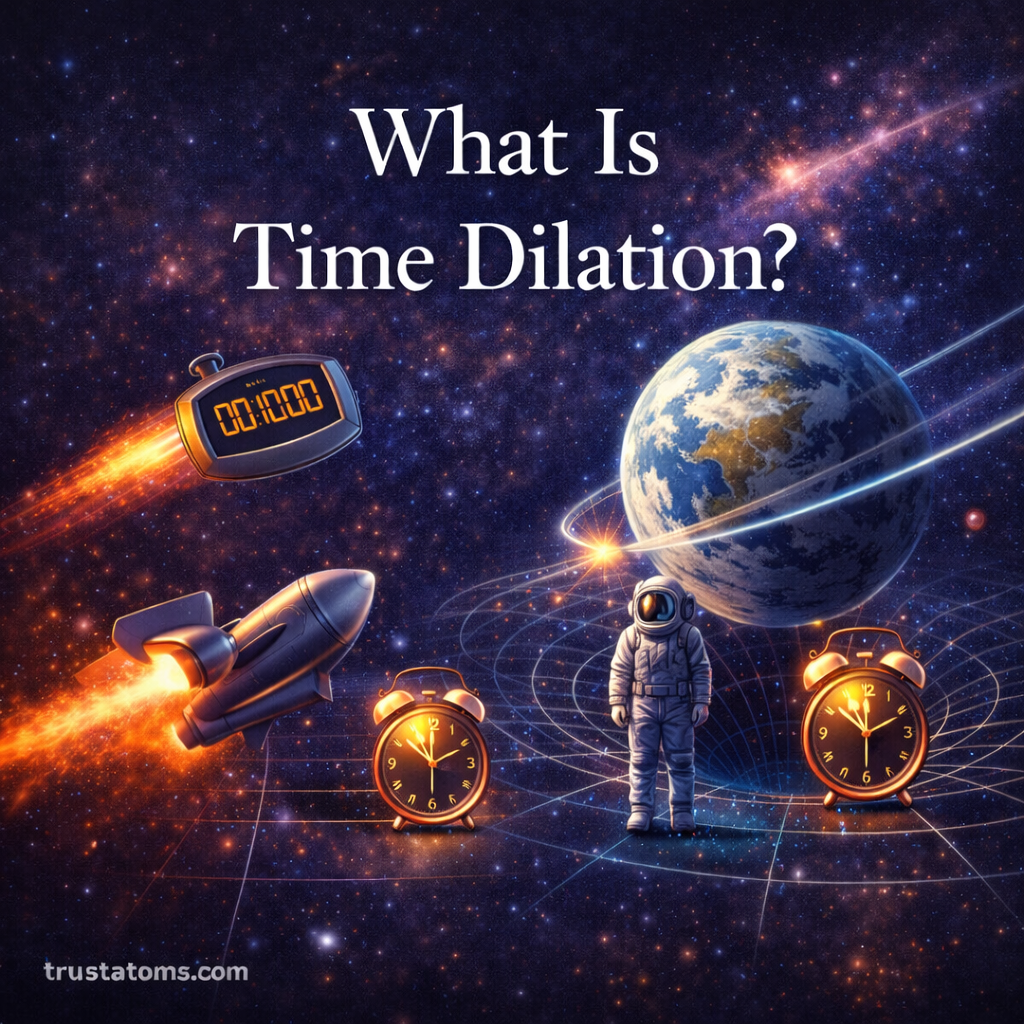
Illustration showing a fast-moving rocket, clocks ticking at different rates, an astronaut, and curved spacetime around Earth representing time dilation.
Conceptual visualization of time dilation caused by high speed and gravity. trustatoms.com

Time dilation is a phenomenon in physics where time passes at different rates depending on speed or gravity.

In everyday life, time feels constant. A second is always a second. But according to modern physics, time is not absolute. Under certain conditions — especially at very high speeds or near massive objects — time can slow down.

Time dilation is a key prediction of relativity and has been confirmed through experiments.

Continue reading “What Is Time Dilation?”

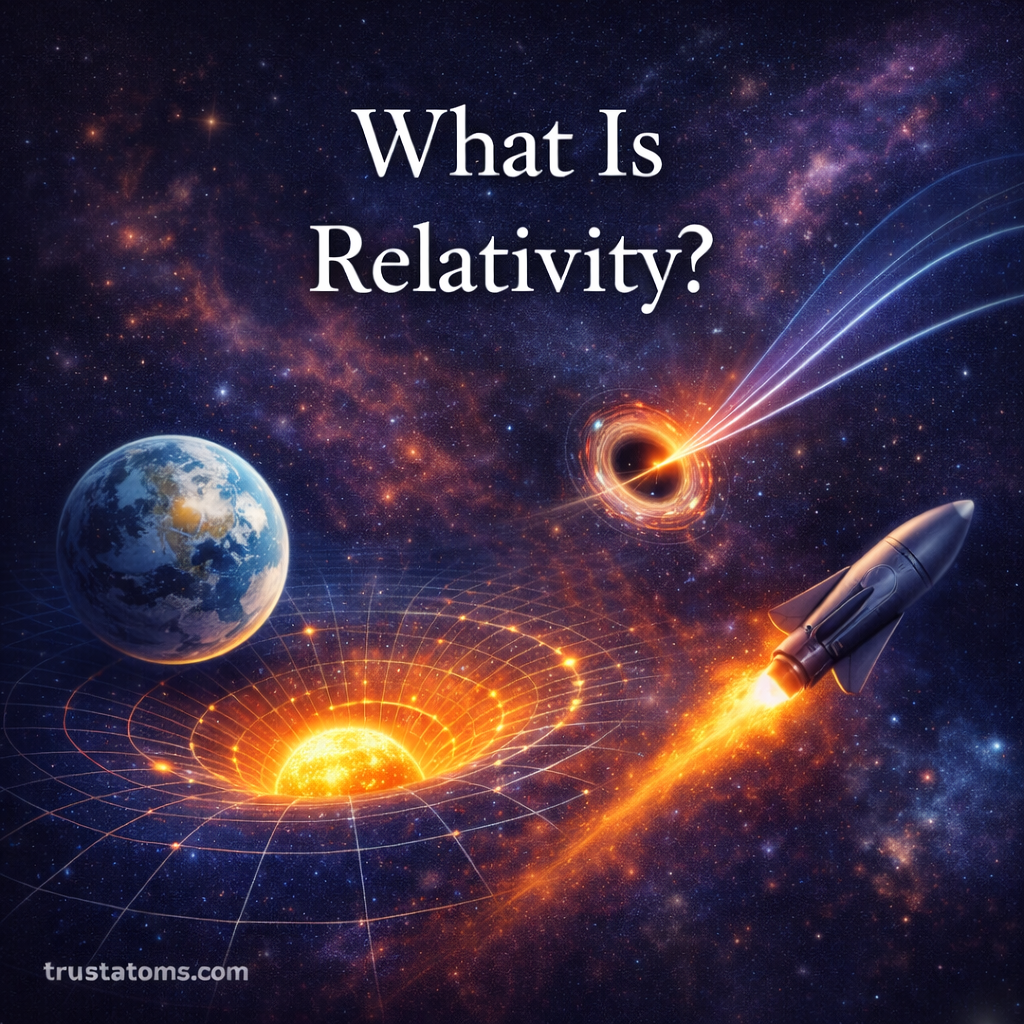
What Is Relativity?

Illustration of spacetime curvature around a massive object with Earth, a rocket, and a black hole representing relativity in physics.
Visual representation of relativity showing spacetime curvature, gravity, and motion in space. trustatoms.com

Relativity is a theory in physics that explains how space, time, gravity, and motion are connected. Developed in the early 20th century, it transformed our understanding of the universe.

Relativity shows that time is not universal, space can curve, and gravity is not simply a force pulling objects together — it is the result of spacetime bending.

There are two main parts of relativity:

  1. Special Relativity
  2. General Relativity

Together, they describe how the universe behaves at very high speeds and in strong gravitational fields.

Continue reading “What Is Relativity?”

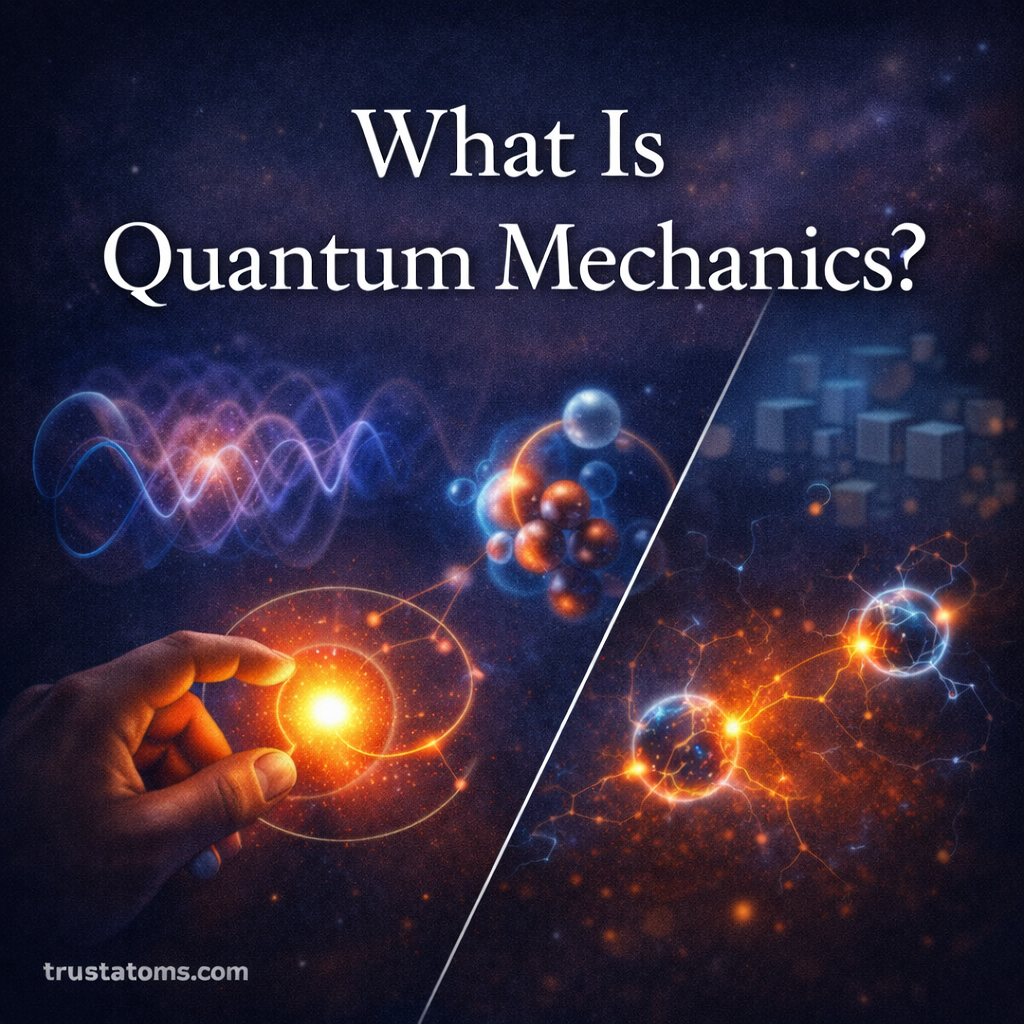
What Is Quantum Mechanics?

Illustration representing quantum mechanics with glowing particles, wave patterns, atomic structures, and entangled particles in a space-like background.
Conceptual visualization of quantum mechanics showing wave–particle duality and entanglement. trustatoms.com

Quantum mechanics is the branch of physics that explains how matter and energy behave at the smallest scales — atoms, electrons, photons, and other subatomic particles.

While classical physics describes everyday objects like cars and planets, quantum mechanics governs the strange and fascinating world of the microscopic.

It is one of the most successful scientific theories ever developed, forming the foundation of modern electronics, chemistry, and even emerging technologies like quantum computing.

Continue reading “What Is Quantum Mechanics?”

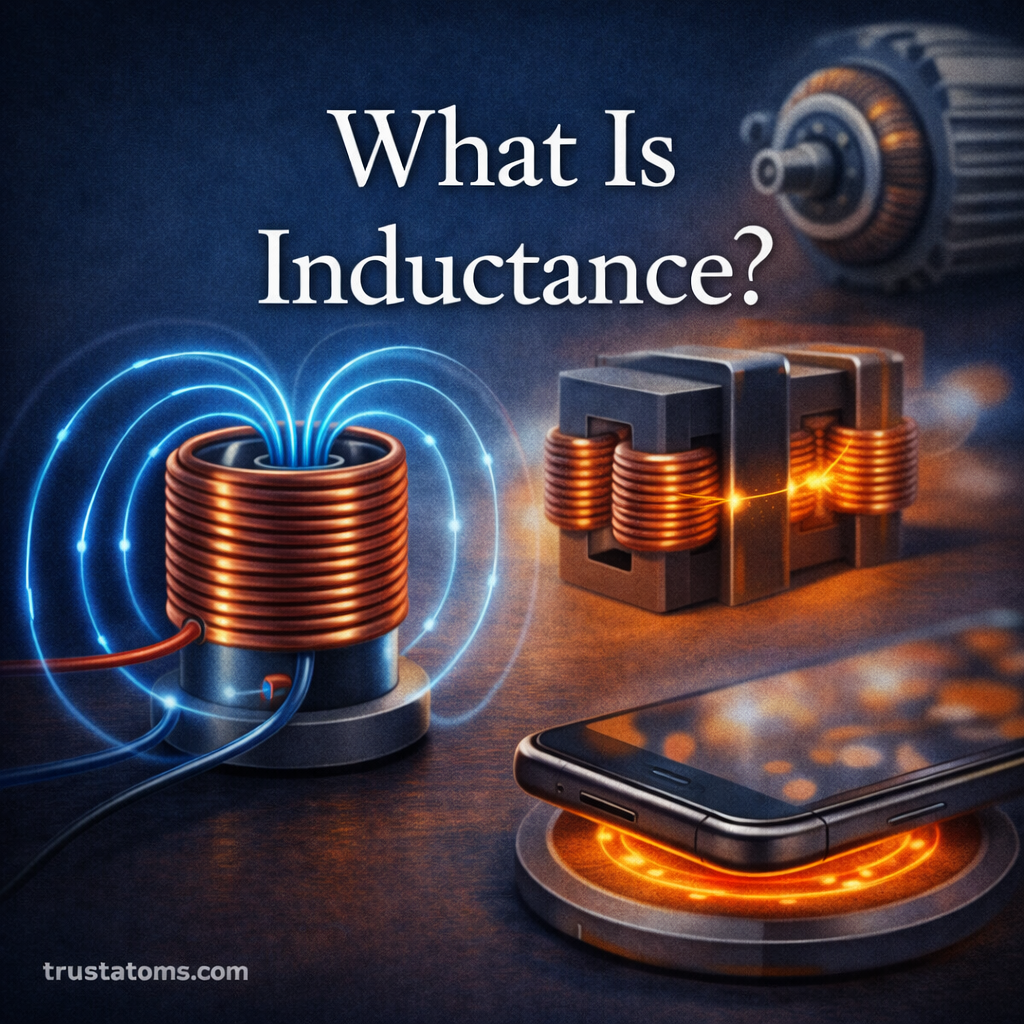
What Is Inductance?

Illustration of a copper coil generating a magnetic field alongside a transformer and wireless charging pad representing inductance in physics.
Visual explanation of inductance showing magnetic fields created by a coil and real-world applications. trustatoms.com

Inductance is a fundamental concept in physics that explains how electrical energy can be stored in a magnetic field. It plays a central role in circuits, power systems, motors, transformers, and wireless charging technologies.

In simple terms, inductance describes how a conductor resists changes in electric current by generating a magnetic field.

This guide explains what inductance is, how it works, the formula behind it, and why it matters in real-world applications.

Continue reading “What Is Inductance?”

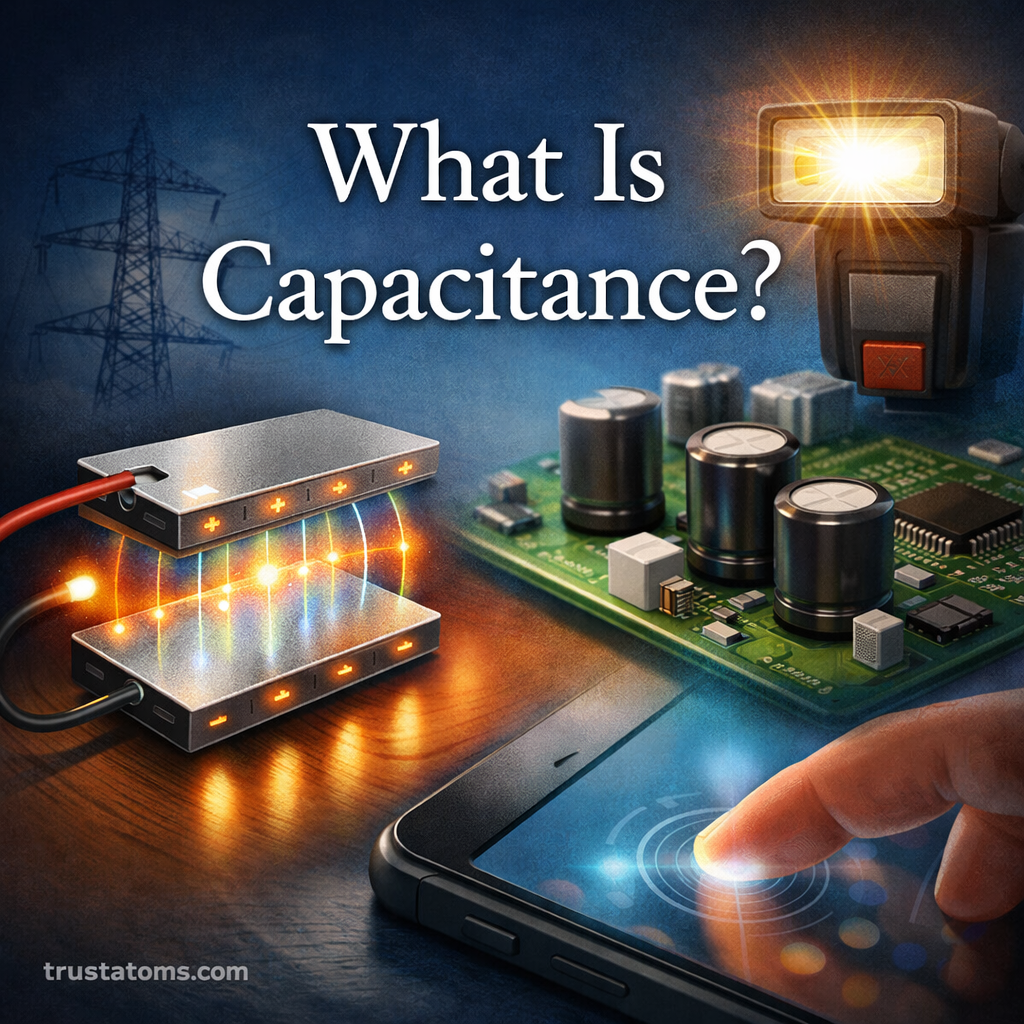
What Is Capacitance?

Illustration showing a simple capacitor with electric field between two plates alongside circuit board components and touchscreen technology representing capacitance in physics.
Simple visual explanation of capacitance showing energy stored between two conductive plates. trustatoms.com

Capacitance is a fundamental concept in physics and electrical engineering that explains how electrical energy can be stored in an electric field. From smartphone circuits to power grids and camera flashes, capacitance plays a critical role in modern technology.

In simple terms, capacitance measures a system’s ability to store electric charge.

This guide explains what capacitance is, how it works, the formula behind it, and where it appears in real-world applications.

Continue reading “What Is Capacitance?”

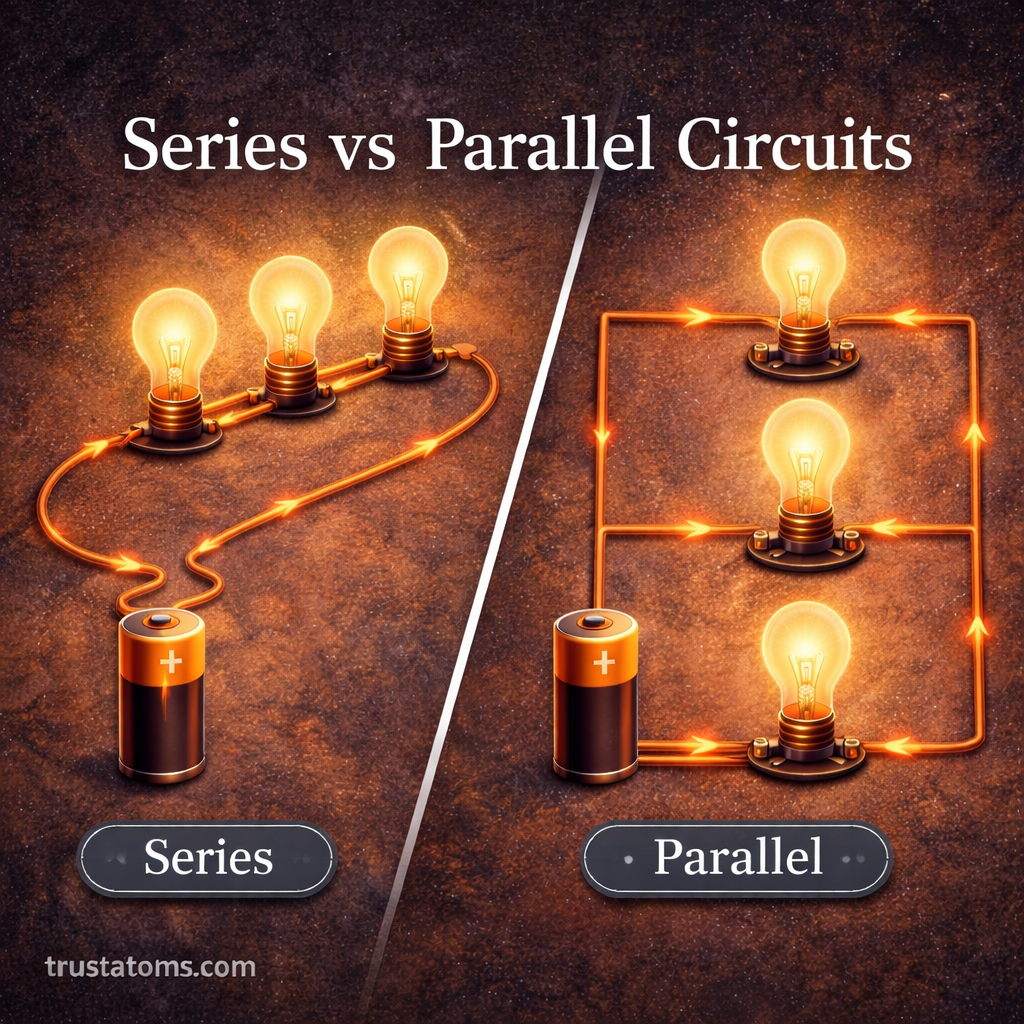
Series vs Parallel Circuits

Educational diagram comparing series and parallel circuits with light bulbs and batteries, showing single-path versus multi-branch wiring, titled “Series vs Parallel Circuits,” with trustatoms.com watermark.
Side-by-side comparison of series and parallel circuit layouts showing how current flows through single and multiple paths. trustatoms.com.

Understanding the difference between series and parallel circuits is essential in physics and electrical engineering. These two circuit types determine how electric current flows, how voltage is distributed, and what happens when one component fails.

From holiday lights to household wiring, nearly every electrical system uses one of these configurations — or a combination of both.

This guide explains series vs parallel circuits in simple terms, including how they work and where they’re used.

Continue reading “Series vs Parallel Circuits”

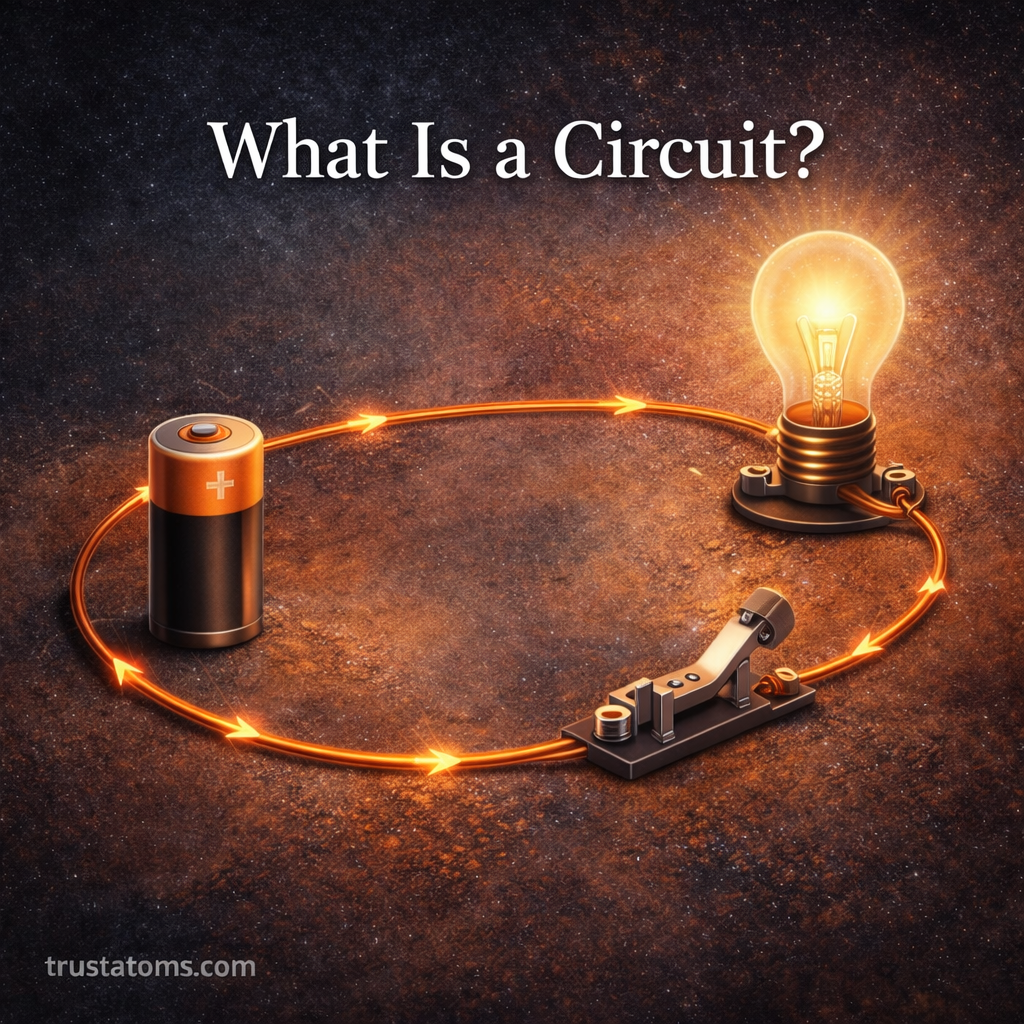
What Is a Circuit?

Simple educational diagram showing a closed electrical circuit with a battery, wires, switch, and glowing light bulb, titled “What Is a Circuit?” with trustatoms.com watermark.
Basic closed-loop electrical circuit showing a battery, switch, and light bulb demonstrating how electric current flows. trustatoms.com.

A circuit is a closed loop that allows electric current to flow.

Without a complete path, electricity cannot move. Circuits are the foundation of all electronic devices — from flashlights and smartphones to power grids and computers.

In physics, understanding circuits helps explain how electrical energy moves, how devices function, and how power is controlled.

Continue reading “What Is a Circuit?”

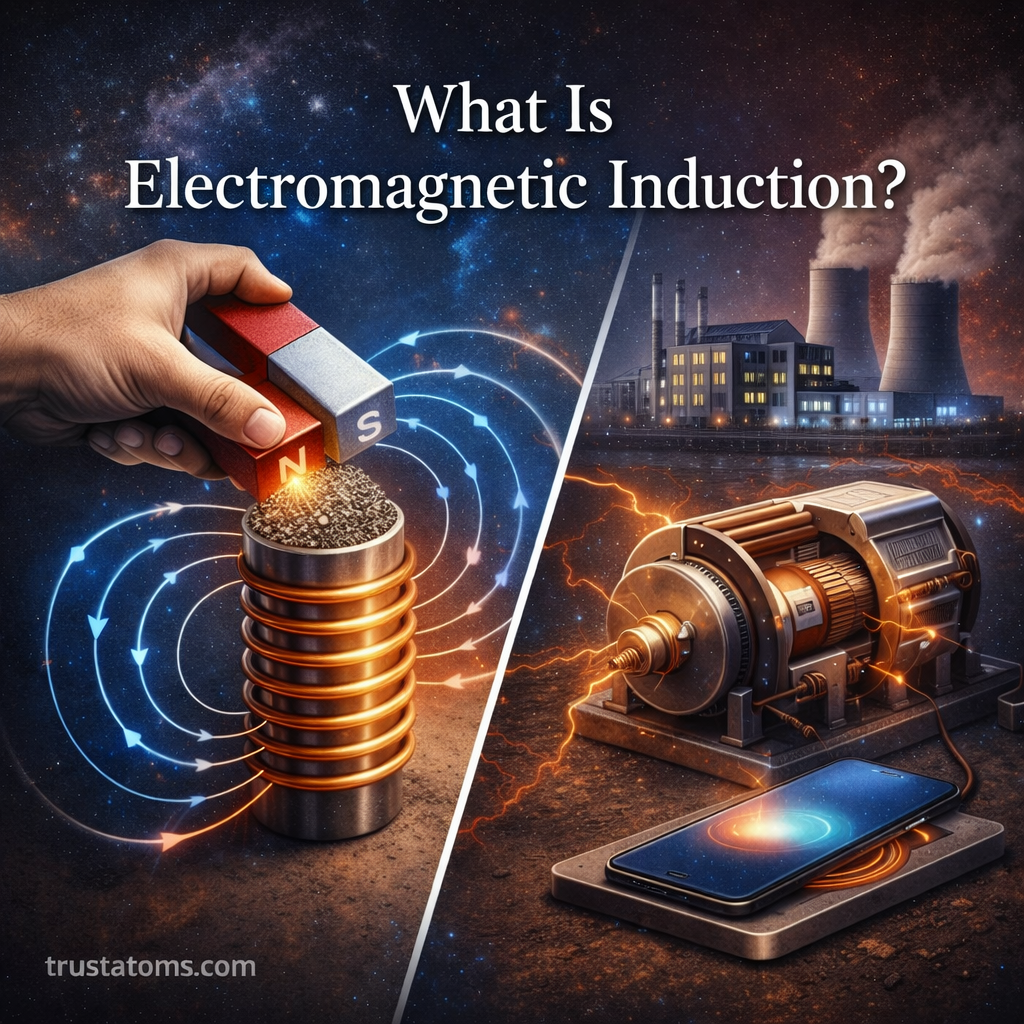
What Is Electromagnetic Induction?

Educational illustration showing a magnet moving through a copper coil creating electric current, alongside a generator and wireless charging example, titled “What Is Electromagnetic Induction?” with trustatoms.com watermark.
Visual explanation of electromagnetic induction showing how a changing magnetic field in a coil produces electricity and powers generators and wireless charging. trustatoms.com.

Electromagnetic induction is the process by which a changing magnetic field creates an electric current in a conductor.

This principle is one of the most important discoveries in physics. It explains how electricity is generated in power plants, how transformers work, and how many modern devices operate.

Without electromagnetic induction, large-scale electricity production would not be possible.

Continue reading “What Is Electromagnetic Induction?”