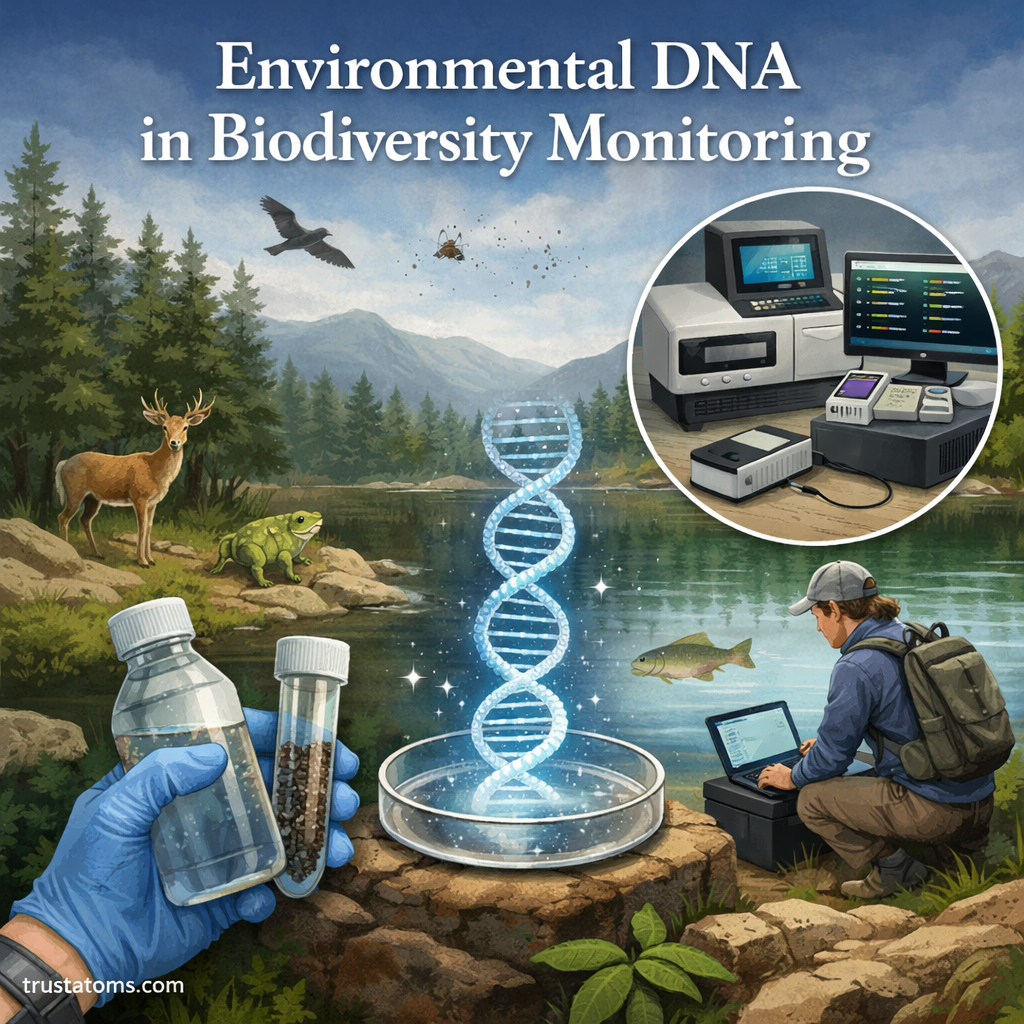
Environmental DNA (eDNA) is genetic material collected from environmental samples such as water, soil, and sediment rather than directly from an organism. In biodiversity monitoring, scientists analyze this DNA to detect species, investigate biological communities, and track changes in ecosystems without necessarily observing or capturing wildlife.
Organisms release DNA through skin cells, mucus, waste, reproductive material, and decomposing tissue. Researchers use methods from the science of biology to recover these genetic traces and identify the organisms that may have contributed them.
Environmental DNA is especially useful for investigating rare, elusive, or aquatic species. However, detecting DNA does not automatically establish how many individuals are present or whether they remain at the sampling location.
What Is Environmental DNA?
Environmental DNA refers to genetic material recovered from an environmental sample. It may come from whole microorganisms, shed cells, tissue fragments, or DNA released into the surrounding environment.
Scientists collect eDNA from several sources:
- Freshwater: Rivers, streams, lakes, and ponds.
- Marine water: Coastal habitats, reefs, and open oceans.
- Soil and sediment: Forest floors, wetlands, and aquatic sediments.
- Air: Airborne biological particles collected using specialized equipment.
After extracting DNA, researchers test for genetic sequences associated with particular organisms. DNA sequencing technologies in research allow scientists to read genetic fragments and compare them with reference sequences.
These comparisons draw on principles also used in genomic sequencing in molecular biology, although eDNA studies often examine short genetic markers rather than complete genomes.
A reliable sequence match provides evidence that DNA from an organism occurred in the sample. Interpreting that evidence requires considering contamination, DNA transport, and the quality of reference databases.
How Environmental DNA Monitoring Works
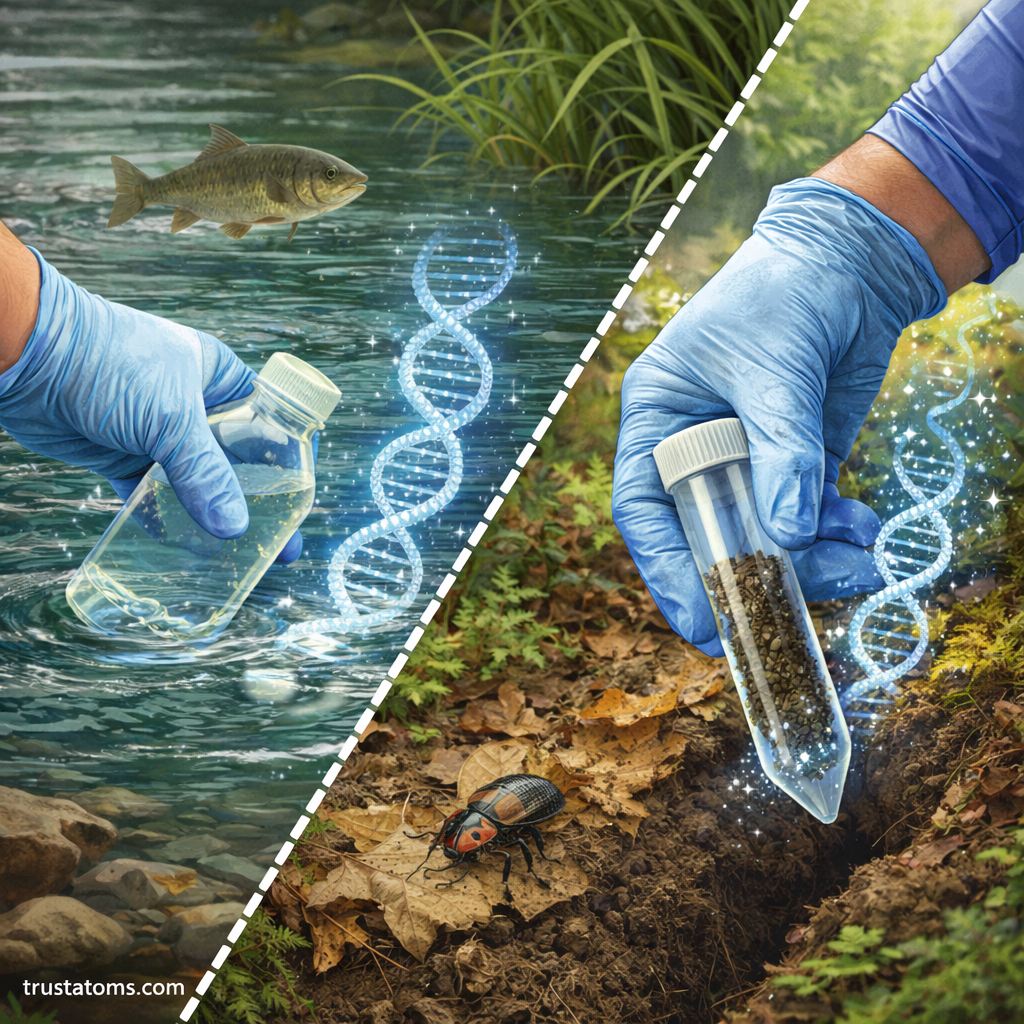
Environmental DNA monitoring follows a sequence of field sampling, laboratory processing, genetic analysis, and interpretation. Each stage affects the reliability of the results.
1. Collect Environmental Samples
Researchers select sampling locations based on the species or habitats being investigated. They might collect river water to search for fish DNA or soil samples to examine organisms associated with forest habitats.
Water samples are commonly filtered to capture DNA-containing particles. Sterile equipment, appropriate storage, and field controls help reduce contamination and DNA degradation.
2. Extract DNA
In the laboratory, scientists separate DNA from collected material using chemical extraction methods. Environmental samples may contain substances that interfere with later testing, so purification is often necessary.
3. Amplify Target DNA
Polymerase chain reaction (PCR) produces many copies of selected DNA regions, making small quantities easier to detect.
Species-specific studies may use quantitative PCR (qPCR) or digital PCR to test for particular genetic markers. Community surveys commonly amplify barcode regions shared across groups of organisms.
4. Sequence and Identify DNA
For metabarcoding studies, amplified DNA fragments are sequenced and compared with reference databases. Software groups and evaluates sequences before assigning them to species or broader taxonomic categories.
Not every sequence can be identified to species level. Closely related organisms may share similar markers, and some species lack suitable reference sequences.
5. Interpret and Verify Results
Researchers examine controls, replicate samples, and detection patterns before drawing conclusions. Repeated positive detections generally provide stronger evidence than an isolated result.
Where decisions have major conservation consequences, scientists may confirm eDNA findings with additional sampling or conventional field surveys.
Why Environmental DNA Is Useful
Traditional biodiversity surveys rely on methods such as visual observations, nets, traps, and camera monitoring. Environmental DNA offers a complementary approach with several advantages.
Less Direct Disturbance to Wildlife
Researchers can often collect water or soil without capturing the animals they want to study. This is particularly helpful when handling wildlife would be difficult or undesirable.
Detection of Difficult-to-Observe Species
Some organisms are nocturnal, secretive, or present at low densities. Their DNA may be detectable even when field observers do not encounter them.
Monitoring Multiple Species
Metabarcoding can identify genetic evidence from numerous organisms in one sample. This makes it useful for examining fish communities, aquatic invertebrates, and other groups.
Potential Savings in Fieldwork
Collecting environmental samples can reduce the need for extensive trapping or repeated visual searches. However, laboratory processing, sequencing, and specialist analysis still require resources.
Applications of eDNA in Biodiversity Monitoring
Environmental DNA supports conservation planning, invasive species surveillance, and ecological research. It is one of several biodiversity monitoring technologies that scientists combine to obtain a more complete picture of ecosystems.
Monitoring Rare and Endangered Species
Conservation teams use eDNA to investigate species that are difficult to locate. Applications include detecting threatened amphibians in wetlands and monitoring rare fish populations in rivers.
Repeated surveys can reveal changes in detection patterns across sites or seasons. These findings help identify locations where more detailed conservation assessments may be needed.
Detecting Invasive Species
Early detection can improve the chances of managing harmful introduced organisms before they become widespread.
Environmental DNA testing has been used to monitor organisms such as zebra mussels and invasive carp in freshwater systems. Positive results can guide follow-up surveys and management decisions.
Assessing Ecosystem Change
Scientists can compare DNA-based community profiles across locations or sampling periods to investigate ecological changes associated with pollution, habitat modification, or environmental stress.
Such comparisons require consistent methods because differences in sampling or laboratory procedures can influence which organisms are detected.
Surveying Marine Biodiversity
Marine environments are challenging to survey because organisms may occupy deep water, large areas, or inaccessible habitats.
Seawater eDNA can provide evidence of fish, marine mammals, and other organisms. Ocean currents complicate interpretation because DNA may travel away from its original source.
A Practical Example: Searching for a Rare Fish
Imagine conservation scientists investigating whether a rare freshwater fish remains in a river. Visual surveys have produced few observations, but researchers suspect the species may still occupy sheltered sections.
They collect water from five river locations, taking repeated samples at each site. Laboratory tests target a DNA marker associated with the fish.
Suppose the marker appears consistently in samples from two locations but not the other three. This pattern would suggest that the fish’s DNA is more readily detected near those two sampling areas.
However, the results would not establish that fish were absent elsewhere. Low DNA concentrations, water movement, and imperfect detection could explain negative samples.
The team could then prioritize the positive locations for additional sampling and habitat surveys. This example illustrates how eDNA can guide fieldwork without replacing direct ecological observations.
Types of Environmental DNA Analysis
Different analytical approaches answer different ecological questions. Choosing the correct method depends on whether researchers want to detect one species, survey a community, or investigate broader genetic information.
Species-Specific Detection
Species-specific assays target genetic sequences associated with one organism. They are useful when researchers need to determine whether a particular endangered or invasive species may be present.
DNA Metabarcoding
Metabarcoding uses selected genetic markers to identify multiple organisms from a mixed environmental sample.
It can reveal broad community composition, although the organisms detected depend on the markers, laboratory methods, and reference databases used.
Metagenomic Sequencing
Metagenomics goes even further by sequencing all DNA present in an environmental sample, rather than amplifying only selected barcode regions.
In practice, sequencing captures a sample of the available DNA, not necessarily every molecule. Metagenomic analysis is particularly useful for studying microbial communities and genes associated with ecological functions.
Limitations of Environmental DNA Monitoring
Environmental DNA provides valuable evidence, but results must be interpreted carefully. Several factors can affect detection and identification.
DNA Degradation and Transport
Sunlight, temperature, microbial activity, and other environmental conditions influence how long DNA remains detectable.
Water currents can transport DNA downstream, while sediments may preserve genetic material longer than surrounding water. A positive result therefore does not always indicate a living organism at the exact sampling point.
Uncertain Population Abundance
DNA concentration is influenced by shedding rates, organism activity, environmental conditions, and sampling efficiency.
Consequently, a stronger DNA signal does not automatically mean more individuals are present. Estimating abundance requires additional evidence and carefully validated models.
Contamination and False Negatives
Contamination can introduce DNA from outside the study site, potentially producing false-positive results. Conversely, insufficient sampling, DNA degradation, or substances that inhibit PCR can prevent detection of species that are present.
Field blanks, laboratory controls, and replicate samples help researchers identify these problems.
Incomplete Reference Databases
Species identification depends on suitable reference sequences. When databases lack certain organisms or genetic markers cannot distinguish close relatives, results may only support identification at the genus or family level.
Emerging Developments in eDNA Technology
Researchers are developing tools to make environmental DNA monitoring faster, more consistent, and easier to use in remote locations.
- Portable sequencing: Compact instruments can support genetic analysis closer to sampling locations.
- Automated sampling: Devices can collect or filter environmental samples at scheduled intervals.
- Improved reference libraries: Expanded genetic databases can increase identification accuracy.
- Computational analysis: Bioinformatics and machine learning can assist with processing large sequencing datasets.
These advances may improve monitoring coverage, but reliable results will still depend on careful sampling, laboratory controls, and ecological interpretation.
Frequently Asked Questions
Can environmental DNA identify animals without capturing them?
Yes. Scientists can detect DNA released by organisms into water, soil, or other environments. Identification depends on suitable genetic markers, reference data, and reliable sampling procedures.
Does finding eDNA prove a species currently lives at a site?
Not necessarily. DNA can persist after an organism leaves or be transported from another location. Repeated sampling and additional observations help establish whether a species occupies the area.
Can environmental DNA determine how many animals are present?
Usually not from detection alone. DNA quantities may relate to abundance under some conditions, but shedding rates, transport, degradation, and sampling differences complicate population estimates.
Environmental DNA allows researchers to investigate biodiversity through genetic traces that organisms leave in their surroundings. Species-specific testing, metabarcoding, and metagenomics provide different levels of information, from detecting a rare fish to examining entire microbial communities. When combined with field surveys and appropriate quality controls, eDNA helps conservation teams detect ecological changes and make better-informed management decisions.
Sources: Taberlet et al., Environmental DNA: For Biodiversity Research and Monitoring; Thomsen and Willerslev, Environmental DNA – An Emerging Tool in Conservation for Monitoring Past and Present Biodiversity; United States Geological Survey, Environmental DNA research and monitoring resources.