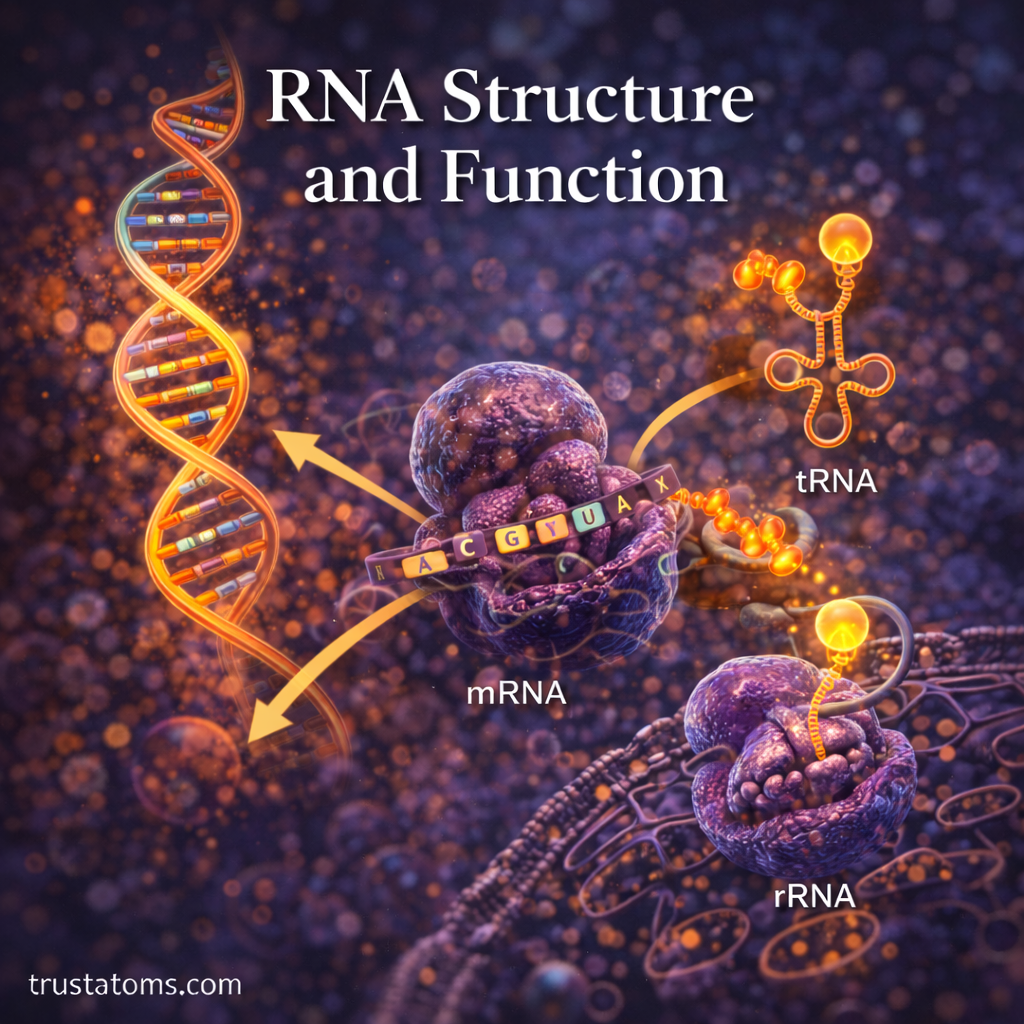
RNA, or ribonucleic acid, is a nucleic acid that helps cells use genetic information to produce proteins, regulate genes, and carry out essential chemical reactions. Its usually single-stranded structure allows it to fold into different shapes, enabling RNA molecules to perform functions ranging from carrying genetic instructions to controlling cellular activity.
In biological science, RNA connects genetic information with the molecular processes that sustain living cells. While DNA primarily stores hereditary instructions, RNA molecules help interpret, regulate, and sometimes directly carry out those instructions.
Understanding RNA structure explains why different RNA molecules can perform specialized tasks, including protein synthesis, gene regulation, and catalysis. These properties also make RNA useful in modern medicine and biotechnology.
What Is RNA?
RNA is a nucleic acid composed of repeating molecular units called nucleotides. Most cellular RNA is produced using DNA as a template, although RNA genomes also occur in many viruses.
For a broader introduction to its biological functions, see What Is RNA?, which explains how RNA participates in gene expression and other cellular processes.
Each RNA nucleotide contains three components:
- Ribose sugar: A five-carbon sugar that forms part of the RNA backbone.
- Phosphate group: Connects neighboring nucleotides through phosphodiester bonds.
- Nitrogenous base: Carries sequence information and participates in molecular recognition.
RNA contains four principal nitrogenous bases: adenine (A), uracil (U), cytosine (C), and guanine (G). Their sequence determines how an RNA molecule interacts with other molecules and, for messenger RNA, which protein it encodes.
Structural Differences Between RNA and DNA
RNA and DNA are both nucleic acids, but their chemical structures differ in ways that influence their biological functions. A detailed DNA vs RNA comparison explains how these molecules differ in structure, stability, and function.
| Feature | RNA | DNA |
|---|---|---|
| Sugar | Ribose | Deoxyribose |
| Bases | A, U, C, G | A, T, C, G |
| Typical structure | Single-stranded | Double-stranded |
| Primary functions | Gene expression, regulation, and catalysis | Long-term genetic information storage |
| Chemical stability | Generally less stable | Generally more stable |
Single-Stranded Structure
DNA typically forms a double helix containing two complementary strands. RNA is usually single-stranded, although portions of the same RNA molecule can pair with one another to form double-stranded regions.
This flexibility allows RNA to form structures that interact with proteins, DNA, and other RNA molecules.
Ribose Sugar and Chemical Stability
RNA contains ribose, which has a hydroxyl group at the 2′ carbon. DNA contains deoxyribose, which lacks this hydroxyl group.
The additional hydroxyl group makes RNA more susceptible to certain chemical reactions that break its backbone. Consequently, RNA is generally less chemically stable than DNA under comparable conditions.
Uracil Instead of Thymine
RNA normally uses uracil where DNA uses thymine. During standard RNA base pairing, adenine pairs with uracil, while guanine pairs with cytosine.
These complementary relationships help RNA interact with DNA templates and form internal structures.
Three Main Types of RNA in Protein Synthesis
Messenger RNA, transfer RNA, and ribosomal RNA cooperate during protein synthesis. Each has a distinct structure suited to its function.
Messenger RNA (mRNA)
Messenger RNA carries genetic information from DNA to ribosomes, where proteins are synthesized.
The nucleotide sequence of a protein-coding mRNA is read in groups of three bases called codons. Most codons specify an amino acid, while stop codons signal the end of protein synthesis.
For example, the mRNA codon AUG specifies methionine and commonly serves as the starting signal for translation. This illustrates how a particular nucleotide sequence communicates a specific instruction to the protein-building machinery.
Transfer RNA (tRNA)
Transfer RNA connects mRNA codons with their corresponding amino acids. Each tRNA contains an anticodon region that recognizes a compatible codon and an attachment site for an amino acid.
Specialized enzymes called aminoacyl-tRNA synthetases attach the appropriate amino acids to tRNA molecules.
During protein synthesis, charged tRNAs enter the ribosome and contribute their amino acids to the growing protein chain. This process translates nucleotide information into an amino acid sequence.
Ribosomal RNA (rRNA)
Ribosomal RNA forms the structural and catalytic core of ribosomes. Together with ribosomal proteins, it creates the molecular machinery responsible for assembling proteins.
Ribosomal RNA helps position messenger RNA and transfer RNA during translation. It also catalyzes peptide bond formation, the chemical reaction that joins amino acids together.
Because RNA performs this catalytic reaction, the ribosome demonstrates that biological catalysts are not limited to proteins.
Regulatory RNAs Control Gene Expression
Not all RNA molecules carry instructions for protein production. Many non-coding RNAs influence when genes are expressed and how much protein cells produce.
Important regulatory RNA classes include:
- MicroRNA (miRNA): Short RNA molecules that generally reduce the expression of target genes.
- Small interfering RNA (siRNA): RNA molecules that guide sequence-specific gene silencing.
- Long non-coding RNA (lncRNA): Longer transcripts that can interact with proteins, DNA, or other RNAs to influence cellular processes.
These molecules regulate gene activity by influencing RNA stability, translation efficiency, or transcription processes.
For instance, a microRNA can bind to a complementary region of messenger RNA and promote its degradation or reduce its translation. This allows cells to adjust protein production without altering the DNA sequence.
How RNA Folding Determines Its Function
Although RNA is generally single-stranded, complementary regions within a molecule can form hydrogen bonds. These interactions produce secondary structures that influence RNA stability and molecular recognition.
Common RNA structural features include hairpin loops, stem-loops, internal loops, and bulges.
Transfer RNA provides a familiar example. Its secondary structure resembles a cloverleaf, while its three-dimensional structure folds into an L-shaped arrangement that helps it interact with the ribosome.
Other RNA molecules form complex three-dimensional structures containing binding pockets or catalytic regions. Their functions depend not only on nucleotide sequences but also on how those sequences fold.
How RNA Participates in Gene Expression
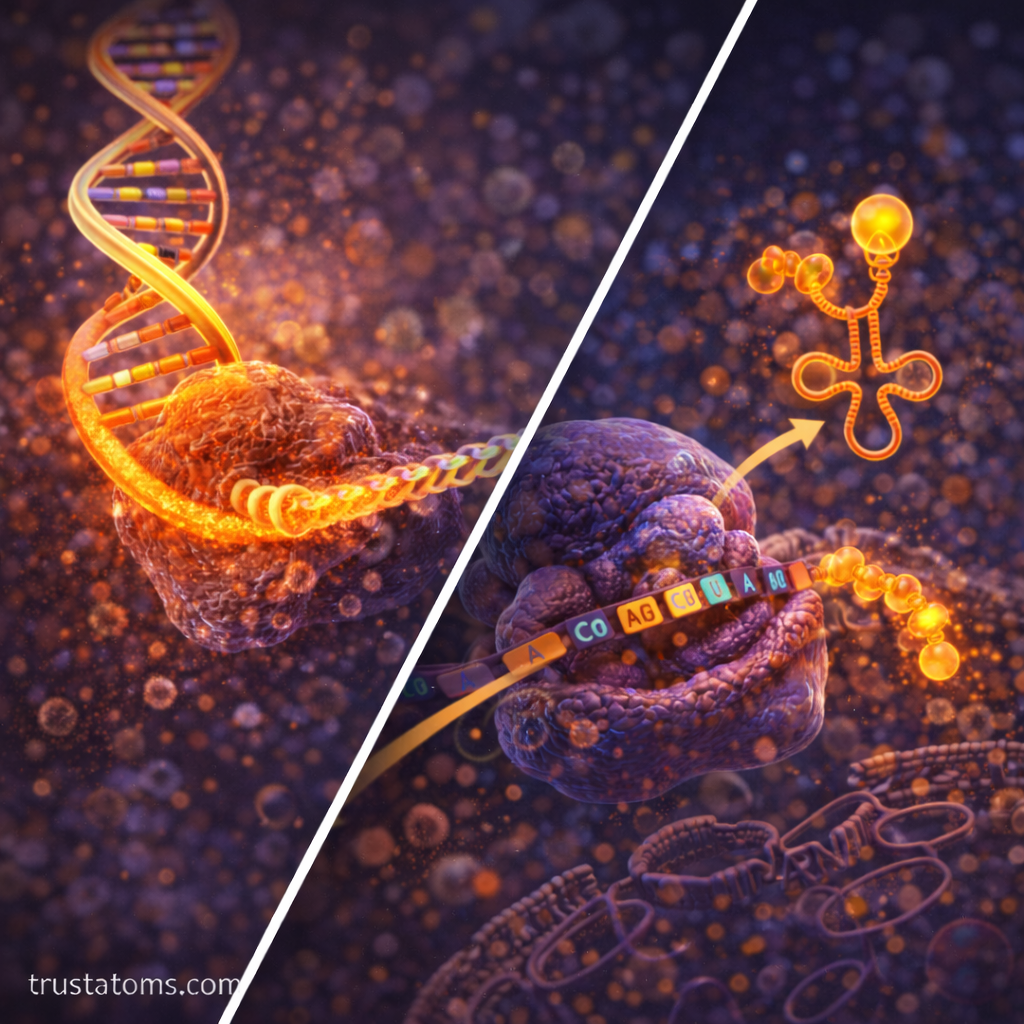
For protein-coding genes, gene expression commonly involves two major processes: transcription and translation.
Transcription Produces RNA from DNA
During transcription, RNA polymerase uses one DNA strand as a template to synthesize a complementary RNA molecule.
In eukaryotic cells, protein-coding transcripts usually undergo processing before translation. This includes adding a protective cap, removing introns through splicing, and adding a poly(A) tail.
The resulting mature messenger RNA can then be exported from the nucleus to the cytoplasm.
Translation Converts RNA Instructions into Proteins
During translation, ribosomes read messenger RNA codons and coordinate the addition of amino acids delivered by transfer RNAs.
As amino acids are joined by peptide bonds, a polypeptide chain forms. The chain subsequently folds and may undergo additional modifications before becoming a functional protein.
RNA Molecules That Catalyze Chemical Reactions
Some RNA molecules function as biological catalysts called ribozymes. Unlike ordinary messenger RNA, these molecules can directly accelerate specific chemical reactions.
Examples include catalytic RNA in ribosomes, certain self-splicing introns, and RNA molecules that cleave other RNA sequences.
These discoveries established that catalytic activity is not exclusive to proteins. RNA can both carry genetic information and participate directly in biochemical reactions.
RNA Applications in Medicine and Biotechnology
RNA-based technologies allow researchers to introduce genetic instructions, regulate gene expression, and investigate cellular processes.
Applications include mRNA vaccines, RNA interference therapies, and RNA components used in certain CRISPR systems.
For example, mRNA vaccines deliver instructions for producing a selected antigen. Cells temporarily translate those instructions into a protein that the immune system can recognize, helping establish an immune response.
RNA-based treatments can also reduce the production of disease-associated proteins by targeting specific messenger RNA molecules. However, delivery, stability, and unintended molecular interactions remain important considerations in therapeutic development.
The RNA World Hypothesis and Early Life
The RNA world hypothesis proposes that RNA-like molecules may have contributed to early biological systems before the emergence of modern DNA-based genetic storage and protein-based enzymes.
Scientists investigate this hypothesis because RNA can store sequence information and, in some forms, catalyze chemical reactions. These properties suggest a possible mechanism through which early molecular systems could have combined information storage with chemical activity.
However, the hypothesis remains an active area of research. Scientists have not established a complete pathway explaining how the first self-sustaining RNA-based systems originated.
Frequently Asked Questions
What is the main function of RNA?
RNA performs several functions, including carrying genetic instructions for protein synthesis, helping assemble proteins, regulating gene expression, and catalyzing certain chemical reactions. Its specific function depends on the RNA molecule’s sequence and structure.
Why is RNA usually single-stranded?
RNA molecules are commonly synthesized as individual nucleotide strands. Their single-stranded arrangement allows regions within the same molecule to pair and fold into structures suited to different biological functions. However, double-stranded RNA also occurs in cells and some viruses.
Can RNA function without producing proteins?
Yes. Many non-coding RNAs function without being translated into proteins. Examples include ribosomal RNA, transfer RNA, microRNA, and certain catalytic RNAs. These molecules perform structural, regulatory, or enzymatic functions directly.
RNA’s chemical structure allows it to perform tasks that extend far beyond carrying genetic instructions. Messenger RNA, transfer RNA, and ribosomal RNA coordinate protein synthesis, while regulatory and catalytic RNAs influence gene activity and chemical reactions. Understanding these differences helps explain how cells convert genetic information into functioning biological systems.
Sources: Alberts et al., Molecular Biology of the Cell; Lodish et al., Molecular Cell Biology; National Human Genome Research Institute, Talking Glossary of Genomic and Genetic Terms.