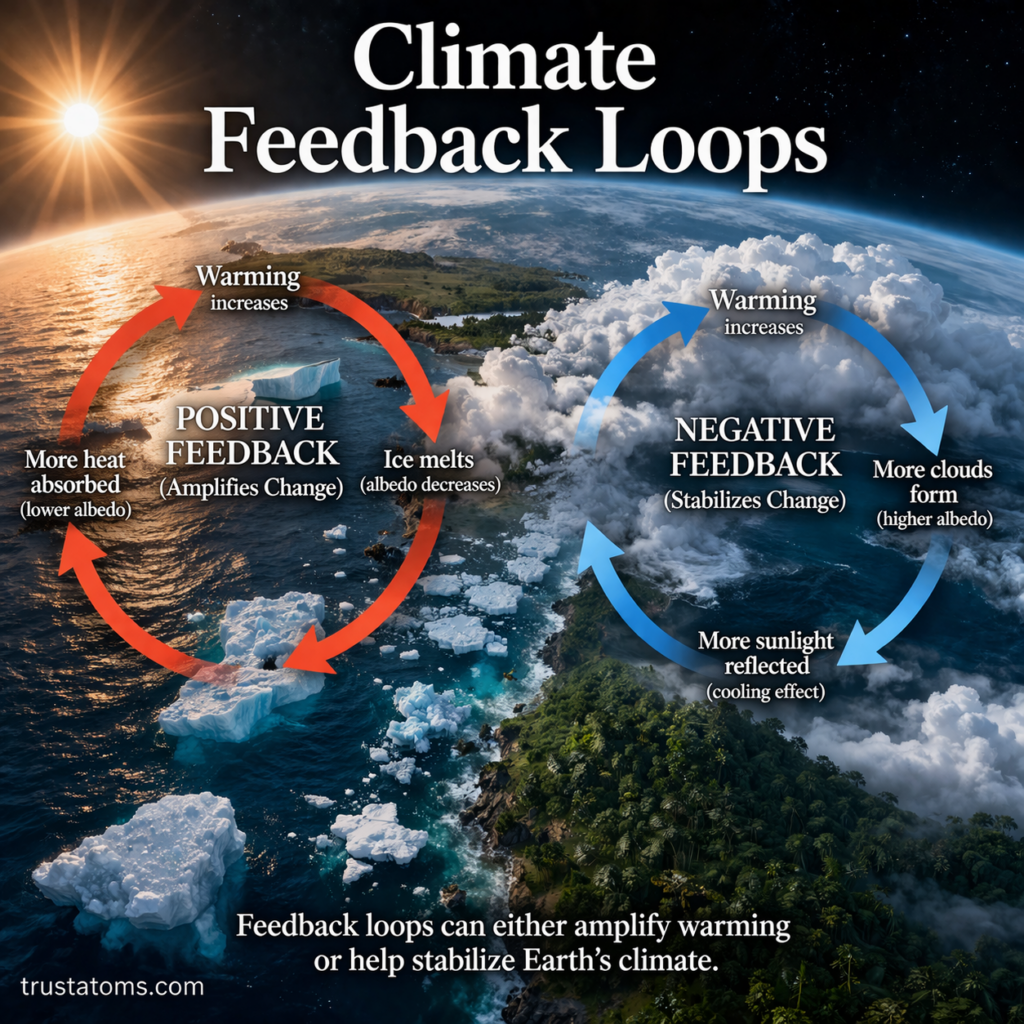
Climate feedback loops are processes within Earth’s climate system that either amplify (positive feedback) or reduce (negative feedback) changes in temperature and environmental conditions. These loops play a critical role in determining how the climate responds to natural variations and human influences.
Understanding feedback loops helps explain why small changes can sometimes lead to large, long-term climate effects.
What Are Climate Feedback Loops?
A climate feedback loop occurs when a change in one part of the climate system triggers additional changes that either reinforce or counteract the original effect.
Simple Explanation
- A change occurs (e.g., temperature increases)
- The system responds
- That response either increases or decreases the original change
Positive Feedback Loops (Amplifying Effects)
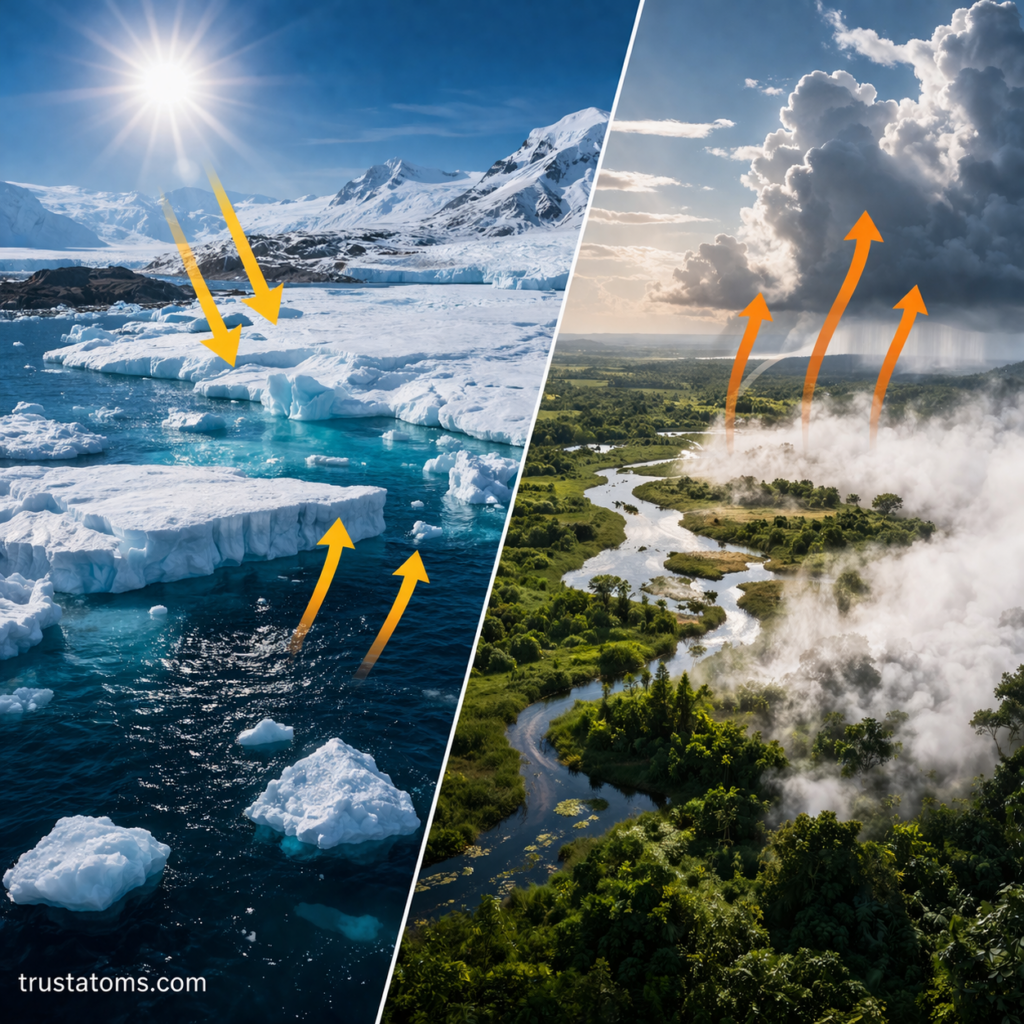
Positive feedback loops increase the intensity of an initial change, often accelerating climate shifts.
1. Ice-Albedo Feedback
- Ice and snow reflect sunlight (high albedo)
- As temperatures rise, ice melts
- Less ice means more heat is absorbed by darker surfaces
- This leads to further warming
Why It Matters
- Accelerates polar warming
- Contributes to shrinking ice sheets and glaciers
2. Water Vapor Feedback
- Warmer air holds more water vapor
- Water vapor is a greenhouse gas
- More water vapor traps additional heat
- This leads to further warming
Why It Matters
- One of the strongest climate feedbacks
- Amplifies global temperature increases
3. Permafrost Carbon Feedback
- Permafrost contains frozen organic material
- Warming causes it to thaw
- Decomposition releases carbon dioxide and methane
- These gases increase warming
Why It Matters
- Adds greenhouse gases to the atmosphere
- Can create long-term warming effects
Negative Feedback Loops (Stabilizing Effects)
Negative feedback loops counteract changes and help stabilize the climate system.
1. Cloud Reflection Feedback
- Increased evaporation leads to more cloud formation
- Clouds can reflect sunlight back into space
- This can reduce surface warming
Why It Matters
- Helps limit temperature increases
- Acts as a natural cooling mechanism (in some cases)
2. Vegetation Growth Feedback
- Higher CO₂ levels can promote plant growth
- Plants absorb carbon dioxide during photosynthesis
- This reduces the amount of CO₂ in the atmosphere
Why It Matters
- Helps slow the rise of greenhouse gases
- Supports ecosystem balance
Complex Interactions Between Feedbacks
Climate feedback loops do not operate in isolation. They interact in complex ways.
Key Points
- Multiple feedbacks can occur simultaneously
- Some may amplify while others reduce change
- The overall effect depends on which feedbacks dominate
This complexity makes climate prediction challenging.
Feedback Loops and Tipping Points
In some cases, feedback loops can push the climate system toward tipping points.
What Is a Tipping Point?
A tipping point is a threshold beyond which a system changes rapidly and often irreversibly.
Examples
- Collapse of major ice sheets
- Large-scale forest dieback
- Disruption of ocean circulation
Once crossed, these changes can be difficult or impossible to reverse.
Why Climate Feedback Loops Matter
Feedback loops are essential for understanding both past and future climate changes.
Key Importance
- Explain rapid climate shifts in Earth’s history
- Help improve climate models
- Highlight potential risks of accelerated warming
They also show why even small increases in temperature can have large consequences.
Climate Feedback Loops and Human Influence
Human activities—especially greenhouse gas emissions—can trigger and intensify feedback loops.
Key Impacts
- Increased warming activates positive feedbacks
- Natural stabilizing processes may be overwhelmed
- Faster and more extreme climate changes may occur
Understanding these effects is crucial for managing future climate risks.
Final Thoughts
Climate feedback loops are powerful forces within Earth’s climate system. Whether amplifying warming through melting ice or helping stabilize temperatures through cloud formation, these processes shape how the planet responds to change.
By studying feedback loops, scientists gain deeper insight into the complexity of climate systems—and the importance of maintaining balance in a rapidly changing world.