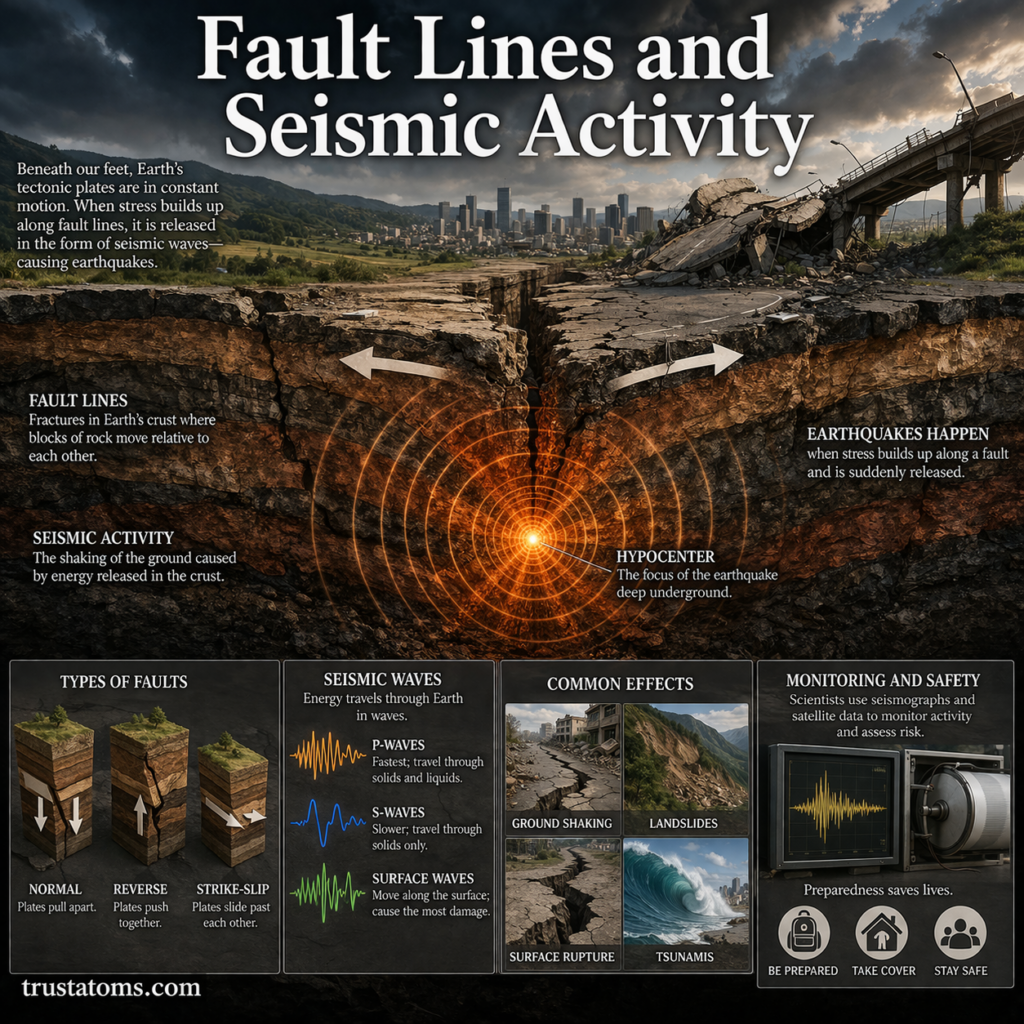
Earth’s surface is constantly shifting, even if those movements are too slow to notice. Beneath our feet, massive tectonic plates are in motion, and where they interact, stress builds up along fractures in the crust known as fault lines.
When that stress is suddenly released, it produces seismic activity—most commonly experienced as earthquakes.
What Is a Fault Line?
A fault line is a fracture or zone of fractures in Earth’s crust where blocks of rock move relative to each other.
These movements can be slow and gradual or sudden and violent, depending on how stress accumulates and is released.
Key Characteristics
- Occur along tectonic plate boundaries or within plates
- Can extend for hundreds or even thousands of kilometers
- Are the primary locations where earthquakes originate
What Causes Seismic Activity?
Seismic activity refers to the shaking of the ground caused by energy released in Earth’s crust.
How It Happens
- Tectonic plates move slowly over time
- Friction prevents smooth movement along faults
- Stress builds up in the rocks
- When stress exceeds the strength of the rocks, they suddenly slip
- Energy is released in the form of seismic waves
This process is known as elastic rebound, and it explains how earthquakes occur.
Types of Faults
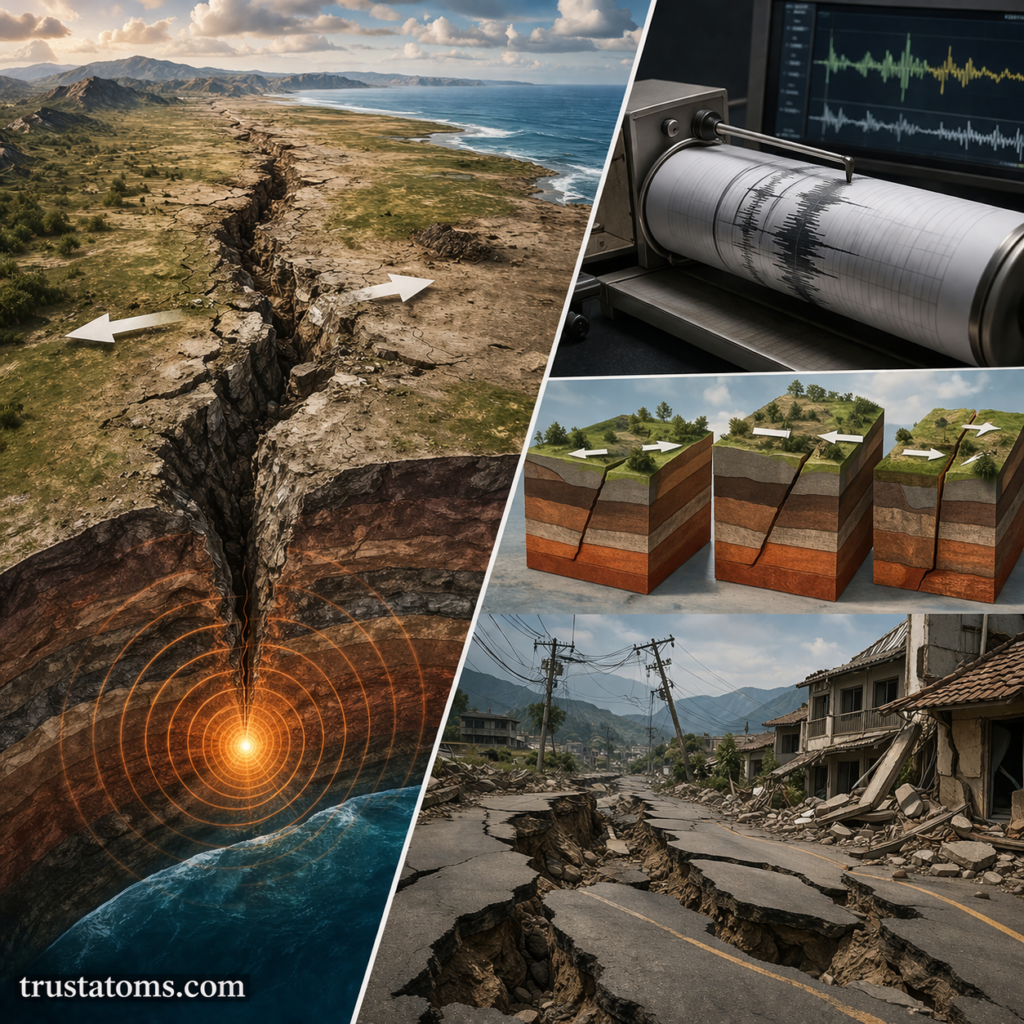
Faults are classified based on the direction of movement between rock blocks.
Normal Faults
- Occur when the crust is being pulled apart
- One block moves downward relative to the other
- Common in areas of crustal stretching
Reverse (Thrust) Faults
- Occur when the crust is compressed
- One block is pushed upward over another
- Common at convergent plate boundaries
Strike-Slip Faults
- Occur when blocks slide horizontally past each other
- Movement is primarily side-to-side
- Common along transform boundaries
Each type of fault produces different patterns of seismic activity.
Types of Seismic Waves
When an earthquake occurs, energy travels through Earth in the form of seismic waves.
Primary Waves (P-Waves)
- Travel fastest
- Move through solids, liquids, and gases
- Cause compressions and expansions in the material
Secondary Waves (S-Waves)
- Slower than P-waves
- Move only through solids
- Cause side-to-side motion
Surface Waves
- Travel along Earth’s surface
- Cause the most damage
- Produce rolling or shaking motions
Where Earthquakes Commonly Occur
Most earthquakes occur along tectonic plate boundaries.
Major Seismic Zones
- The Pacific Ring of Fire (most active region)
- Mid-ocean ridges (divergent boundaries)
- Subduction zones (convergent boundaries)
- Transform fault systems
However, earthquakes can also occur within plates, known as intraplate earthquakes.
Measuring Earthquakes
Scientists use several tools and scales to measure seismic activity.
Seismographs
- Instruments that record ground motion
- Detect even very small vibrations
Magnitude
- Measures the energy released
- Commonly reported using the Richter or moment magnitude scale
Intensity
- Describes the effects on people and structures
- Measured using the Modified Mercalli Scale
Effects of Seismic Activity
Earthquakes can have a wide range of impacts.
Ground Shaking
- Buildings and infrastructure can be damaged or destroyed
Surface Rupture
- The ground may crack or shift visibly along fault lines
Landslides
- Shaking can destabilize slopes
Tsunamis
- Underwater earthquakes can displace water, creating large waves
Aftershocks
- Smaller earthquakes that follow the main event
How Scientists Monitor and Predict Seismic Activity
While exact prediction of earthquakes is not currently possible, scientists monitor activity to assess risk.
Monitoring Methods
- Seismic networks that detect vibrations
- GPS systems tracking plate movement
- Satellite data for ground deformation
Risk Assessment
- Identifying active fault zones
- Mapping hazard areas
- Developing building codes and safety guidelines
Safety and Preparedness
Understanding fault lines helps communities prepare for earthquakes.
Basic Safety Measures
- Secure heavy furniture and objects
- Have an emergency kit ready
- Know safe spots (under sturdy furniture)
- Practice evacuation and safety drills
Preparedness can significantly reduce injury and damage.
Key Takeaways
- Fault lines are fractures in Earth’s crust where movement occurs
- Seismic activity is caused by the sudden release of built-up stress
- There are three main types of faults: normal, reverse, and strike-slip
- Seismic waves carry energy from earthquakes through the Earth
- Monitoring systems help reduce risk, even though earthquakes cannot be precisely predicted
Final Thoughts
Fault lines and seismic activity are powerful reminders that Earth is constantly in motion. While these processes can be destructive, they are also essential to shaping the planet’s surface.
By studying fault lines and understanding seismic behavior, scientists and communities can better prepare for earthquakes and reduce their impact.