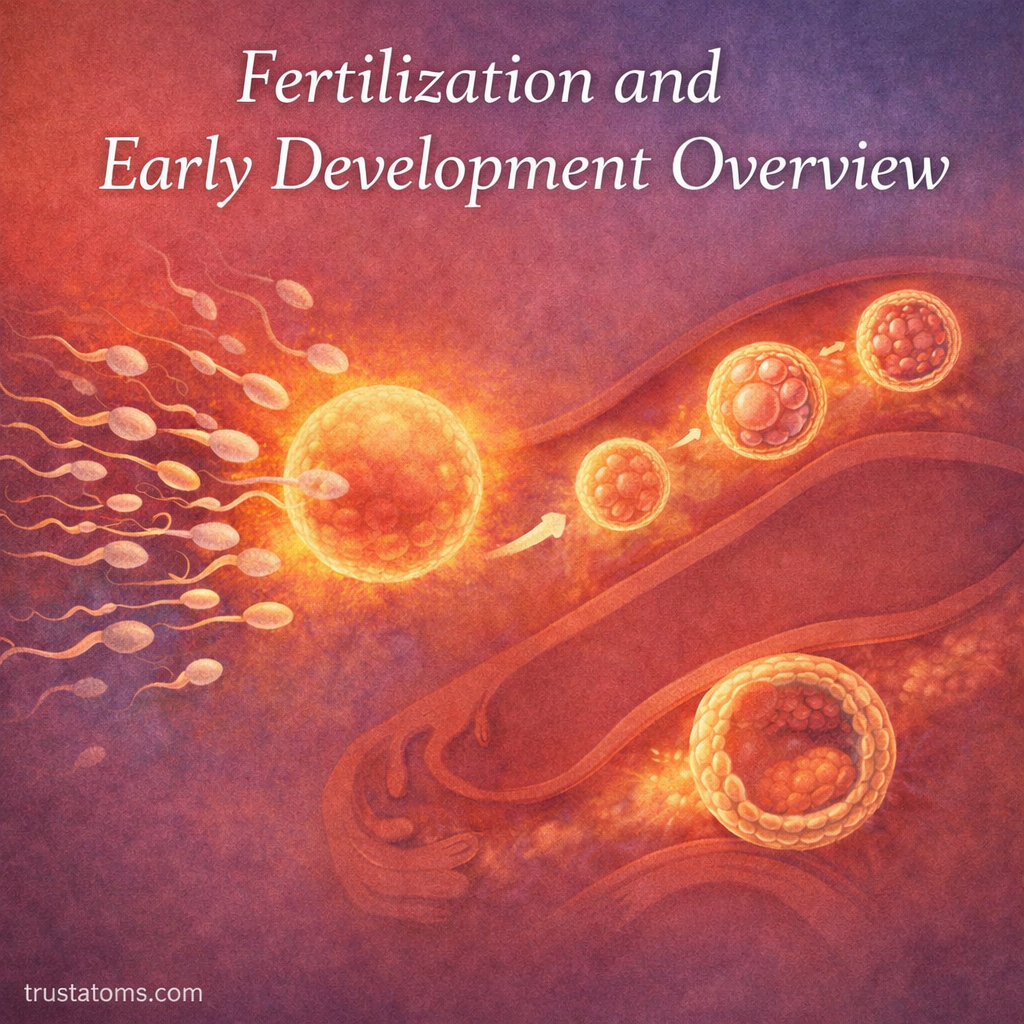
Fertilization and early development mark the beginning of human life at the cellular level. This process starts when a sperm cell successfully fuses with an egg and continues through a series of rapid changes as the newly formed organism prepares for implantation in the uterus.
Understanding these early stages provides insight into reproduction, genetics, and the foundations of human development.
What Is Fertilization?
Fertilization is the process by which a sperm cell and an egg cell combine to form a single cell called a zygote.
Where Fertilization Occurs
- Typically in the fallopian tube
- Most often in the ampulla (middle section)
Key Features of Fertilization
- Combines genetic material from both parents
- Restores the full set of chromosomes (46 total)
- Determines genetic traits such as sex and inherited characteristics
Key Point
Fertilization creates a unique genetic individual with a complete DNA blueprint.
The Journey to Fertilization
Before fertilization can occur, both sperm and egg must reach the same location at the right time.
Egg Transport
- Released from the ovary during ovulation
- Moves into the fallopian tube
- Remains viable for about 12–24 hours
Sperm Transport
- Enter through the vagina during intercourse
- Travel through the cervix and uterus
- Reach the fallopian tube within minutes to hours
Key Point
Timing is critical—fertilization can only occur if sperm are present while the egg is viable.
How Fertilization Happens
Fertilization involves several coordinated steps.
Step-by-Step Process
- Sperm Penetration
- Sperm bind to and penetrate the outer layer of the egg
- Prevention of Multiple Fertilizations
- The egg changes its surface to block additional sperm
- Fusion of Genetic Material
- The nuclei of sperm and egg merge
- Formation of the Zygote
- A single cell with complete genetic information is formed
Key Point
Only one sperm successfully fertilizes the egg, ensuring normal development.
Early Cell Division (Cleavage)
After fertilization, the zygote begins dividing rapidly through a process called cleavage.
What Happens During Cleavage
- The zygote divides into 2, 4, 8, and more cells
- Cells become smaller with each division
- No overall growth in size initially
Timeline
- Day 1–3: Rapid cell divisions
- Day 3–4: Formation of a solid cluster called the morula
Key Point
Cleavage increases cell number without increasing overall size, preparing for further development.
Blastocyst Formation
As cell division continues, the structure becomes more complex and forms a blastocyst.
Structure of the Blastocyst
- Inner cell mass: Will develop into the embryo
- Outer layer (trophoblast): Will contribute to the placenta
- Fluid-filled cavity
Timeline
- Around day 5 after fertilization
Key Point
The blastocyst is the stage that prepares for implantation into the uterine lining.
Movement Toward the Uterus
During early development, the embryo travels through the fallopian tube toward the uterus.
How Movement Occurs
- Tiny hair-like structures (cilia) help move the embryo
- Muscular contractions of the tube assist transport
Duration
- About 3–5 days
Key Point
Proper movement is essential for the embryo to reach the uterus at the right time for implantation.
Implantation Process
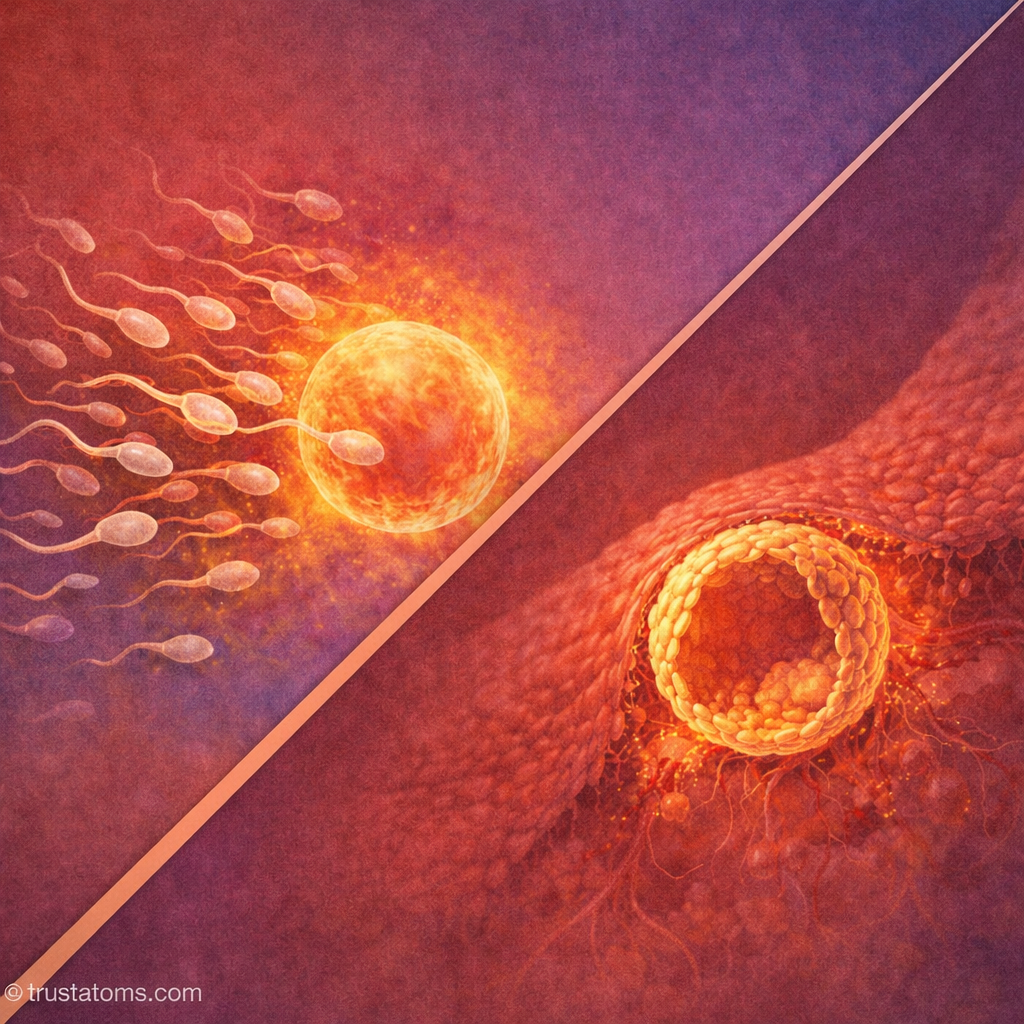
Implantation is when the blastocyst attaches to the uterine lining (endometrium).
When Implantation Occurs
- Approximately 6–10 days after fertilization
What Happens During Implantation
- The blastocyst embeds into the uterine lining
- The trophoblast begins forming connections with maternal blood supply
- Hormonal signals help maintain the pregnancy
Key Point
Successful implantation marks the beginning of pregnancy.
Hormonal Support in Early Development
Hormones play a crucial role in supporting fertilization and early development.
Key Hormones
- Progesterone: Maintains the uterine lining
- Human chorionic gonadotropin (hCG): Signals the body to continue progesterone production
Role of hCG
- Produced after implantation
- Detected in pregnancy tests
- Prevents breakdown of the uterine lining
Key Point
Hormonal support ensures the embryo can develop in a stable environment.
What Happens If Development Does Not Continue?
If fertilization or implantation is unsuccessful:
- The embryo does not attach to the uterus
- Hormone levels decrease
- The uterine lining is shed during menstruation
Key Point
The body naturally resets, allowing the cycle to begin again.
Why Early Development Matters
Understanding fertilization and early development helps explain:
- How pregnancy begins
- The importance of timing and hormonal balance
- The early stages of genetic and cellular growth
- Factors that influence reproductive health
Final Thoughts
Fertilization and early development are highly coordinated biological processes that transform a single cell into a developing organism. From the moment of fertilization to implantation, each step depends on precise timing, cellular division, and hormonal support.
By understanding these early stages, we gain a clearer picture of how human life begins and how the body supports its earliest development.