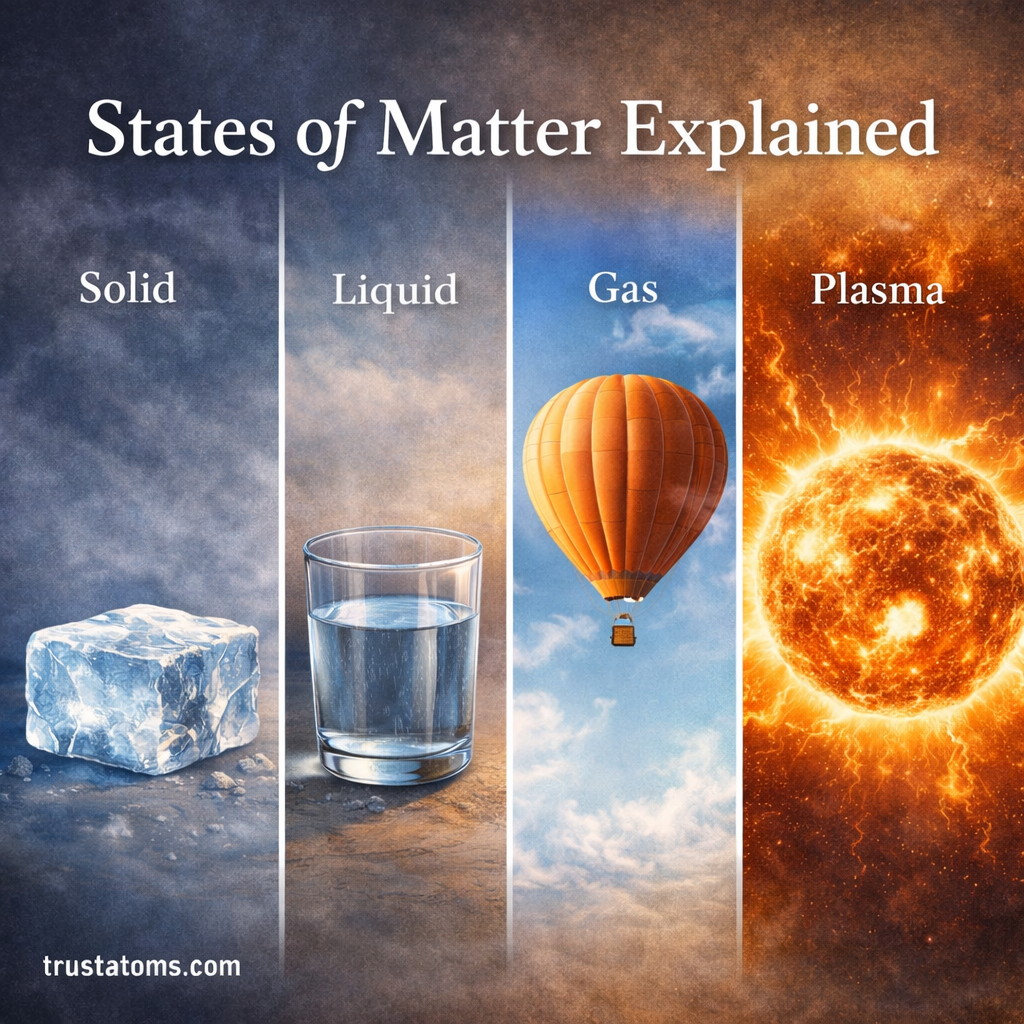
States of matter are the different physical forms a substance can take, commonly classified as solid, liquid, gas, and plasma. Each state has distinct properties determined by how its particles are arranged, how they move, and how they interact.
Matter in chemistry exists in different physical forms depending on temperature, pressure, and interactions between particles. Understanding these states is a basic part of chemistry and chemical reactions because the physical state of a substance influences its behavior and the changes it can undergo.
Ice, liquid water, and water vapor provide a familiar example: all three consist of H₂O molecules, but their different particle arrangements and movements produce very different physical properties.
What Are States of Matter?
A state of matter describes the physical condition of a substance based on the behavior of its constituent particles. These particles may be atoms, molecules, or ions, depending on the substance.
Three major factors help determine a substance’s state:
- Particle arrangement: How closely particles are packed and whether they occupy fixed positions.
- Particle movement: Whether particles mainly vibrate, slide past one another, or move throughout a container.
- Temperature and pressure: Conditions that influence particle motion and the relative stability of different phases.
Scientists use phase diagrams in chemical systems to show which phases are stable at different temperatures and pressures.
Phase changes also involve changes in energy and the number of possible particle arrangements. The concept of entropy in chemistry helps explain why different phases become favorable under different conditions.
The Four Main States of Matter Compared
Introductory chemistry commonly focuses on solids, liquids, gases, and plasma. The table summarizes their typical behavior.
| State | Shape | Volume | Particle behavior |
|---|---|---|---|
| Solid | Definite | Definite | Particles remain near fixed positions or neighbors |
| Liquid | Takes container’s shape | Nearly definite | Particles move past one another |
| Gas | Fills container | Fills container | Particles move freely and spread apart |
| Plasma | No definite shape | No definite volume | Charged particles respond collectively to electric and magnetic fields |
These descriptions are general. Some materials, such as liquid crystals, display properties that do not fit neatly into the simplest categories.
Solids: Particles That Maintain Their Structure
A solid state of matter is a physical state in which particles remain closely associated and maintain a relatively stable structure. Solids usually have a definite shape and volume.
In crystalline solids, such as table salt, particles occupy repeating arrangements called crystal lattices. In amorphous solids, such as ordinary glass, the particles lack long-range crystalline order.
Solid particles are not completely motionless. At temperatures above absolute zero, they generally vibrate or undergo other microscopic motions, even though the material retains its overall shape.
Examples include ice, metals, rocks, wood, and salt crystals. Their hardness and flexibility vary because different solids have different bonding and internal structures.
Liquids: Particles That Flow Past One Another
A liquid has a nearly definite volume but no fixed shape. It flows to match the shape of its container while maintaining a free surface under ordinary conditions.
Liquid particles remain relatively close together, but they can rearrange and move past neighboring particles. This movement allows liquids to flow and makes them difficult to compress compared with gases.
Water, cooking oil, ethanol, and mercury are examples of liquids at ordinary room temperature. Their viscosity, or resistance to flow, depends on temperature and intermolecular interactions.
Unlike gases, liquids do not normally expand to fill an entire container. A half-full bottle of water remains partly filled with liquid even though water vapor may occupy some of the space above it.
Gases: Particles That Spread Throughout a Container
A gas has neither a definite shape nor a definite volume. Its particles move throughout the available space, so a gas expands to fill its container.
In an ordinary gas, particles are much farther apart on average than in a liquid or solid. This spacing makes gases relatively easy to compress.
Common examples include oxygen, nitrogen, helium, and carbon dioxide. Air is a mixture of gases, primarily nitrogen and oxygen.
Gas particles collide with container walls, producing pressure. Heating a gas in a rigid, sealed container generally increases its pressure because the particles move faster on average.
Plasma: Matter Containing Free Charged Particles
Plasma in chemistry is often called the fourth state of matter. It forms when a gas becomes sufficiently ionized to contain significant numbers of free electrons and positively charged ions.
Because plasma contains mobile charged particles, it can conduct electricity and respond to electric and magnetic fields. Plasma can also exhibit collective behavior that distinguishes it from an ordinary neutral gas.
Examples include:
- The Sun and other stars, where hot ionized gases are widespread.
- Lightning channels, where electrical discharge ionizes air.
- Neon signs and certain fluorescent lamps, which contain electrically excited, partially ionized gases.
- Auroras, which involve energetic charged particles interacting with atmospheric gases.
Not all plasmas are extremely hot. Some laboratory and industrial plasmas have relatively cool neutral gas while their electrons possess much higher average energies.
How Matter Changes Between States
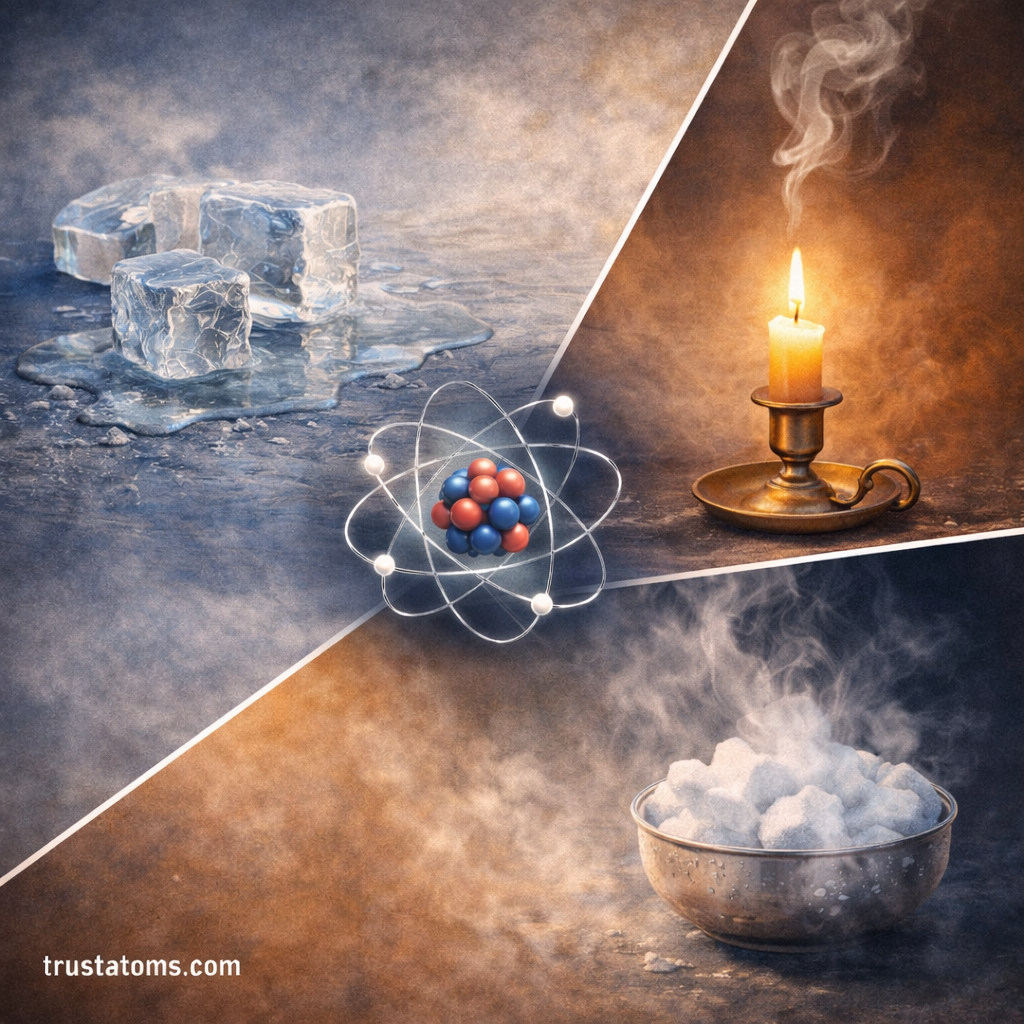
A phase change occurs when a substance transforms from one physical state to another. Heating, cooling, or changing pressure can cause these transitions without necessarily changing the substance’s chemical identity.
| Phase change | Transition | Example |
|---|---|---|
| Melting | Solid → liquid | Ice becoming water |
| Freezing | Liquid → solid | Water becoming ice |
| Vaporization | Liquid → gas | Boiling water |
| Condensation | Gas → liquid | Water droplets on a cold glass |
| Sublimation | Solid → gas | Dry ice becoming carbon dioxide gas |
| Deposition | Gas → solid | Frost forming from water vapor |
Evaporation is vaporization that occurs at a liquid’s surface, even below its boiling point. Boiling occurs when vapor bubbles can form throughout the liquid.
Ionization can transform a gas into plasma, while recombination can reduce its ionization. These processes involve changes in the electrical states of particles.
Example: Ice, Water, and Steam at Different Temperatures
At standard atmospheric pressure, pure water melts or freezes at approximately 0°C and boils at approximately 100°C. These familiar temperatures illustrate how the same substance can occupy different physical states.
- At −10°C, pure water is normally solid ice under atmospheric pressure.
- At 25°C, it is normally a liquid.
- At 100°C, liquid water and water vapor can coexist during boiling.
- Above 100°C, water can remain a gas at atmospheric pressure when sufficient energy is supplied.
During melting or boiling at constant pressure, added energy can drive the phase change without raising the temperature until the transition is complete. This energy is called latent heat.
How Temperature and Pressure Affect Matter
Temperature is related to the average kinetic energy of particles. Heating generally increases their motion, but during phase transitions, energy also changes the interactions and arrangements of particles.
Pressure can change which state is stable. For example, water boils at a lower temperature at high elevations because atmospheric pressure is lower. A pressure cooker raises the boiling temperature by maintaining higher pressure inside the vessel.
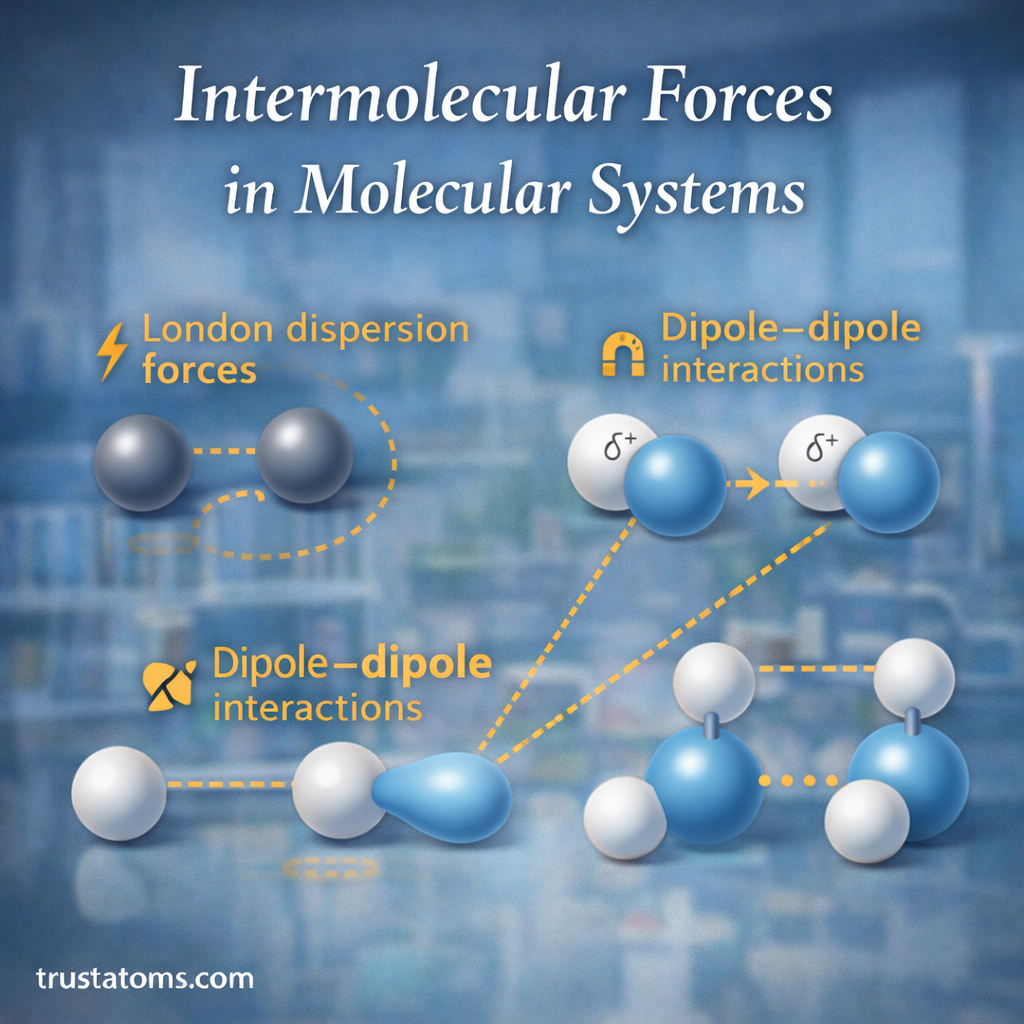
Particle attractions do not simply disappear when a substance melts or boils. Instead, changes in thermal energy and intermolecular interactions determine whether a particular phase is stable.
States of Matter in Everyday Life and Science
Phase behavior explains refrigeration, weather, cooking, and many manufacturing processes. Refrigerators transfer heat using a refrigerant that evaporates and condenses, while clouds form when water vapor condenses into tiny droplets or deposits as ice crystals.
Materials scientists study solid structures to develop stronger alloys and useful electronic materials. Engineers control boiling and condensation in heat exchangers, and plasma technologies are used in processes such as surface treatment and semiconductor manufacturing.
Scientists also study additional phases beyond the four familiar categories, including liquid crystals and Bose–Einstein condensates, under specialized conditions.
Frequently Asked Questions
What are the four main states of matter?
The four commonly taught states are solid, liquid, gas, and plasma. They differ in particle arrangement, movement, electrical behavior, and whether they maintain a definite shape or volume.
Is steam a gas or a liquid?
Steam is gaseous water. However, the visible white cloud above a kettle consists mainly of tiny liquid water droplets formed when water vapor cools and condenses. Water vapor itself is invisible.
Does a phase change create a new substance?
Usually not. Melting ice produces liquid water, and boiling water produces water vapor; both remain H₂O. These are physical changes rather than chemical reactions that create different substances.
The states of matter describe how particles organize and move under different conditions, from tightly structured solids to freely moving gases and electrically responsive plasmas. Ice melting at 0°C and water boiling near 100°C at standard atmospheric pressure show how temperature and energy can change a substance’s physical state without changing its molecular identity. Understanding these transitions helps explain everyday observations as well as processes used in engineering, materials science, and atmospheric chemistry.
Sources: OpenStax, Chemistry 2e; Chemistry: The Central Science by Brown, LeMay, Bursten, et al.; IUPAC Compendium of Chemical Terminology (Gold Book).