Earth’s crust is constantly under stress from tectonic forces. Over time, these forces cause rocks to bend, break, and shift—processes known as folding and faulting.
These geological processes are responsible for shaping mountains, valleys, and many of the landscapes we see today. They also play a major role in earthquakes and the overall structure of Earth’s surface.
What Is Folding?
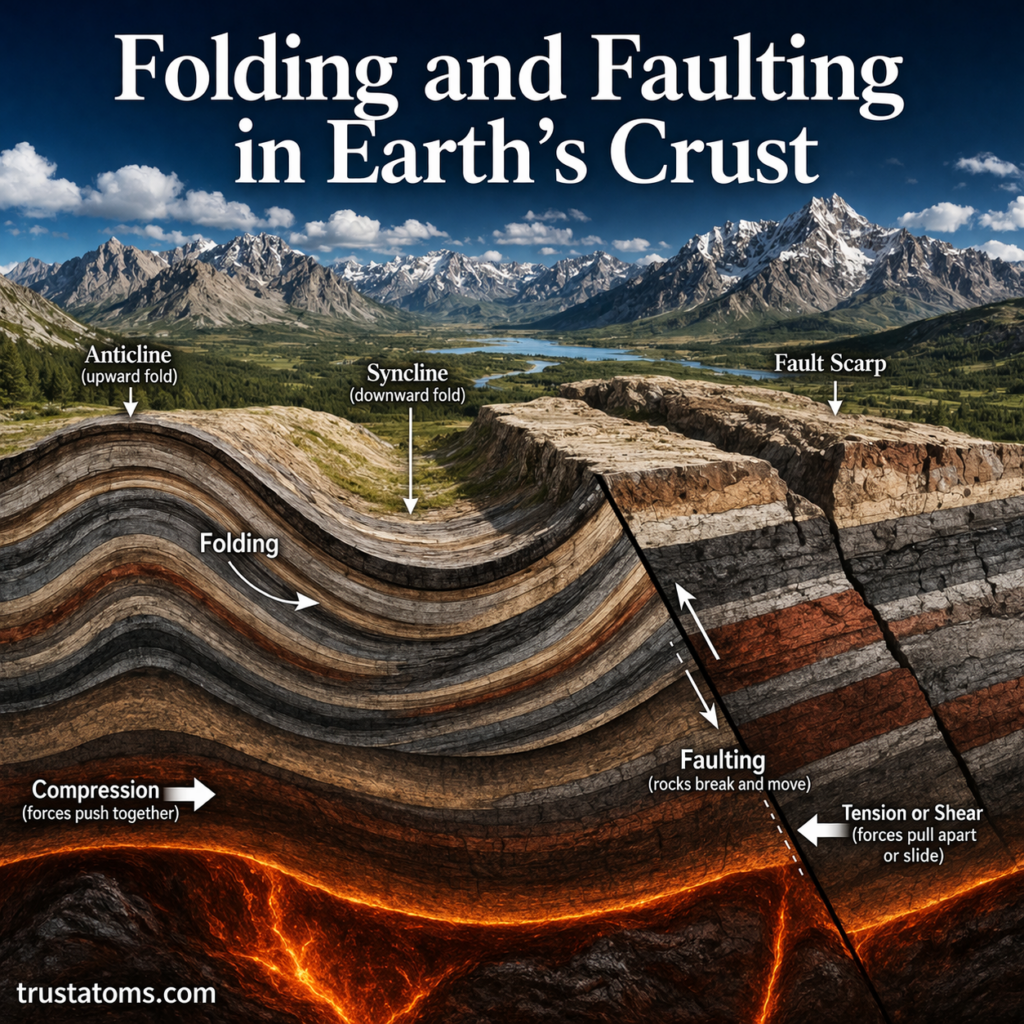
Folding occurs when rock layers bend due to compressional forces, rather than breaking.
This typically happens when:
- Tectonic plates push toward each other
- Rocks are subjected to long-term pressure
- The crust behaves in a ductile (flexible) way
Instead of snapping, the rock layers deform into wave-like structures.
Types of Folds
Folds come in several forms depending on how the rock layers bend:
Anticline
- Upward-arching fold
- Oldest rocks are found at the center
- Often forms ridges or hills
Syncline
- Downward-curving fold
- Youngest rocks are at the center
- Often forms valleys
Monocline
- A step-like fold
- Rock layers bend sharply in one direction
Overturned Fold
- One side of the fold is tilted beyond vertical
- Caused by intense pressure
What Is Faulting?
Faulting occurs when rocks break and move along fractures due to stress.
Unlike folding, faulting happens when the stress exceeds the strength of the rock, causing it to snap and shift.
Faults can vary in size from small cracks to massive fractures stretching hundreds of miles.
Types of Faults
Different types of faults form depending on the direction of stress:
Normal Fault
- Occurs under tension (pulling apart)
- One block of rock moves downward relative to another
- Common in rift zones
Reverse Fault (Thrust Fault)
- Occurs under compression (pushing together)
- One block is pushed upward over another
- Associated with mountain building
Strike-Slip Fault
- Occurs when plates slide horizontally past each other
- Movement is side-to-side
- Often causes earthquakes
Folding vs. Faulting
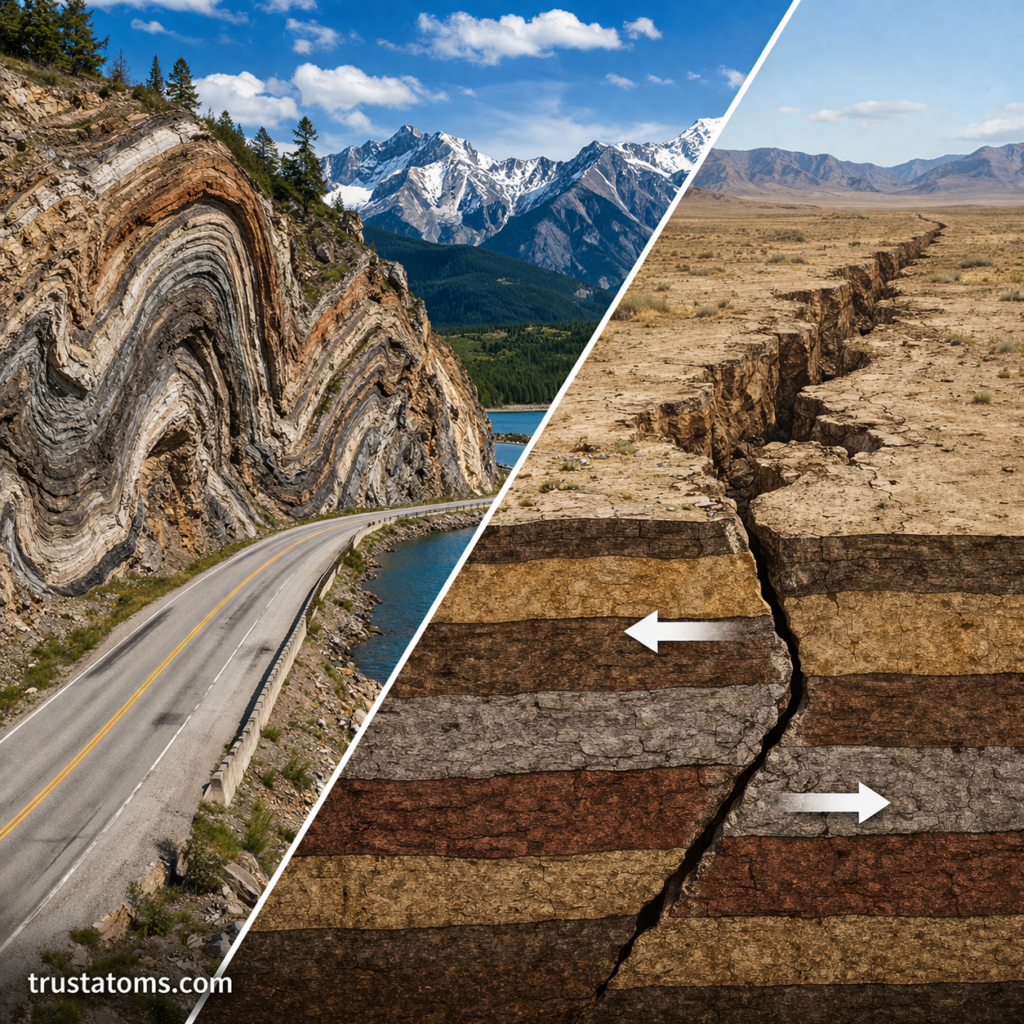
Although both processes result from tectonic stress, they differ in how rocks respond:
- Folding: rocks bend without breaking
- Faulting: rocks break and move
Key Differences
- Folding occurs under slower, sustained pressure
- Faulting occurs when stress builds up quickly or exceeds rock strength
- Folding forms smooth, curved structures
- Faulting creates fractures and displacement
What Causes Folding and Faulting?
The main driving force behind both processes is plate tectonics.
Key Causes Include:
- Converging tectonic plates (compression)
- Diverging plates (tension)
- Transform boundaries (shear stress)
- Heat and pressure deep within Earth
- Movement of the mantle beneath the crust
These forces act over millions of years to reshape the crust.
Role in Mountain Formation
Folding and faulting are essential in building mountain ranges:
- Folding creates layered, wave-like mountain structures
- Faulting can uplift or drop sections of the crust
- Combined processes form complex landscapes
Many famous mountain ranges, such as fold mountains, are primarily shaped by these forces.
Connection to Earthquakes
Faulting is directly linked to earthquakes.
When stress builds up along a fault:
- Rocks become locked due to friction
- Stress increases over time
- Sudden movement releases energy
- Seismic waves travel through the Earth
This release of energy is what we feel as an earthquake.
Evidence of Folding and Faulting
Geologists identify folding and faulting through:
- Exposed rock layers in cliffs and mountains
- Geological maps and cross-sections
- Seismic data
- Satellite imagery
- Field observations of displaced rock layers
These clues help scientists reconstruct Earth’s geological history.
Real-World Examples
Folded Landscapes
- Mountain belts with visible curved rock layers
- Regions shaped by long-term compression
Fault Zones
- Areas where earthquakes frequently occur
- Visible displacement of land features
Examples include major fault systems and folded mountain ranges found across the world.
Why These Processes Matter
Folding and faulting are not just geological concepts—they have real-world impacts:
- Influence natural hazards like earthquakes
- Shape landscapes and ecosystems
- Affect natural resource distribution
- Help scientists understand Earth’s history
Understanding these processes can improve hazard preparedness and land-use planning.
Common Misconceptions
Rocks Are Always Rigid
In reality, rocks can behave plastically under high pressure and temperature, allowing them to fold.
Faults Always Cause Large Earthquakes
Not all faults produce major earthquakes; many release energy gradually.
Folding and Faulting Are Separate
They often occur together in the same region, especially in tectonically active zones.
Final Thoughts
Folding and faulting are fundamental processes that shape Earth’s crust. Through bending, breaking, and shifting, these forces create mountains, trigger earthquakes, and continuously reshape the planet’s surface.
By studying these processes, scientists gain valuable insight into Earth’s dynamic nature and the forces that continue to mold our world.