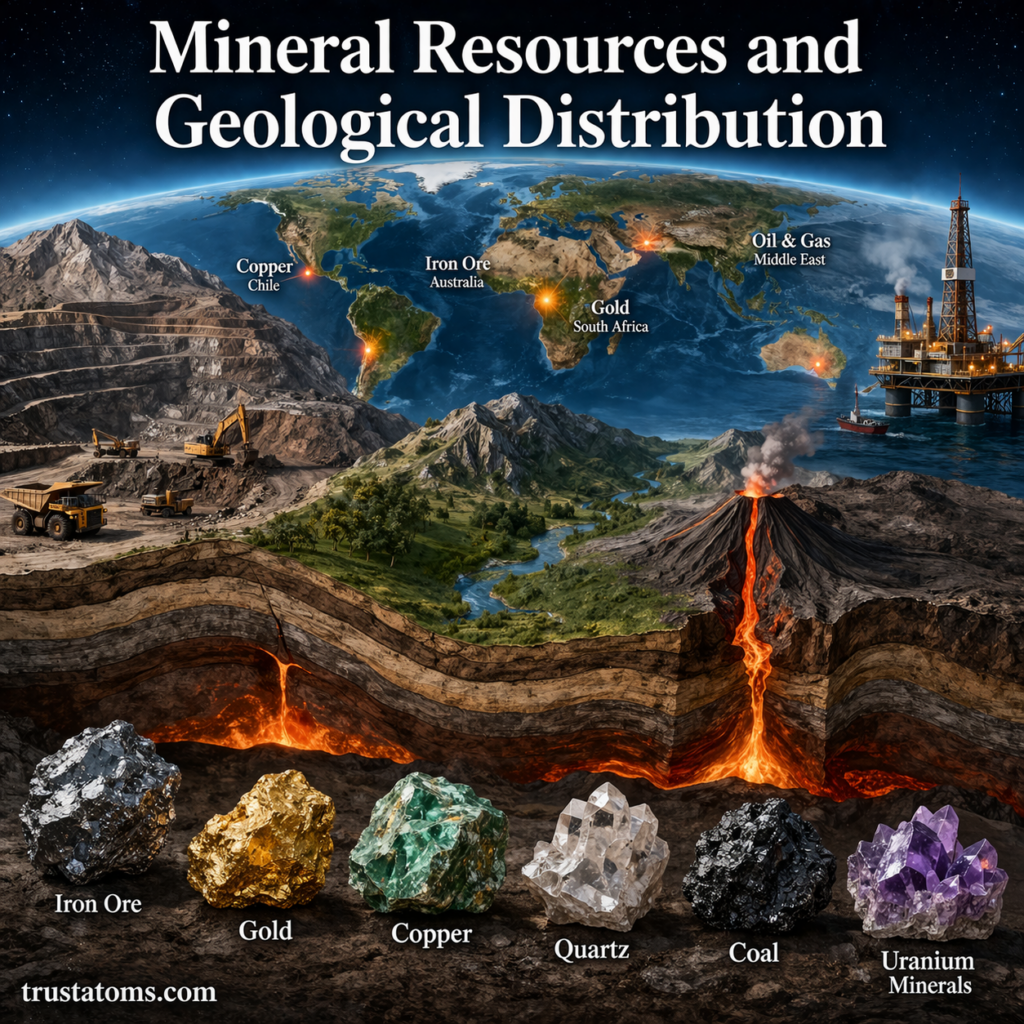
Mineral resources are naturally occurring geological materials that contain useful substances in concentrations with potential economic value. Their distribution across Earth is uneven because processes such as magma cooling, hydrothermal circulation, sedimentation, and metamorphism concentrate different materials in particular geological settings.
These resources supply metals for electronics, minerals for fertilizers, and raw materials for construction and manufacturing. Understanding where they occur is part of Earth science, which examines the processes that shape Earth’s materials and landscapes.
What Are Mineral Resources?
A mineral resource is a concentration of naturally occurring solid material with reasonable prospects for eventual economic extraction. Resources may contain valuable metals, industrial minerals, or other useful geological materials.
Not every mineral occurrence is a usable resource. Economic value depends on concentration, deposit size, accessibility, extraction technology, environmental requirements, and market conditions.
Mineral deposits occur in different rock environments. Understanding igneous, sedimentary, and metamorphic rocks helps explain why particular resources are associated with specific geological settings.
These environments are connected through weathering, melting, burial, and recrystallization, as described in The Rock Cycle and Earth Materials.
Layered geological formations can preserve economically useful deposits, including evaporite minerals and certain metal-bearing sediments. Sedimentary Basins and Stratigraphy explains how sediment accumulation and geological layering help scientists locate these materials.
Other deposits form near magma bodies and volcanic systems. The processes involved are explored in Volcanic Rocks and Magma Formation.
How Geological Processes Concentrate Minerals
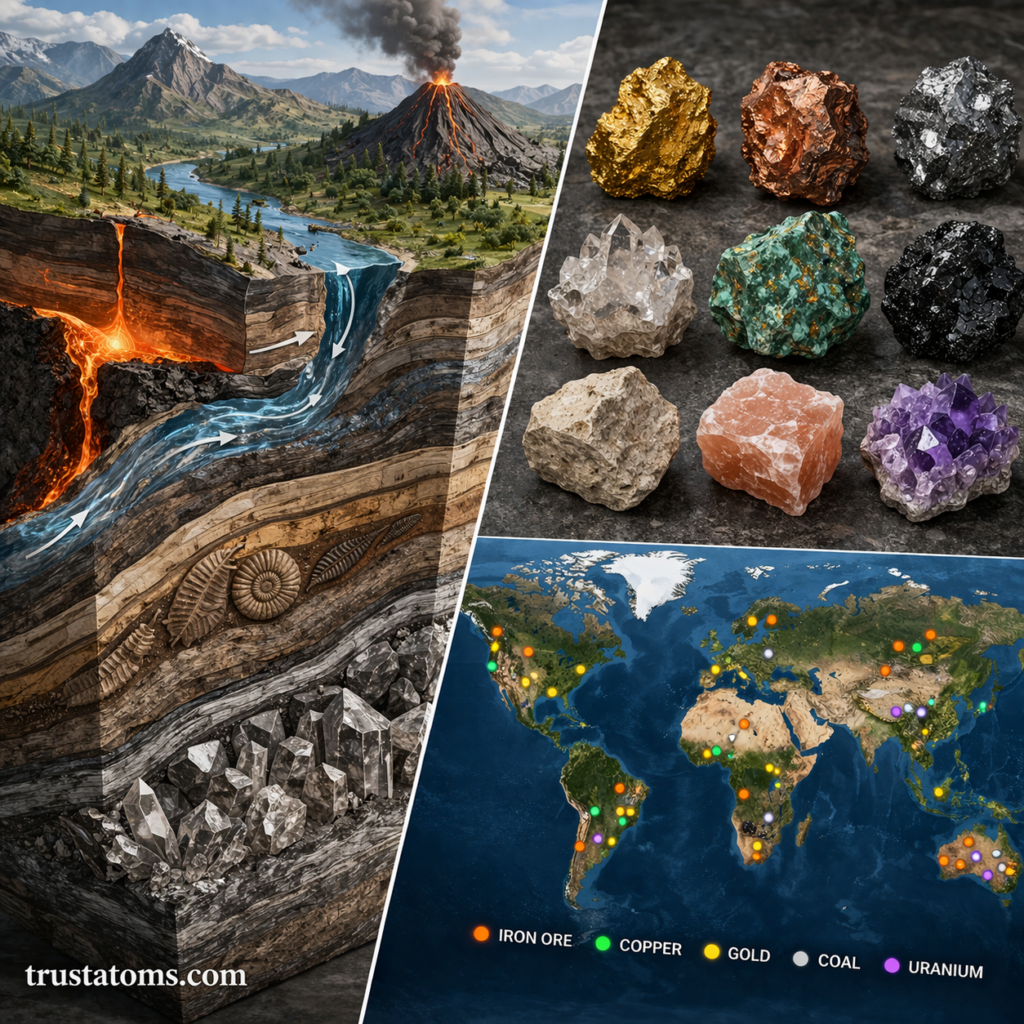
Most valuable deposits form when geological processes concentrate useful elements or minerals above their typical abundance in surrounding rocks. Four major mechanisms account for many economically important deposits.
Magmatic Concentration
As magma cools, different minerals crystallize at different temperatures. Under suitable conditions, dense crystals or immiscible sulfide liquids can separate and accumulate, concentrating elements such as chromium, nickel, and platinum-group metals.
Hydrothermal Mineral Deposits
Hot fluids circulate through fractures and porous rocks, transporting dissolved metals. Changes in temperature, pressure, or fluid chemistry can cause minerals to precipitate, forming veins or larger ore bodies containing copper, gold, silver, or zinc.
Sedimentary Concentration
Weathering and erosion release minerals that may accumulate in rivers, beaches, or sedimentary basins. Evaporation can concentrate dissolved salts, producing deposits of halite or gypsum. Some sedimentary environments also preserve economically important iron and phosphate deposits.
Metamorphic Processes
Heat, pressure, and chemically active fluids can transform existing rocks and minerals. Metamorphic processes may produce or modify deposits of graphite, talc, and other industrial minerals, sometimes increasing their concentration or usefulness.
Major Types of Mineral Resources
Mineral resources are commonly grouped according to their composition and industrial applications.
| Resource Category | Examples | Common Uses |
|---|---|---|
| Metallic resources | Iron ore, copper ores, bauxite | Steel, wiring, aluminum production |
| Industrial minerals | Gypsum, halite, phosphate minerals | Plaster, chemicals, fertilizers |
| Construction materials | Limestone, sand, gravel | Cement, concrete, infrastructure |
| Energy-related mineral resources | Uranium-bearing minerals | Nuclear fuel production |
Coal, petroleum, and natural gas are geological energy resources, but they are not minerals in the strict mineralogical sense. Coal is an organic sedimentary rock, while petroleum and natural gas are fluids.
Geological Distribution of Minerals
Mineral deposits are concentrated in regions where geological conditions favored their formation and preservation. The location of ancient volcanoes, mountain-building zones, sedimentary basins, and deeply weathered landscapes helps determine which resources occur in a region.
Plate tectonics influences mineral distribution by creating environments for magma generation, fluid circulation, deformation, and sediment accumulation. The relationship is examined further in Plate Boundaries and Resource Distribution.
Convergent Plate Boundaries
Where oceanic plates descend beneath other plates, magma and hydrothermal fluids can form large copper and gold deposits. The Andes provide a prominent example of mineralization associated with long-lived subduction and mountain building.
Divergent Boundaries and Ancient Rift Systems
At spreading centers, hot fluids circulate through volcanic rocks and can deposit metal sulfides on or beneath the seafloor. Ancient deposits formed in these environments may later be exposed on land through tectonic uplift.
Stable Continental Regions
Some major mineral deposits occur far from active plate boundaries. Ancient continental shields contain important iron, gold, nickel, and other resources formed during earlier geological events. Long periods of weathering can also concentrate materials such as bauxite.
Examples of Mineral-Rich Regions
Several countries illustrate how different geological histories produce distinctive resource concentrations.
- Chile: The Andes contain major copper deposits associated with magmatic and hydrothermal processes.
- Australia: Ancient geological formations host extensive iron ore, gold, and bauxite resources.
- South Africa: The Bushveld Complex contains exceptionally important platinum-group metal deposits.
- Canada: Geological provinces contain significant nickel, uranium, potash, and gold resources.
- Guinea: Deep chemical weathering has produced substantial bauxite deposits.
For a concrete example, the Bushveld Complex in South Africa contains layered igneous rocks formed as a large magma body cooled. Specific layers became enriched in platinum-group minerals, demonstrating how mineral concentration depends on the physical and chemical conditions within a magma system.
How Geologists Identify Ore Deposits
Geologists combine field mapping, geochemical sampling, geophysical surveys, and drilling to investigate potential deposits. Laboratory analysis helps determine mineral composition and the concentration of economically useful elements.
A mineral resource differs from a mineral reserve. Under established reporting standards, a reserve is the economically mineable portion of a measured or indicated resource after relevant technical, economic, environmental, and other factors have been evaluated.
Mining Methods and Environmental Effects
Extraction methods depend on deposit depth, geometry, rock conditions, and economic feasibility. Surface mining is common for accessible deposits, while underground mining can reach deeper ore bodies. Placer mining recovers valuable dense minerals concentrated in sediments.
Mining can disturb habitats, generate dust, consume water, and produce waste rock or tailings. Certain sulfide-bearing wastes may generate acidic drainage when exposed to oxygen and water, potentially releasing dissolved metals into nearby waterways.
Risk reduction measures include careful waste management, water treatment, land rehabilitation, and environmental monitoring. Recycling metals can also reduce demand for some newly mined materials, although primary extraction remains necessary for many uses.
Frequently Asked Questions
Why are mineral resources unevenly distributed?
Mineral deposits form only where suitable geological conditions concentrate useful materials. Differences in tectonic history, rock composition, fluid movement, weathering, and erosion explain why some regions contain major deposits while others do not.
What is the difference between a mineral and an ore?
A mineral is a naturally occurring crystalline solid with a characteristic chemical composition and structure. Ore is rock or other geological material containing valuable substances that can be extracted economically under particular conditions.
Are mineral resources renewable?
Mineral resources are generally considered nonrenewable on human timescales because geological processes usually form economically significant deposits extremely slowly. Many metals can be recycled repeatedly, however, helping extend available supplies and reduce waste.
The distribution of mineral resources reflects specific geological processes rather than chance: magma crystallization, mineral-bearing fluids, sedimentation, and metamorphism create deposits in different settings. Understanding these patterns helps geologists locate resources and evaluate their economic potential. Responsible extraction, recycling, and environmental management can reduce the impacts of supplying materials used throughout modern society.
Sources: U.S. Geological Survey (USGS), Mineral Commodity Summaries; British Geological Survey (BGS), MineralsUK; Society of Economic Geologists, Economic Geology.