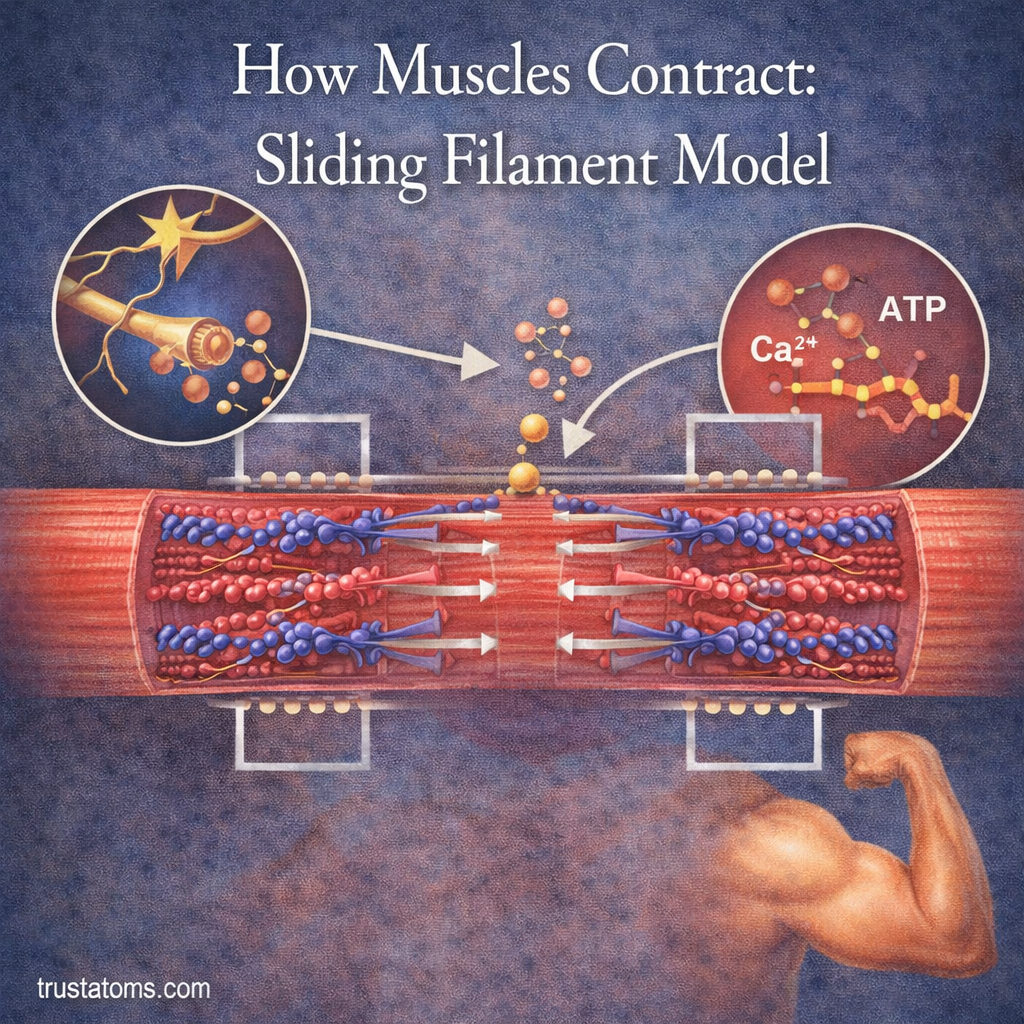
Muscle contraction is what allows your body to move, lift, and perform everyday tasks. At the microscopic level, this process is explained by the sliding filament model—a widely accepted theory that describes how muscle fibers shorten to produce force.
Understanding this model helps explain how muscles generate movement and how the body responds to physical activity.
What Is the Sliding Filament Model?
The sliding filament model describes how muscle fibers contract by the interaction of two protein filaments:
- Actin (thin filaments)
- Myosin (thick filaments)
Instead of the filaments shortening, they slide past each other, causing the muscle to contract.
Structure of a Sarcomere
The sarcomere is the basic unit of muscle contraction. It is found within myofibrils inside muscle fibers.
Key Components of a Sarcomere
- Actin filaments: Thin strands attached to the Z-line
- Myosin filaments: Thick strands located in the center
- Z-lines: Boundaries of each sarcomere
- M-line: Center of the sarcomere
- A band and I band: Regions that change during contraction
The arrangement of these structures gives skeletal muscle its striped (striated) appearance.
How the Sliding Filament Model Works
Muscle contraction occurs through a repeating cycle of interactions between actin and myosin.
Step-by-Step Process
- Nerve Signal Activation
A signal from the nervous system reaches the muscle fiber, triggering contraction. - Calcium Release
Calcium ions are released inside the muscle cell, enabling the interaction between actin and myosin. - Cross-Bridge Formation
Myosin heads attach to specific sites on actin, forming cross-bridges. - Power Stroke
The myosin heads pull the actin filaments toward the center of the sarcomere. - Detachment
ATP binds to myosin, causing it to release from actin. - Re-cocking of Myosin
The myosin head resets, ready to attach again.
This cycle repeats rapidly, causing the muscle to shorten and generate force.
What Happens During Contraction?
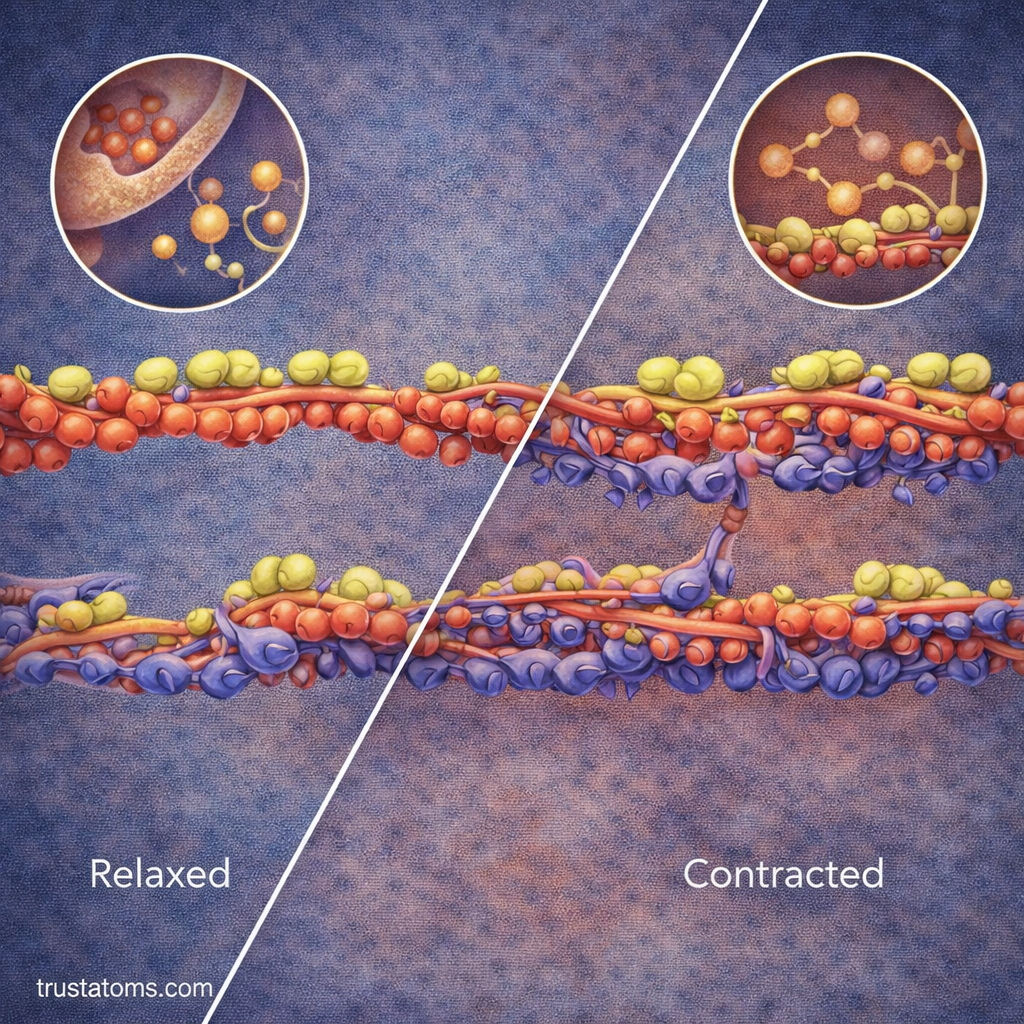
As the filaments slide:
- The sarcomere shortens
- The Z-lines move closer together
- The I band becomes smaller
- The A band remains the same length
This coordinated shortening across many sarcomeres leads to overall muscle contraction.
Role of ATP in Muscle Contraction
ATP (adenosine triphosphate) is essential for muscle contraction.
Functions of ATP
- Provides energy for the power stroke
- Allows myosin to detach from actin
- Resets the myosin head for the next cycle
Without ATP, muscles cannot relax, which is why stiffness occurs after death (rigor mortis).
Role of Calcium in Muscle Contraction
Calcium ions play a key role in regulating contraction.
How Calcium Works
- Released from the sarcoplasmic reticulum
- Binds to regulatory proteins on actin
- Exposes binding sites for myosin
When calcium levels decrease, the muscle relaxes.
Muscle Relaxation
Muscle relaxation occurs when:
- Nerve signals stop
- Calcium is pumped back into storage
- Actin binding sites are covered
- Cross-bridge cycling stops
The muscle then returns to its resting state.
Why the Sliding Filament Model Matters
This model explains how muscles:
- Generate force and movement
- Adapt to exercise and training
- Respond to fatigue and energy availability
It is fundamental to understanding both normal muscle function and muscle-related disorders.
Common Issues Affecting Muscle Contraction
Problems with the contraction process can lead to various conditions.
Examples
- Muscle fatigue (lack of ATP or oxygen)
- Cramps (abnormal calcium regulation)
- Neuromuscular disorders (impaired signaling)
Maintaining proper nutrition, hydration, and activity levels helps support healthy muscle function.
How to Support Efficient Muscle Contraction
Healthy habits can improve muscle performance and contraction efficiency.
Nutrition
- Adequate protein for muscle repair
- Sufficient carbohydrates for energy
- Electrolytes (calcium, potassium, magnesium)
Exercise
- Strength training to improve muscle القوة
- Endurance training for efficiency
- Stretching for flexibility
Recovery
- Rest between workouts
- Proper sleep
- Hydration
Final Thoughts
The sliding filament model provides a clear explanation of how muscles contract at the microscopic level. Through the interaction of actin and myosin, muscles are able to generate force and enable movement.
By understanding this process, you can better appreciate how your body works and take steps to support muscle health, performance, and recovery.