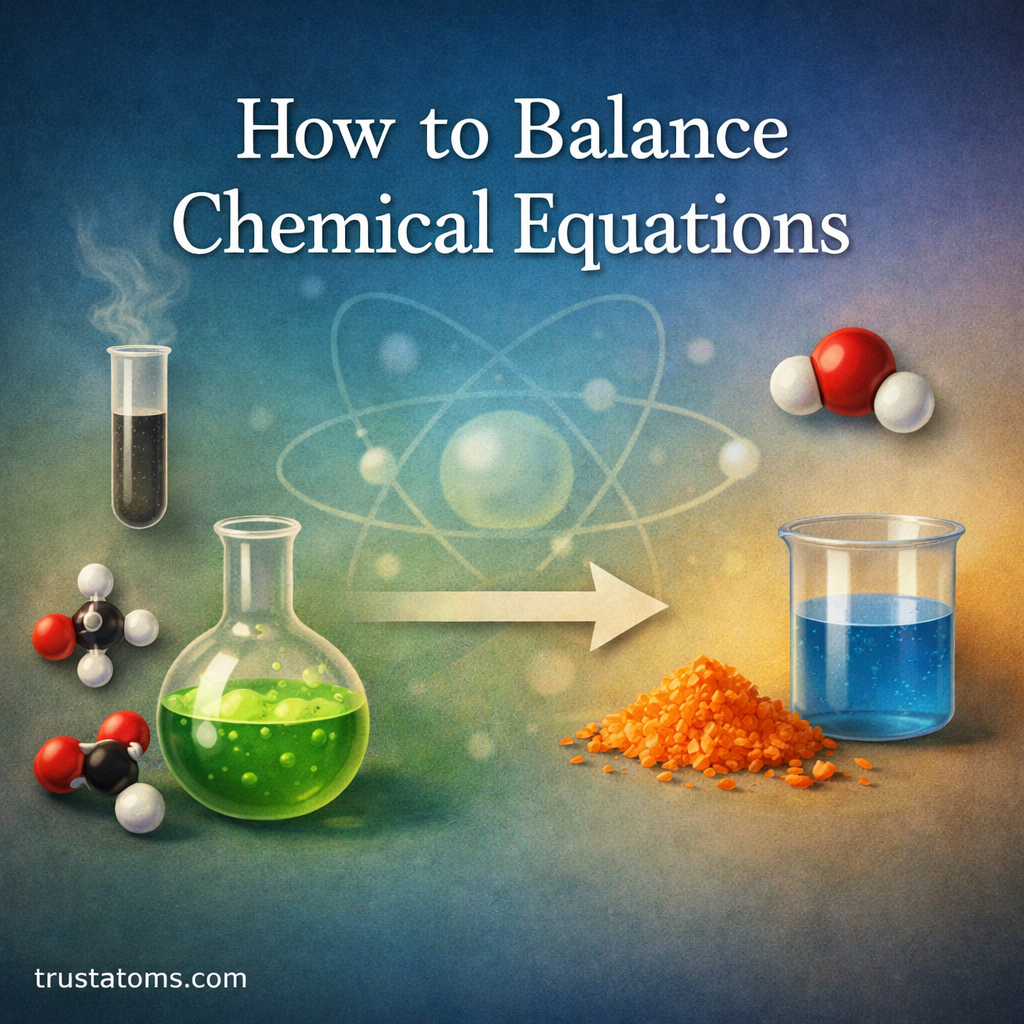
Chemical reactions describe how substances transform into new substances. Chemists represent these reactions using chemical equations, which show the reactants (starting materials) and the products (new substances formed).
However, chemical equations must follow one critical rule: the law of conservation of mass. This means matter cannot be created or destroyed during a reaction. The number of atoms of each element must be the same on both sides of the equation.
Balancing chemical equations ensures that this rule is satisfied and that the equation accurately reflects the reaction taking place.
What Does It Mean to Balance a Chemical Equation?
A balanced chemical equation has the same number of atoms for each element on the reactant side and the product side.
For example, an unbalanced equation might look like this:
H₂ + O₂ → H₂O
In this equation:
- Left side: 2 hydrogen atoms and 2 oxygen atoms
- Right side: 2 hydrogen atoms and 1 oxygen atom
The oxygen atoms are not equal, so the equation must be adjusted.
By adding coefficients, we can balance it:
2H₂ + O₂ → 2H₂O
Now both sides contain:
- 4 hydrogen atoms
- 2 oxygen atoms
The equation is balanced.
Why Balancing Chemical Equations Is Important
Balancing chemical equations is essential in chemistry because it ensures reactions are scientifically accurate.
Key reasons include:
- Following the law of conservation of mass
- Predicting correct reaction quantities
- Calculating reactants and products in experiments
- Understanding reaction mechanisms
Balanced equations are also necessary for stoichiometry, which determines how much of each substance participates in a reaction.
Basic Rules for Balancing Chemical Equations
Before balancing equations, it helps to follow a few fundamental rules:
- Do not change chemical formulas You can only adjust coefficients (numbers placed in front of compounds), not the subscripts inside formulas.
- Balance one element at a time
- Start with metals or elements that appear only once
- Leave hydrogen and oxygen for last
- Check your final atom counts
Step-by-Step Method for Balancing Chemical Equations
Here is a simple process commonly used in chemistry.
Step 1: Write the Unbalanced Equation
Example reaction:
Fe + O₂ → Fe₂O₃
This reaction represents iron reacting with oxygen to form iron(III) oxide (rust).
Step 2: List the Atoms on Each Side
Reactants:
- Fe = 1
- O = 2
Products:
- Fe = 2
- O = 3
The atoms do not match yet.
Step 3: Balance One Element at a Time
Start with iron (Fe).
There are 2 Fe atoms on the product side, so add a coefficient to iron on the reactant side:
2Fe + O₂ → Fe₂O₃
Now iron is balanced.
Step 4: Balance the Remaining Elements
Now balance oxygen.
Left side: 2 oxygen atoms
Right side: 3 oxygen atoms
To balance oxygen, multiply the compounds:
4Fe + 3O₂ → 2Fe₂O₃
Now count again:
Left side:
- Fe = 4
- O = 6
Right side:
- Fe = 4
- O = 6
The equation is balanced.
Example of a Balanced Chemical Equation
Consider the combustion of methane:
CH₄ + O₂ → CO₂ + H₂O
Balancing steps produce:
CH₄ + 2O₂ → CO₂ + 2H₂O
Final atom counts:
- Carbon = 1
- Hydrogen = 4
- Oxygen = 4
Both sides match.
Common Types of Chemical Reactions to Balance
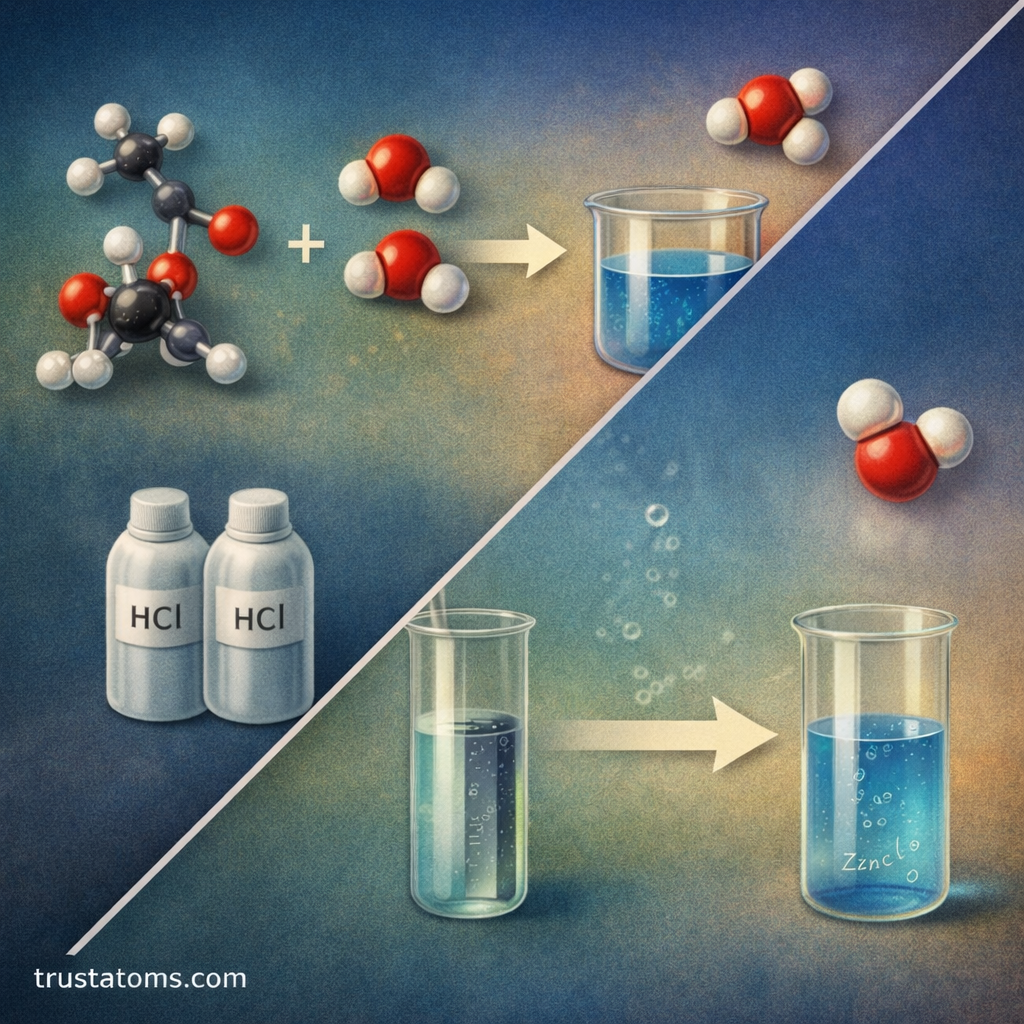
Many chemistry problems involve balancing equations from different reaction types.
1. Synthesis Reactions
Two or more substances combine to form a new compound.
Example:
2Na + Cl₂ → 2NaCl
2. Decomposition Reactions
A compound breaks down into simpler substances.
Example:
2H₂O → 2H₂ + O₂
3. Single Replacement Reactions
One element replaces another in a compound.
Example:
Zn + 2HCl → ZnCl₂ + H₂
4. Combustion Reactions
A substance reacts with oxygen to produce carbon dioxide and water.
Example:
C₃H₈ + 5O₂ → 3CO₂ + 4H₂O
Common Mistakes When Balancing Equations
Students often encounter a few common errors when learning this skill.
Changing Subscripts
Incorrect:
H₂ + O₂ → H₂O₂
This changes the chemical formula and represents a different substance.
Correct approach: adjust coefficients only.
Forgetting to Recount Atoms
After adding coefficients, always recheck atom totals.
Balancing Only One Side
Both sides of the equation must be verified before the equation is considered balanced.
Tips for Balancing Chemical Equations Faster
With practice, balancing equations becomes easier. Helpful strategies include:
- Start with elements that appear in only one compound on each side
- Leave hydrogen and oxygen until last
- Use fractions temporarily, then multiply to remove them
- Double-check totals at the end
Working methodically prevents mistakes and saves time.
How Balanced Equations Connect to Real Chemistry
Balancing equations is more than a classroom exercise. It is fundamental to real-world chemistry applications, including:
- industrial chemical production
- environmental chemistry
- energy generation
- pharmaceuticals
- laboratory experiments
Scientists rely on balanced equations to determine how much material is needed and what products will form.
Chemical reactions ultimately involve rearranging atoms within molecules while preserving the total number of atoms present in the system.
Final Thoughts
Balancing chemical equations is a foundational skill in chemistry that ensures reactions obey the law of conservation of mass. By carefully adjusting coefficients and checking atom counts, chemists can accurately represent how substances interact during chemical reactions.
With consistent practice and a clear step-by-step approach, balancing equations becomes a straightforward and powerful tool for understanding the chemistry of the world around us.