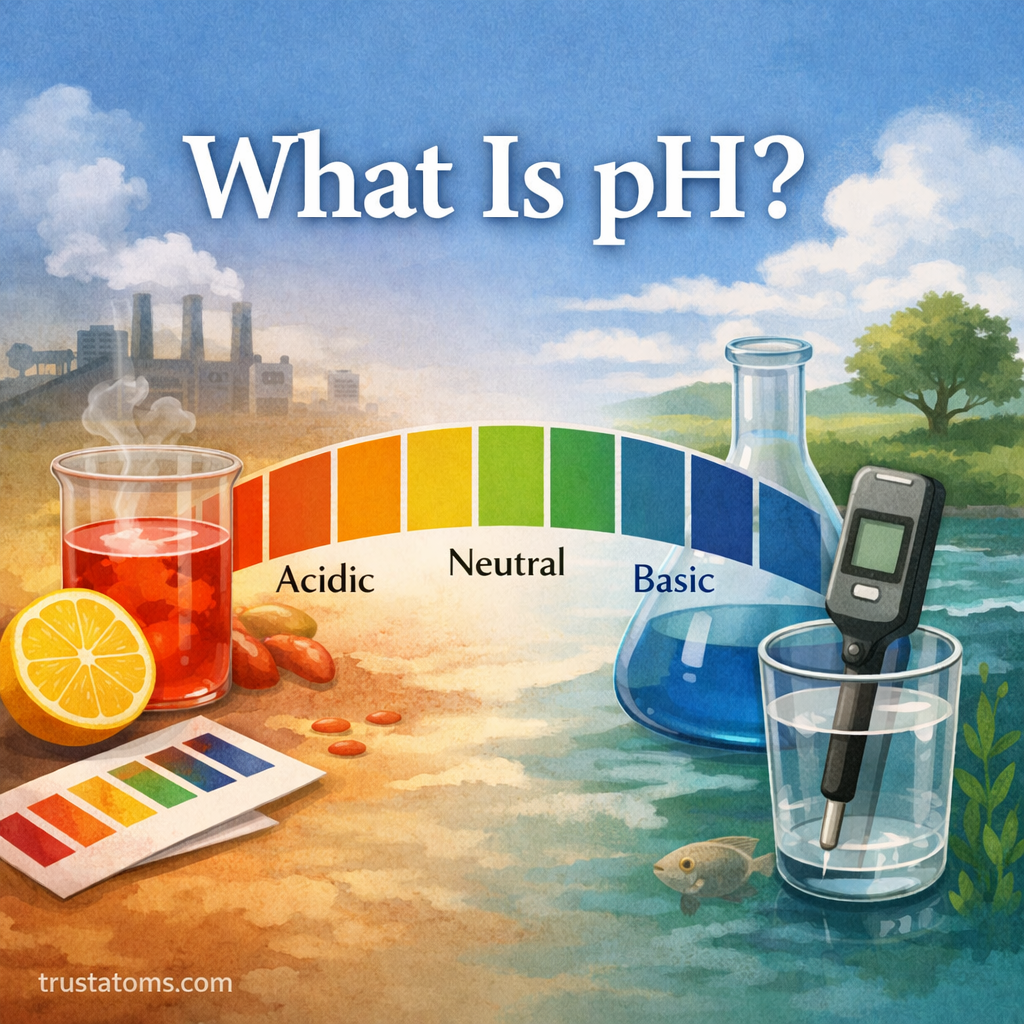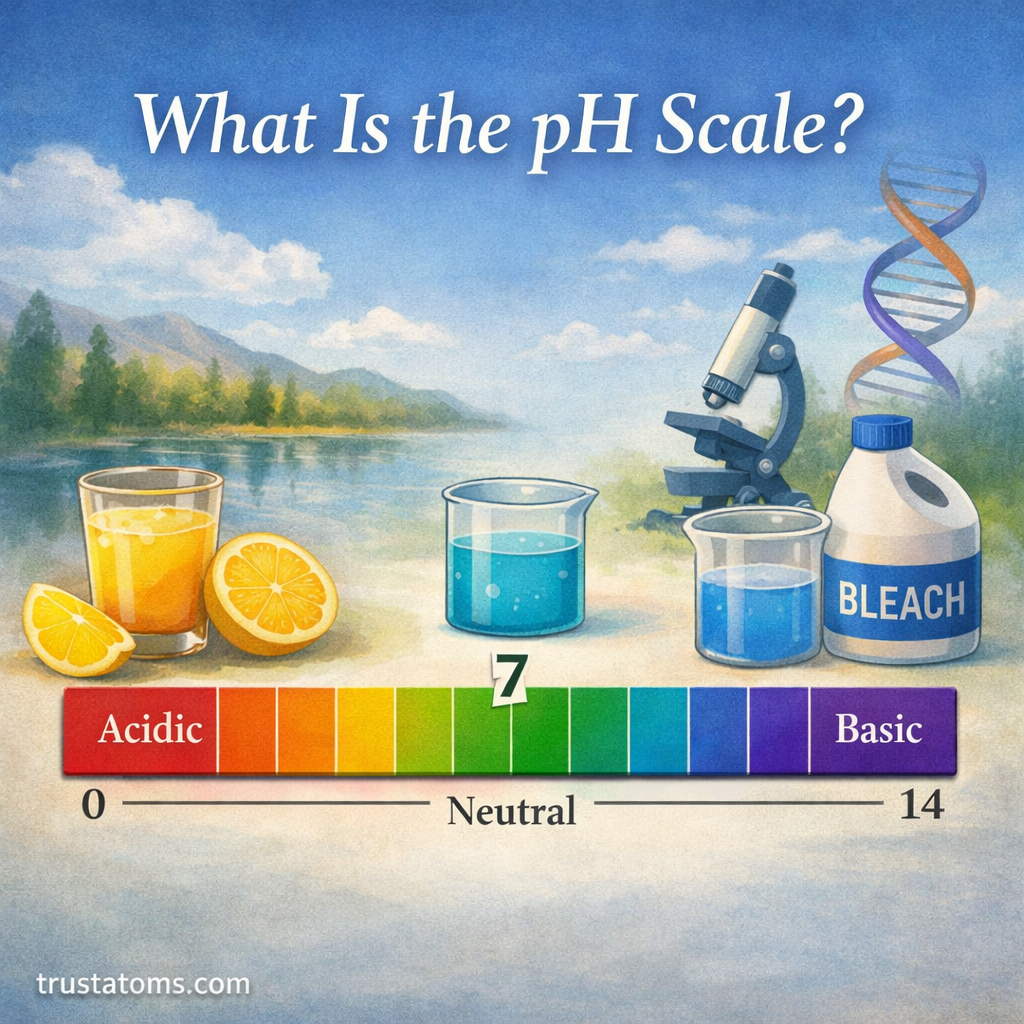
The pH scale measures how acidic or basic an aqueous solution is, using a logarithmic measure of hydrogen ion activity. At 25°C, a pH below 7 indicates an acidic solution, a pH of 7 is neutral, and a pH above 7 indicates a basic or alkaline solution.
The familiar scale runs from 0 to 14, although values outside this range are possible. In chemistry, pH helps explain chemical reactions and compare substances such as lemon juice, drinking water, baking soda solutions, and household cleaners.
What Does pH Mean?
pH is commonly described as a measure of acidity based on hydrogen ions (H+). More precisely, it is defined using hydrogen ion activity, which accounts for how ions behave in a solution rather than simply counting their concentration.
In dilute aqueous solutions, hydrogen ion concentration is often a useful approximation. The relationship is straightforward: greater hydrogen ion activity means lower pH, while lower hydrogen ion activity means higher pH. For a closer explanation of the measurement itself, see What Is pH?
An acid is a substance that can donate a proton in an acid-base reaction, while a base can accept one. When acids and bases react, they may undergo a neutralization reaction, changing the solution’s pH.
Understanding the pH Scale From 0 to 14
At 25°C, the familiar pH scale ranges from 0 to 14, with lower numbers representing more acidic solutions and higher numbers representing more basic solutions. A pH of 7 is neutral under these conditions.
| pH range | Classification | Example |
|---|---|---|
| 0–3 | Highly acidic | Lemon juice |
| 4–6 | Mildly acidic | Tomato juice |
| 7 | Neutral at 25°C | Pure water |
| 8–10 | Mildly basic | Baking soda solution |
| 11–14 | Highly basic | Some household bleach solutions |
These ranges describe how acidic or basic a solution is, not necessarily the strength of the acid or base dissolved in it. Chemical strength refers to how readily an acid or base ionizes or reacts, while pH also depends on concentration.
The familiar 0–14 range is not an absolute limit. Highly concentrated acidic or basic solutions can have pH values below 0 or above 14, and the pH of neutrality changes with temperature.
Examples of pH in Everyday Substances
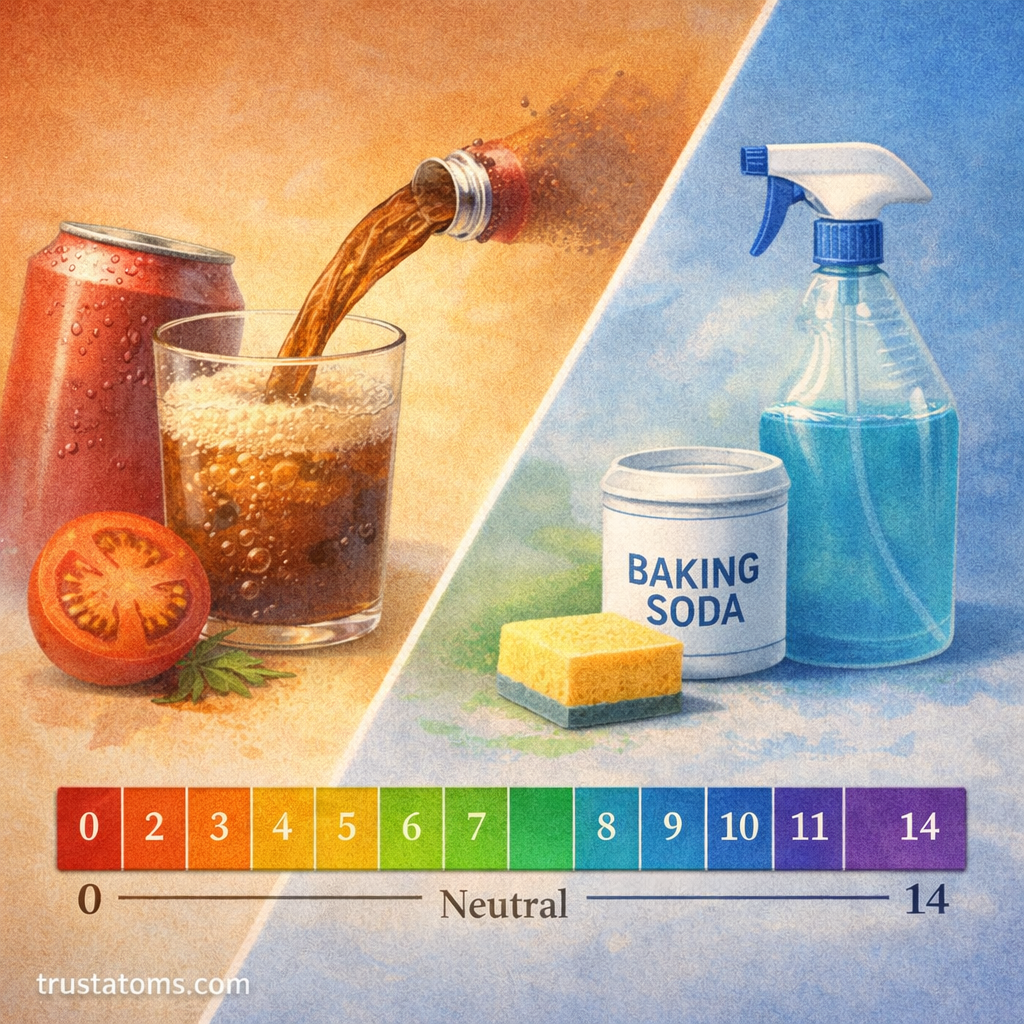
Many familiar liquids have recognizable pH ranges, although exact readings vary with ingredients, dilution, and temperature.
- Lemon juice: Approximately pH 2, due largely to citric acid.
- Vinegar: Commonly around pH 2–3, depending on its acetic acid concentration.
- Tomato juice: Approximately pH 4.
- Pure water: pH 7 at 25°C, before absorbing significant carbon dioxide.
- Baking soda solution: Approximately pH 8–9.
- Household ammonia solution: Often around pH 11–12.
These examples illustrate the difference between acids and bases in familiar materials. However, pH alone does not establish whether a substance is safe to touch, taste, or mix with another chemical.
Why the pH Scale Is Logarithmic
The pH scale is logarithmic rather than linear. At the same temperature and under comparable conditions, each decrease of one pH unit corresponds to a tenfold increase in hydrogen ion activity.
For example, compare three dilute aqueous solutions:
- A solution at pH 5 has approximately 10 times the hydrogen ion activity of one at pH 6.
- A solution at pH 4 has approximately 100 times the hydrogen ion activity of one at pH 6.
- A solution at pH 3 has approximately 1,000 times the hydrogen ion activity of one at pH 6.
For an ideal dilute solution, pH can be approximated by the formula pH = −log10[H+], where [H+] represents hydrogen ion concentration in moles per liter relative to the standard concentration. More precisely, pH is calculated from hydrogen ion activity.
This logarithmic relationship allows scientists to express very large differences in acidity with relatively small numerical changes.
How to Measure pH Accurately
Different methods provide different levels of precision. The appropriate choice depends on whether someone needs a quick estimate or a reliable numerical measurement.
Indicator Paper and Test Strips
pH test strips contain chemical indicators that change color when exposed to a solution. The resulting color is compared with a reference chart to estimate pH.
Litmus paper provides a simpler acid-or-base indication, while universal indicator strips can estimate a broader range of pH values. Colored or cloudy samples may make visual interpretation more difficult.
Liquid and Natural Indicators
Universal indicator solutions contain dyes that produce different colors across a range of pH values. Red cabbage extract is a familiar natural indicator because its pigments change color depending on acidity.
These methods are useful for demonstrations but generally provide less precise results than properly calibrated instruments.
Electronic pH Meters
A pH meter uses an electrode system to measure an electrical potential related to hydrogen ion activity. Proper calibration with standard buffer solutions is necessary for accurate readings.
Temperature compensation, clean electrodes, and suitable storage also affect measurement quality. Laboratories, water treatment facilities, and food manufacturers frequently use calibrated pH meters.
How pH Affects Biology and the Environment
Many biological and environmental processes are sensitive to changes in acidity. Even relatively small pH shifts can alter chemical reactions, nutrient availability, and the behavior of dissolved substances.
- Human biology: Healthy blood pH is normally maintained around 7.35–7.45, while stomach fluids are much more acidic.
- Soil: pH affects how readily plants can absorb nutrients and whether certain metals become more soluble.
- Aquatic ecosystems: Changes in water pH can affect fish, shell-forming organisms, and other aquatic life.
- Food production: Acidity influences flavor, preservation, microbial growth, and processing conditions.
- Water treatment: Monitoring pH helps operators manage corrosion, disinfection, and chemical treatment processes.
For example, adding an acid to water may lower its pH, but the size of the change depends on the water’s buffering capacity. Dissolved substances such as bicarbonate can resist sudden changes in pH.
Common Misconceptions About pH
A Lower pH Does Not Always Mean a Stronger Acid
A concentrated solution of a weak acid can have a lower pH than a sufficiently dilute solution of a strong acid. Acid strength describes the extent of ionization, not simply the measured pH.
Neutral Does Not Automatically Mean Safe
A solution near pH 7 may still contain toxic or otherwise hazardous substances. Safety depends on chemical composition, concentration, exposure, and other factors.
pH 7 Is Not Neutral at Every Temperature
Pure water is neutral when hydrogen ion and hydroxide ion activities are equal. Because water’s ionization changes with temperature, its neutral pH is not always exactly 7.
Frequently Asked Questions
What is the normal pH range?
The commonly taught pH range is 0 to 14, with 7 representing neutrality at 25°C. However, some highly concentrated solutions have pH values outside this range.
Is a pH of 6 acidic or neutral?
At 25°C, a pH of 6 is mildly acidic. It corresponds to approximately ten times the hydrogen ion activity of a solution at pH 7.
Can you measure the pH of a solid?
pH is defined for solutions, so a dry solid does not have a directly measurable aqueous pH. For materials such as soil, technicians typically prepare a water-based mixture or extract and measure its pH using a standardized procedure.
The pH scale provides a quantitative way to compare the acidity and basicity of aqueous solutions, with each whole-number change representing a tenfold difference in hydrogen ion activity. Understanding its logarithmic nature, measurement methods, and limitations helps explain everything from lemon juice acidity to soil conditions and water treatment. Accurate interpretation also requires considering temperature, concentration, and the chemical composition of the solution.
Sources: IUPAC, Compendium of Chemical Terminology (Gold Book); OpenStax, Chemistry 2e; U.S. Geological Survey (USGS), Water Science School, pH and Water.