The Earth is made up of several layers, each with its own unique composition, structure, and role in shaping the planet. These layers—known as the crust, mantle, and core—work together to drive processes like earthquakes, volcanic activity, and plate tectonics.
Understanding Earth’s layers helps explain how the planet formed, how it continues to change, and why natural events occur.
Overview of Earth’s Layers
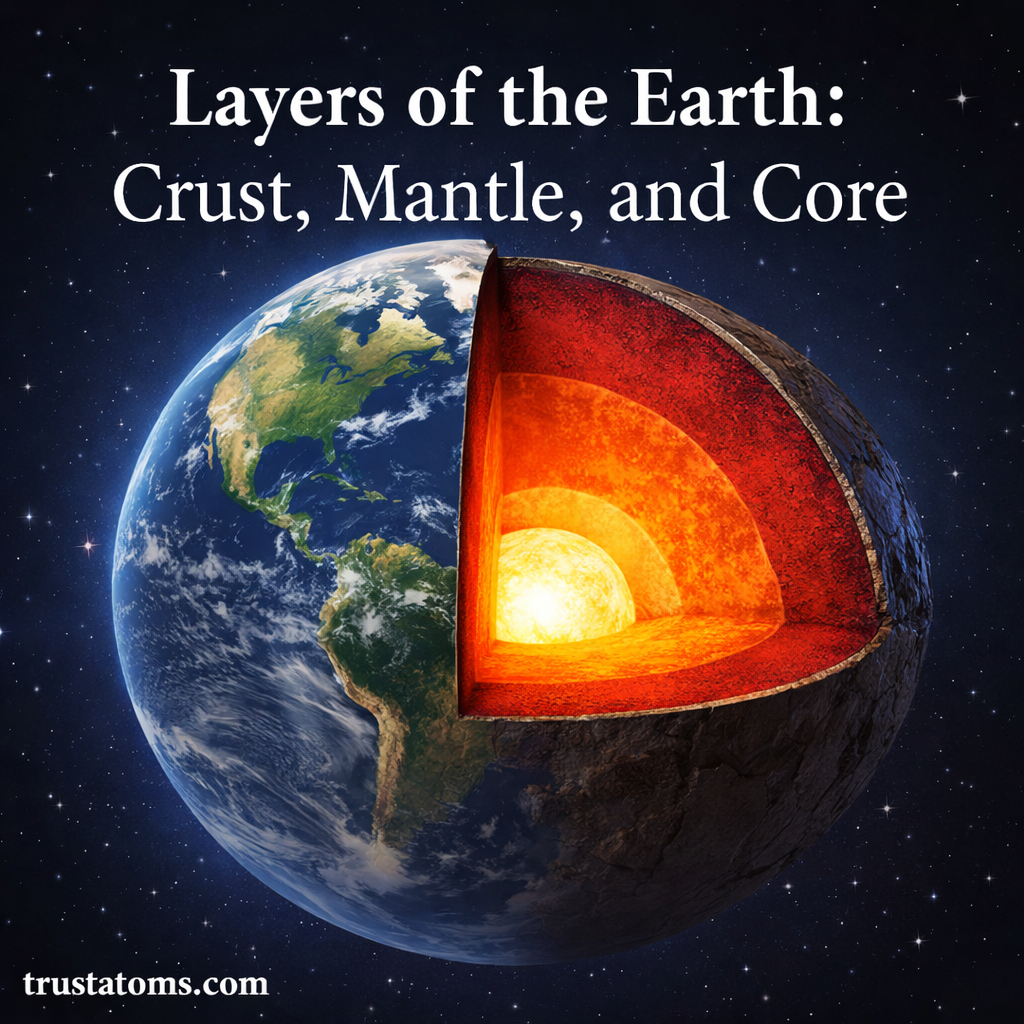
Earth can be divided into three main layers based on composition:
- Crust – the thin outer surface where we live
- Mantle – a thick middle layer of hot, semi-solid rock
- Core – the dense, extremely hot center of the planet
Each layer differs in thickness, temperature, and physical properties.
The Crust: Earth’s Outer Layer
The crust is the outermost layer of Earth and the one we interact with every day.
Key Characteristics of the Crust
- Thickness ranges from about 5 km (oceanic crust) to 70 km (continental crust)
- Composed mainly of solid rock
- Divided into tectonic plates
- Includes continents, mountains, and ocean floors
Types of Crust
- Continental crust – thicker and less dense, found under land
- Oceanic crust – thinner and denser, found beneath oceans
The crust may be thin compared to other layers, but it plays a major role in supporting life and shaping landscapes.
The Mantle: Earth’s Thickest Layer
Beneath the crust lies the mantle, which makes up about 84% of Earth’s volume.
Key Characteristics of the Mantle
- Extends to a depth of about 2,900 km
- Composed of hot, dense rock rich in iron and magnesium
- Mostly solid but behaves like a slow-moving fluid over time
- Contains convection currents that drive plate movement
Why the Mantle Matters
The mantle is responsible for many of Earth’s dynamic processes:
- Movement of tectonic plates
- Formation of volcanoes
- Creation of new crust at mid-ocean ridges
These processes continuously reshape Earth’s surface.
The Core: Earth’s Inner Layer
The core lies at the center of the planet and is divided into two parts: the outer core and the inner core.
Outer Core
- Liquid layer made mostly of iron and nickel
- Extends from about 2,900 km to 5,100 km below the surface
- Generates Earth’s magnetic field through the movement of molten metal
Inner Core
- Solid due to extreme pressure
- Temperatures can reach over 5,000°C (9,000°F)
- Composed mainly of iron and nickel
Importance of the Core
The core plays a crucial role in protecting life on Earth:
- The magnetic field shields the planet from harmful solar radiation
- Helps maintain a stable atmosphere
How the Layers Work Together
Although the layers are distinct, they interact in powerful ways:
- Heat from the core drives convection currents in the mantle
- Mantle movement shifts tectonic plates in the crust
- Plate interactions cause earthquakes, mountain building, and volcanic eruptions
This constant interaction makes Earth a dynamic and ever-changing planet.
Temperature and Pressure Differences
As you move deeper into Earth, both temperature and pressure increase significantly.
General Trends
- Crust: relatively cool and low pressure
- Mantle: increasing heat and pressure with depth
- Core: extremely high temperatures and immense pressure
These conditions influence whether materials are solid or liquid in each layer.
Why Understanding Earth’s Layers Matters
Learning about Earth’s layers is essential for both science and everyday life.
Practical Applications
- Predicting and understanding earthquakes and volcanic eruptions
- Exploring natural resources like minerals and fossil fuels
- Studying Earth’s history through rock layers
- Understanding the magnetic field and its impact on technology
Earth’s internal structure affects everything from natural disasters to modern navigation systems.
Final Thoughts
The crust, mantle, and core form the foundation of our planet. Each layer has unique properties, but they are all connected through powerful geological processes.
By understanding Earth’s layers, we gain insight into how the planet works—from the ground beneath our feet to the forces deep within its center.