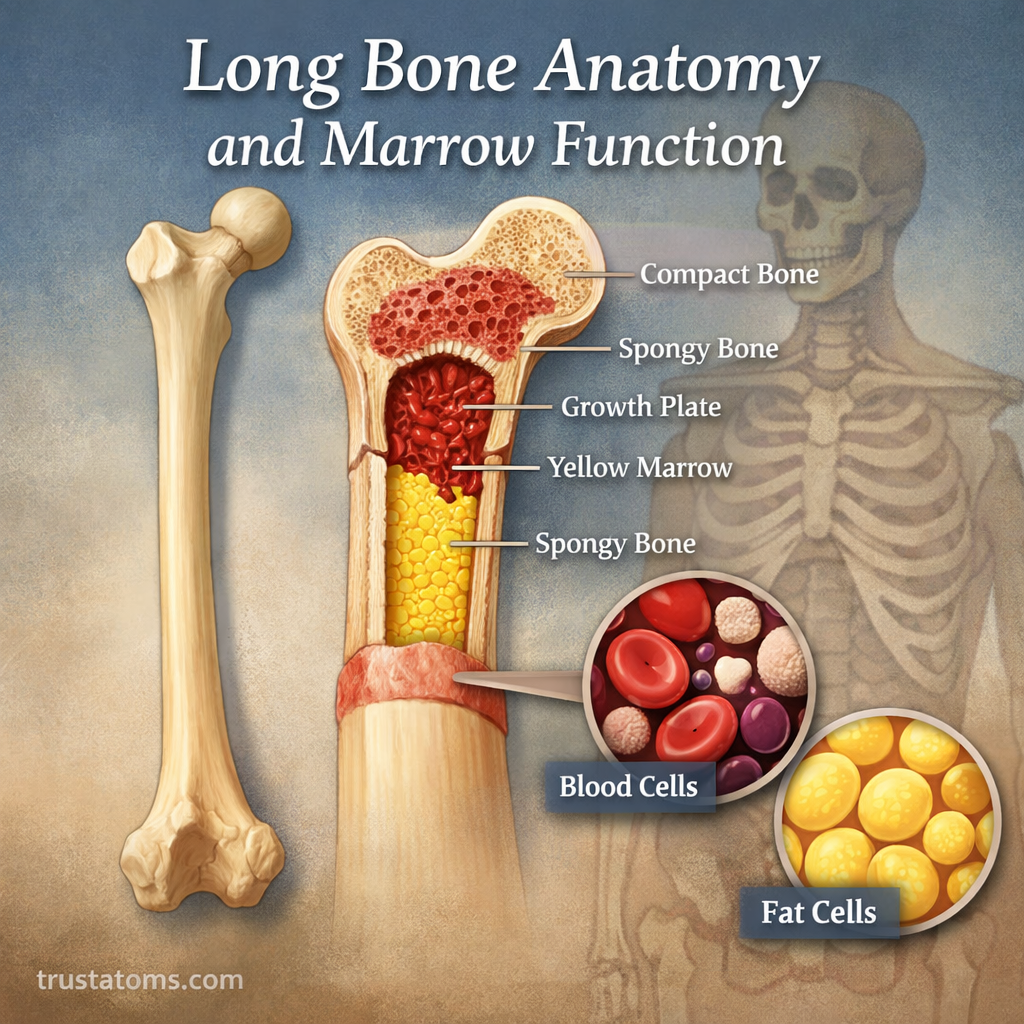
Long bones are essential structural components of the human body, providing strength, mobility, and a site for critical biological processes like blood cell production. Found in areas such as the arms and legs, long bones are uniquely designed to balance durability with efficiency, allowing us to move, support weight, and maintain overall health.
This article explores the anatomy of long bones and the vital role of bone marrow in keeping the body functioning properly.
What Are Long Bones?
Long bones are bones that are longer than they are wide. They primarily function to support body weight and facilitate movement.
Common examples include:
- Femur (thigh bone)
- Humerus (upper arm bone)
- Tibia and fibula (lower leg bones)
- Radius and ulna (forearm bones)
Despite their name, long bones are not necessarily “long” in absolute size—they are defined by their elongated shape and structure.
Structure of a Long Bone
A long bone consists of several specialized regions, each with a distinct function.
Diaphysis (Shaft)
The diaphysis is the long, cylindrical central portion of the bone.
- Made mostly of compact bone
- Provides strength and support
- Contains the medullary cavity (central hollow area)
This region is designed to withstand stress from weight-bearing and movement.
Epiphysis (Ends of the Bone)
The epiphyses are the rounded ends of a long bone.
- Composed primarily of spongy (cancellous) bone
- Covered with articular cartilage to reduce friction in joints
- Helps absorb shock during movement
Each long bone typically has a proximal (near) and distal (far) epiphysis.
Metaphysis
The metaphysis is the transitional zone between the diaphysis and epiphysis.
- Contains the epiphyseal plate (growth plate) in children
- Responsible for longitudinal bone growth
- Eventually becomes the epiphyseal line in adults
This region is crucial during development and adolescence.
Periosteum
The periosteum is a dense, fibrous membrane covering the outer surface of the bone.
- Contains blood vessels and nerves
- Plays a role in bone growth and repair
- Serves as an attachment point for tendons and ligaments
It is highly sensitive, which is why bone injuries can be painful.
Endosteum
The endosteum lines the inner surface of the bone, including the medullary cavity.
- Contains bone-forming and bone-resorbing cells
- Involved in bone remodeling and repair
Compact Bone vs. Spongy Bone
Long bones contain two types of bone tissue that work together for strength and efficiency.
Compact Bone
- Dense and tightly packed
- Forms the outer layer of the diaphysis
- Provides structural strength and protection
Spongy Bone (Cancellous Bone)
- Porous and lightweight
- Found mainly in the epiphyses
- Contains spaces filled with bone marrow
This combination allows bones to remain strong without being excessively heavy.
The Medullary Cavity
The medullary cavity is the hollow center of the diaphysis.
- Houses bone marrow
- Reduces bone weight
- Plays a role in energy storage (via fat in yellow marrow)
This cavity is central to the bone’s role beyond structural support.
Bone Marrow: Types and Functions
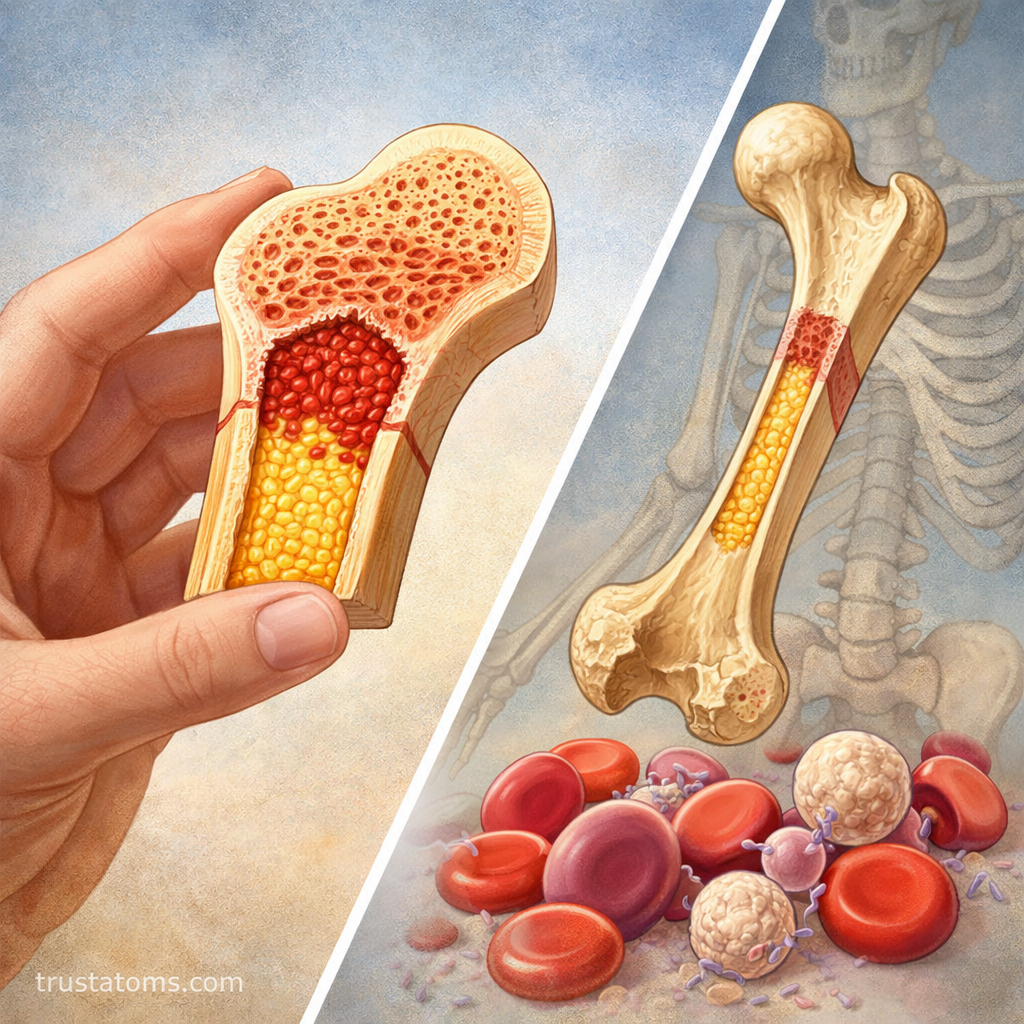
Bone marrow is a soft, spongy tissue found inside bones, particularly within the medullary cavity and spongy bone.
There are two main types of bone marrow:
Red Bone Marrow
Red marrow is responsible for hematopoiesis—the production of blood cells.
It produces:
- Red blood cells (carry oxygen)
- White blood cells (fight infection)
- Platelets (help with blood clotting)
In children, most bones contain red marrow. In adults, it is primarily found in:
- Flat bones (like the pelvis and sternum)
- Ends of long bones (epiphyses)
Yellow Bone Marrow
Yellow marrow mainly stores fat (adipose tissue).
- Acts as an energy reserve
- Found mostly in the medullary cavity of adult long bones
- Can convert back to red marrow in cases of severe blood loss
This adaptability highlights the body’s ability to respond to physiological demands.
How Long Bones Grow and Develop
Long bones grow in length through a process called endochondral ossification.
Key steps include:
- Cartilage model forms during early development
- Bone tissue gradually replaces cartilage
- Growth occurs at the epiphyseal (growth) plates
- Plates close after puberty, stopping lengthwise growth
Bone growth is influenced by:
- Hormones (growth hormone, estrogen, testosterone)
- Nutrition (calcium, vitamin D)
- Physical activity
Bone Remodeling and Maintenance
Bone is a dynamic tissue that constantly renews itself.
Two main cell types are involved:
- Osteoblasts: build new bone
- Osteoclasts: break down old bone
This process helps:
- Maintain bone strength
- Repair micro-damage
- Regulate calcium levels in the body
Why Bone Marrow Function Matters
Bone marrow plays a critical role in overall health beyond the skeletal system.
Key functions include:
- Supporting the immune system through white blood cell production
- Ensuring oxygen delivery via red blood cells
- Enabling clotting through platelet production
Disruptions in marrow function can lead to serious conditions such as:
- Anemia (low red blood cells)
- Leukemia (cancer of blood-forming tissues)
- Bone marrow failure disorders
Key Takeaways
- Long bones are specialized structures designed for strength, movement, and biological function
- They consist of regions like the diaphysis, epiphysis, and metaphysis, each with a specific role
- Compact bone provides strength, while spongy bone houses marrow
- Bone marrow exists in two forms: red (blood cell production) and yellow (fat storage)
- Long bones grow through epiphyseal plates and are constantly remodeled throughout life
- Healthy bone marrow is essential for blood production, immunity, and overall survival
Final Thoughts
Long bones are more than just rigid supports for the body—they are living, dynamic structures that contribute to movement, growth, and vital internal processes. Their internal architecture allows them to remain strong yet lightweight, while bone marrow ensures the continuous production of the cells that keep us alive.
Understanding long bone anatomy and marrow function provides valuable insight into how the skeletal and circulatory systems are closely connected, emphasizing the importance of bone health in overall well-being.