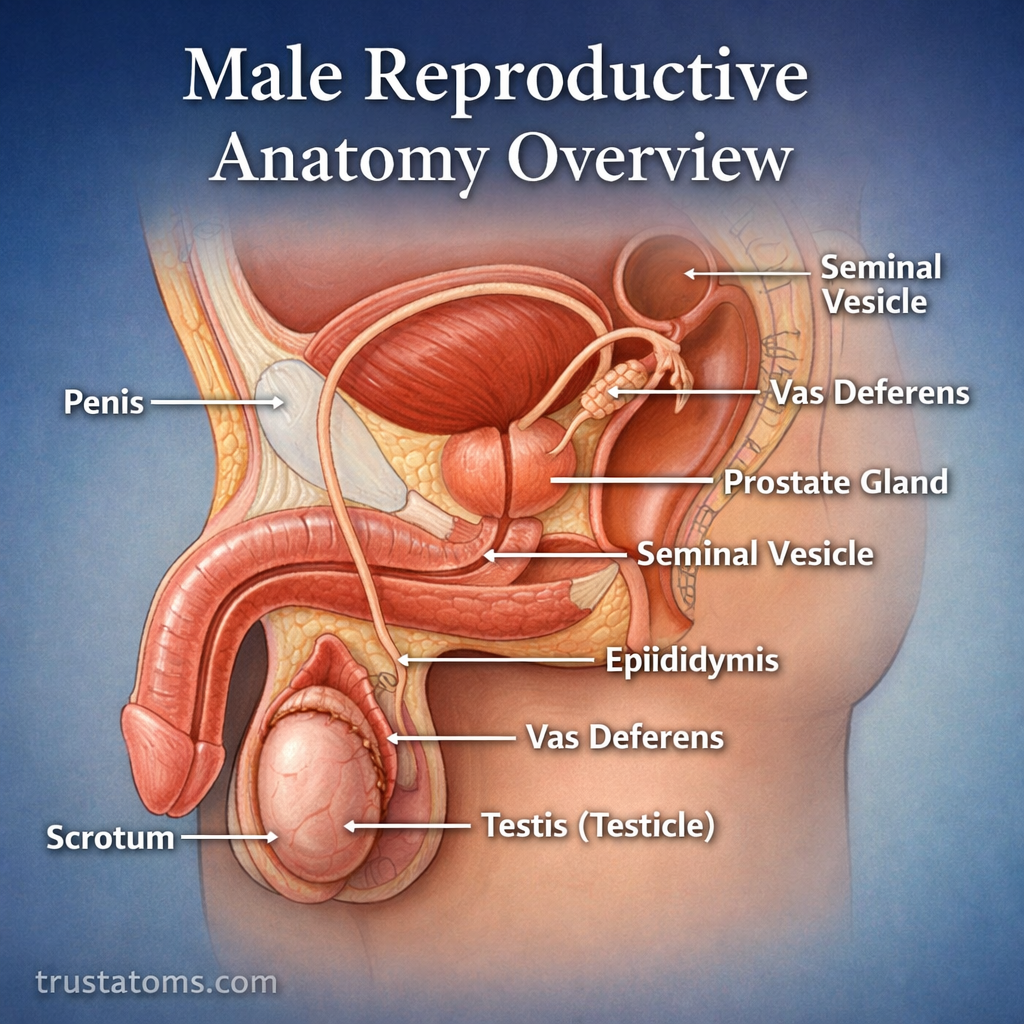
The male reproductive system is a specialized group of organs responsible for producing, storing, and delivering sperm, as well as generating male sex hormones like testosterone. These structures work together to support reproduction, sexual function, and overall hormonal balance.
Understanding male reproductive anatomy helps explain how fertility works, how hormones regulate the body, and how different organs contribute to the reproductive process.
Primary Functions of the Male Reproductive System
The male reproductive system has three main roles:
- Sperm production (spermatogenesis) – creating male reproductive cells
- Hormone production – primarily testosterone, which regulates male traits
- Sperm delivery – transporting sperm into the female reproductive tract
Each organ plays a specific part in achieving these functions.
Key Structures of Male Reproductive Anatomy
External Organs
Penis
The penis is the external organ used for sexual intercourse and urination.
- Contains erectile tissue that fills with blood during arousal
- Delivers semen through the urethra during ejaculation
- Also serves as the outlet for urine from the bladder
Scrotum
The scrotum is a pouch of skin that holds the testes.
- Regulates temperature for optimal sperm production
- Contracts or relaxes to adjust the distance from the body
- Keeps testes slightly cooler than core body temperature
Internal Organs
Testes (Testicles)
The testes are the primary reproductive organs.
- Produce sperm cells
- Secrete testosterone
- Contain tightly coiled tubes called seminiferous tubules where sperm is formed
Epididymis
A long, coiled tube attached to each testis.
- Stores immature sperm
- Allows sperm to mature and gain mobility
- Acts as a transport pathway to the vas deferens
Vas Deferens
A muscular tube that carries sperm from the epididymis.
- Transports sperm during ejaculation
- Connects to the ejaculatory duct
- Can be surgically cut in a vasectomy
Accessory Glands and Their Functions
Accessory glands produce fluids that mix with sperm to form semen.
Seminal Vesicles
- Produce a sugar-rich fluid (fructose) that provides energy for sperm
- Contribute a large portion of semen volume
Prostate Gland
- Adds a milky fluid that helps sperm mobility
- Contains enzymes that support sperm survival
Bulbourethral (Cowper’s) Glands
- Release a lubricating fluid before ejaculation
- Neutralize acidity in the urethra
The Urethra: Dual Function
The urethra is a shared pathway for both urine and semen.
- Runs through the penis
- Carries urine from the bladder
- Transports semen during ejaculation
The body prevents urine and semen from mixing by using internal valves.
How Sperm Production Works
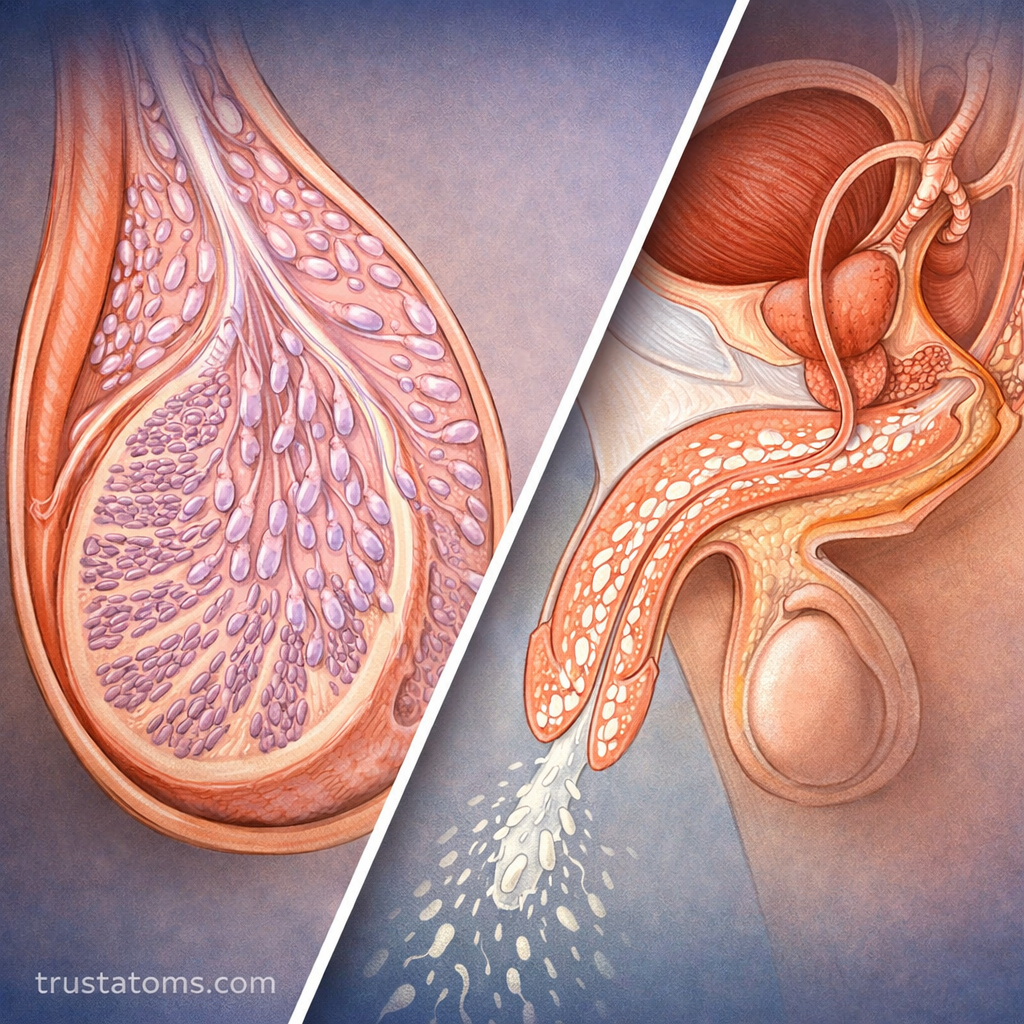
Sperm production, or spermatogenesis, occurs in the testes and involves several steps:
- Cell division creates immature sperm cells
- Maturation occurs in the seminiferous tubules
- Storage and development take place in the epididymis
- Transport happens through the vas deferens during ejaculation
This process is continuous and produces millions of sperm daily.
Hormonal Control of the Male Reproductive System
Hormones regulate development, function, and fertility.
Key Hormones
- Testosterone – responsible for male traits (voice, muscle mass, libido)
- Follicle-stimulating hormone (FSH) – stimulates sperm production
- Luteinizing hormone (LH) – signals testosterone production
These hormones are controlled by the brain, specifically the hypothalamus and pituitary gland.
Common Functions Working Together
The male reproductive system operates as a coordinated system:
- Testes produce sperm and hormones
- Epididymis matures and stores sperm
- Vas deferens transports sperm
- Accessory glands add fluid to create semen
- Penis delivers semen during ejaculation
Each part is essential—if one is impaired, fertility or function may be affected.
Common Conditions Affecting Male Reproductive Anatomy
Understanding anatomy also helps explain certain conditions:
- Erectile dysfunction – difficulty achieving or maintaining an erection
- Varicocele – enlarged veins in the scrotum affecting sperm production
- Prostatitis – inflammation of the prostate
- Testicular torsion – twisting of the spermatic cord, requiring emergency care
- Infertility – often linked to sperm production or transport issues
Why Understanding Male Reproductive Anatomy Matters
Learning about male reproductive anatomy provides insight into:
- Fertility and reproductive health
- Hormonal balance and development
- Sexual function and performance
- Prevention and early detection of health issues
It also supports better communication with healthcare providers and informed health decisions.
Final Thoughts
The male reproductive system is a complex and highly coordinated network of organs and hormones. From sperm production in the testes to delivery through the penis, every structure has a vital role.
A clear understanding of this anatomy not only helps explain how reproduction works but also highlights the importance of maintaining reproductive and overall health.