Ocean currents are powerful, continuous movements of seawater that play a major role in regulating Earth’s climate. By transporting heat around the planet, these currents help balance temperature differences between the equator and the poles.
Understanding ocean currents is essential for explaining weather patterns, marine ecosystems, and global climate systems.
What Are Ocean Currents?
Ocean currents are large-scale flows of seawater that move in consistent patterns across the globe.
They are driven by a combination of factors, including:
- Wind
- Earth’s rotation
- Temperature differences
- Salinity variations
These currents act like a global transportation system for heat, nutrients, and energy.
Types of Ocean Currents
Ocean currents are generally divided into two main types:
Surface Currents
- Occur in the upper 10% of the ocean
- Driven primarily by wind patterns
- Influenced by Earth’s rotation (Coriolis effect)
Examples:
- Gulf Stream (warm current)
- California Current (cold current)
Deep Ocean Currents
- Occur below the surface
- Driven by differences in water density
- Influenced by temperature and salinity
This movement is known as thermohaline circulation.
What Drives Ocean Currents?
Several key forces drive ocean circulation.
Wind
- Pushes surface water across the ocean
- Creates large circular patterns called gyres
Earth’s Rotation
- Causes currents to curve (Coriolis effect)
- Deflects currents right in the Northern Hemisphere and left in the Southern Hemisphere
Temperature Differences
- Warm water is less dense and rises
- Cold water is denser and sinks
Salinity
- Higher salt content increases water density
- Influences deep ocean movement
Global Ocean Circulation System
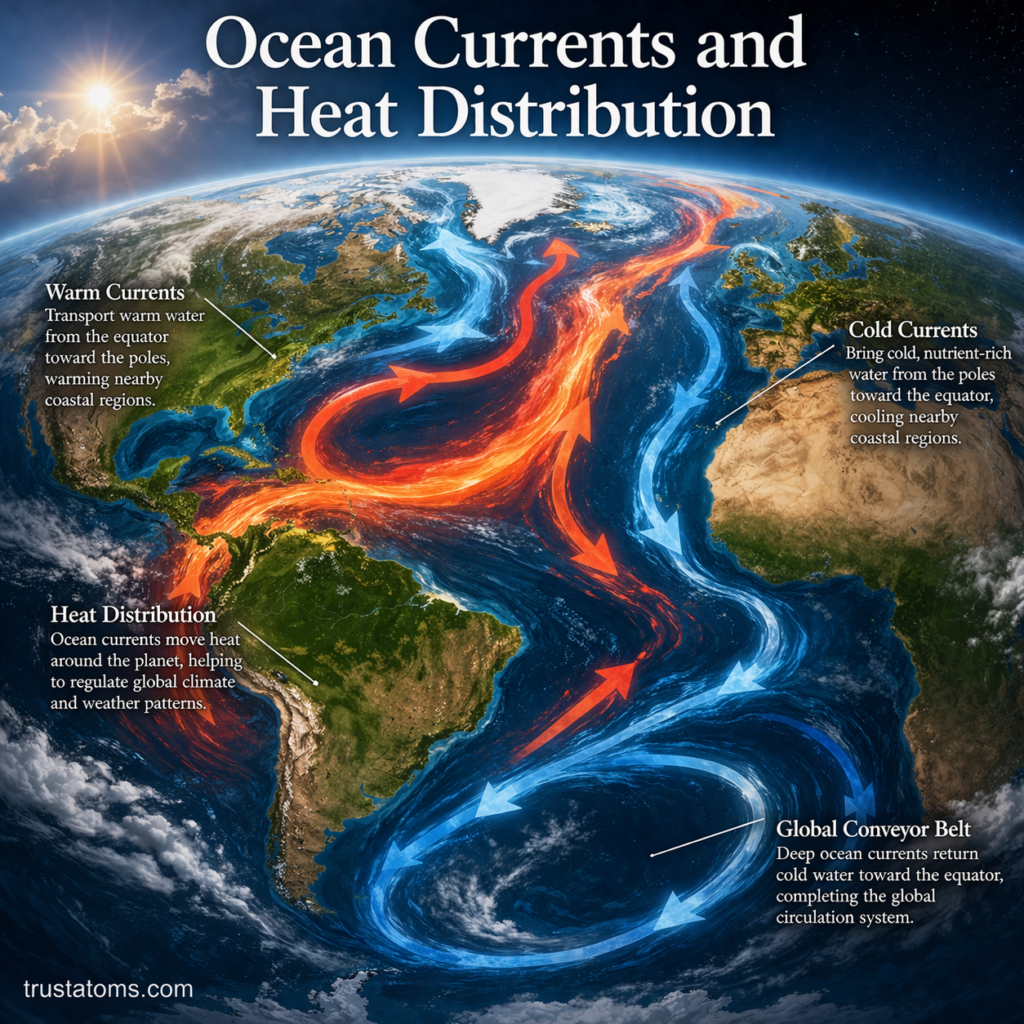
All ocean currents are part of a larger system often called the “global conveyor belt.”
Key features
- Connects all major oceans
- Moves warm surface water toward the poles
- Returns cold, dense water toward the equator
This system operates over long timescales and is crucial for climate stability.
How Ocean Currents Distribute Heat
Ocean currents play a vital role in redistributing heat across Earth.
Heat movement process
- Sun heats equatorial waters
- Warm water moves toward higher latitudes
- Heat is released into the atmosphere
- Cooler water returns toward the equator
This process helps prevent extreme temperature differences between regions.
Impact on Climate
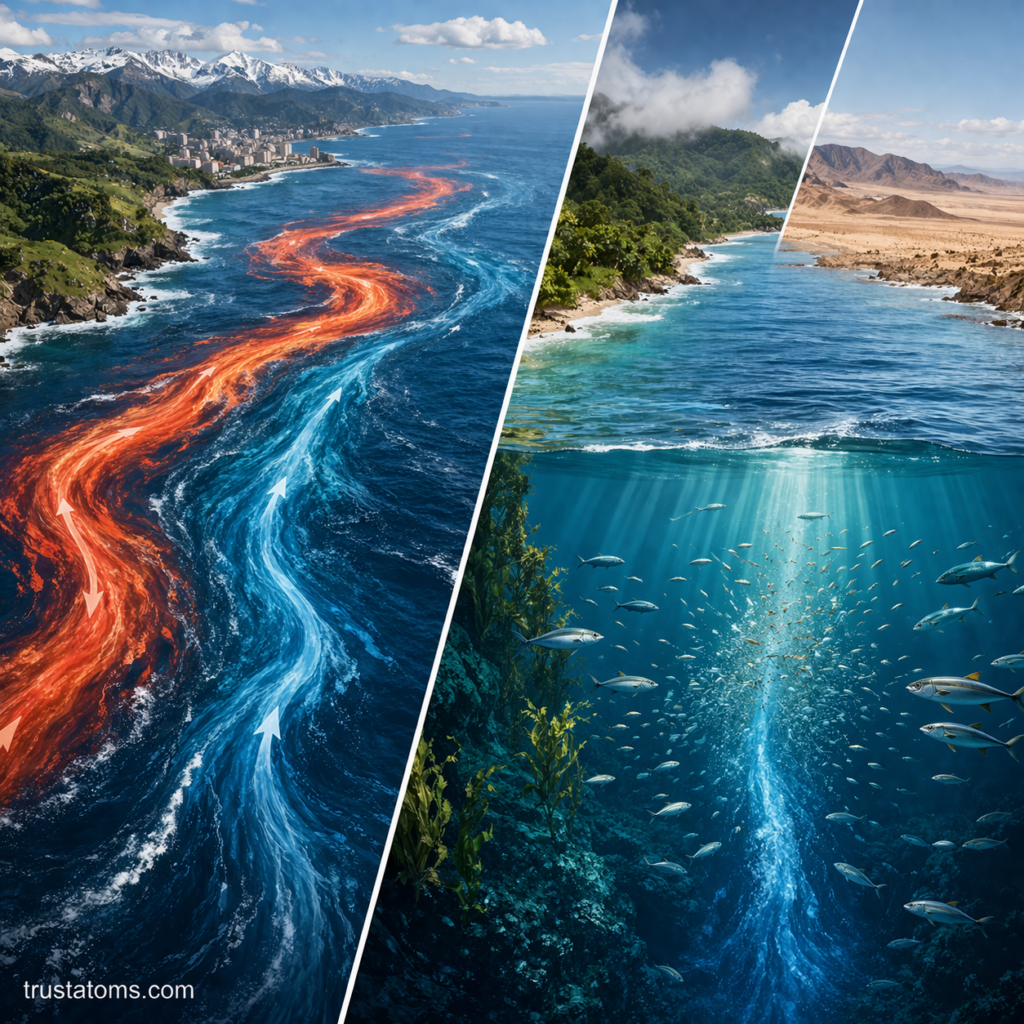
Ocean currents significantly influence global and regional climates.
Examples
- Warm currents can make nearby land areas warmer and wetter
- Cold currents can create cooler and drier coastal climates
Real-world effects
- Western Europe is warmer due to the Gulf Stream
- Coastal deserts form near cold currents (e.g., Atacama Desert)
Ocean Currents and Weather Patterns
Ocean currents interact with the atmosphere to shape weather systems.
Key influences
- Affect storm development
- Influence rainfall patterns
- Contribute to climate phenomena like El Niño and La Niña
These interactions make ocean currents essential for predicting weather and climate events.
Role in Marine Ecosystems
Ocean currents also support marine life.
Benefits
- Transport nutrients across oceans
- Support plankton growth
- Sustain fish populations
Upwelling zones, where deep water rises to the surface, are especially rich in nutrients and biodiversity.
Human Impact on Ocean Currents
Human activity is affecting ocean circulation systems.
Key factors
- Climate change warming ocean waters
- Melting ice altering salinity levels
- Increased freshwater input from glaciers
Potential consequences
- Slowing of major currents
- Disrupted climate patterns
- Changes in marine ecosystems
Even small disruptions can have large-scale global effects.
Why Ocean Currents Matter
Ocean currents are essential for maintaining Earth’s balance.
Key importance
- Regulate global temperatures
- Drive climate systems
- Support marine ecosystems
- Influence weather patterns
Without ocean currents, Earth would experience much more extreme climate conditions.
Ocean Currents in Simple Terms
Think of ocean currents as Earth’s heat distribution system:
- Warm water carries heat away from the equator
- Cold water brings cooler temperatures back
This constant movement keeps the planet’s climate more stable.
Final Thoughts
Ocean currents are a fundamental part of Earth’s climate system. By moving heat, water, and nutrients around the globe, they help maintain environmental balance and support life.
As climate change continues to affect ocean systems, understanding how currents work becomes increasingly important for predicting future climate conditions.