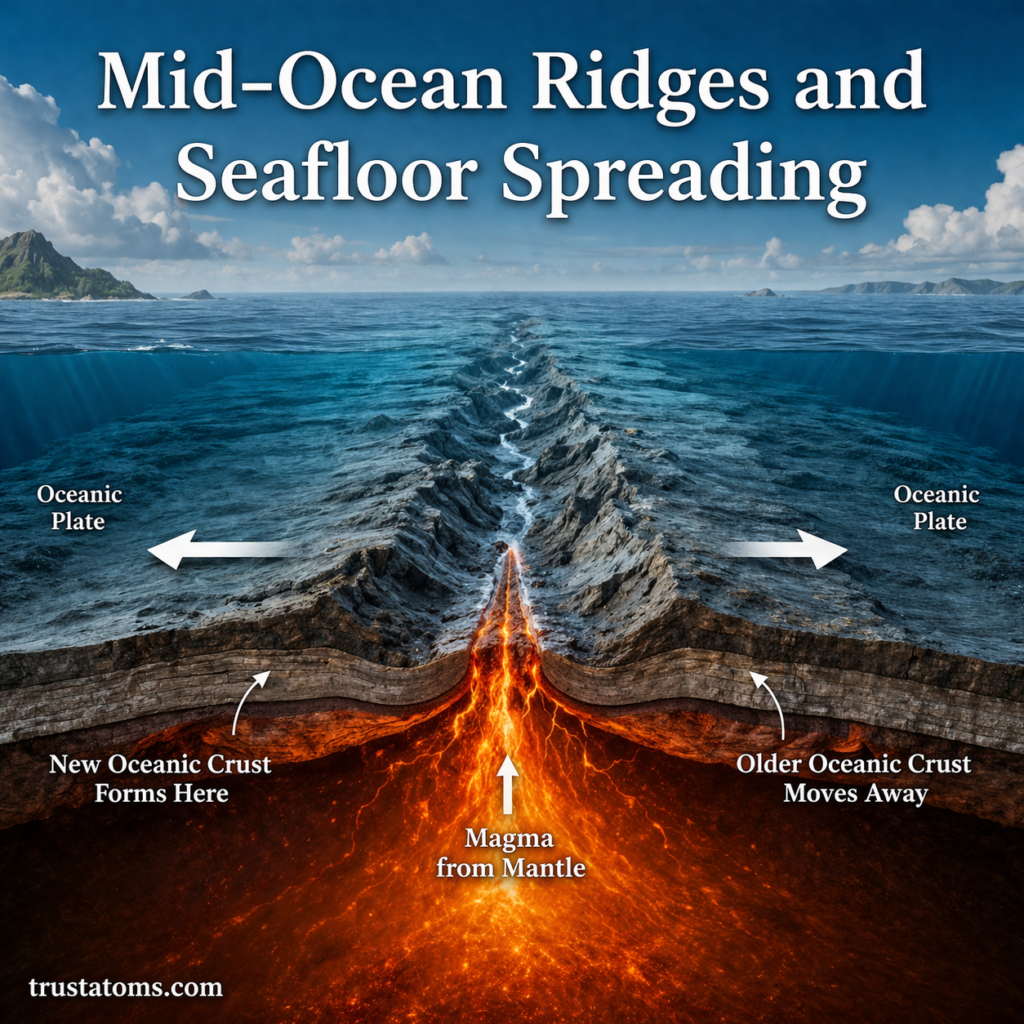
Mid-ocean ridges are underwater mountain chains formed where tectonic plates move apart, allowing magma to rise and create new oceanic crust. Seafloor spreading is the process by which this newly formed crust moves away from the ridge as the plates continue separating.
At these boundaries, oceanic crust is continuously created as part of the movement of tectonic plates. Studying these processes is an important part of Earth science because they explain how ocean basins develop, how the seafloor changes, and how Earth’s outer rocky shell moves.
What Are Mid-Ocean Ridges?
Mid-ocean ridges are extensive submarine mountain systems located along divergent plate boundaries. They form as hot mantle material rises beneath separating plates, partially melts, and supplies magma that builds new oceanic crust.
The global mid-ocean ridge system extends for approximately 65,000 kilometers (40,000 miles), making it Earth’s longest connected mountain system. Most of it lies beneath the ocean, although sections rise above sea level in places such as Iceland.
Ridge systems are associated with oceanic crust, which differs in thickness, composition, and density from continental crust. These distinctions are explored in Continental Crust vs Oceanic Crust.
Some ocean basins begin forming when continental crust stretches and splits. The early stages of this process, before a mature ocean ridge develops, are described in Rift Valleys and Continental Separation.
What Is Seafloor Spreading?
Seafloor spreading occurs when tectonic plates separate at an oceanic divergent boundary and new crust forms between them. Magma produced by partial melting of the upper mantle rises into the opening, cools, and solidifies into basalt and related igneous rocks.
As plate separation continues, the newly formed crust moves away from the ridge on both sides. The detailed processes of magma generation, crust formation, and plate separation are examined in Seafloor Spreading Mechanisms.
How New Oceanic Crust Forms
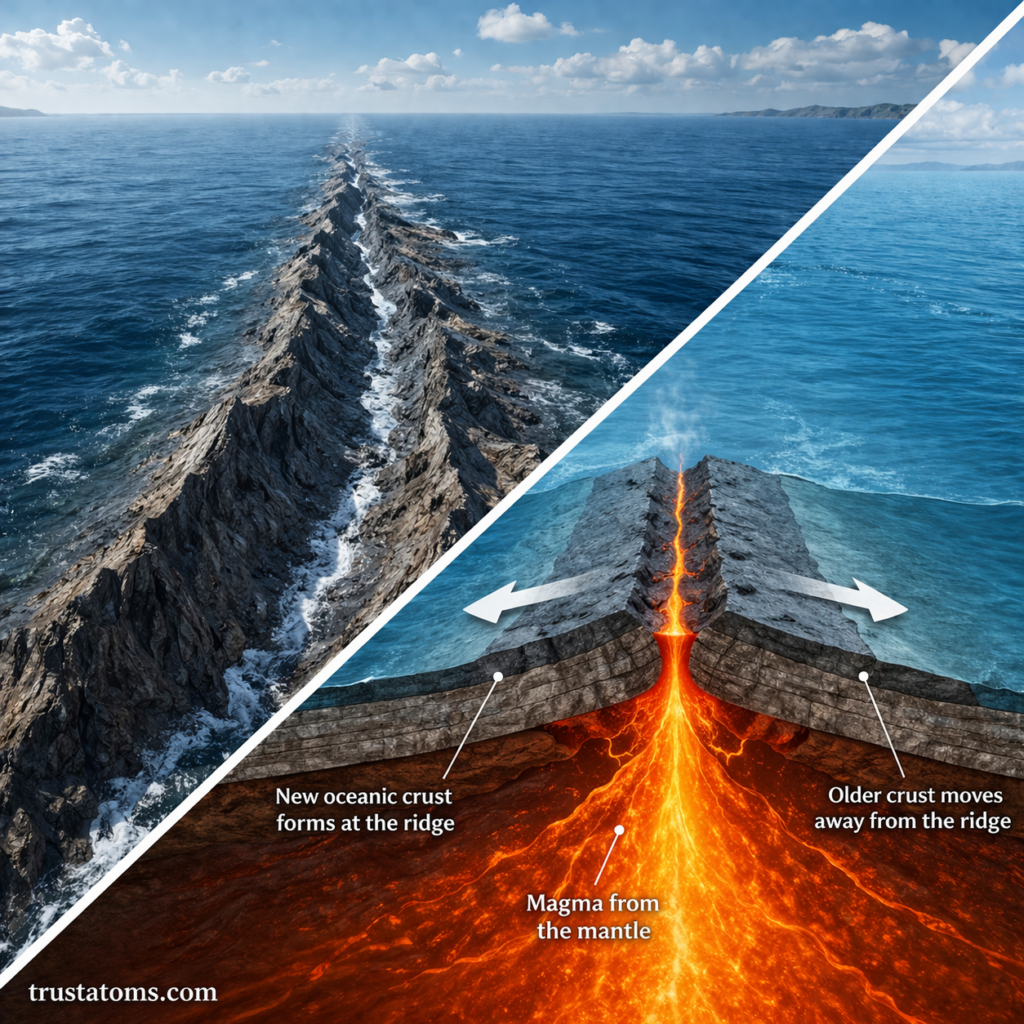
- Two oceanic plates move apart along a divergent boundary.
- Hot mantle rock rises beneath the ridge and undergoes partial melting as pressure decreases.
- Basaltic magma moves upward through fractures and magma reservoirs beneath the seafloor.
- Magma cools and crystallizes, adding new rock to the oceanic crust.
- Continued plate separation carries the newly formed crust away from the ridge axis.
This process is not simply magma pushing older crust aside. Plate movement results from interacting tectonic forces, including the pull of descending plates at subduction zones and gravitational forces associated with elevated ridge regions.
How Fast Does the Seafloor Spread?
Seafloor spreading rates vary between ridge systems. Slow-spreading ridges typically separate at a few centimeters per year, while fast-spreading systems can separate at more than 10 centimeters per year. These values generally describe the total separation rate across the ridge.
For example, if two plates separate at a combined rate of 4 centimeters per year, their distance increases by approximately 40 kilometers over one million years, assuming the rate remains constant. The movement is too slow to notice directly, but its accumulated effects can substantially change ocean basin dimensions.
Evidence That Confirms Seafloor Spreading
Scientists established seafloor spreading through several independent observations. Together, these findings demonstrate that oceanic crust forms near ridges and moves outward over time.
Magnetic Stripes on the Ocean Floor
As basalt cools, certain iron-bearing minerals preserve the direction of Earth’s magnetic field. Because the magnetic field has reversed repeatedly, successive bands of oceanic crust record alternating magnetic orientations.
These magnetic bands often form approximately symmetrical patterns on opposite sides of a ridge. Their arrangement provides strong evidence that new crust forms near the ridge axis and moves outward in both directions.
Oceanic Crust Becomes Older Away From Ridges
Radiometric dating and other geological evidence show that oceanic rocks are generally youngest near active spreading centers. Their ages increase with distance from the ridge, although faults and complex plate boundaries can disturb the pattern.
Heat Flow and Seafloor Depth
New oceanic lithosphere is relatively hot and buoyant near a ridge. As it moves outward, it cools, thickens, and becomes denser, causing the seafloor to subside. Heat-flow measurements and increasing water depth away from ridges support this cooling model.
Slow-Spreading and Fast-Spreading Ridges
Not all mid-ocean ridges have the same appearance. Spreading rate, magma supply, and fault activity influence their shape and structure.
| Feature | Slow-Spreading Ridge | Fast-Spreading Ridge |
|---|---|---|
| Typical example | Mid-Atlantic Ridge | East Pacific Rise |
| Central structure | Often has a prominent rift valley | Often has a broad axial high |
| Terrain | Rugged, with extensive faulting | Generally smoother ridge topography |
| Magma supply | Often more variable | Generally more continuous |
These are general patterns rather than absolute rules. Local geological conditions can produce substantial variations within the same ridge system.
Mid-Ocean Ridges and Plate Tectonics
Mid-ocean ridges are essential to the theory of plate tectonics, which explains the movement of Earth’s outer shell.
At divergent boundaries, new oceanic lithosphere develops as plates separate. Elsewhere, older oceanic lithosphere can descend into the mantle at subduction zones. These processes help explain how crust is created and recycled without requiring Earth’s surface to expand continuously.
Mid-ocean ridges also provide evidence of past plate movement. By measuring magnetic patterns and seafloor ages, geologists can reconstruct how ocean basins opened and how continents changed position according to plate tectonic reconstructions.
Hydrothermal Vents and Underwater Ecosystems
Seawater can circulate through fractures in hot oceanic crust near spreading centers. As it heats, it reacts with surrounding rock and may return to the seafloor carrying dissolved minerals.
At hydrothermal vents, mineral-rich fluids can support communities of microorganisms that obtain energy through chemical reactions rather than sunlight. Larger animals, including certain tube worms and shellfish, depend directly or indirectly on this chemosynthetic production.
Examples of Major Mid-Ocean Ridge Systems
Mid-Atlantic Ridge
The Mid-Atlantic Ridge extends through the Atlantic Ocean, separating the North American and Eurasian plates in the north and the South American and African plates in the south. It is generally a slow-spreading system with rugged terrain and prominent faulting.
East Pacific Rise
The East Pacific Rise is a major spreading center in the eastern Pacific Ocean. Its relatively rapid spreading produces a different ridge shape, often characterized by a broad elevated axis rather than a deep central rift valley.
Frequently Asked Questions
Do mid-ocean ridges cause earthquakes?
Yes. As plates separate and faults move, earthquakes occur along ridge systems and associated transform faults. Most earthquakes directly beneath spreading centers are relatively shallow because the surrounding rocks are hot.
Is new oceanic crust always forming at mid-ocean ridges?
Active spreading centers continually accommodate plate separation and produce new oceanic crust over time. Individual volcanic eruptions and magma intrusions are intermittent, however, rather than occurring uniformly at every location.
Why does the seafloor get deeper farther from a ridge?
New oceanic lithosphere is hot and relatively buoyant. As it ages, it loses heat, becomes denser, and subsides, generally increasing ocean depth with distance from the ridge until other geological processes modify the seafloor.
Mid-ocean ridges mark the boundaries where oceanic plates separate and mantle-derived magma creates new crust. Magnetic stripes, rock ages, and seafloor depth patterns provide independent evidence that this crust moves outward through seafloor spreading. Together, these observations explain how ocean basins develop and how Earth’s tectonic plates continue to reshape the planet.
Sources: U.S. Geological Survey (USGS), This Dynamic Earth: The Story of Plate Tectonics; National Oceanic and Atmospheric Administration (NOAA), Ocean Exploration; Encyclopaedia Britannica, Seafloor Spreading.