Water Transport in Plants

Educational illustration showing water transport in plants, including roots absorbing water from soil, water moving upward through xylem vessels in the stem, and water vapor exiting leaf stomata during transpiration.
Illustration demonstrating water transport in plants, showing root absorption, upward movement through xylem vessels, and water loss through stomata in leaves. trustatoms.com.

Water is essential for plant survival. It supports photosynthesis, maintains cell structure, transports nutrients, and helps regulate temperature. To move water efficiently from roots to leaves, plants rely on specialized tissues and physical processes that form a highly organized transport system.

This process, known as water transport in plants, primarily occurs through vascular tissues and involves mechanisms such as root absorption, capillary action, and transpiration. Together, these systems allow plants to move water upward against gravity.

Understanding how plants transport water is a key concept in plant biology and helps explain how plants grow and survive in diverse environments.

Continue reading “Water Transport in Plants”

Plant Hormones in Growth Regulation

Educational illustration showing plant hormones regulating growth, including stem elongation, seedling root development, fruit ripening, and hormone signaling within leaf tissues.
Illustration depicting how plant hormones regulate growth processes such as stem elongation, seedling development, fruit ripening, and cellular signaling in leaves. trustatoms.com.

Plants grow and develop through carefully coordinated biological processes. One of the most important systems controlling these processes is plant hormone signaling. Plant hormones, also called phytohormones, are chemical messengers that regulate growth, development, and responses to environmental conditions.

Even though they are produced in very small amounts, plant hormones influence many essential activities, including seed germination, stem elongation, leaf formation, flowering, fruit development, and responses to stress.

Understanding plant hormones in growth regulation is essential for plant biology, agriculture, and crop science.

Continue reading “Plant Hormones in Growth Regulation”

Chemical Signaling in Plant Systems

Educational illustration showing chemical signaling in plants, including signaling molecules moving through plant tissues, vascular transport in stems, defensive interactions with insects, and stomata responses on leaves.
Illustration depicting chemical signaling processes in plants, including hormone movement through vascular tissues, plant defense interactions with insects, and cellular signaling in leaf structures. trustatoms.com.

Plants may appear passive, but they constantly sense and respond to their environment. One of the primary ways they coordinate growth, defense, and development is through chemical signaling. Chemical signals allow plants to communicate internally between tissues and sometimes even externally with nearby organisms.

Through specialized molecules such as plant hormones and signaling compounds, plants can regulate processes like growth direction, flowering, stress responses, and defense against pests. These signaling systems help plants survive changing environmental conditions and maintain healthy development.

Understanding chemical signaling in plant systems is a central topic in plant biology and helps scientists improve agriculture, crop resilience, and ecosystem management.

Continue reading “Chemical Signaling in Plant Systems”

Plant Reproduction in Angiosperms

Educational illustration showing stages of plant reproduction in angiosperms, including a flowering plant releasing pollen, a bee pollinating a flower, fruit development, and seeds dispersing.
Illustration showing key stages of angiosperm reproduction, including flower pollination by a bee, fertilization within the flower, fruit formation, and seed dispersal. trustatoms.com.

Angiosperms are flowering plants that reproduce through specialized reproductive structures called flowers. They represent the largest and most diverse group of plants on Earth, including trees, grasses, fruits, vegetables, and ornamental flowers.

The reproductive process in angiosperms involves the production of pollen, the transfer of that pollen to a receptive flower, fertilization of ovules, and the development of seeds and fruits.

Understanding plant reproduction in angiosperms is essential for studying plant biology, agriculture, ecology, and food production.

Continue reading “Plant Reproduction in Angiosperms”

Competition in Ecological Communities

Educational illustration showing ecological competition, including deer competing for territory, plants competing for water and nutrients, birds competing for food, and predators competing over prey.
Illustration showing different forms of ecological competition among animals and plants, including competition for food, territory, and environmental resources. trustatoms.com.

In nature, organisms often compete with one another for limited resources. This interaction is known as competition, a key ecological process that influences how species survive, reproduce, and interact within ecosystems.

Competition occurs when two or more organisms require the same limited resource, such as food, water, sunlight, territory, or shelter. Because resources are finite, organisms must compete to obtain what they need to survive.

This process plays a major role in shaping ecological communities by affecting species populations, distribution, and evolutionary adaptations.

Continue reading “Competition in Ecological Communities”

What Is a Carnivore?

Educational illustration showing carnivorous animals hunting prey, including a lion catching an antelope, an eagle capturing a small mammal, a shark attacking a fish, and a praying mantis catching an insect.
Illustration showing examples of carnivores in different ecosystems, including mammals, birds, fish, and insects hunting animal prey. trustatoms.com.

A carnivore is an organism that primarily eats other animals. In biological terms, carnivores obtain most or all of their energy by consuming the flesh of other organisms.

Carnivores play an important role in ecosystems by controlling populations of herbivores and other animals. By doing so, they help maintain ecological balance and support healthy food webs.

Carnivorous animals exist across many environments, including forests, oceans, deserts, grasslands, and freshwater ecosystems. Examples range from large predators like lions and sharks to smaller carnivores such as spiders, frogs, and certain birds.

Continue reading “What Is a Carnivore?”

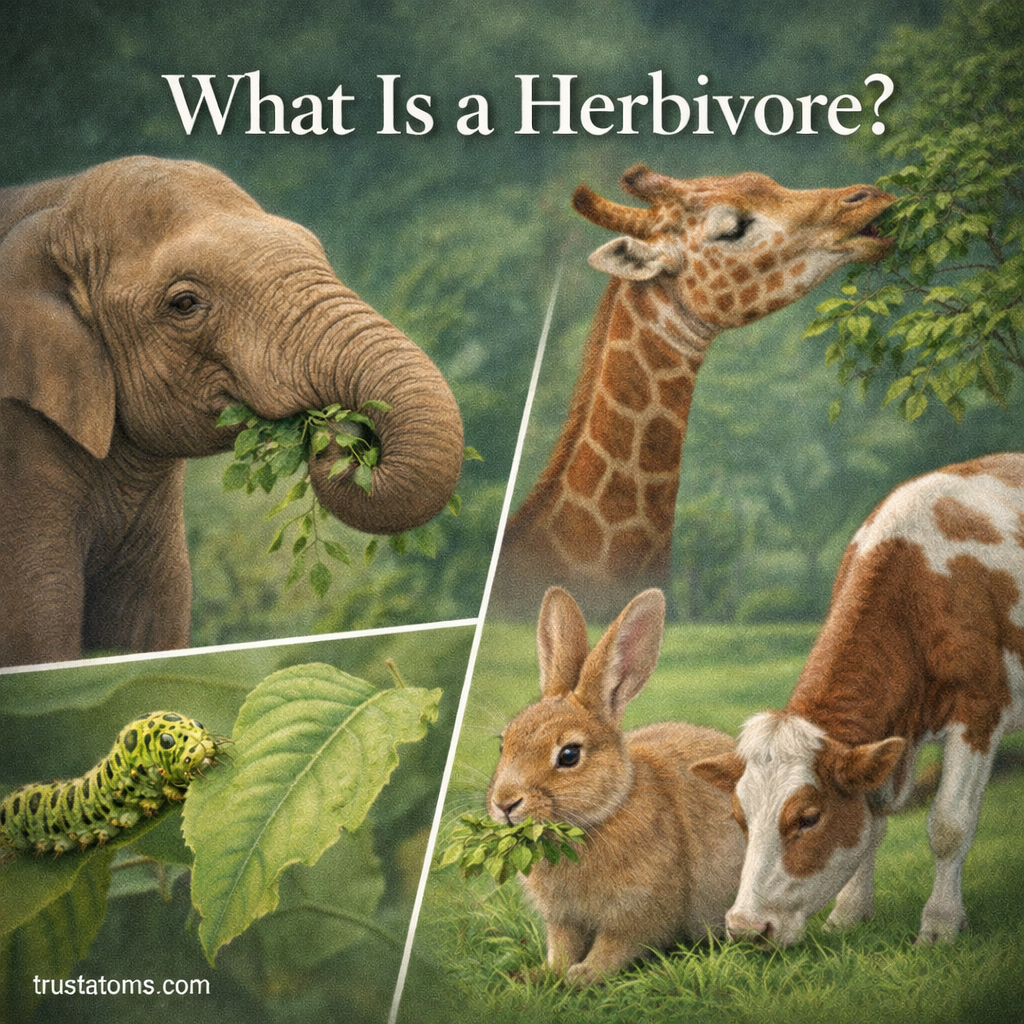
What Is a Herbivore?

Educational illustration showing herbivorous animals eating plants, including an elephant eating leaves, a giraffe feeding from a tree, a rabbit chewing grass, a cow grazing, and a caterpillar eating a leaf.
Illustration showing examples of herbivores that eat plants, including mammals and insects feeding on leaves and grass. trustatoms.com.

A herbivore is an organism that primarily eats plants. In biological terms, herbivores are animals that obtain energy and nutrients by consuming plant material such as leaves, stems, fruits, seeds, flowers, roots, and algae.

Herbivores play an important role in ecosystems because they transfer energy from producers—plants that create energy through photosynthesis—to higher levels of the food chain. Many herbivores are also prey for carnivores and omnivores, making them a key link in ecological food webs.

From large mammals like elephants and giraffes to small insects like caterpillars and grasshoppers, herbivores exist in nearly every ecosystem on Earth.

Continue reading “What Is a Herbivore?”

What Is a Predator?

Educational biology illustration showing different predators hunting prey, including a lion catching an antelope, an eagle swooping toward a mouse, a shark attacking a fish, and a praying mantis capturing an insect.
Illustration demonstrating examples of predators in different ecosystems, including mammals, birds, fish, and insects hunting prey. trustatoms.com.

In biology, a predator is an organism that hunts, kills, and eats another organism called its prey. This interaction is known as predation, one of the most important ecological relationships in nature.

Predators exist across nearly every ecosystem on Earth—from oceans and forests to grasslands and deserts. They include animals such as lions, wolves, sharks, spiders, and birds of prey, as well as some plants and microscopic organisms.

Predation helps maintain balance in ecosystems by controlling prey populations and shaping the evolution of species.

Continue reading “What Is a Predator?”

Parasitic Life Cycles in Host Organisms

Educational illustration showing the life cycle of parasites in host organisms, including intestinal worms releasing eggs and mosquitoes transmitting parasites between hosts.
Diagram illustrating parasitic life cycles, showing how parasites develop in hosts and spread through stages such as eggs, larvae, and transmission by insects. trustatoms.com.

Parasites survive and reproduce by living on or inside other organisms known as hosts. To maintain their populations, parasites follow specific biological patterns called life cycles. These cycles describe how parasites grow, reproduce, and move between hosts or environments.

Many parasites rely on complex life cycles that involve multiple developmental stages and sometimes several different host species. Understanding parasitic life cycles is important in biology, medicine, and ecology because it helps scientists understand how diseases spread and how organisms interact in ecosystems.

Continue reading “Parasitic Life Cycles in Host Organisms”

What Is a Parasite?

Illustration explaining what a parasite is, showing examples such as a tick feeding on skin, a tapeworm in the digestive system, protozoa under magnification, and insects that transmit parasites.
Educational illustration showing different types of parasites, including ectoparasites like ticks and fleas and internal parasites such as tapeworms and protozoa. trustatoms.com.

Parasites are organisms that survive by living on or inside another organism, known as a host. Unlike organisms that live independently, parasites rely on their host for food, protection, or reproduction.

This relationship typically benefits the parasite while harming the host to some degree. Parasites exist across many forms of life, including microscopic organisms, worms, and insects. They play important roles in biology, ecology, medicine, and evolutionary science.

Understanding parasites helps scientists study disease transmission, ecosystem balance, and how species evolve alongside one another.

Continue reading “What Is a Parasite?”