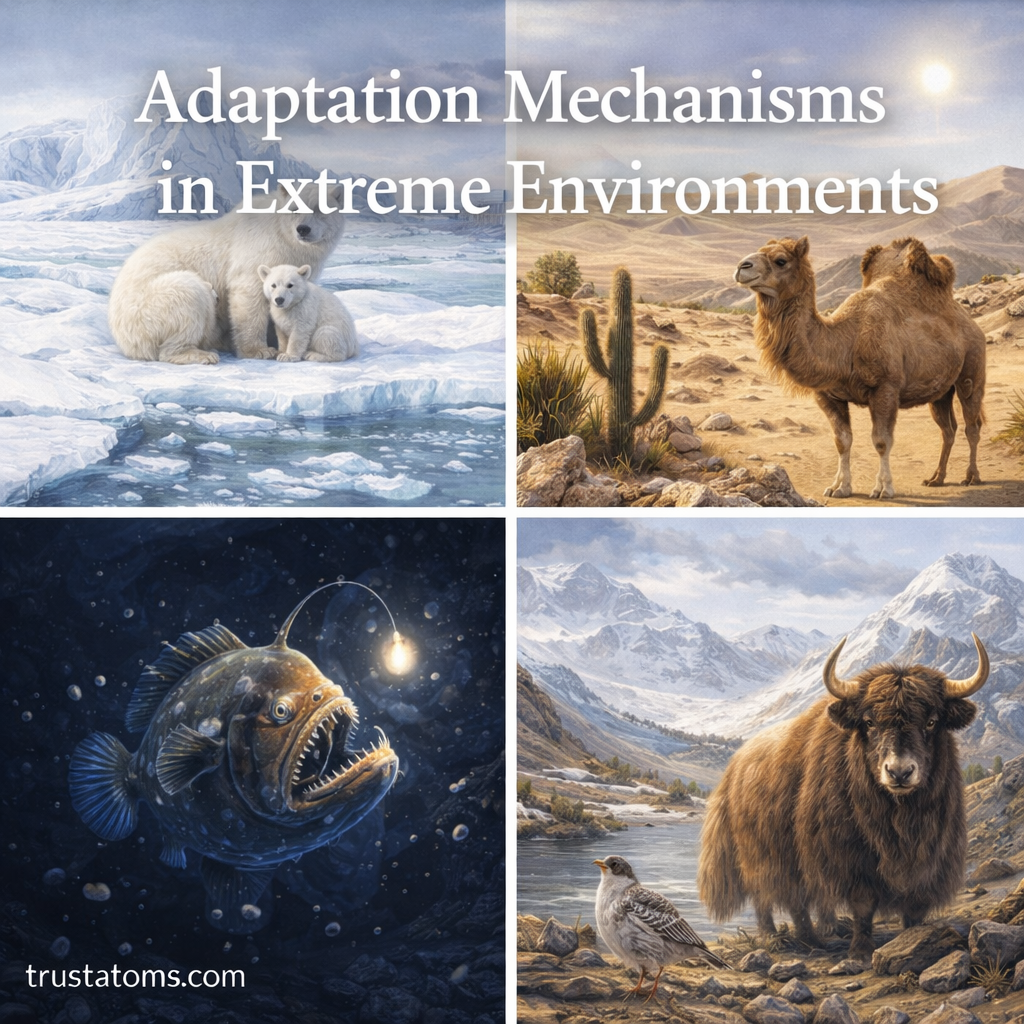
Adaptation Mechanisms in Extreme Environments

Illustration showing organisms adapted to extreme environments including polar bears in the Arctic, camels in deserts, deep-sea anglerfish, and high-altitude mammals.
Illustration showing how organisms adapt to extreme environments such as polar regions, deserts, deep oceans, and high-altitude ecosystems. trustatoms.com.

Life on Earth exists in environments that range from freezing polar regions to scorching deserts and deep ocean trenches. Despite these harsh conditions, many organisms survive and even thrive thanks to specialized biological adaptations.

Adaptation mechanisms in extreme environments are the physical, physiological, and behavioral strategies organisms develop to cope with environmental stress. These mechanisms allow life to persist where temperatures, pressure, salinity, radiation, or nutrient availability would normally make survival difficult.

Studying these adaptations helps scientists understand evolution, ecosystem resilience, and the limits of life on Earth.

Continue reading “Adaptation Mechanisms in Extreme Environments”
Environmental Stress in Biological Systems

Illustration showing wildfire, coral reef stress, drought-affected plants, and polluted environments representing environmental stress in biological systems.
Illustration showing multiple environmental stress factors including wildfire, drought, ocean pollution, and habitat disruption affecting biological systems. trustatoms.com.

Environmental stress refers to conditions in an ecosystem that challenge the survival, growth, or reproduction of living organisms. In biology, environmental stress occurs when organisms face factors such as extreme temperatures, limited resources, pollution, or habitat disruption.

All living organisms—from microorganisms to plants and animals—must constantly adapt to changes in their environment. When environmental conditions move beyond what organisms can tolerate, biological systems become stressed.

Understanding environmental stress helps scientists study ecosystem health, species adaptation, biodiversity, and the long-term stability of natural systems.

Continue reading “Environmental Stress in Biological Systems”

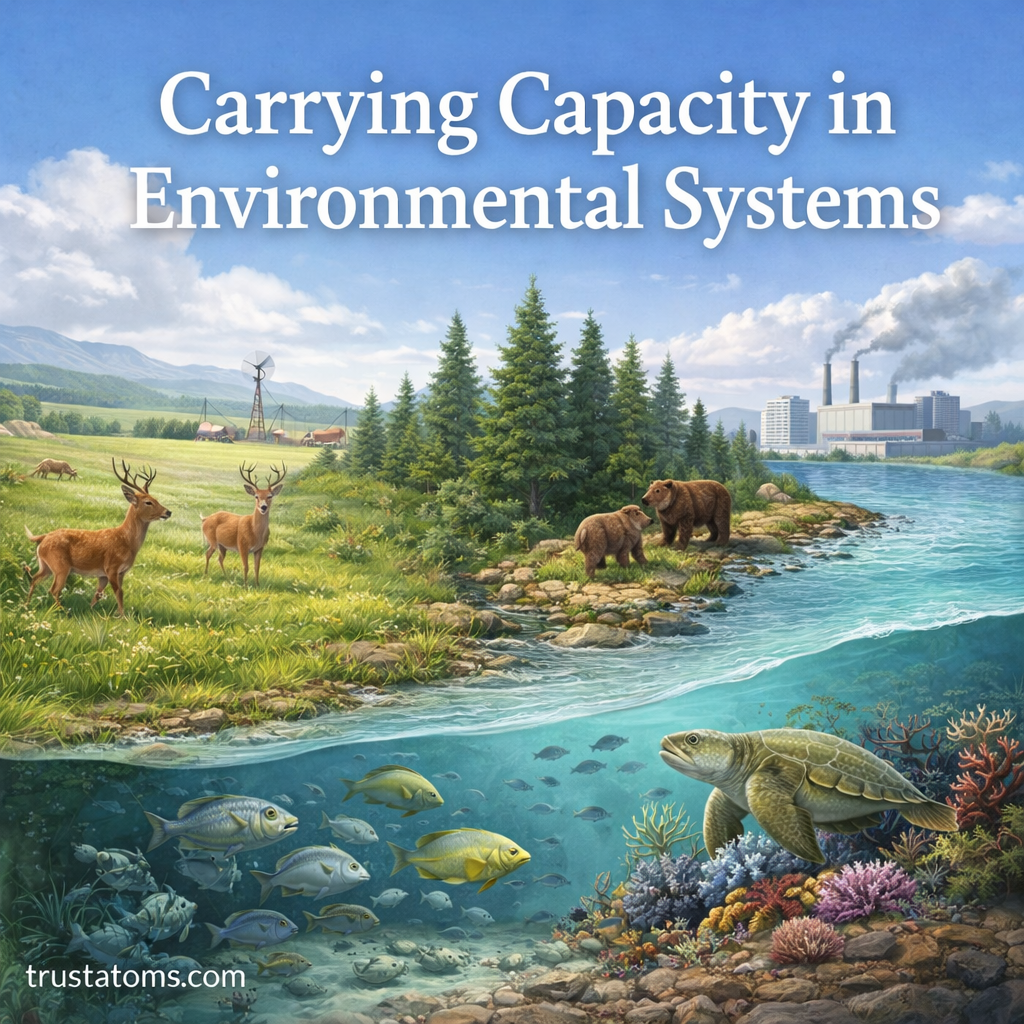
Carrying Capacity in Environmental Systems

Illustration showing forest, grassland, and ocean ecosystems with animals and plants demonstrating carrying capacity in environmental systems.
Illustration showing multiple ecosystems—including forests, grasslands, and oceans—demonstrating how environmental systems support limited populations based on available resources. trustatoms.com.

Carrying capacity is a foundational concept in environmental science and ecology. It describes the maximum population size of a species that an ecosystem can support sustainably over time without damaging the environment.

In environmental systems, resources such as food, water, space, and energy are limited. These limits naturally regulate population growth and help maintain ecological balance. When populations grow too large for available resources, ecosystems experience stress, and populations may decline.

Understanding carrying capacity helps scientists study sustainability, resource management, and long-term environmental stability.

Continue reading “Carrying Capacity in Environmental Systems”

What Is Carrying Capacity?

Illustration showing animals, fish, and plants in an ecosystem representing the concept of carrying capacity in biology.
Illustration showing how ecosystems support a limited number of organisms based on available resources. trustatoms.com.

Carrying capacity is a core concept in ecology that describes how many individuals of a species an environment can support over time. It explains why populations don’t grow endlessly and how natural limits shape ecosystems.

From forests and oceans to grasslands and lakes, every habitat has boundaries determined by resources such as food, water, space, and shelter. Understanding carrying capacity helps scientists study population growth, wildlife conservation, environmental sustainability, and ecosystem balance.

Continue reading “What Is Carrying Capacity?”

Population Structure in Genetic Analysis

Educational illustration showing groups of individuals, a world map, and DNA strands representing genetic variation and population structure in genetic analysis.
Illustration showing how genetic variation is distributed across populations, highlighting migration, gene flow, and DNA analysis in population genetics. trustatoms.com.

Population structure refers to the genetic organization of individuals within and between populations of a species. In genetic analysis, scientists study how genetic variation is distributed across groups of organisms and how factors like migration, reproduction, and environmental barriers influence these patterns.

Understanding population structure helps researchers explore evolutionary history, identify genetic diversity, track disease inheritance, and design effective conservation strategies.

Population genetics combines biology, statistics, and computational analysis to reveal how populations evolve over time.

Continue reading “Population Structure in Genetic Analysis”

Population Modeling in Ecology

Educational illustration showing wildlife populations, ecological maps, and growth trend charts representing population modeling in ecology.
Illustration showing how scientists use ecological data, wildlife observations, and modeling tools to predict population changes in ecosystems. trustatoms.com.

Population modeling is a scientific method used to predict how populations of organisms change over time. In ecology, researchers build mathematical or conceptual models that simulate population growth, decline, migration, and interactions with environmental factors.

These models help scientists understand complex biological systems and forecast how populations may respond to changes such as climate shifts, habitat loss, disease outbreaks, or conservation efforts.

Population modeling plays an important role in wildlife management, conservation biology, epidemiology, and environmental planning.

Continue reading “Population Modeling in Ecology”

Population Dynamics in Biological Systems

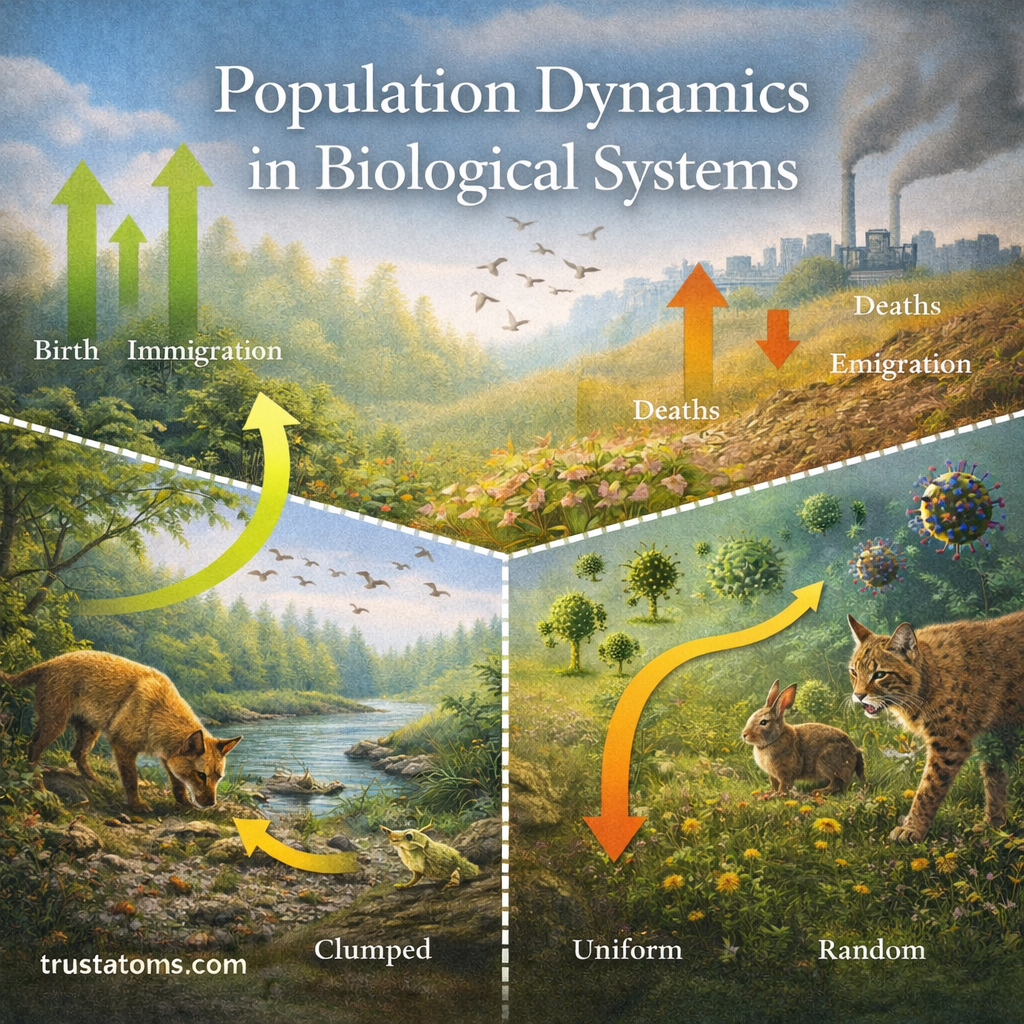
Educational biology illustration showing population dynamics with animals, ecosystems, and arrows representing births, deaths, immigration, and emigration.
Illustration explaining population dynamics in biological systems, showing how births, deaths, immigration, and emigration influence population changes in ecosystems. trustatoms.com.

Population dynamics is the study of how and why populations change over time. In biology and ecology, it focuses on the patterns of population growth, decline, stability, and interactions within ecosystems.

Scientists examine population dynamics to understand how species survive, reproduce, compete for resources, and respond to environmental changes. These patterns help researchers predict future population trends and manage ecosystems more effectively.

Population dynamics connects several important biological concepts, including population growth, environmental limits, species interactions, and evolutionary processes.

Continue reading “Population Dynamics in Biological Systems”

What Is Population Growth?

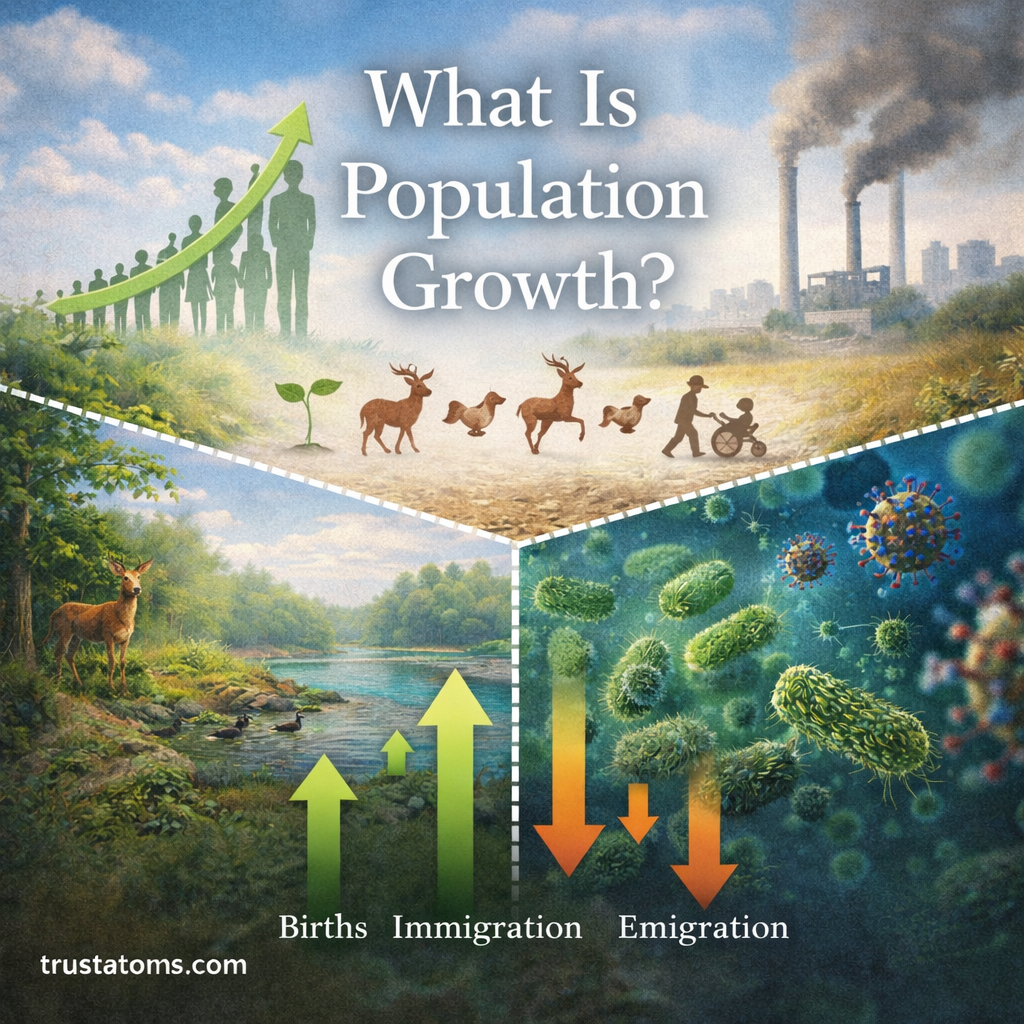
Educational illustration explaining population growth with animals, microbes, and environmental factors showing how populations increase or decrease over time.
Illustration explaining population growth in biology, showing how births, deaths, immigration, and emigration influence changes in population size. trustatoms.com.

Population growth refers to the increase or decrease in the number of individuals within a population over time. In biology and ecology, population growth is a key concept used to understand how species expand, stabilize, or decline within an environment.

Scientists study population growth to understand how organisms respond to environmental conditions, how ecosystems maintain balance, and how human activities influence wildlife and natural systems.

Population growth occurs through a combination of births, deaths, and the movement of individuals into or out of a population.

Continue reading “What Is Population Growth?”

What Is a Population in Biology?

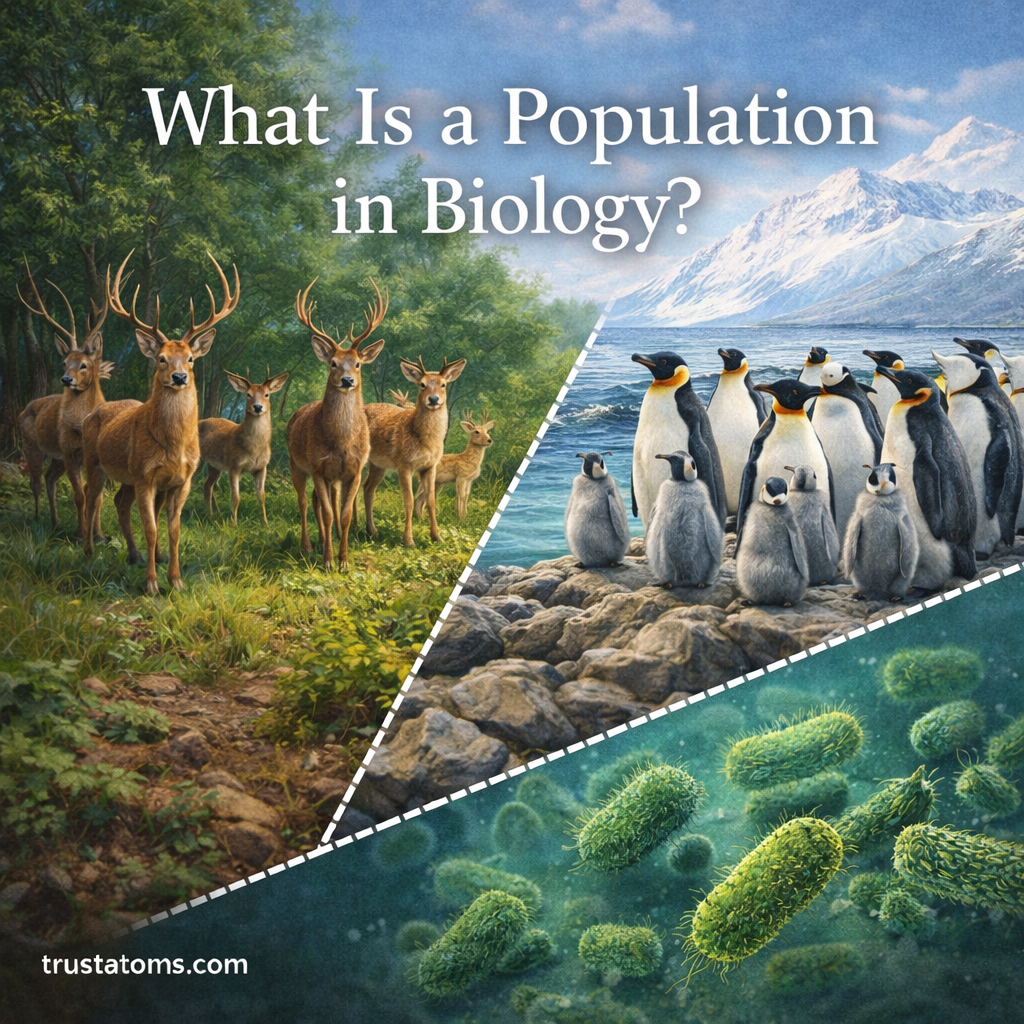
Educational illustration showing groups of deer, penguins, and bacteria representing biological populations of the same species living in shared environments.
Illustration showing examples of biological populations including deer in a forest, penguins in a coastal colony, and bacteria in a microscopic environment. trustatoms.com.

In biology, a population refers to a group of organisms of the same species that live in the same geographic area and interact with one another. Populations form the foundation of ecological and evolutionary studies because they represent the level at which biological processes such as reproduction, competition, and natural selection occur.

By studying populations, scientists can understand how species survive, grow, adapt, and respond to environmental changes.

Continue reading “What Is a Population in Biology?”

What Is a Species?

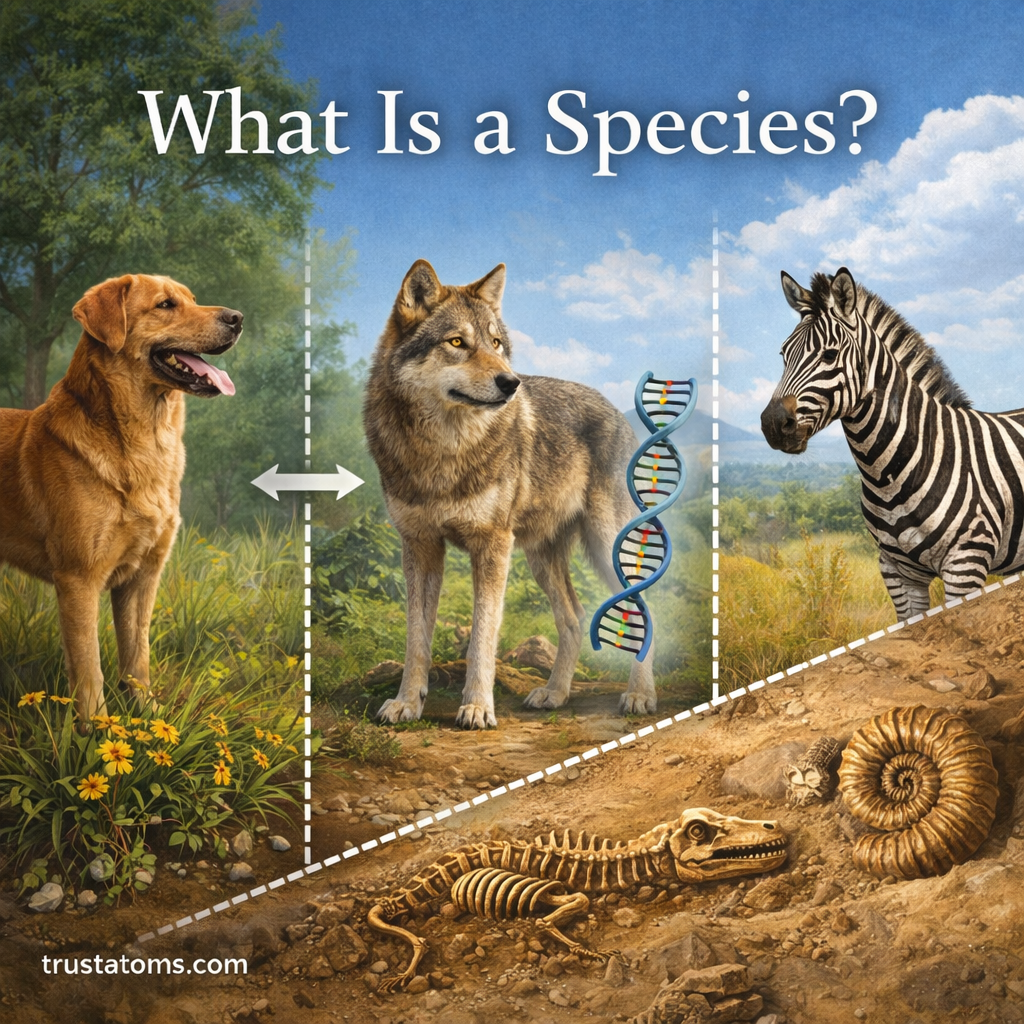
Educational biology illustration showing a dog, wolf, zebra, and fossils with DNA imagery to explain how scientists define a species.
Illustration explaining the biological concept of a species using animals, genetics, and fossil evidence to show how scientists classify organisms. trustatoms.com.

In biology, the concept of a species is one of the most fundamental ways scientists classify living organisms. A species represents a group of organisms that share common characteristics and can typically reproduce with one another to produce fertile offspring.

Understanding what a species is helps biologists organize biodiversity, study evolution, and understand how life on Earth changes over time.

However, defining a species is not always simple. While many organisms clearly belong to distinct species, others blur the boundaries through hybridization, genetic similarities, or evolutionary transitions.

Continue reading “What Is a Species?”