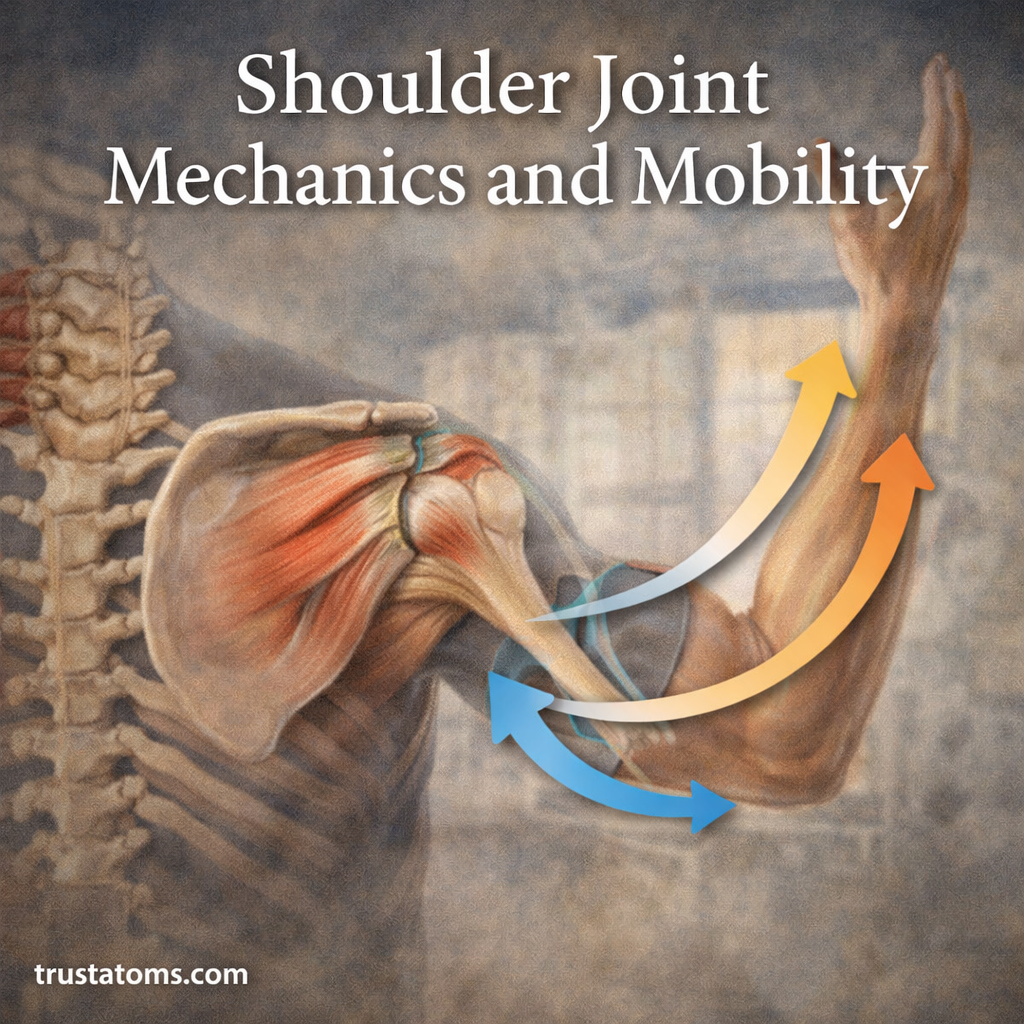
The shoulder joint is one of the most mobile and complex joints in the human body. It allows a wide range of motion necessary for daily activities such as reaching, lifting, throwing, and pushing. However, this high level of mobility comes with a trade-off—reduced stability compared to other joints.
Understanding shoulder joint mechanics and mobility helps explain how movement is produced, how injuries occur, and how to maintain long-term joint health.
Anatomy of the Shoulder Joint
The shoulder is not a single joint but a system of multiple structures working together.
Key Components
- Glenohumeral joint – the main ball-and-socket joint
- Acromioclavicular (AC) joint – connects the clavicle to the shoulder blade
- Sternoclavicular joint – connects the clavicle to the sternum
- Scapulothoracic articulation – movement of the shoulder blade over the rib cage
Bones Involved
- Humerus (upper arm bone)
- Scapula (shoulder blade)
- Clavicle (collarbone)
These structures work together to provide both mobility and support.
Range of Motion in the Shoulder
The shoulder has the greatest range of motion of any joint in the body.
Primary Movements
- Flexion – raising the arm forward
- Extension – moving the arm backward
- Abduction – lifting the arm away from the body
- Adduction – bringing the arm toward the body
- Internal rotation – rotating the arm inward
- External rotation – rotating the arm outward
- Circumduction – circular movement combining all motions
This wide range allows for complex and coordinated movements in sports and daily life.
Shoulder Joint Mechanics
Shoulder movement depends on coordinated interaction between joints, muscles, and connective tissues.
Ball-and-Socket Design
The glenohumeral joint is a ball-and-socket joint:
- The head of the humerus acts as the ball
- The glenoid cavity of the scapula acts as the socket
However, the socket is relatively shallow, which increases mobility but reduces stability.
Scapulohumeral Rhythm
One of the most important aspects of shoulder mechanics is scapulohumeral rhythm.
What It Means
- Movement of the humerus and scapula are coordinated
- For every 2 degrees of humeral movement, the scapula moves about 1 degree
Why It Matters
- Ensures smooth and efficient movement
- Maintains joint alignment
- Reduces strain on soft tissues
Disruption of this rhythm can lead to pain and dysfunction.
Muscles Involved in Shoulder Movement
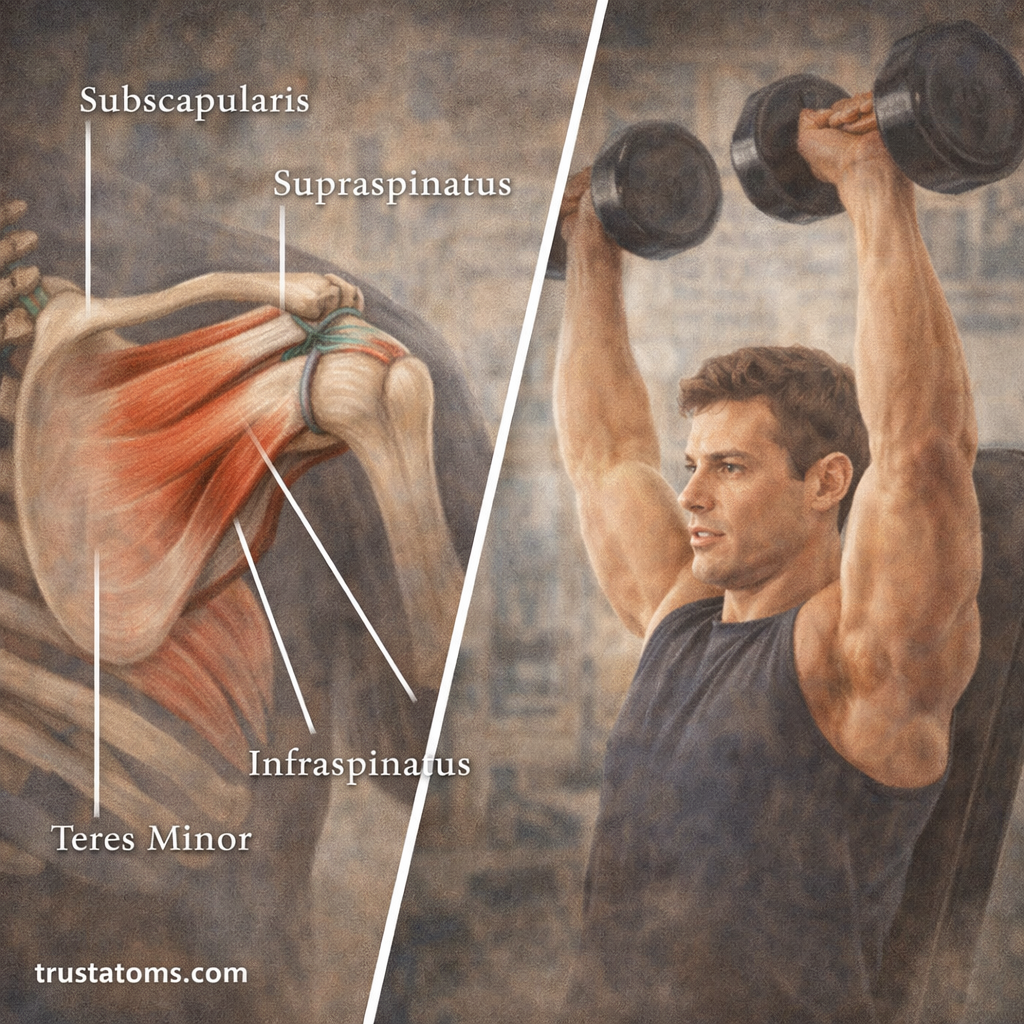
The shoulder relies on several muscle groups to produce and control movement.
Rotator Cuff Muscles
These muscles stabilize the shoulder joint:
- Supraspinatus – initiates abduction
- Infraspinatus – external rotation
- Teres minor – external rotation
- Subscapularis – internal rotation
Larger Shoulder Muscles
- Deltoid – primary mover for lifting the arm
- Pectoralis major – contributes to flexion and adduction
- Latissimus dorsi – extension and internal rotation
- Trapezius and serratus anterior – control scapular movement
Stability vs Mobility Trade-Off
The shoulder sacrifices stability for mobility.
Why the Shoulder Is Less Stable
- Shallow socket (glenoid cavity)
- High reliance on soft tissues
- Wide range of motion
How Stability Is Maintained
- Rotator cuff muscles keep the humeral head centered
- Ligaments provide passive support
- The labrum deepens the socket slightly
If these stabilizing structures weaken or are injured, instability can occur.
Factors That Affect Shoulder Mobility
Shoulder mobility depends on multiple factors:
1. Muscle Flexibility
- Tight muscles limit range of motion
- Balanced flexibility allows smooth movement
2. Joint Capsule Health
- The capsule surrounds the joint
- Stiffness can restrict mobility (e.g., frozen shoulder)
3. Scapular Function
- Proper movement of the scapula is essential
- Poor control reduces overall shoulder mobility
4. Posture
- Rounded shoulders and forward head posture limit movement
- Good posture supports proper mechanics
Common Shoulder Movement Patterns
The shoulder is involved in many functional movements.
Everyday Examples
- Reaching overhead (placing items on a shelf)
- Pushing movements (opening doors)
- Pulling movements (lifting objects)
- Throwing or swinging (sports activities)
Each movement requires coordination between muscles, joints, and the nervous system.
Common Shoulder Issues Related to Mechanics
Because of its complexity, the shoulder is prone to dysfunction.
Frequent Problems
- Impingement syndrome
- Rotator cuff injuries
- Shoulder instability or dislocation
- Frozen shoulder (adhesive capsulitis)
These issues often result from poor mechanics, overuse, or muscle imbalances.
Improving Shoulder Mobility and Function
Maintaining healthy shoulder mechanics requires a combination of strength, flexibility, and control.
Practical Strategies
- Stretch tight muscles (chest, shoulders)
- Strengthen the rotator cuff
- Improve scapular control
- Maintain good posture
- Use controlled, full-range movements
Consistency is key to improving mobility and preventing injury.
Final Thoughts
The shoulder joint is a remarkable structure that balances mobility and stability to enable a wide range of movements. Its mechanics depend on coordinated action between bones, muscles, and connective tissues.
By understanding how the shoulder works, you can improve movement efficiency, reduce injury risk, and maintain long-term joint health.