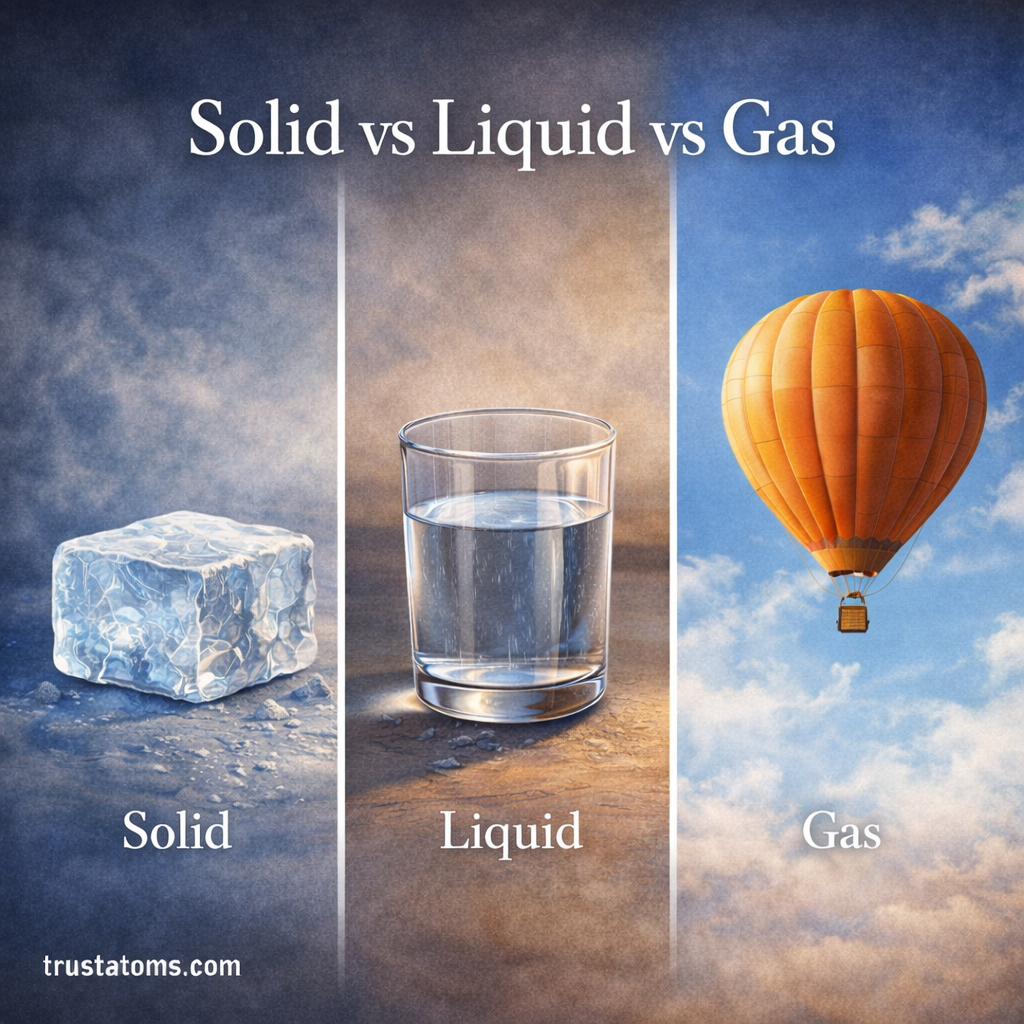
Matter exists in different physical forms known as states of matter. The three most familiar states are solid, liquid, and gas, and each behaves differently depending on how its particles are arranged and how much energy those particles have.
Understanding the differences between solids, liquids, and gases is a core concept in chemistry because it explains how substances behave, how materials change with temperature, and how molecules interact in different environments.
This guide explores the characteristics of solids, liquids, and gases, how they differ, and how matter transitions between these states.
What Are the Three States of Matter?
In basic chemistry, the three most common states of matter are:
- Solid
- Liquid
- Gas
Each state is defined by:
- The arrangement of particles
- The movement of particles
- The amount of energy particles contain
When heat or pressure changes, matter can shift from one state to another.
For example:
- Ice melts into water
- Water evaporates into steam
- Steam condenses back into liquid
These changes occur because particle energy and motion change.
Solids
A solid is a state of matter in which particles are tightly packed together and held in fixed positions.
Because of this structure, solids keep both their shape and volume.
Key Properties of Solids
Solids typically have:
- A fixed shape
- A fixed volume
- High density
- Strong intermolecular forces
- Very little particle movement
Particles in a solid vibrate slightly but generally stay in the same location.
Examples of Solids
Common solids include:
- Ice
- Wood
- Metal
- Glass
- Salt
- Rocks
Many solids form organized structures known as crystals, where atoms are arranged in repeating patterns.
Liquids
A liquid has a definite volume but does not maintain a fixed shape. Instead, it flows and takes the shape of the container holding it.
Particles in liquids remain close together but can move around one another.
Key Properties of Liquids
Liquids generally have:
- A fixed volume
- No fixed shape
- Moderate density
- Weaker intermolecular forces than solids
- Particles that slide past each other
This movement allows liquids to flow and be poured.
Examples of Liquids
Examples of liquids include:
- Water
- Oil
- Milk
- Alcohol
- Mercury
Liquids are often grouped with gases under the term fluids, because both can flow.
Gases
A gas is a state of matter in which particles are far apart and move freely at high speeds.
Because of this freedom of movement, gases do not have a fixed shape or volume.
Key Properties of Gases
Gases typically have:
- No fixed shape
- No fixed volume
- Very low density
- Weak intermolecular forces
- Rapid particle motion
Gas particles spread out to fill any available space.
Examples of Gases
Common gases include:
- Oxygen
- Nitrogen
- Carbon dioxide
- Hydrogen
- Helium
Air itself is a mixture made primarily of nitrogen and oxygen.
Particle Behavior in Each State

The key difference between solids, liquids, and gases lies in how particles behave.
Particle Movement
Particle motion increases as energy increases.
- Solids: particles vibrate in place
- Liquids: particles move around each other
- Gases: particles move freely in all directions
Particle Spacing
Particle spacing also changes between states.
- Solids: particles are tightly packed
- Liquids: particles are close but mobile
- Gases: particles are widely separated
These differences explain why gases expand easily while solids maintain rigid shapes.
Comparison of Solids, Liquids, and Gases
The three states can be compared by looking at several physical properties.
Shape
- Solid: fixed shape
- Liquid: takes shape of container
- Gas: fills entire container
Volume
- Solid: fixed volume
- Liquid: fixed volume
- Gas: no fixed volume
Particle Movement
- Solid: vibration only
- Liquid: sliding motion
- Gas: rapid free motion
Compressibility
- Solid: nearly incompressible
- Liquid: slightly compressible
- Gas: highly compressible
These differences arise from the spacing and forces between particles.
How Matter Changes Between States
Matter can change between solid, liquid, and gas through phase changes.
These transitions occur when heat energy is added or removed.
Common Phase Changes
- Melting – solid to liquid
- Freezing – liquid to solid
- Evaporation – liquid to gas
- Condensation – gas to liquid
- Sublimation – solid to gas
For example:
- Ice melting into water is melting.
- Water boiling into steam is evaporation.
- Water vapor forming droplets is condensation.
During these changes, the substance itself remains chemically the same.
Why Understanding States of Matter Is Important
The study of solids, liquids, and gases is fundamental to chemistry because it helps explain how materials behave under different conditions.
Understanding states of matter helps scientists:
- Predict chemical reactions
- Design new materials
- Study atmospheric processes
- Improve industrial manufacturing
- Understand biological systems
These principles apply everywhere—from cooking and weather patterns to advanced scientific research.
Everyday Examples of Solid, Liquid, and Gas
States of matter are constantly observed in daily life.
Examples include:
- Ice cubes melting in a drink
- Water boiling in a kettle
- Steam rising from hot food
- Air filling a balloon
- Gas bubbles forming in soda
These simple observations reflect the particle behavior described in chemistry.
Final Thoughts
Solids, liquids, and gases represent the three most familiar states of matter. Each state has unique properties based on how particles are arranged and how much energy they possess.
Solids maintain their shape, liquids flow while keeping their volume, and gases expand to fill their containers. By understanding these differences, scientists can explain how substances behave and how matter transitions between states.
This knowledge forms a foundation for studying chemistry, physics, materials science, and many natural processes that shape the world around us.