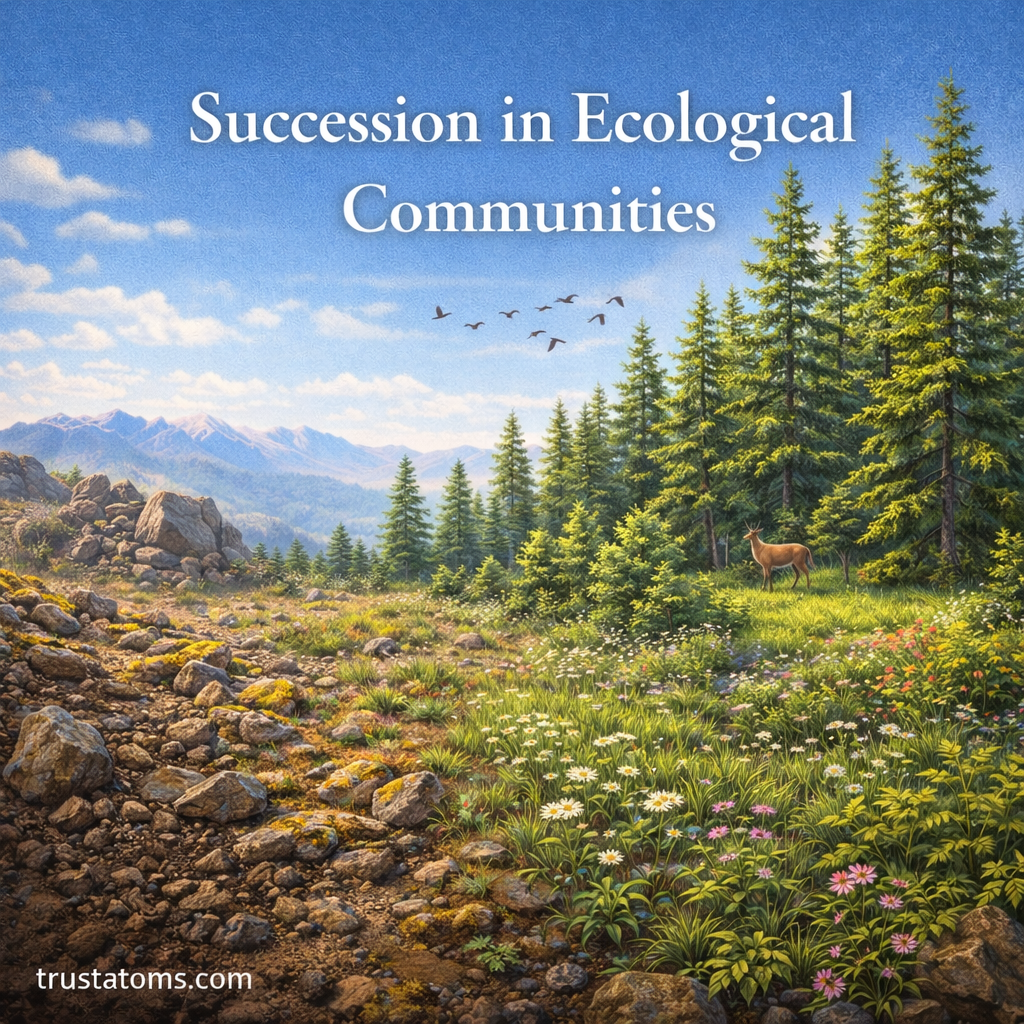
Ecological communities are constantly changing. Over time, plants, animals, and microorganisms gradually replace one another in an area through a natural process known as ecological succession. This process shapes ecosystems after disturbances such as volcanic eruptions, floods, fires, or human activity.
Succession helps ecosystems recover and rebuild, allowing new communities of organisms to develop and adapt to environmental conditions. By studying ecological succession, scientists gain insight into how ecosystems form, evolve, and maintain biodiversity.
What Is Ecological Succession?
Ecological succession is the gradual process by which species colonize, change, and develop within an ecosystem over time.
Instead of appearing all at once, ecological communities develop in stages. Different groups of organisms establish themselves, modify the environment, and create conditions that allow other species to thrive.
This process continues until the ecosystem reaches a relatively stable community.
Key characteristics of ecological succession include:
- Gradual change in species composition
- Increasing biodiversity over time
- Alteration of environmental conditions by organisms
- Development of complex ecological relationships
Why Ecological Succession Matters
Ecological succession plays a critical role in maintaining healthy ecosystems.
It helps ecosystems:
- Recover after disturbances
- Restore soil fertility
- Support biodiversity
- Rebuild food webs
- Stabilize environmental conditions
Without succession, ecosystems damaged by natural disasters or human activity would struggle to recover.
Types of Ecological Succession

Ecologists generally recognize two major types of succession depending on how the process begins.
Primary Succession
Primary succession occurs in areas where no previous ecosystem existed, often where the surface lacks soil.
Examples include:
- Newly formed volcanic islands
- Areas exposed by retreating glaciers
- Bare rock surfaces after landslides
- Newly formed sand dunes
Because soil is absent, only certain hardy organisms can colonize the area initially.
Pioneer Species
The first organisms to colonize these barren environments are known as pioneer species.
Common pioneer organisms include:
- Lichens
- Mosses
- Certain bacteria
- Hardy grasses
These organisms begin breaking down rock and producing organic material. Over time, this process creates soil that allows other plants to grow.
Development of the Ecosystem
As soil forms, larger plants gradually establish themselves.
The progression often follows this pattern:
- Pioneer species colonize bare surfaces.
- Soil begins to accumulate.
- Small plants and grasses appear.
- Shrubs begin to grow.
- Trees eventually dominate the ecosystem.
Primary succession can take hundreds or even thousands of years to develop fully.
Secondary Succession
Secondary succession occurs when an existing ecosystem is disturbed but soil remains intact.
Because soil and some organisms are already present, recovery occurs more quickly than in primary succession.
Common causes of secondary succession include:
- Forest fires
- Flooding
- Hurricanes
- Human land clearing
- Agricultural abandonment
After a disturbance, plants and animals gradually recolonize the area.
Early Stages of Secondary Succession
Fast-growing plants typically dominate the early stages.
Examples include:
- Grasses
- Weeds
- Small flowering plants
These species grow rapidly and help stabilize the soil.
Later Stages
As the ecosystem develops, larger plants begin to replace early colonizers.
The typical sequence may include:
- Grasses and small plants
- Shrubs and bushes
- Young trees
- Mature forests
Because soil and nutrients are already present, secondary succession may occur over decades rather than centuries.
Pioneer Species and Their Role
Pioneer species are crucial for starting ecological succession.
These organisms have special adaptations that allow them to survive in harsh environments.
Common pioneer characteristics include:
- Tolerance to extreme conditions
- Rapid reproduction
- Ability to grow in nutrient-poor environments
- High dispersal ability
By modifying the environment, pioneer species make the habitat suitable for more complex organisms.
For example:
- Lichens produce acids that slowly break down rock.
- Plants add organic matter to the soil.
- Roots stabilize soil and prevent erosion.
These changes gradually improve the environment for future species.
Climax Communities
Over time, ecological succession may lead to a relatively stable community called a climax community.
A climax community represents the final stage of succession under stable environmental conditions.
Characteristics of climax communities include:
- High biodiversity
- Complex food webs
- Stable populations
- Efficient nutrient cycling
Examples of climax communities vary depending on climate and location.
Examples include:
- Temperate deciduous forests
- Tropical rainforests
- Grasslands
- Coral reefs
Although considered stable, climax communities can still change due to disturbances or environmental shifts.
Factors That Influence Succession
Several factors influence the speed and direction of ecological succession.
Climate
Temperature, rainfall, and seasonal patterns affect which species can survive in an area.
Soil Conditions
Soil nutrients, moisture levels, and microbial activity influence plant growth.
Disturbances
Events such as fires, storms, or volcanic eruptions can reset or alter the succession process.
Species Interactions
Competition, predation, and mutualism shape how species establish and replace one another.
These factors create different ecological outcomes across ecosystems.
Ecological Succession and Biodiversity
Succession often increases biodiversity over time.
In early stages, ecosystems contain relatively few species. As the environment becomes more complex, additional species establish themselves.
Greater biodiversity provides several ecological benefits:
- Increased ecosystem stability
- Improved nutrient cycling
- More complex food webs
- Greater resilience to disturbances
Healthy ecosystems typically support a wide range of organisms across multiple trophic levels.
Human Influence on Ecological Succession
Human activities can alter or disrupt natural succession processes.
Examples include:
- Urban development
- Agriculture
- Logging
- Mining
- Pollution
In some cases, humans intentionally guide succession through ecological restoration.
Restoration efforts may include:
- Replanting native vegetation
- Rebuilding wetlands
- Controlling invasive species
- Reintroducing native animals
These efforts help ecosystems recover and regain biodiversity.
Examples of Ecological Succession
Ecological succession can be observed in many environments.
Volcanic Islands
After volcanic eruptions, bare rock gradually becomes colonized by lichens and plants, eventually forming forests.
Glacier Retreat
When glaciers melt, newly exposed land slowly develops plant communities through primary succession.
Forest Recovery After Fire
After wildfires, grasses and shrubs often appear first, followed by trees and forest ecosystems.
Abandoned Farmland
Fields left unused may gradually return to grasslands or forests through secondary succession.
These examples demonstrate how ecosystems naturally rebuild over time.
Key Takeaways
Ecological succession explains how ecosystems develop and recover through gradual changes in species composition.
Important points include:
- Succession describes the gradual development of ecological communities.
- Primary succession begins in areas without soil.
- Secondary succession occurs after disturbances where soil remains.
- Pioneer species initiate ecosystem development.
- Climax communities represent stable ecological stages.
- Environmental factors influence succession patterns.
Understanding succession helps scientists study ecosystem recovery and environmental change.
Final Thoughts
Succession in ecological communities is a powerful natural process that shapes landscapes and ecosystems across the planet. From barren rock to thriving forests, ecosystems evolve through predictable stages driven by biological interactions and environmental conditions.
By studying ecological succession, scientists gain valuable insights into ecosystem resilience, biodiversity, and long-term environmental change. This knowledge is essential for conserving ecosystems and restoring habitats affected by natural or human disturbances.