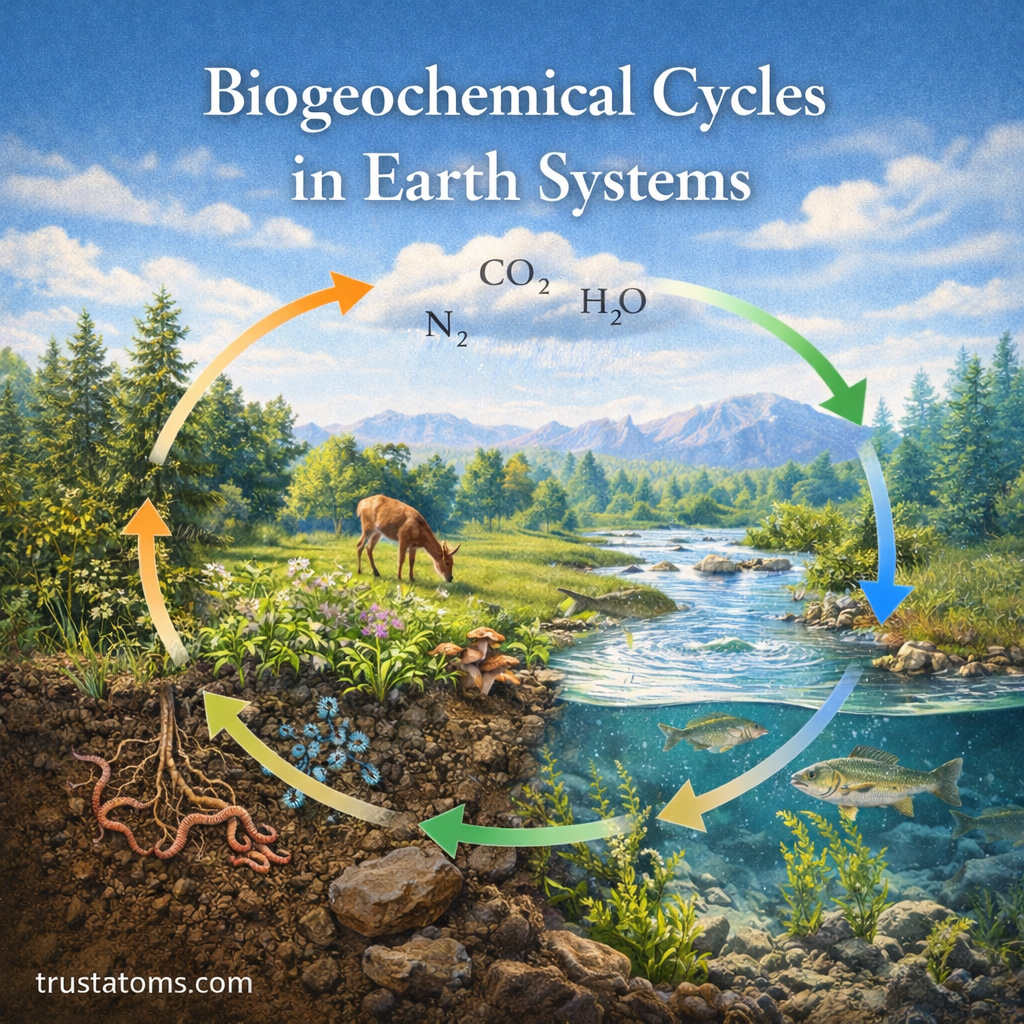
Biogeochemical cycles are natural processes that move and recycle chemical elements between living organisms, the atmosphere, water, soil, and rocks. These cycles keep essential nutrients such as carbon, nitrogen, and phosphorus available for biological processes, including growth, metabolism, and reproduction.
In the study of biology, biogeochemical cycles explain how living organisms interact with Earth’s nonliving systems. They connect the biosphere, atmosphere, hydrosphere, and geosphere, allowing nutrients to circulate through ecosystems and their food webs and support life.
Unlike energy, which flows through ecosystems and eventually disperses as heat, chemical elements are continually reused. However, nutrients do not always remain equally available: some become stored in rocks, sediments, or other reservoirs for long periods.
What Are Biogeochemical Cycles?
A biogeochemical cycle describes how a chemical element moves through living organisms and the physical environment through biological, geological, and chemical processes.
The term combines three components:
- Bio: Living organisms that absorb, transform, and release elements.
- Geo: Earth’s rocks, soils, sediments, and other physical reservoirs.
- Chemical: The elements and compounds exchanged between these systems.
For example, nitrogen may move from the atmosphere into soil bacteria, become part of a plant’s proteins, pass into an animal, and eventually return to the environment through waste or decomposition.
Microorganisms carry out many of these transformations. Microbial roles in nutrient cycling include decomposing organic matter and converting nitrogen between chemical forms.
Microbial ecology in environmental systems examines how microbial communities interact with soil, water, and other organisms to influence nutrient availability.
Some nutrient exchanges depend on close biological partnerships. Microbial symbiosis in environmental systems helps explain relationships such as those between nitrogen-fixing bacteria and certain plants.
The Four Earth Systems Involved in Nutrient Cycling
Biogeochemical cycles connect four major parts of Earth’s environment. Each acts as a reservoir, a transport pathway, or both.
| Earth System | What It Includes | Role in Nutrient Cycling |
|---|---|---|
| Biosphere | Plants, animals, fungi, and microorganisms | Absorbs, stores, transforms, and releases nutrients |
| Atmosphere | Gases surrounding Earth | Stores and transports carbon dioxide, nitrogen, and water vapor |
| Hydrosphere | Oceans, rivers, lakes, groundwater, and ice | Moves dissolved substances and stores water and nutrients |
| Geosphere | Rocks, sediments, minerals, and soil materials | Stores elements and releases them through weathering and other processes |
These systems constantly interact. Rainwater can dissolve minerals from rocks, carry them into soil, and make some of their elements available for plant uptake.
The Carbon Cycle: How Carbon Moves Through Earth
Carbon is a building block of carbohydrates, fats, proteins, and nucleic acids. The carbon cycle moves this element between organisms, the atmosphere, oceans, soils, and geological reservoirs.
Major carbon cycle processes include:
- Photosynthesis: Plants, algae, and some bacteria incorporate carbon dioxide into organic compounds.
- Consumption: Carbon moves through food webs when organisms eat plants or other organisms.
- Respiration: Organisms release carbon dioxide while extracting energy from organic molecules.
- Decomposition: Microorganisms break down organic material, releasing carbon dioxide or, under some conditions, methane.
- Ocean exchange: Carbon dioxide moves between the atmosphere and seawater.
Carbon can remain stored in forests, soils, oceans, carbonate rocks, and fossil fuels for very different lengths of time. Burning fossil fuels transfers carbon from geological reservoirs into the atmosphere, increasing atmospheric carbon dioxide concentrations.
The Nitrogen Cycle: Turning Atmospheric Nitrogen Into Usable Nutrients
Nitrogen is required to build proteins, DNA, RNA, and other cellular molecules. Although nitrogen gas makes up approximately 78% of Earth’s atmosphere, most organisms cannot use it directly.
The nitrogen cycle converts nitrogen into chemical forms that organisms can absorb and use.
Nitrogen Fixation
Specialized microorganisms convert atmospheric nitrogen gas into ammonia. In soil, ammonia commonly exists as ammonium ions, which can be used by plants or transformed by other microorganisms.
Some nitrogen-fixing bacteria live in root nodules of legumes, including peas and beans. Lightning and industrial fertilizer production also convert atmospheric nitrogen into reactive forms.
Nitrification and Assimilation
During nitrification, microorganisms oxidize ammonia or ammonium into nitrite and then nitrate. Plants can absorb nitrate and ammonium and incorporate their nitrogen into organic molecules.
Animals obtain nitrogen by eating plants or other animals. When organisms produce waste or die, decomposers return organic nitrogen to inorganic forms through mineralization, including ammonification.
Denitrification
Under low-oxygen conditions, certain microorganisms convert nitrate into gaseous nitrogen compounds, including nitrogen gas. This process returns nitrogen to the atmosphere and completes an important part of the cycle.
Other microbial pathways, including anammox, also contribute to nitrogen gas production in some environments.
The Phosphorus Cycle: Recycling a Nutrient Stored in Rocks
Phosphorus is needed for DNA, RNA, ATP, and phospholipids in cell membranes. Unlike carbon and nitrogen, phosphorus does not have a major gaseous phase in its usual environmental cycle.
Much of Earth’s phosphorus is stored in rocks and sediments. Weathering releases phosphate into soil and water, where organisms can absorb it.
Plants take up dissolved phosphate through their roots. Animals obtain phosphorus through food, and decomposers return it to the environment when organisms die or release waste.
Some phosphorus becomes buried in sediments and may eventually form new rocks. Geological processes can later expose these rocks to weathering, although this portion of the cycle operates much more slowly than biological nutrient uptake.
The Water Cycle: Moving Water and Dissolved Nutrients
The water cycle, also called the hydrologic cycle, describes the movement of water between Earth’s surface, atmosphere, and underground reservoirs.
Its major processes include:
- Evaporation: Liquid water changes into water vapor.
- Transpiration: Plants release water vapor, primarily through leaf stomata.
- Condensation: Water vapor forms liquid droplets or ice crystals in clouds.
- Precipitation: Water returns to Earth’s surface as rain, snow, or other forms.
- Runoff and infiltration: Water flows across land or enters soil and groundwater.
Water transports dissolved nutrients, influences soil chemistry, and connects terrestrial and aquatic environments. However, evaporation generally leaves most dissolved salts and nutrients behind rather than carrying them into the atmosphere.
A Real-World Example: Nitrogen Cycling in a Vegetable Garden
Consider a vegetable garden where a gardener grows beans, adds compost, and later plants leafy vegetables.
- Compatible bacteria living in bean root nodules convert atmospheric nitrogen into forms the plant can use.
- The bean plants incorporate nitrogen into proteins and other molecules as they grow.
- After harvest, remaining roots and plant material decompose, releasing some nitrogen back into the soil.
- Soil microorganisms convert part of that nitrogen into ammonium and nitrate.
- Later crops absorb available nitrogen through their roots.
Not all nitrogen remains in the garden. Some leaves through harvested crops, leaching, or gaseous losses. The example shows how biological recycling can improve nutrient availability without creating new nitrogen atoms.
How Human Activities Change Biogeochemical Cycles

Human activities can change how quickly elements move between reservoirs and how much of a nutrient becomes available in a particular environment.
Burning fossil fuels releases carbon dioxide that had been stored underground. Deforestation changes carbon storage in vegetation and soils while reducing carbon uptake in affected areas.
Agricultural fertilizers add reactive nitrogen and phosphorus to soils. When excess nutrients enter lakes, rivers, or coastal waters, they can stimulate excessive algal growth.
This process, called eutrophication, may lead to oxygen depletion as microorganisms decompose the resulting organic matter. Low oxygen levels can harm fish and other aquatic organisms.
Wastewater management, careful fertilizer application, erosion control, and protection of wetlands can help reduce nutrient pollution.
How Nutrient Cycles Support Ecosystem Stability
Healthy ecosystems depend on balanced nutrient cycling. When these cycles function properly, ecosystems can support diverse plant and animal populations.
Recycling nutrients helps maintain soil fertility, supports plant productivity, and supplies the chemical elements needed throughout food webs.
However, more nutrients do not always mean a healthier ecosystem. Too little nitrogen or phosphorus can limit plant growth, while excessive inputs can alter species composition and damage aquatic environments.
Scientists therefore examine both nutrient availability and the rates at which elements enter, leave, and move through ecosystems. Changes in these rates can affect productivity, biodiversity, and recovery after disturbances.
Frequently Asked Questions
What are the four major biogeochemical cycles?
The four commonly taught cycles are the carbon, nitrogen, phosphorus, and water cycles. Other important cycles include sulfur and oxygen cycling. Each involves different reservoirs and chemical transformations.
Why are microorganisms important in biogeochemical cycles?
Microorganisms decompose organic matter and carry out chemical transformations that many plants and animals cannot perform. For example, specialized bacteria and archaea participate in nitrogen fixation, nitrification, and denitrification.
What is the difference between energy flow and nutrient cycling?
Energy enters ecosystems, passes through organisms, and eventually disperses as heat. Chemical elements are conserved and can be repeatedly transferred between organisms and environmental reservoirs, although some may remain unavailable for long periods.
Biogeochemical cycles connect biological activity with the movement of elements through air, water, soil, and rock. Carbon cycling influences atmospheric composition, nitrogen and phosphorus cycling affect nutrient availability, and the water cycle transports materials between environments. Understanding these connections helps explain both ecosystem productivity and environmental problems such as nutrient pollution and climate change.
Sources: OpenStax, Biology 2e; U.S. Geological Survey, Water Science School; NASA Earth Observatory, The Carbon Cycle.