Earth’s continents may seem fixed, but over geologic time they are constantly moving, colliding, and separating. This long-term process is known as the continental cycle (or supercontinent cycle), and it has shaped the planet’s surface for billions of years.
At certain points in this cycle, most of Earth’s landmass joins together to form a supercontinent—a single massive landmass that dramatically influences climate, oceans, and life.
What Is a Supercontinent?
A supercontinent is a massive landmass made up of multiple continents that have merged together through tectonic plate movement.
Key Characteristics
- Contains most of Earth’s continental crust
- Forms through large-scale plate collisions
- Exists for tens to hundreds of millions of years
- Eventually breaks apart due to internal Earth processes
Supercontinents are temporary stages in a much larger geological cycle.
Understanding the Continental Cycle
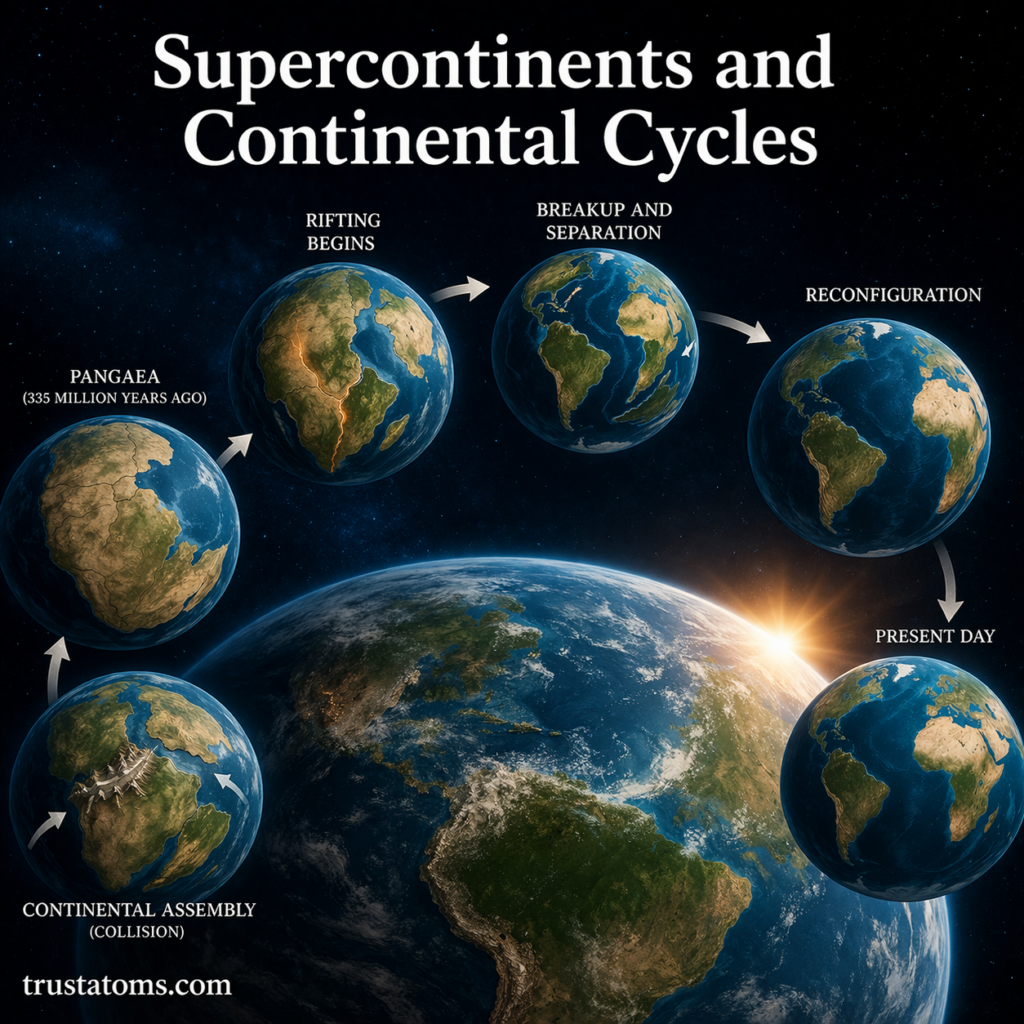
The continental cycle describes how continents repeatedly assemble into supercontinents and then break apart.
The Main Stages
- Continental Movement
Tectonic plates slowly move across Earth’s surface. - Convergence and Collision
Continents collide, forming mountain ranges and merging into a supercontinent. - Stable Phase
The supercontinent remains intact for millions of years. - Rifting Begins
Heat builds beneath the crust, causing it to stretch and crack. - Breakup and Separation
New oceans form as continents drift apart. - Reconfiguration
Continents move into new positions, eventually leading to another collision phase.
Famous Supercontinents in Earth’s History
Pangaea
- Formed about 335 million years ago
- Included nearly all modern continents
- Surrounded by a vast ocean called Panthalassa
- Broke apart around 175 million years ago
Pangaea is the most well-known supercontinent because its remnants are still visible in today’s continental shapes.
Rodinia
- Formed around 1 billion years ago
- Broke apart roughly 750 million years ago
- Associated with major climate shifts, including possible “Snowball Earth” conditions
Columbia (Nuna)
- Existed approximately 1.8 to 1.5 billion years ago
- One of the earliest known supercontinents
- Evidence is less complete due to its age
These supercontinents show that Earth has gone through multiple cycles of assembly and breakup.
What Drives the Continental Cycle?
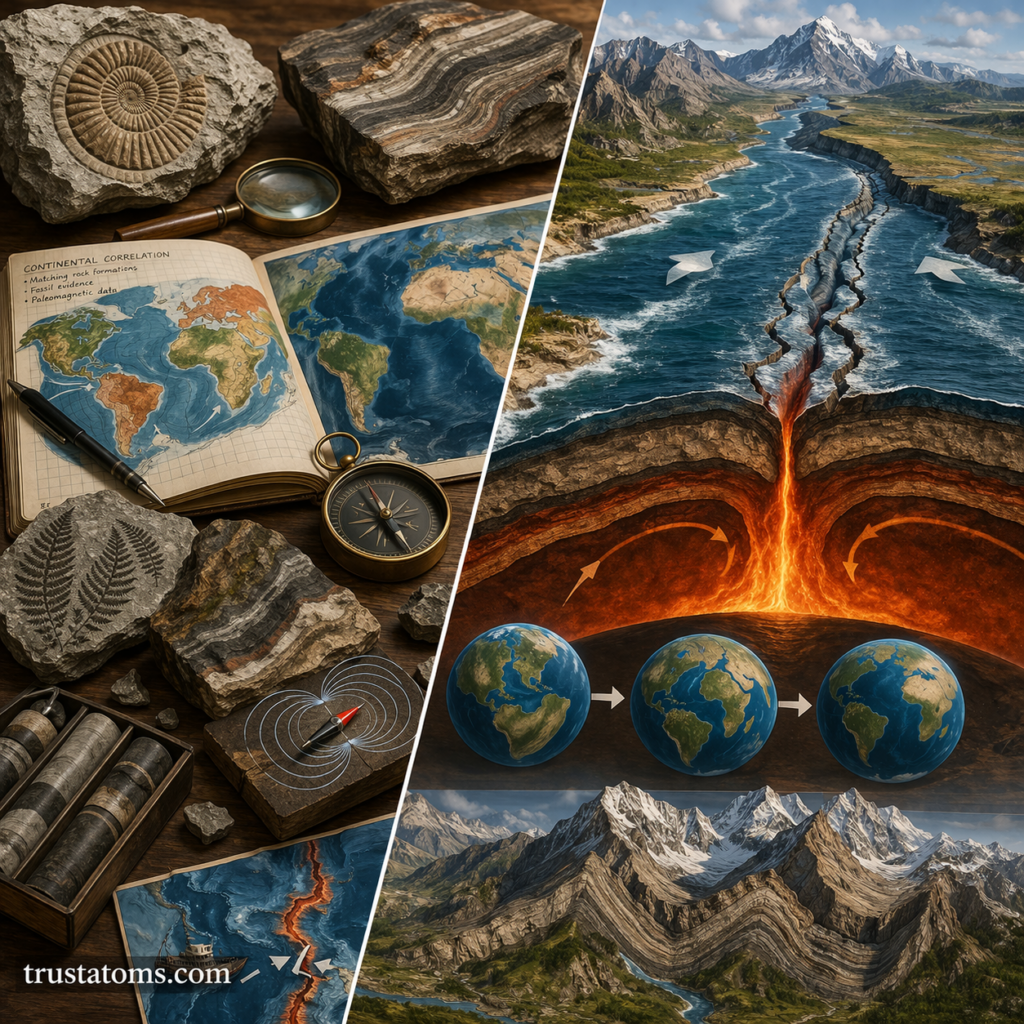
The movement of continents is powered by forces deep within Earth.
Mantle Convection
- Heat from Earth’s core causes mantle material to circulate
- Rising and sinking currents move tectonic plates
Plate Tectonics
- Earth’s crust is divided into moving plates
- Plates interact at boundaries:
- Convergent (colliding)
- Divergent (separating)
- Transform (sliding past each other)
Additional Forces
- Slab pull: sinking oceanic plates pull others along
- Ridge push: new crust formation pushes plates outward
Together, these forces drive the continuous reshaping of Earth’s surface.
Climate Effects of Supercontinents
Supercontinents can significantly alter global climate patterns.
Interior Climate Extremes
- Large landmasses have areas far from oceans
- Leads to dry, hot deserts or cold interiors
Ocean Circulation Changes
- Supercontinents disrupt ocean currents
- Affects heat distribution around the globe
Reduced Coastal Influence
- Fewer coastlines limit moderating ocean effects
Potential for Ice Ages
- Certain configurations can promote widespread glaciation
Impact on Life and Biodiversity
The continental cycle has a strong influence on the evolution of life.
Species Migration
- Connected continents allow organisms to spread widely
Isolation and Evolution
- Breakup separates populations
- Leads to new species through evolution
Habitat Changes
- Mountain formation creates new ecosystems
- Changing coastlines affect marine life
Extinction Events
- Environmental changes during breakup phases may contribute to mass extinctions
Evidence for Supercontinents and Continental Cycles
Scientists use multiple types of evidence to reconstruct Earth’s past.
Geological Clues
- Matching rock formations across continents
- Mountain belts formed by past collisions
Fossil Records
- Identical fossils found on distant continents
Paleomagnetism
- Magnetic signatures in rocks reveal past continental positions
Seafloor Spreading
- Age patterns of ocean crust show how plates move
The Future: Will Another Supercontinent Form?
Yes—scientists believe another supercontinent will eventually form.
Possible Future Supercontinents
- Amasia: continents merge near the Arctic
- Pangaea Proxima: continents reunite in a new configuration
- Novopangaea: driven by current plate motions
Although these scenarios differ, they all support the idea that the continental cycle will continue.
Key Takeaways
- Supercontinents are large landmasses formed by merging continents
- The continental cycle describes repeated assembly and breakup over geologic time
- Plate tectonics and mantle convection drive this process
- Supercontinents influence climate, ocean systems, and life
- Evidence includes fossils, rocks, magnetic data, and seafloor patterns
Final Thoughts
Supercontinents and continental cycles reveal that Earth is far from static. Over immense timescales, continents drift, collide, and reshape the planet in dramatic ways.
By studying these patterns, scientists gain insight into Earth’s past—and a clearer understanding of how the planet may continue to evolve in the future.