The human eye is a highly specialized organ designed to capture light and convert it into meaningful visual information. From detecting brightness and color to recognizing shapes and motion, the vision system works through a coordinated process involving multiple eye structures and neural pathways.
Understanding how the eye is built—and how it processes light—offers valuable insight into how we perceive the world around us.
Overview of the Vision System
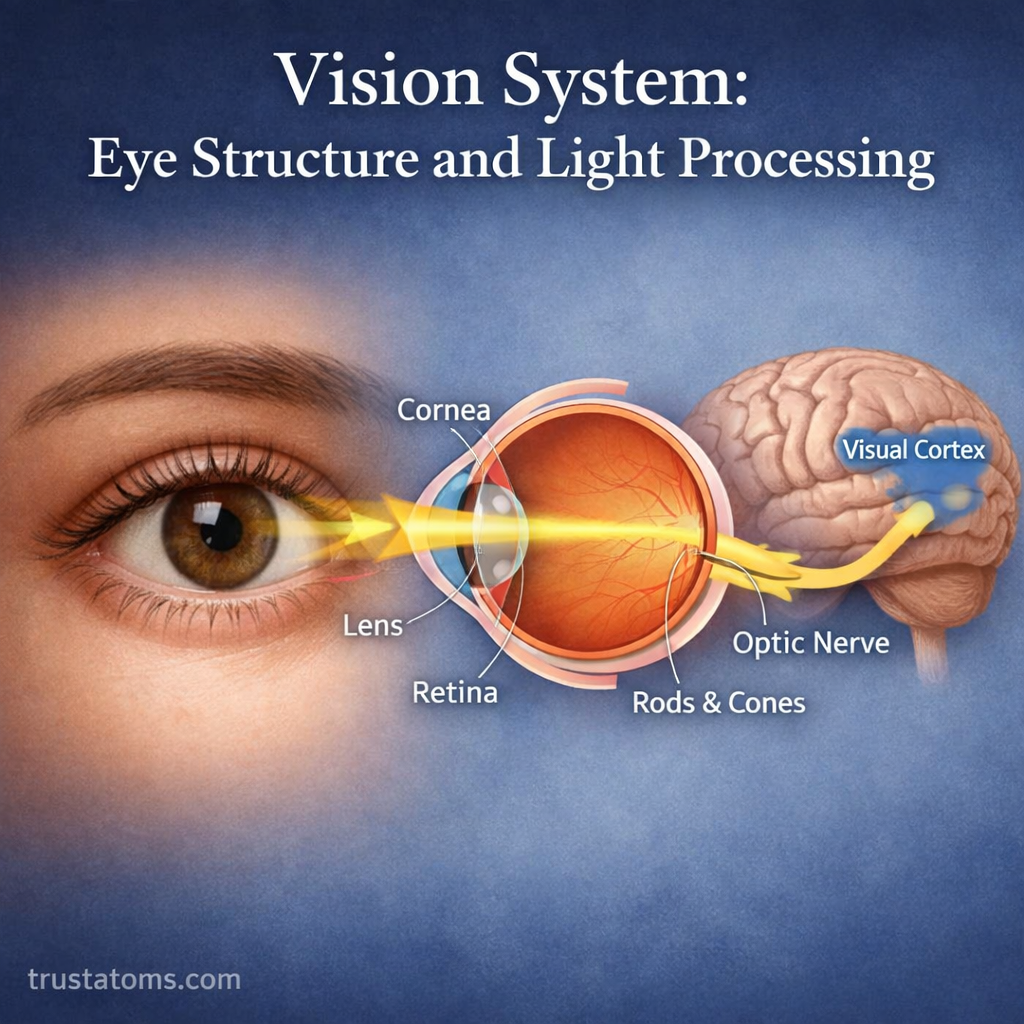
The vision system includes:
- The eyes (sensory organs that detect light)
- The optic nerves (transmit signals)
- The visual cortex in the brain (interprets images)
The process of vision begins when light enters the eye and ends when the brain constructs a visual image.
External Structure of the Eye
The outer components of the eye protect and support its function.
Key External Features
- Sclera
The white, tough outer layer that maintains eye shape and provides protection. - Cornea
A transparent front surface that allows light to enter and begins focusing it. - Conjunctiva
A thin membrane covering the sclera and inner eyelids, helping lubricate the eye.
Internal Structure of the Eye
Inside the eye are specialized structures responsible for focusing light and detecting visual signals.
Major Internal Components
Iris and Pupil
- Iris
The colored part of the eye that controls light entry. - Pupil
The opening at the center of the iris that adjusts size based on light intensity.- Bright light → pupil constricts
- Dim light → pupil dilates
Lens
- A flexible, transparent structure that fine-tunes focus.
- Changes shape through a process called accommodation to focus on near or distant objects.
Retina
- A light-sensitive layer at the back of the eye.
- Contains specialized cells called photoreceptors.
Photoreceptors and Light Detection
The retina contains two main types of photoreceptors:
Rods
- Highly sensitive to light
- Enable vision in low-light conditions
- Do not detect color
- Important for peripheral vision
Cones
- Responsible for color vision
- Function best in bright light
- Provide sharp, detailed vision
- Concentrated in the fovea (center of the retina)
Path of Light Through the Eye
Light follows a precise path before it is converted into neural signals.
Step-by-Step Process
- Light enters through the cornea
The cornea bends (refracts) incoming light. - Passes through the aqueous humor
A clear fluid that maintains pressure and nourishes the eye. - Moves through the pupil
Controlled by the iris to regulate light intensity. - Focused by the lens
Adjusts shape to sharpen the image. - Travels through the vitreous humor
A gel-like substance that helps maintain eye structure. - Reaches the retina
Light is detected by rods and cones.
Conversion of Light to Neural Signals
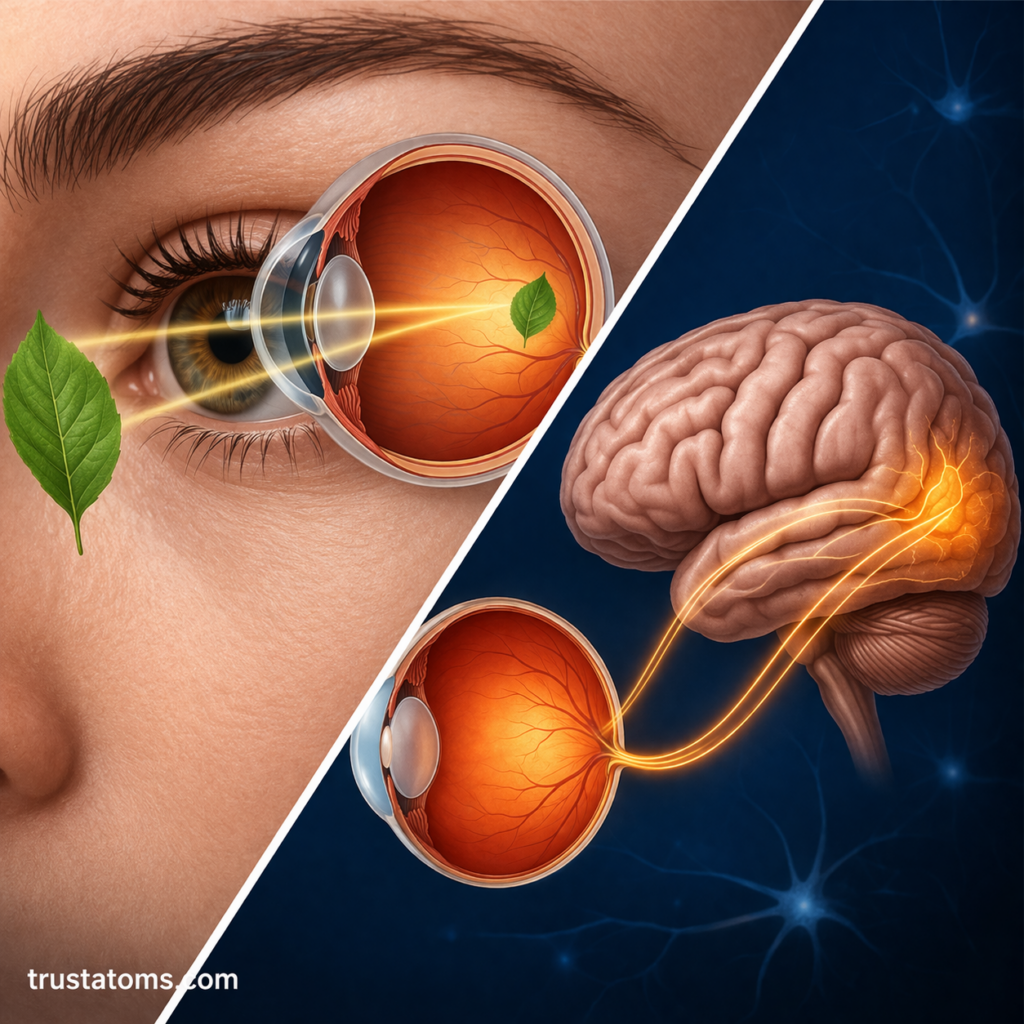
Once light reaches the retina, it must be transformed into electrical signals the brain can understand.
Phototransduction
- Light activates photoreceptor cells.
- These cells convert light energy into electrical impulses.
- Signals are passed to:
- Bipolar cells
- Then to ganglion cells
- Ganglion cell axons form the optic nerve.
Signal Transmission to the Brain
After leaving the eye, visual information travels to the brain for interpretation.
Visual Pathway
- Signals travel through the optic nerve
- Cross partially at the optic chiasm
- Continue to the thalamus (lateral geniculate nucleus)
- Reach the visual cortex in the occipital lobe
Image Processing in the Brain
The brain interprets signals from both eyes to create a coherent image.
Key Functions of the Visual Cortex
- Detects edges, shapes, and motion
- Processes color and depth
- Combines input from both eyes for binocular vision
This processing allows us to:
- Recognize faces
- Judge distances
- Track moving objects
Common Vision Adjustments
The eye constantly adapts to changing conditions.
Light Adaptation
- Pupils adjust size
- Photoreceptors adapt sensitivity
Focus Adjustment (Accommodation)
- Lens changes curvature for near vs. far objects
Depth Perception
- Uses input from both eyes (stereoscopic vision)
Common Vision Problems
Disruptions in eye structure or function can lead to visual impairments.
Refractive Errors
- Myopia (nearsightedness) – difficulty seeing distant objects
- Hyperopia (farsightedness) – difficulty seeing near objects
- Astigmatism – distorted vision due to irregular cornea shape
Other Conditions
- Cataracts – clouding of the lens
- Glaucoma – increased eye pressure damaging the optic nerve
- Macular degeneration – damage to central vision
Why the Vision System Matters
The vision system is essential for everyday functioning, from reading and driving to recognizing people and navigating environments.
Key takeaways:
- The eye captures and focuses light through a series of structures.
- Photoreceptors convert light into electrical signals.
- The brain processes these signals into meaningful images.
- Small structural changes can significantly impact vision quality.
Final Thoughts
The human eye is a remarkable example of biological engineering, combining optics, neurology, and adaptability. Its ability to transform light into detailed visual experiences highlights the complexity and efficiency of the human body.
Understanding eye structure and light processing not only deepens appreciation for vision but also helps in recognizing and addressing common visual issues.