Magnetic fields are one of the fundamental forces that shape the physical world. From the way a compass points north to how planets interact with the Sun, magnetic fields influence motion, energy, and matter across both everyday life and the universe.
In physics, a magnetic field describes the region around a magnet, electric current, or moving charged particle where magnetic forces can be detected. Although invisible, magnetic fields can be measured, mapped, and observed through their effects on objects.
This article explains what a magnetic field is, how it works, and why it plays such an important role in science and technology.
What Is a Magnetic Field?
A magnetic field is a region of space where magnetic forces act on moving electric charges or magnetic materials.
These fields are produced by:
- Magnets
- Electric currents
- Moving charged particles
Inside a magnetic field, certain objects experience a force that can cause them to move, rotate, or align with the field.
For example:
- A compass needle aligns with Earth’s magnetic field.
- Iron filings placed around a magnet form patterns that reveal the field’s shape.
- Electric motors use magnetic fields to create motion.
Even though magnetic fields cannot be seen directly, their effects make them easy to detect and study.
How Magnetic Fields Are Represented
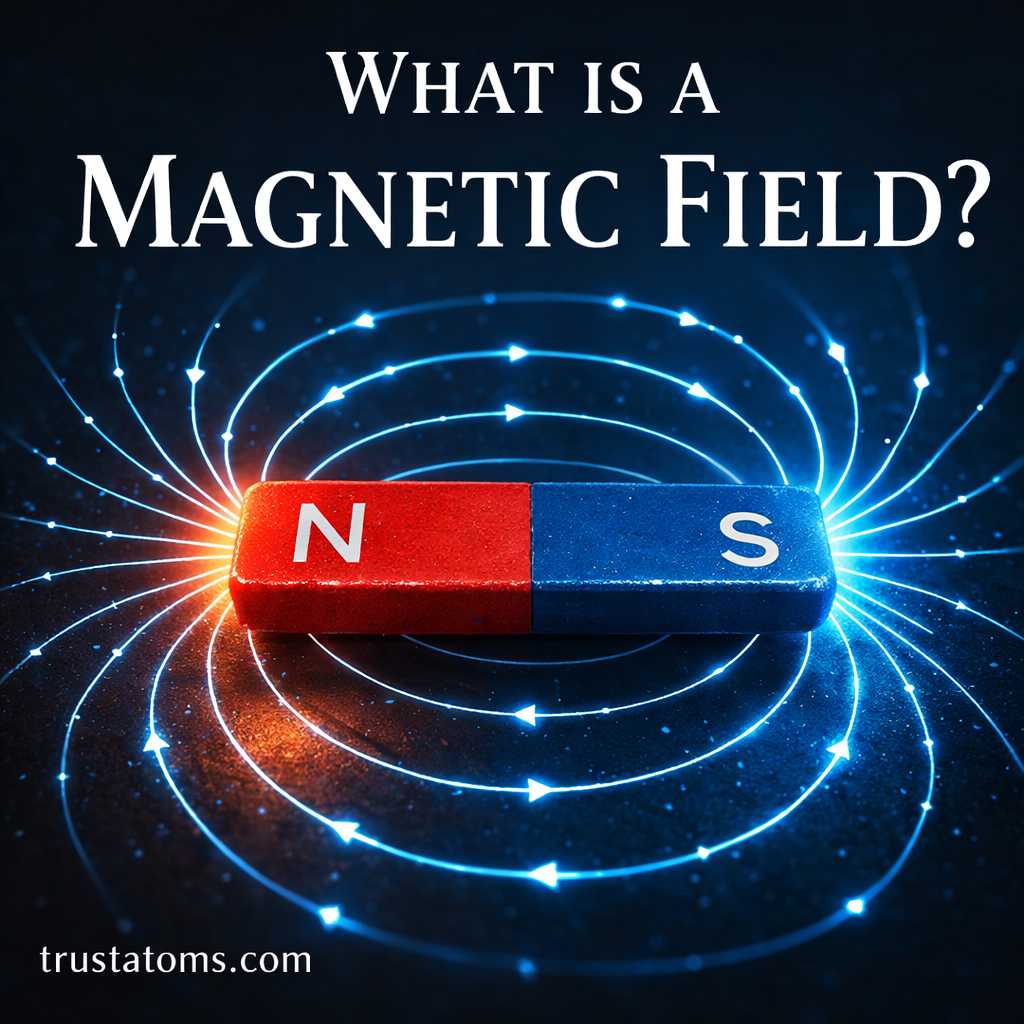
Scientists often represent magnetic fields using magnetic field lines.
These imaginary lines help visualize the direction and strength of a magnetic field.
Key properties of magnetic field lines include:
- They emerge from the north pole of a magnet.
- They enter the south pole of a magnet.
- The closer the lines are together, the stronger the magnetic field.
- Field lines always form closed loops.
When iron filings are sprinkled around a magnet, they align along these field lines, creating visible patterns that map the magnetic field.
Where Magnetic Fields Come From
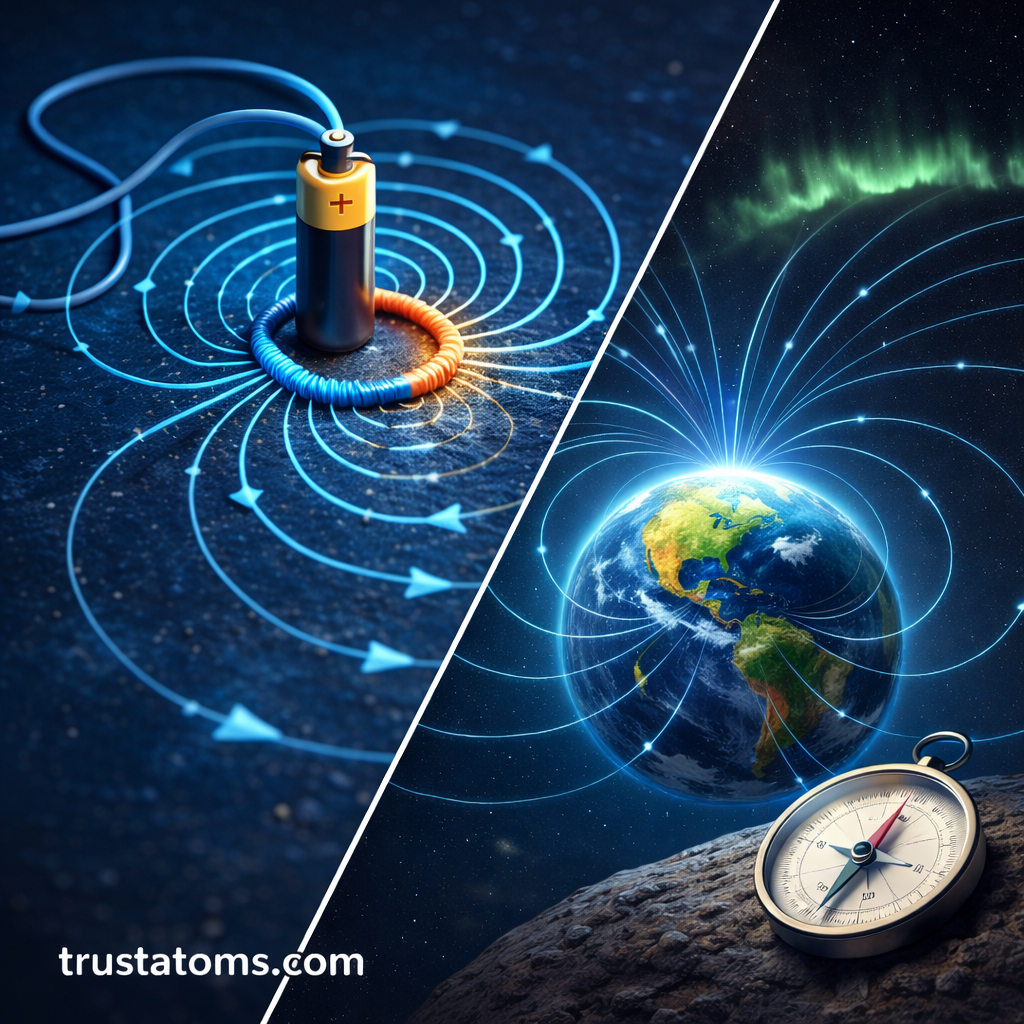
Magnetic fields originate from the movement of electric charges. In physics, electricity and magnetism are closely connected and are part of a larger concept known as electromagnetism.
There are three main ways magnetic fields are generated.
1. Permanent Magnets
Certain materials, such as iron, nickel, and cobalt, can form permanent magnets.
Inside these materials, atoms behave like tiny magnets. When many atoms align in the same direction, they create a strong magnetic field.
Examples include:
- Bar magnets
- Refrigerator magnets
- Magnetic compasses
2. Electric Currents
When electric current flows through a wire, it produces a magnetic field around the wire.
This discovery was made in 1820 by physicist Hans Christian Ørsted, who noticed that a compass needle moved when placed near a current-carrying wire.
This principle is used in many technologies, including:
- Electric motors
- Generators
- Transformers
- Electromagnets
3. Moving Charged Particles
Magnetic fields also arise when charged particles move through space.
Examples include:
- Electrons moving in electrical circuits
- Charged particles traveling through space
- Plasma flows in stars
These moving particles generate magnetic fields that interact with other fields and forces.
Magnetic Fields Around Magnets
A simple bar magnet produces a magnetic field that extends outward from the magnet and loops back around it.
The field is strongest:
- Near the poles of the magnet
- At points closest to the magnetic material
Objects made of magnetic materials tend to move toward stronger regions of the field.
This is why:
- Paper clips stick to magnets
- Magnets attract iron objects
- Magnets can repel or attract each other depending on pole orientation
Like poles repel, while opposite poles attract.
Earth’s Magnetic Field
Earth itself acts like a giant magnet.
Deep within the planet, the movement of molten iron in the outer core generates a magnetic field that surrounds the entire planet. This process is called the geodynamo.
Earth’s magnetic field serves several important functions:
- It guides compass navigation.
- It protects the planet from charged particles from the Sun.
- It shapes the magnetosphere, a protective magnetic bubble around Earth.
When solar particles interact with Earth’s magnetic field near the poles, they create beautiful light displays known as auroras.
Magnetic Fields and Electric Charges
Magnetic fields exert forces on moving charged particles.
When a charged particle enters a magnetic field:
- The field pushes the particle sideways.
- The particle follows a curved or circular path.
This principle is used in many scientific instruments, including:
- Particle accelerators
- Mass spectrometers
- Magnetic confinement devices in fusion research
The relationship between electric charges and magnetic fields is one of the key foundations of modern physics.
Real-World Applications of Magnetic Fields
Magnetic fields are essential to many technologies used every day.
Some important applications include:
Electric Motors
Electric motors convert electrical energy into mechanical motion using magnetic forces.
They power devices such as:
- Fans
- Washing machines
- Electric vehicles
- Industrial machinery
Generators
Generators do the opposite of motors. They convert mechanical motion into electrical energy using magnetic fields.
Power plants rely on generators to produce electricity for homes and businesses.
Magnetic Resonance Imaging (MRI)
MRI machines use extremely strong magnetic fields to produce detailed images of the human body.
Doctors use MRI scans to examine:
- Organs
- Muscles
- Brain tissue
- Spinal cords
Data Storage
Magnetic fields are also used to store digital information.
Examples include:
- Hard disk drives
- Magnetic stripe cards
- Some types of data tapes
Why Magnetic Fields Matter in Physics
Magnetic fields are part of the broader framework of electromagnetism, one of the four fundamental forces of nature.
Understanding magnetic fields helps scientists explain:
- Electricity and circuits
- The behavior of charged particles
- The structure of stars and galaxies
- Space weather and solar activity
Magnetic fields are also essential in advanced technologies such as particle accelerators, magnetic levitation trains, and experimental fusion reactors.
Final Thoughts
A magnetic field is an invisible but powerful region of influence created by magnets, electric currents, and moving charged particles. Although we cannot see magnetic fields directly, their effects are everywhere—from the alignment of a compass needle to the functioning of electric motors and medical imaging systems.
By studying magnetic fields, scientists have unlocked many technologies that power modern life. From electricity generation to space exploration, magnetic fields continue to play a central role in understanding how the universe works.