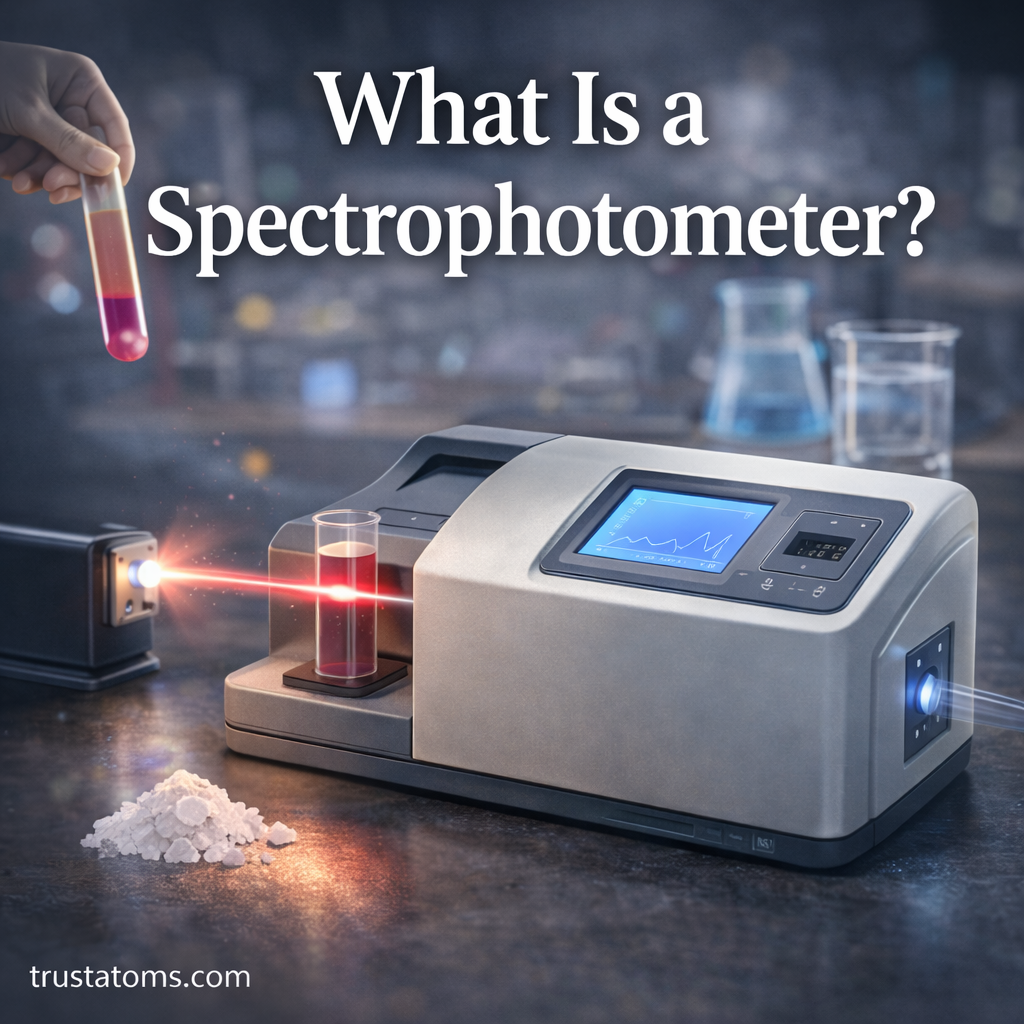
A spectrophotometer is a scientific instrument used to measure how much light a substance absorbs or transmits. In chemistry, biology, and environmental science, it is commonly used to analyze the concentration of substances in a solution.
By measuring how light interacts with matter, a spectrophotometer allows scientists to determine the amount of a chemical present in a sample.
In simple terms, a spectrophotometer measures how much light a sample absorbs at specific wavelengths.
Why Spectrophotometers Are Important in Chemistry
Spectrophotometers are widely used in laboratories because many chemical substances absorb light at specific wavelengths. By analyzing this absorption, scientists can identify compounds and measure their concentration.
Key benefits of spectrophotometry include:
- Accurate measurement of chemical concentrations
- Rapid analysis of samples
- Non-destructive testing
- High reproducibility
This method is essential in fields such as:
- Analytical chemistry
- Biochemistry
- Pharmaceutical research
- Environmental monitoring
- Medical diagnostics
How a Spectrophotometer Works
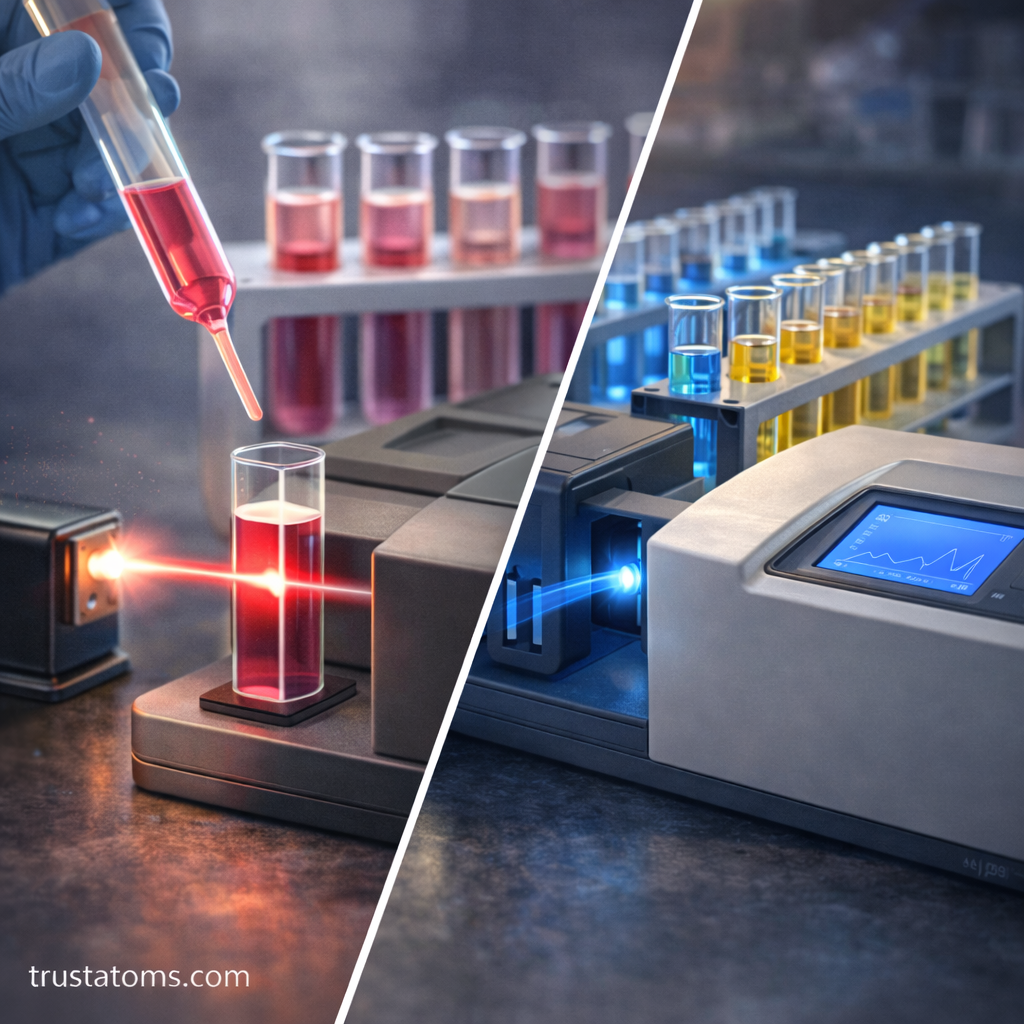
A spectrophotometer works by passing a beam of light through a sample and measuring how much light is absorbed.
The general process includes the following steps:
- A light source produces a beam of light.
- The light passes through a wavelength selector (monochromator).
- The selected wavelength of light passes through the sample.
- A detector measures the amount of light that passes through the sample.
- The instrument calculates absorbance or transmittance.
If the sample absorbs more light, less light reaches the detector.
Main Components of a Spectrophotometer
A spectrophotometer contains several key components that work together to measure light absorption.
Light Source
The light source generates the radiation used for measurement.
Common sources include:
- Tungsten lamps (visible light)
- Deuterium lamps (ultraviolet light)
- Xenon lamps (broad spectrum)
Different light sources allow spectrophotometers to analyze different regions of the electromagnetic spectrum.
Monochromator
The monochromator isolates a single wavelength of light from the light source.
It typically uses:
- Prisms
- Diffraction gratings
- Optical filters
This allows the instrument to test how the sample interacts with specific wavelengths.
Sample Holder (Cuvette)
The sample is placed in a small transparent container called a cuvette.
Cuvettes are usually made of:
- Glass
- Plastic
- Quartz (for UV measurements)
The cuvette ensures consistent path length for accurate measurements.
Detector
The detector measures the amount of light that passes through the sample.
It converts light into an electrical signal that the instrument can interpret.
Common detectors include:
- Photodiodes
- Photomultiplier tubes
Readout System
The readout system displays the measurement results.
Modern spectrophotometers often use digital screens or software that provides:
- Absorbance values
- Transmittance percentages
- Spectral graphs
Absorbance and Transmittance
Spectrophotometers measure two important quantities.
Absorbance
Absorbance describes how much light a sample absorbs.
Higher absorbance indicates that more light is absorbed by the substance.
Transmittance
Transmittance measures the percentage of light that passes through the sample.
Higher transmittance means the sample absorbs less light.
These measurements help determine the concentration of substances in a solution.
The Beer–Lambert Law
Spectrophotometry is based on the Beer–Lambert Law, which describes the relationship between absorbance and concentration.
The law states that:
- Absorbance increases as concentration increases
- Absorbance increases with the length of the light path
Because of this relationship, spectrophotometers can be used to calculate the concentration of unknown solutions by comparing them to known standards.
Types of Spectrophotometers
There are several types of spectrophotometers designed for different scientific applications.
UV–Visible Spectrophotometer
This is the most common type used in chemistry labs.
It measures light in the:
- Ultraviolet region (about 200–400 nm)
- Visible region (about 400–700 nm)
It is widely used to analyze solutions, proteins, and chemical reactions.
Infrared Spectrophotometer
Infrared spectrophotometers measure how molecules absorb infrared radiation.
They are commonly used to:
- Identify functional groups
- Determine molecular structures
- Analyze organic compounds
Atomic Absorption Spectrophotometer
This specialized instrument measures the concentration of metal elements.
It is frequently used in:
- Environmental testing
- Food safety analysis
- Water quality monitoring
Applications of Spectrophotometers
Spectrophotometers are used in many scientific and industrial fields.
Chemical Analysis
Chemists use spectrophotometry to determine the concentration of substances in a solution.
Examples include:
- Measuring reaction progress
- Identifying unknown compounds
- Studying reaction kinetics
Medical Testing
In clinical laboratories, spectrophotometers help measure biological molecules such as:
- Glucose
- Proteins
- Enzymes
- Hemoglobin
These measurements support medical diagnosis and health monitoring.
Environmental Monitoring
Spectrophotometers help detect pollutants in air, water, and soil.
They can measure substances such as:
- Nitrates
- Phosphates
- Heavy metals
- Organic contaminants
Pharmaceutical Research
Drug manufacturers use spectrophotometers to ensure:
- Correct drug concentration
- Quality control
- Stability of pharmaceutical products
Advantages of Using a Spectrophotometer
Spectrophotometry offers several important advantages in laboratory analysis.
Key benefits include:
- High sensitivity and precision
- Quick analysis times
- Ability to measure very small concentrations
- Minimal sample preparation
- Non-destructive testing
These advantages make spectrophotometers one of the most widely used instruments in modern laboratories.
Key Takeaways
A spectrophotometer is a laboratory instrument that measures how much light a substance absorbs or transmits.
Important points to remember include:
- It works by passing light through a sample and measuring absorption.
- It uses components such as a light source, monochromator, cuvette, and detector.
- Measurements are based on the Beer–Lambert Law.
- It helps determine the concentration of substances in solutions.
- Spectrophotometers are widely used in chemistry, biology, medicine, and environmental science.
Because of its precision and versatility, the spectrophotometer is one of the most essential tools in analytical chemistry.