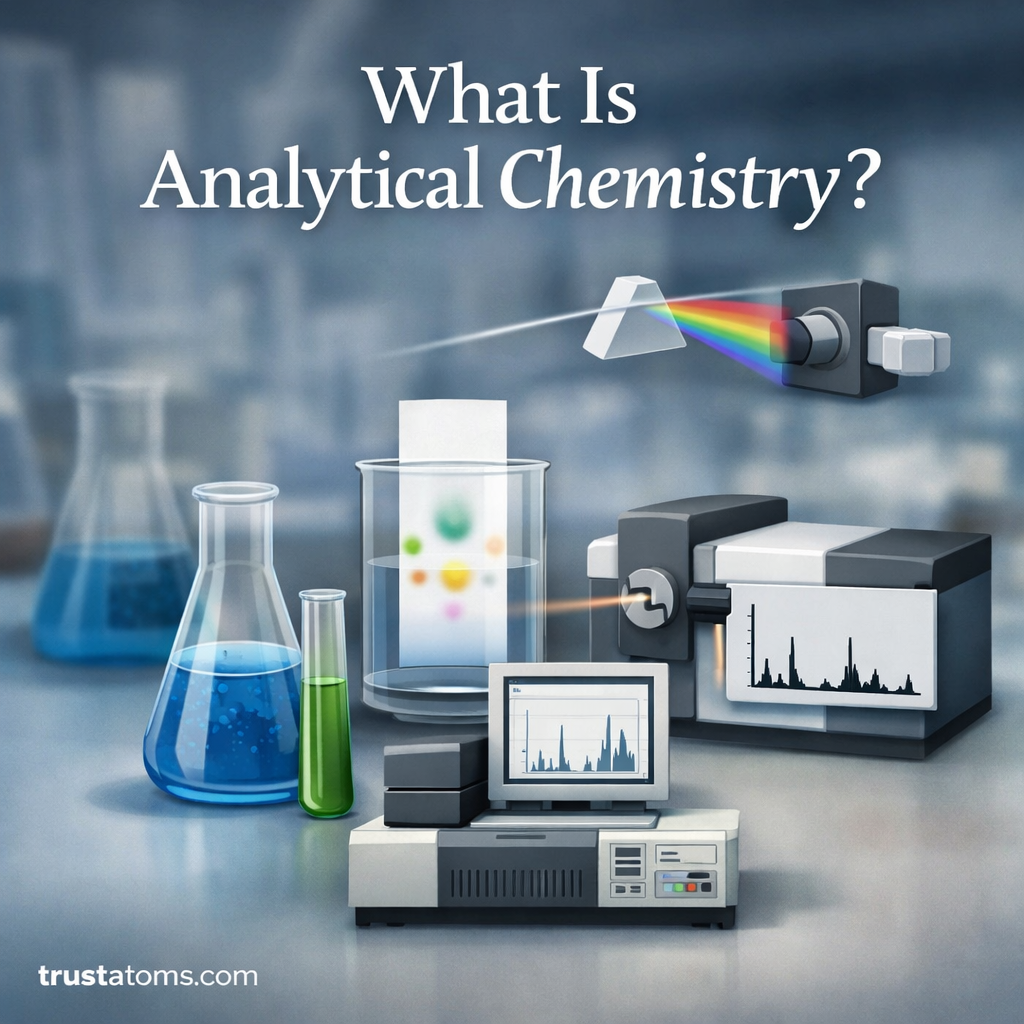
Analytical chemistry is the branch of chemistry concerned with identifying substances, separating mixtures, and measuring the amounts of chemical components in a sample. It answers two fundamental questions: what chemicals are present, and how much of each is there?
As a specialized field within the study of chemistry, analytical chemistry provides the measurements used to test drinking water, examine blood samples, verify pharmaceutical purity, and monitor environmental pollution. Its methods range from simple laboratory titrations to instruments capable of detecting extremely small quantities of substances.
For example, a laboratory testing tap water might first determine whether lead is present and then measure its concentration in micrograms per liter. The first task identifies a substance; the second provides a numerical result that can be compared with an applicable safety standard.
Understanding Analytical Chemistry
Analytical chemistry uses chemical reactions, physical measurements, and specialized instruments to investigate the composition of matter. Unlike methods primarily intended to synthesize new substances, analytical methods focus on obtaining reliable information about existing samples.
Samples may contain a single substance or a complicated mixture of compounds. Analytical chemists select methods according to the chemicals being studied, their expected concentrations, and the accuracy required.
Common samples include drinking water, soil, food, medicines, biological fluids, and industrial materials. A sample may require preparation before measurement, especially when the target chemical is present in a complex mixture.
Some methods identify substances by characteristic signals. For example, infrared spectroscopy in chemical identification uses absorption patterns to help recognize chemical bonds and functional groups.
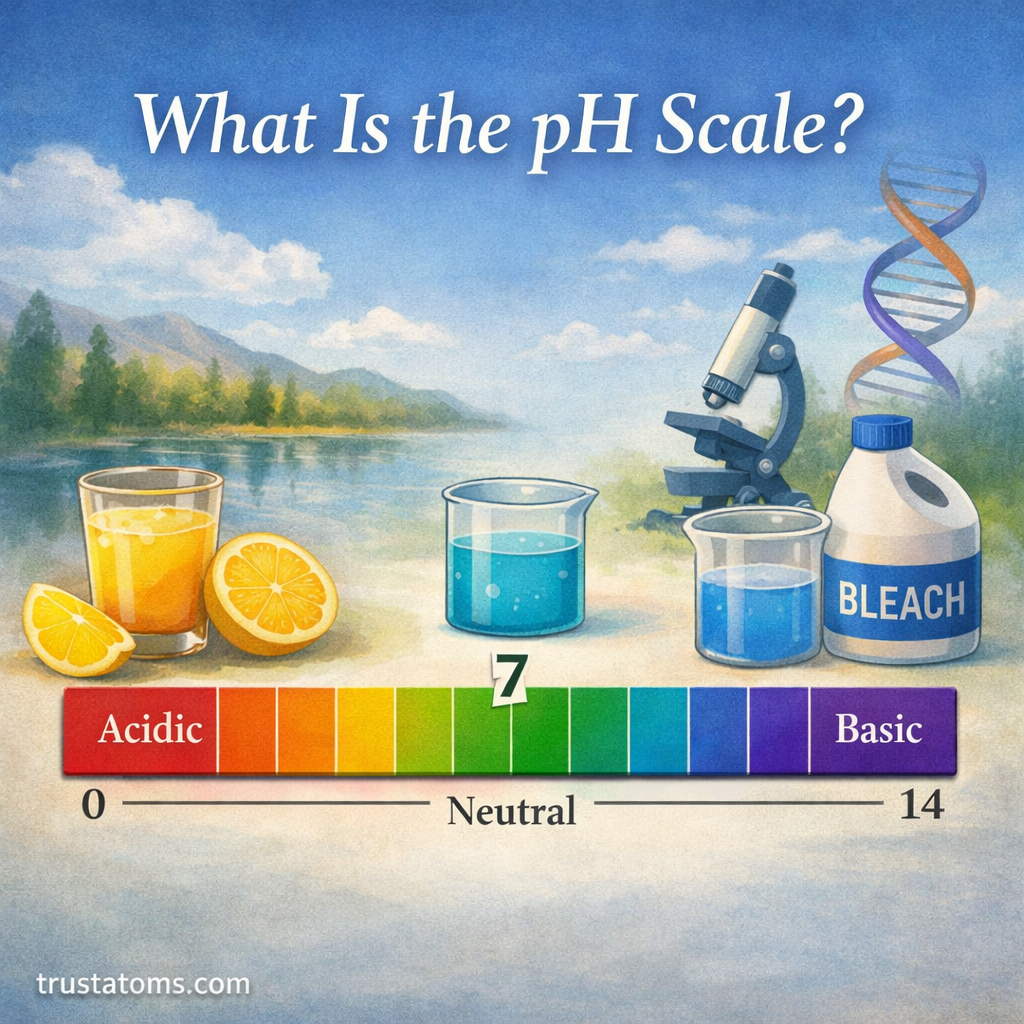
Other methods determine concentration through a controlled chemical reaction. Acid-base titration in analytical chemistry illustrates how a solution of known concentration can be used to measure an unknown acid or base concentration.
Qualitative vs. Quantitative Analysis
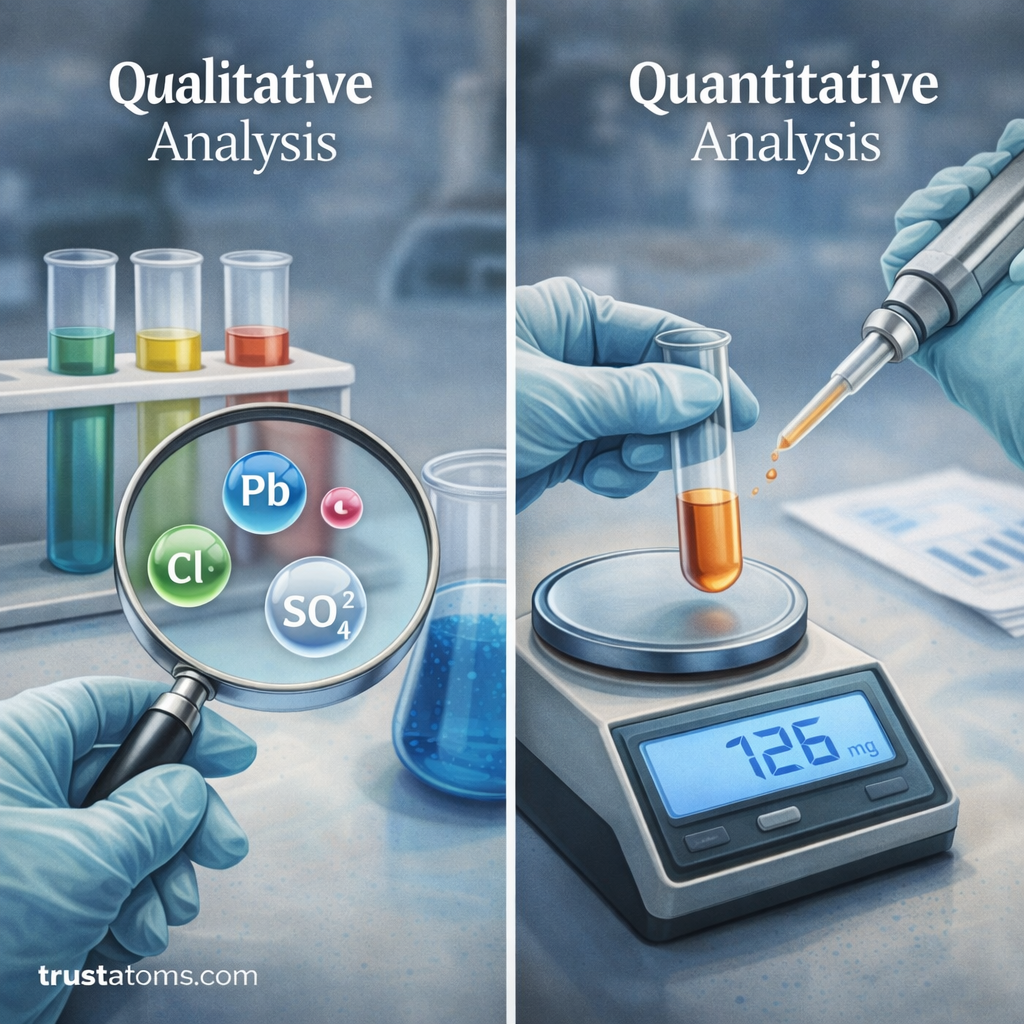
Analytical chemistry is commonly divided into qualitative and quantitative analysis. These approaches answer different questions but are often used together in the same investigation.
Qualitative Analysis: Identifying Substances
Qualitative analysis determines which chemical substances are present. It focuses on identification rather than measuring their exact amounts.
Examples include identifying an unknown powder, detecting a particular metal ion in water, or determining whether a forensic sample contains a specific drug.
Common techniques used for qualitative analysis include spectroscopy and chromatography. Depending on the method, identification may rely on absorption patterns, retention times, or other characteristic signals.
Quantitative Analysis: Measuring Amounts
Quantitative analysis determines how much of a substance is present. Results may be reported as mass, concentration, percentage composition, or another measurable quantity.
For example, a food laboratory might measure sugar concentration in a beverage, while a clinical laboratory might determine glucose concentration in blood.
A quantitative result must include appropriate units. Reporting a pollutant concentration as 5 milligrams per liter is more informative than simply saying that the pollutant was detected.
| Feature | Qualitative Analysis | Quantitative Analysis |
|---|---|---|
| Main question | What is present? | How much is present? |
| Typical result | Substance identity | Numerical measurement |
| Example | Detecting copper ions | Measuring copper concentration |
| Common methods | Spectroscopy, chromatography | Titration, calibrated spectroscopy |
Common Techniques Used in Analytical Chemistry
Different analytical methods measure different chemical properties. Choosing the right technique depends on whether the goal is separation, identification, concentration measurement, or structural characterization.
More specialized approaches are covered in advanced analytical techniques in chemistry, including methods used for complex mixtures and trace-level measurements.
Spectroscopy
Spectroscopy examines how matter interacts with electromagnetic radiation. Depending on the technique, a substance may absorb, emit, or scatter radiation in ways that reveal information about its composition.
UV-visible spectroscopy can measure the concentration of certain dissolved compounds by examining light absorption. Infrared spectroscopy helps identify functional groups, while atomic absorption spectroscopy can measure selected elements.
Chromatography
Chromatography separates mixture components based on how differently they interact with a stationary phase and a moving phase. As substances travel through the system, they separate because of differences in their chemical and physical properties.
Gas chromatography is often used for volatile compounds, while high-performance liquid chromatography is useful for many compounds dissolved in liquids. Thin-layer chromatography provides a simpler method for comparing mixture components.
Titration
Titration determines the amount or concentration of a substance by reacting it with a measured quantity of another substance. The solution added from a burette is called the titrant.
The equivalence point occurs when the reactants have combined in the required stoichiometric proportions. An indicator or instrument helps identify an endpoint close to that point, allowing the unknown concentration to be calculated.
Mass Spectrometry
Mass spectrometry measures the masses of molecules and fragments produced from them.
More precisely, a mass spectrometer measures the mass-to-charge ratios of ions. The resulting spectrum can help identify compounds, determine molecular masses, and investigate chemical structures.
Mass spectrometry is frequently combined with chromatography so that mixture components can be separated before their ions are analyzed.
Worked Example: Measuring Acid Concentration by Titration
Suppose a laboratory needs to determine the concentration of hydrochloric acid (HCl) in a solution. A chemist measures 25.0 milliliters of the acid and titrates it with sodium hydroxide (NaOH) at a known concentration of 0.100 mol/L.
The neutralization reaction is:
HCl + NaOH → NaCl + H₂O
The reaction has a 1:1 mole ratio. Suppose the equivalence point is reached after adding 20.0 milliliters of sodium hydroxide.
First, calculate the moles of NaOH used:
0.100 mol/L × 0.0200 L = 0.00200 mol
Because the mole ratio is 1:1, the original sample contained 0.00200 mol of HCl. Divide by the acid sample volume:
0.00200 mol ÷ 0.0250 L = 0.0800 mol/L
The hydrochloric acid concentration is 0.0800 mol/L. This example demonstrates how a measured reaction volume and known concentration produce a quantitative analytical result.
How Analytical Chemists Ensure Reliable Results
Reliable analysis requires more than sensitive instruments. Laboratories must control contamination, calibrate equipment, and evaluate the quality of their measurements.
- Accuracy describes how close a measurement is to the accepted or reference value.
- Precision describes how closely repeated measurements agree with one another.
- Calibration relates an instrument’s response to known reference standards.
- Detection limits describe the smallest amount of a substance that a method can reliably distinguish from background signals under specified conditions.
- Quality control uses blanks, reference materials, and repeated measurements to identify potential errors.
A highly precise instrument can still produce inaccurate results if it is improperly calibrated. Similarly, contamination during sample collection can affect the final measurement even when the instrument operates correctly.
Where Analytical Chemistry Is Used
Environmental Monitoring
Environmental laboratories measure metals, pesticides, nutrients, and other substances in water, soil, and air. These measurements help identify contamination and evaluate environmental conditions.
Medical and Pharmaceutical Testing
Clinical laboratories measure substances such as blood glucose, electrolytes, and hormones. Pharmaceutical laboratories use analytical methods to verify ingredient identity, measure drug content, detect impurities, and monitor chemical stability.
Food Safety and Manufacturing
Food laboratories measure nutrients, additives, and chemical contaminants. Manufacturers use analytical testing to verify raw materials, monitor production processes, and confirm that finished products meet specifications.
Forensic Investigations
Forensic chemists examine substances such as suspected drugs, chemical residues, and unknown powders. Analytical results can help identify evidence, although their interpretation also depends on proper sampling, validated methods, and documentation.
Modern Analytical Instruments and Research
Modern laboratories use spectrophotometers, chromatographs, mass spectrometers, electrochemical sensors, and automated sample-handling systems. Some validated methods can detect substances at parts-per-billion or parts-per-trillion levels, depending on the substance and sample.
Research continues to improve analytical methods for studying proteins, environmental contaminants, advanced materials, and very small samples. Combining separation techniques with sensitive detectors allows scientists to investigate mixtures that would be difficult to analyze using a single method.
Frequently Asked Questions
What is the main purpose of analytical chemistry?
Its main purpose is to identify substances and determine their amounts in samples. Analytical chemistry also develops and validates methods that make those measurements reliable.
What is the difference between analytical and organic chemistry?
Analytical chemistry focuses on chemical identification and measurement. Organic chemistry focuses on carbon-containing compounds, including their structures, properties, and reactions. The fields overlap when analytical methods are used to study organic substances.
Can analytical chemistry detect very small amounts of chemicals?
Yes. Depending on the technique and sample, analytical methods can detect trace concentrations, sometimes at parts-per-billion or lower levels. Detection capability depends on instrument sensitivity, sample preparation, interference, and method validation.
Analytical chemistry turns chemical samples into measurable evidence about composition and concentration. A simple titration can determine acid concentration, while chromatography and mass spectrometry can investigate complex mixtures. Reliable results depend on selecting suitable methods, controlling measurement errors, and interpreting the data correctly.
Sources: Douglas A. Skoog, F. James Holler, and Stanley R. Crouch, Principles of Instrumental Analysis; Daniel C. Harris and Charles A. Lucy, Quantitative Chemical Analysis; IUPAC, Compendium of Chemical Terminology (Gold Book).