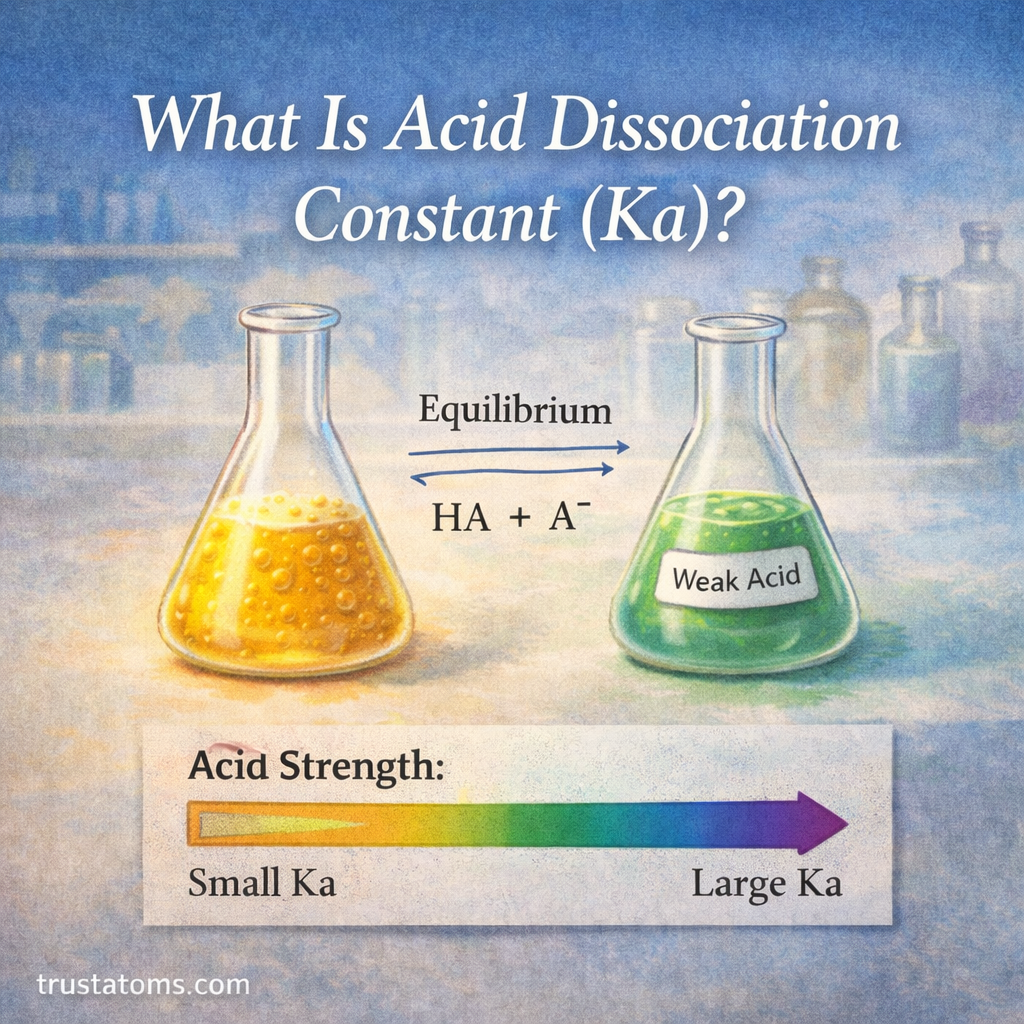
The acid dissociation constant (Ka) is a value used in chemistry to measure how strongly an acid releases hydrogen ions (H⁺) in a solution. It helps scientists understand how completely an acid separates into its ions when dissolved in water.
In simple terms, Ka tells us how strong or weak an acid is based on how easily it donates hydrogen ions during a chemical reaction.
- Large Ka value → stronger acid
- Small Ka value → weaker acid
Because many chemical reactions depend on acids releasing hydrogen ions, the acid dissociation constant is an important concept in acid–base chemistry, biochemistry, environmental science, and industrial chemistry.
Understanding Acid Dissociation
When an acid dissolves in water, it can break apart into ions. This process is called dissociation.
For example, a generic acid written as HA can separate into:
- Hydrogen ions (H⁺)
- Its conjugate base (A⁻)
Not all acid molecules dissociate completely. Some acids release many hydrogen ions, while others release only a small amount. The acid dissociation constant measures this behavior at equilibrium.
If an acid dissociates easily, it is considered stronger, and its Ka value is higher.
What the Acid Dissociation Constant Represents
The acid dissociation constant measures the balance between dissociated ions and undissociated acid molecules in a solution.
In equilibrium:
- Some acid molecules remain intact
- Some split into ions
- The system reaches a stable balance between the two states
Ka quantifies this balance.
Key Idea
The larger the Ka value, the more the acid dissociates in water.
This means:
- Strong acids produce more hydrogen ions.
- Weak acids produce fewer hydrogen ions.
Because Ka measures ion formation, it directly relates to acid strength.
Ka and Acid Strength
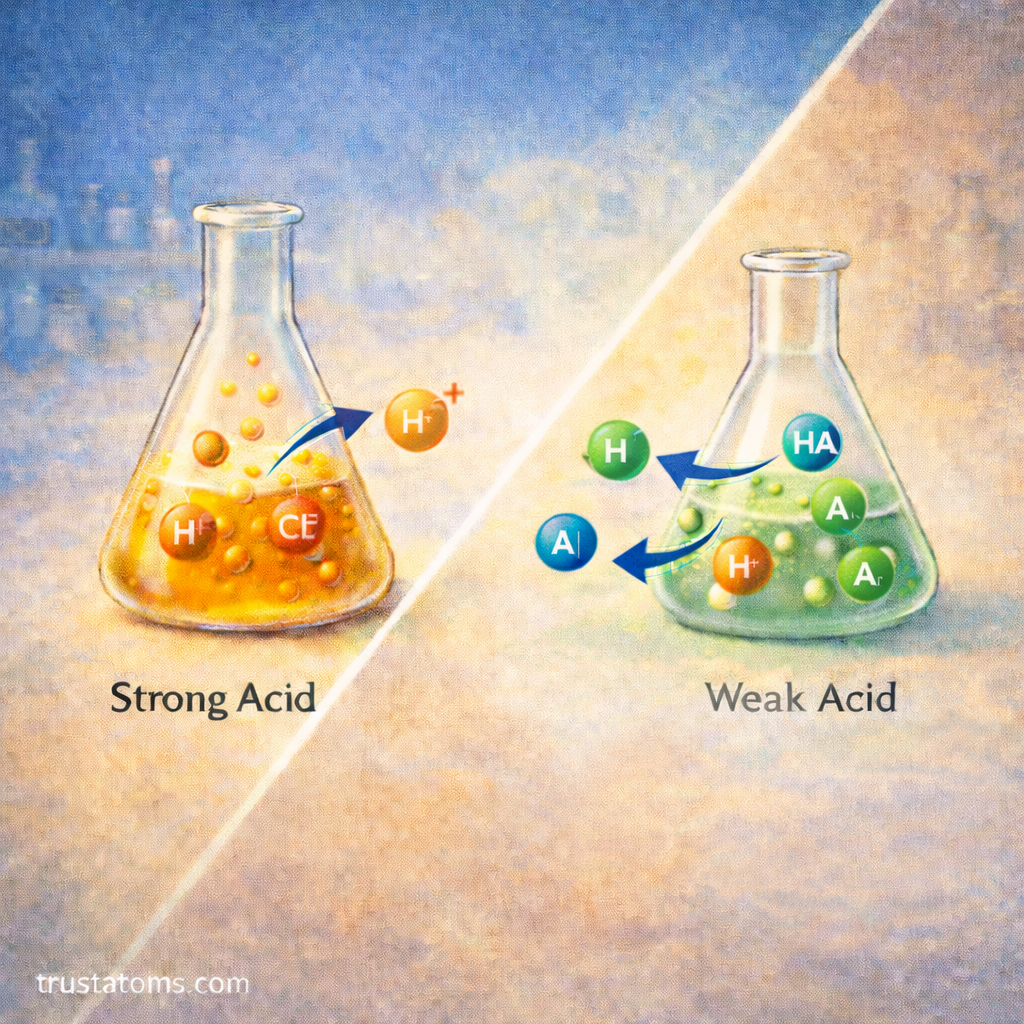
Chemists use Ka values to compare the relative strength of acids.
General guidelines:
Strong acids:
- Dissociate almost completely
- Very large Ka values
Weak acids:
- Dissociate only partially
- Small Ka values
For example:
| Acid | Relative Strength |
|---|---|
| Hydrochloric acid | Very strong |
| Nitric acid | Strong |
| Acetic acid | Weak |
| Carbonic acid | Weak |
Strong acids typically dissociate so completely that Ka values are extremely large and often not listed in basic tables.
Weak acids, however, are commonly described using Ka values because their dissociation is partial and measurable.
Why Chemists Use Ka Instead of Just Saying “Strong” or “Weak”
Simply labeling acids as strong or weak does not provide enough scientific detail. The Ka value allows chemists to compare acids quantitatively.
For example:
- One weak acid may be 10 times stronger than another.
- Another may be 1,000 times weaker.
Ka values allow scientists to:
- Predict reaction outcomes
- Understand equilibrium behavior
- Compare acid strength precisely
- Model chemical systems accurately
This makes Ka an essential tool in chemical calculations and research.
The Relationship Between Ka and pKa
Because Ka values can be extremely large or extremely small, chemists often use a related value called pKa.
The pKa scale simplifies Ka values by converting them into logarithmic form.
Key relationships:
- Low pKa → strong acid
- High pKa → weak acid
For example:
| Acid | pKa | Strength |
|---|---|---|
| Hydrochloric acid | ~ -7 | Very strong |
| Acetic acid | 4.76 | Weak |
| Ammonium ion | 9.25 | Very weak |
The pKa scale is commonly used in biochemistry, pharmaceuticals, and environmental chemistry because it makes comparisons easier.
Why Ka Is Important in Chemistry
The acid dissociation constant plays an important role in many scientific fields.
1. Predicting Chemical Reactions
Ka helps chemists determine:
- Which direction reactions will proceed
- How much product will form
- Whether equilibrium favors reactants or products
2. Understanding Biological Systems
Many biological processes depend on acid–base balance.
Examples include:
- Blood pH regulation
- Enzyme activity
- Cellular metabolism
Ka values help biochemists analyze how molecules behave in biological environments.
3. Designing Buffer Solutions
Buffers are solutions that resist changes in pH.
They are created by combining:
- A weak acid
- Its conjugate base
The Ka value of the acid determines the effective pH range of the buffer, making it essential for laboratory and medical applications.
4. Environmental Chemistry
Ka values help scientists study:
- Ocean acidification
- Carbon dioxide absorption
- Acid rain chemistry
- Soil acidity
Understanding acid dissociation allows researchers to predict how pollutants affect natural systems.
Examples of Weak Acids and Their Ka Values
Several common acids have well-known dissociation constants.
Examples include:
Acetic acid (vinegar):
- Ka ≈ 1.8 × 10⁻⁵
Carbonic acid (found in carbonated beverages):
- Ka ≈ 4.3 × 10⁻⁷
Formic acid (found in ant venom):
- Ka ≈ 1.8 × 10⁻⁴
These values show that formic acid dissociates more than acetic acid, meaning it is slightly stronger.
Comparing Ka values allows chemists to rank acids by their ability to donate hydrogen ions.
Ka and Chemical Equilibrium
Acid dissociation occurs within a system that eventually reaches chemical equilibrium.
At equilibrium:
- The rate of acid dissociation equals the rate of recombination.
- The concentrations of reactants and products remain stable.
Ka describes this equilibrium point.
A high Ka means the equilibrium strongly favors ion formation, while a low Ka means most molecules remain undissociated.
Understanding equilibrium helps chemists control reactions and predict chemical behavior.
Common Misconceptions About Ka
Several misunderstandings can occur when learning about the acid dissociation constant.
Ka Only Applies to Weak Acids
Strong acids dissociate almost completely in water. Because of this, Ka values are usually not used to describe them in basic chemistry contexts.
Ka Does Not Measure Acidity Alone
While Ka relates to acid strength, the actual acidity of a solution also depends on concentration.
A dilute strong acid can sometimes have a higher pH than a concentrated weak acid.
Ka Values Can Span Large Ranges
Ka values can vary dramatically—from numbers close to 1 to extremely tiny values such as 10⁻¹⁰ or smaller.
This wide range is why chemists often convert Ka into the pKa scale.
The Role of Ka in Chemical Education
Understanding the acid dissociation constant introduces students to several core chemistry principles:
- Chemical equilibrium
- Acid–base reactions
- Reaction constants
- Logarithmic scales
- Molecular behavior in water
These ideas form the foundation for more advanced topics such as thermodynamics, biochemistry, and environmental chemistry.
Final Thoughts
The acid dissociation constant (Ka) is a key measurement used to describe how strongly an acid releases hydrogen ions in solution. By quantifying the extent of acid dissociation, Ka allows chemists to compare acid strength, predict reaction behavior, and understand chemical equilibrium.
From laboratory experiments to biological systems and environmental science, Ka plays an essential role in explaining how acids behave in the chemical world.
Understanding this concept provides an important foundation for studying acid–base chemistry and many other scientific disciplines.