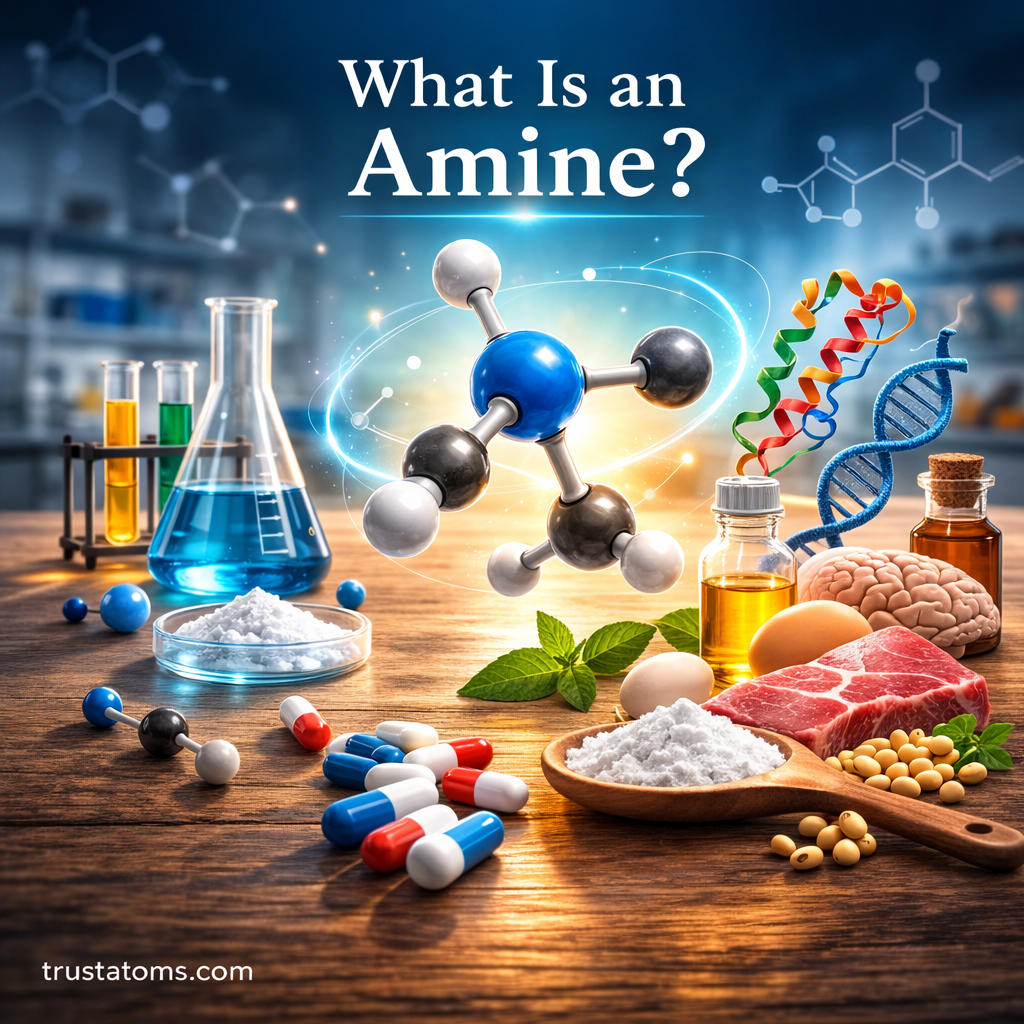
Amines are a class of organic compounds derived from ammonia. They are characterized by the presence of a nitrogen atom bonded to carbon-containing groups, which gives them distinctive chemical properties.
These compounds play essential roles in biology, pharmaceuticals, agriculture, and industrial chemistry. Amines are found in many important biological molecules, including amino acids, neurotransmitters, and vitamins. They are also widely used in manufacturing processes and chemical synthesis.
Understanding amines helps explain how nitrogen-containing compounds behave and why they are important in both natural systems and industrial applications.
The Basic Structure of an Amine
Amines are formed when one or more hydrogen atoms in ammonia (NH₃) are replaced by organic groups such as alkyl or aromatic chains.
The nitrogen atom is the defining feature of an amine.
Amines are commonly grouped into three types depending on how many carbon groups are attached to the nitrogen atom.
Primary Amines
Primary amines contain one carbon group attached to nitrogen.
Structure pattern:
- R–NH₂
Examples include methylamine and ethylamine.
Secondary Amines
Secondary amines contain two carbon groups attached to nitrogen.
Structure pattern:
- R–NH–R’
These compounds often appear in pharmaceutical and chemical synthesis.
Tertiary Amines
Tertiary amines contain three carbon groups attached to nitrogen.
Structure pattern:
- R–N(R’)–R”
They are commonly used in industrial chemistry and organic reactions.
Why Amines Are Important in Chemistry
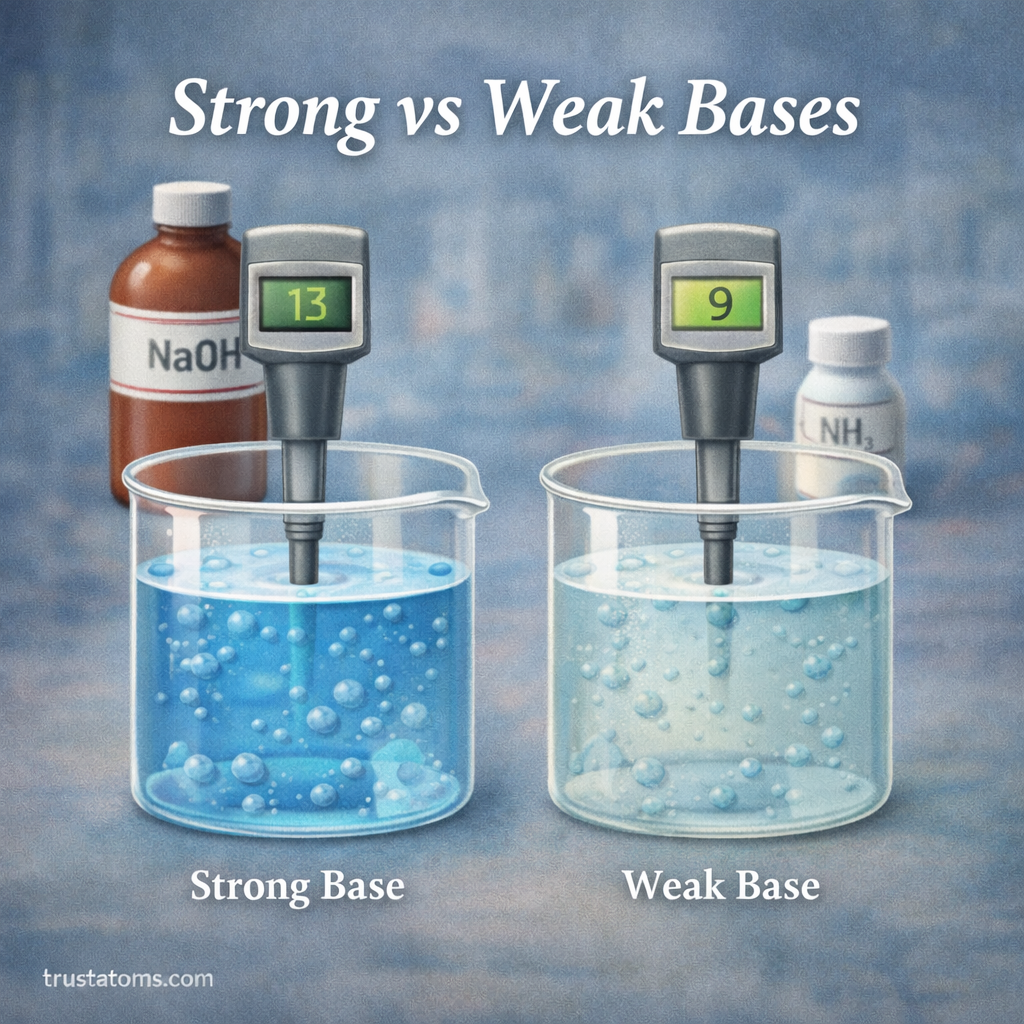
Amines are important because nitrogen is a highly reactive element that participates in many chemical reactions. The nitrogen atom in an amine has a lone pair of electrons, which allows the molecule to act as a base.
This means amines can:
- Accept hydrogen ions
- Participate in acid–base reactions
- Form salts with acids
- Act as nucleophiles in chemical reactions
These properties make amines useful building blocks in organic synthesis.
Where Amines Are Found in Nature
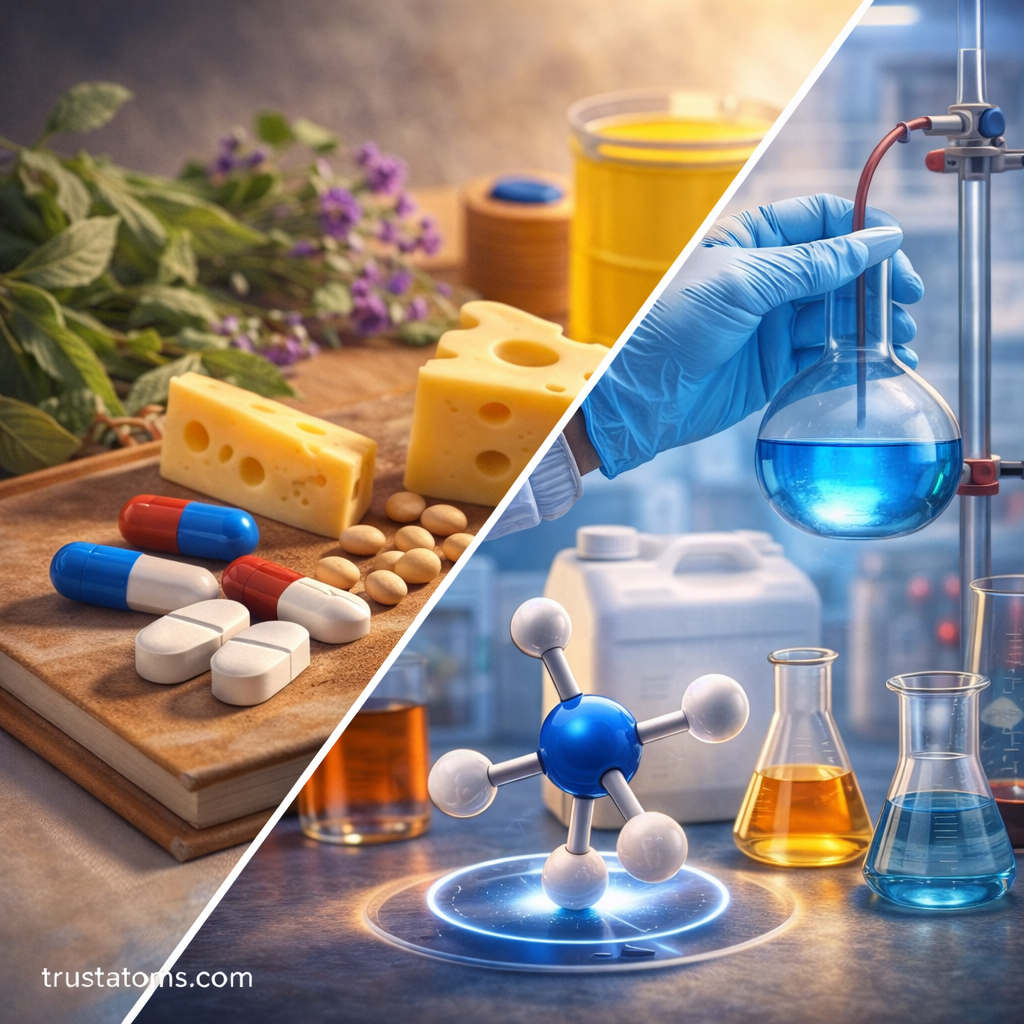
Amines occur naturally in many biological systems and molecules essential to life.
Amino Acids
Amino acids contain both:
- An amine group
- A carboxylic acid group
They are the building blocks of proteins, which are necessary for nearly all biological processes.
Neurotransmitters
Many neurotransmitters in the nervous system contain amine groups.
Examples include:
- Dopamine
- Serotonin
- Histamine
These molecules help transmit signals between nerve cells and regulate functions such as mood, sleep, and appetite.
Vitamins and Biomolecules
Several vitamins and biological compounds also contain amine groups, making them important for metabolism and cellular function.
Physical Properties of Amines
Amines have several distinctive physical properties that result from the nitrogen atom in their structure.
Typical Properties
- Often have strong odors
- Can form hydrogen bonds
- Usually soluble in water if the molecule is small
- Have higher boiling points than similar hydrocarbons
- Become less soluble as carbon chains get longer
Some simple amines are known for their fish-like smell, which comes from naturally occurring amines in decomposing organic matter.
Chemical Reactions Involving Amines
Amines participate in many chemical reactions due to the electron pair on the nitrogen atom.
1. Acid–Base Reactions
Amines can react with acids to form ammonium salts.
Example:
Amine + acid → ammonium salt
These salts are often more stable and water-soluble than the original amine.
2. Alkylation Reactions
Amines can react with alkyl halides to produce new amine compounds.
This reaction is used to build larger nitrogen-containing molecules.
3. Amide Formation
Amines can react with carboxylic acids to form amides, an important group of compounds found in:
- Proteins
- Synthetic materials
- Pharmaceuticals
Naming Amines
Chemists follow specific naming rules when naming amines.
The simplest method uses the -amine suffix added to the name of the parent hydrocarbon.
Examples
- Methane → methylamine
- Ethane → ethylamine
- Propane → propylamine
When multiple groups attach to nitrogen, chemists use prefixes such as N- to indicate their position.
For example:
- N-methylethylamine
This naming system helps chemists identify the structure of the compound.
Industrial Uses of Amines
Amines are widely used in many industries because they are highly reactive and versatile.
Common Applications
- Pharmaceutical production
Many medicines contain amine groups. - Agricultural chemicals
Amines appear in herbicides and pesticides. - Dyes and pigments
Nitrogen-containing compounds are often used in colorants. - Water treatment
Some amines help remove carbon dioxide and acidic gases. - Rubber and polymer manufacturing
Amines are used in chemical processing and material production.
These applications demonstrate the importance of nitrogen-containing compounds in modern technology.
Amines in Everyday Life
Even outside laboratories and industry, amines influence many aspects of daily life.
Examples include:
- Food chemistry — Amines form during the breakdown of proteins.
- Medicines — Many drugs rely on amine structures for biological activity.
- Cleaning products — Some surfactants and detergents contain amine derivatives.
- Biological signaling — Hormones and neurotransmitters often contain amine groups.
Because of their biological importance, amines are studied extensively in chemistry, medicine, and biology.
Why Amines Matter in Organic Chemistry
Amines are one of the most important functional groups in organic chemistry. Their ability to participate in many reactions makes them valuable intermediates in chemical synthesis.
They connect several fields of science:
- Organic chemistry
- Biochemistry
- Pharmacology
- Industrial chemistry
By understanding amines, scientists can design new medicines, materials, and chemical processes.
Final Thoughts
An amine is an organic compound derived from ammonia in which one or more hydrogen atoms are replaced by carbon-containing groups. The presence of nitrogen gives amines unique chemical properties, including the ability to act as bases and participate in a wide range of reactions.
From amino acids and neurotransmitters to pharmaceuticals and industrial chemicals, amines are essential molecules that appear throughout both nature and modern chemistry.
Learning about amines provides an important foundation for understanding nitrogen-containing compounds and their role in biological systems and chemical manufacturing.