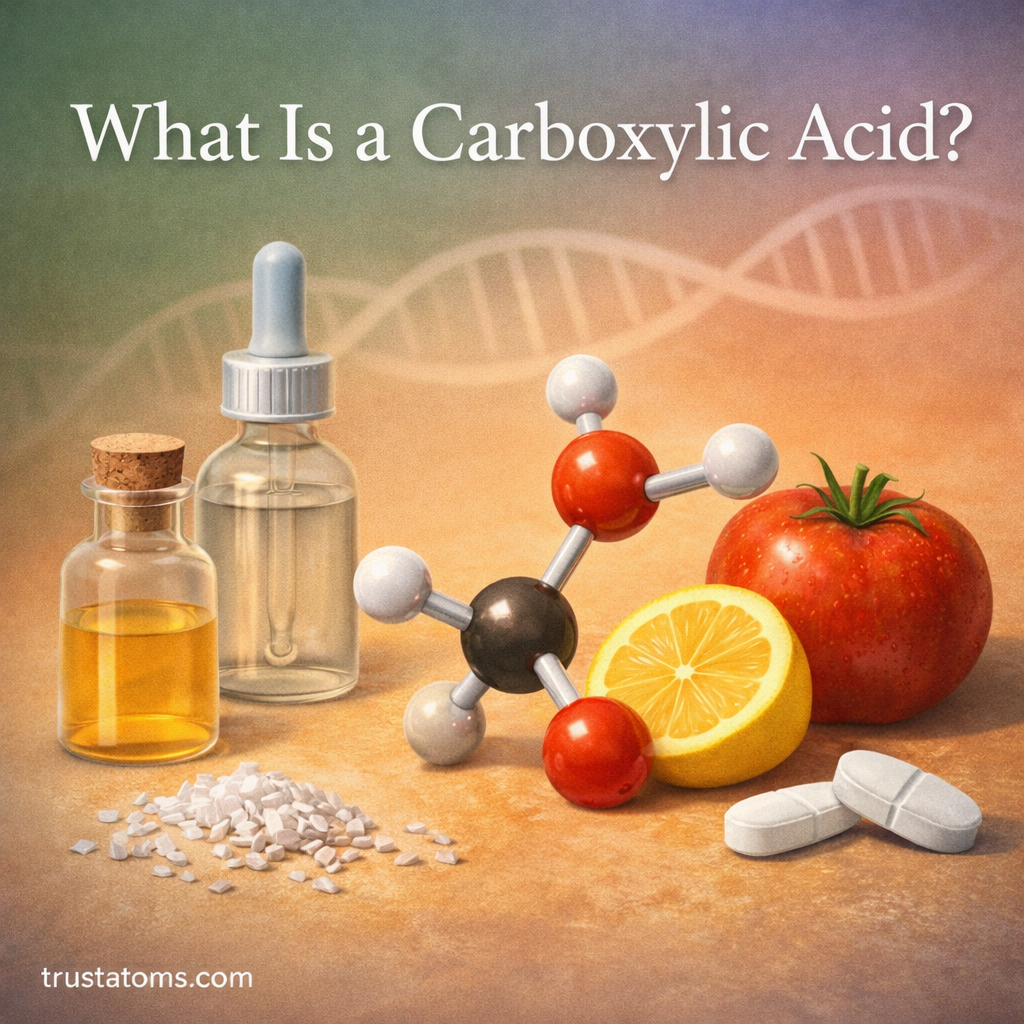
A carboxylic acid is an organic compound containing a carboxyl functional group (–COOH), which consists of a carbonyl group and a hydroxyl group attached to the same carbon atom. Carboxylic acids can donate hydrogen ions in chemical reactions and are found in foods, living organisms, and many manufactured products.
In the study of chemistry, carboxylic acids provide a useful connection between molecular structure and chemical behavior. Acetic acid gives vinegar its characteristic sourness, citric acid contributes to the acidity of citrus fruits, and fatty acids are components of many biological lipids.
From food preservation to manufacturing processes, carboxylic acids are among the most widely studied functional groups in chemistry. Their distinctive structure explains both their acidic properties and their ability to form other organic compounds.
The Basic Structure of a Carboxylic Acid
The general formula for a simple carboxylic acid is R–COOH, where R represents a hydrogen atom or an organic group. The –COOH portion is called the carboxyl group.
This functional group contains two connected parts:
- Carbonyl group (C=O): A carbon atom double-bonded to oxygen.
- Hydroxyl group (–OH): An oxygen atom bonded to hydrogen and attached to the same carbonyl carbon.
The combination of these groups gives carboxylic acids properties different from those of ordinary alcohols or carbonyl compounds. An aldehyde also contains a carbonyl group, but its carbonyl carbon is bonded to hydrogen rather than the hydroxyl group characteristic of a carboxylic acid.
For example, acetic acid has the structural formula CH₃COOH. Its CH₃ group is attached to the carbon atom of the carboxyl group.
Why Carboxylic Acids Are Acidic
Carboxylic acids can donate the hydrogen attached to the oxygen of their carboxyl group as a proton (H⁺). When this happens, the remaining negatively charged species is called a carboxylate ion.
For acetic acid, the equilibrium in water can be represented as:
CH₃COOH + H₂O ⇌ CH₃COO⁻ + H₃O⁺
Acetic acid transfers a proton to water, forming acetate and hydronium ions. The double arrow indicates that the reaction is reversible.
Most simple carboxylic acids are weak acids, meaning only a fraction of their molecules ionize in water. Their acidity is explained partly by resonance: the negative charge of the carboxylate ion is distributed across two oxygen atoms, helping stabilize the ion.
Acetic acid has a pKa of approximately 4.76 at 25°C. A lower pKa generally indicates a stronger acid when comparing substances under similar conditions.
Common Examples of Carboxylic Acids
Carboxylic acids occur in foods, natural substances, and industrial materials. Some familiar examples include:
| Carboxylic Acid | Formula | Common Source or Use |
|---|---|---|
| Formic acid | HCOOH | Ant venom and industrial processing |
| Acetic acid | CH₃COOH | Vinegar and chemical manufacturing |
| Citric acid | C₆H₈O₇ | Citrus fruits and food products |
| Lactic acid | C₃H₆O₃ | Yogurt and fermentation |
| Stearic acid | C₁₈H₃₆O₂ | Fats, soaps, and cosmetics |
Citric acid contains three carboxyl groups, while lactic acid contains both a carboxyl group and an additional hydroxyl group. These examples show how one molecule can contain multiple functional groups.
Where Carboxylic Acids Occur in Nature
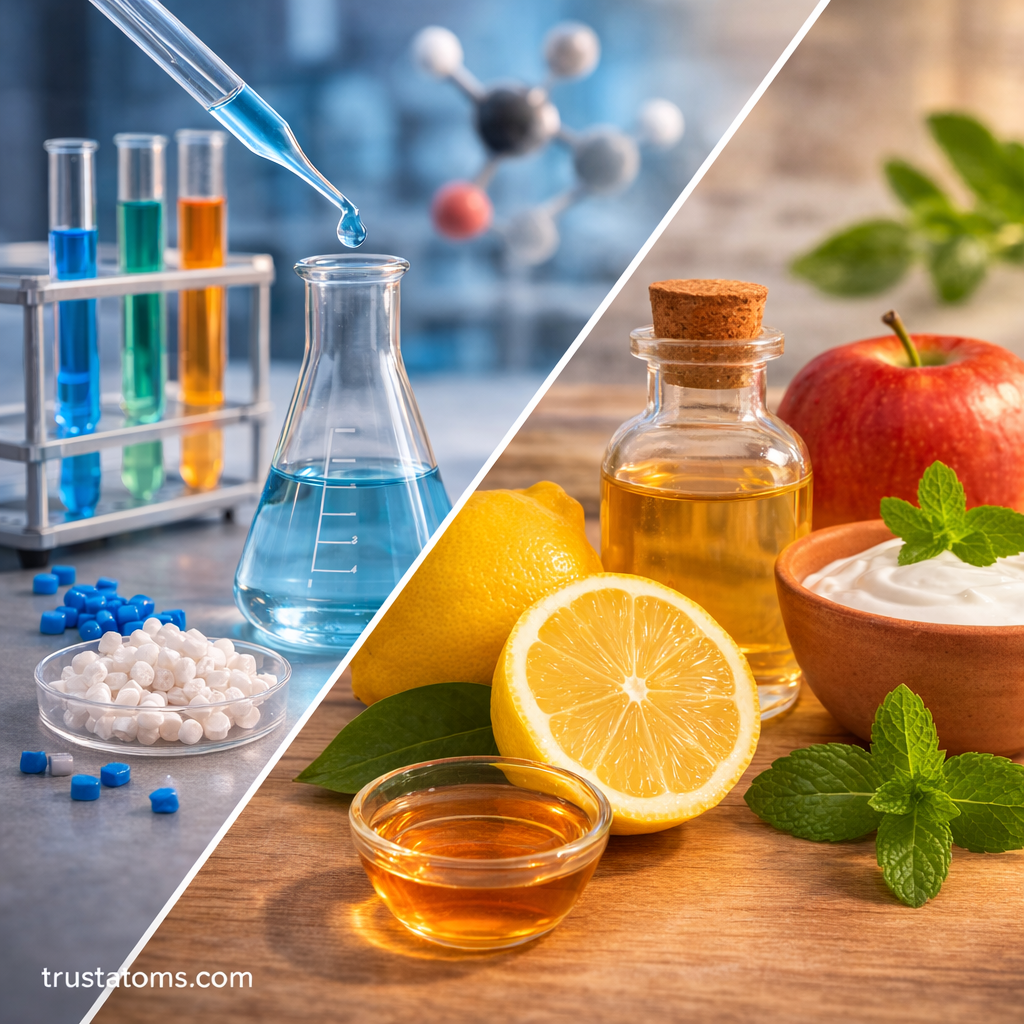
Carboxylic acids and compounds containing carboxyl groups occur throughout biological systems. They contribute to the properties of foods and participate in processes that sustain living organisms.
Food and Fermentation
Acetic acid contributes to vinegar’s acidity, citric acid gives citrus fruits part of their tart flavor, and lactic acid forms during certain fermentation processes. Food manufacturers also use selected organic acids to adjust acidity and support preservation.
Fatty Acids and Cell Structures
Fatty acids contain a carboxyl group attached to a hydrocarbon chain. They occur in fats and oils, contribute to energy storage, and form parts of complex lipids found in cell membranes.
Metabolism and Amino Acids
Several intermediates in the citric acid cycle contain carboxyl or carboxylate groups. Amino acids also contain a carboxyl group alongside an amino group, allowing them to participate in reactions that form proteins.
Physical Properties of Carboxylic Acids
The carboxyl group is polar and can form hydrogen bonds with water and other carboxylic acid molecules. These interactions influence boiling points and solubility.
- Boiling points: Carboxylic acids often have relatively high boiling points compared with similar-sized hydrocarbons because of intermolecular hydrogen bonding.
- Water solubility: Smaller carboxylic acids are generally quite soluble in water, while longer hydrocarbon chains reduce solubility.
- Odor: Some small carboxylic acids have sharp or unpleasant odors, while others have different sensory properties.
- Salt formation: Carboxylate salts can have substantially different solubilities from their corresponding acids.
These patterns help explain why acetic acid mixes readily with water while many long-chain fatty acids have limited water solubility.
Important Reactions of Carboxylic Acids
Ester Formation
Carboxylic acids can react with alcohols to form esters, which often have fruity aromas.
This reaction is called esterification. For example, acetic acid and ethanol can react reversibly to produce ethyl acetate and water, typically with an acid catalyst.
Reaction with Bases
Carboxylic acids react with suitable bases to form carboxylate salts. For example:
CH₃COOH + NaOH → CH₃COONa + H₂O
Here, acetic acid reacts with sodium hydroxide to produce sodium acetate and water.
Amide Formation
Carboxylic acids can react with ammonia or amines to produce amides, an important group of compounds found in proteins and synthetic materials. Direct amide formation generally requires suitable reaction conditions or activation because acids and amines initially tend to form salts.
Reduction to Alcohols
Carboxylic acids can be reduced to primary alcohols using appropriate reducing agents. This transformation changes the carboxyl group into an alcohol group and is useful in organic synthesis.
Worked Example: How Much Acetic Acid Is in Vinegar?
Suppose a bottle of vinegar contains 5 grams of acetic acid per 100 milliliters of vinegar. How much acetic acid is present in a 250-milliliter portion?
- Identify the concentration: 5 g of acetic acid per 100 mL of vinegar.
- Determine the volume ratio: 250 mL ÷ 100 mL = 2.5.
- Calculate the mass: 5 g × 2.5 = 12.5 g.
The 250-milliliter portion contains 12.5 grams of acetic acid, assuming the vinegar has a uniform concentration of 5% mass per volume. This example illustrates how the amount of a carboxylic acid in an everyday product can be calculated from its stated concentration.
How Carboxylic Acids Are Named
In systematic organic nomenclature, a simple carboxylic acid is commonly named by replacing the final -e of the corresponding parent alkane with -oic acid.
- HCOOH: Methanoic acid, commonly called formic acid.
- CH₃COOH: Ethanoic acid, commonly called acetic acid.
- CH₃CH₂COOH: Propanoic acid, commonly called propionic acid.
The carboxyl carbon is normally assigned position 1 when numbering a simple carboxylic acid chain. More complex molecules require additional naming rules to describe branches and other functional groups.
Industrial Uses of Carboxylic Acids
Carboxylic acids are used as starting materials and additives in numerous manufacturing processes. Their applications include food acidity control, pharmaceutical synthesis, polymer production, and the preparation of chemical intermediates.
Long-chain fatty acids and their salts are also important in soap production. In traditional soapmaking, fats and oils undergo saponification with a strong base, producing glycerol and fatty acid salts that act as soaps.
Frequently Asked Questions
Are all carboxylic acids weak acids?
Most common carboxylic acids are weak acids in water because they ionize only partially. Their acid strength varies with molecular structure, particularly the presence of nearby electron-withdrawing groups.
What is the difference between a carboxylic acid and an alcohol?
A carboxylic acid contains a carboxyl group (–COOH), while an alcohol contains a hydroxyl group (–OH) attached to a suitable carbon atom without the adjacent carbonyl arrangement. The carboxyl group makes carboxylic acids generally much more acidic than ordinary alcohols.
Is citric acid a carboxylic acid?
Yes. Citric acid contains three carboxyl groups, making it a tricarboxylic acid. It occurs naturally in citrus fruits and is widely used to adjust acidity in foods and beverages.
Carboxylic acids are identified by the –COOH functional group, which allows them to donate protons and undergo reactions such as esterification and salt formation. Their chemistry connects familiar substances such as vinegar and citric acid with biological molecules, food processing, and industrial organic synthesis.
Sources: OpenStax, Organic Chemistry; McMurry, Organic Chemistry; IUPAC, Compendium of Chemical Terminology (Gold Book).