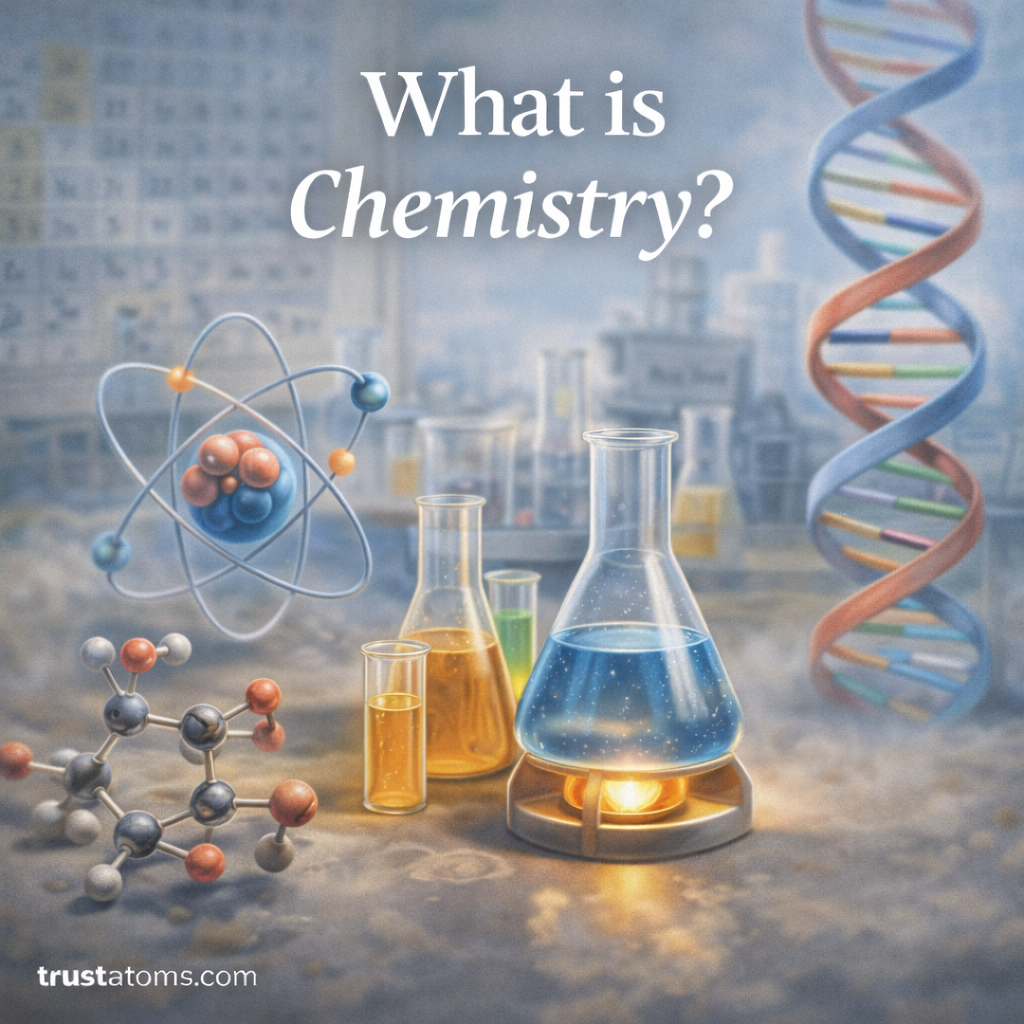
Chemistry is the scientific study of matter—what substances are made of, how they behave, and how they change during chemical reactions. It explores the structure, properties, and interactions of atoms and molecules that form everything in the physical world.
Often called the “central science,” chemistry connects other scientific fields such as physics, biology, environmental science, and materials science. From understanding how medicines work to developing new materials and fuels, chemistry helps explain the processes that shape our everyday lives.
Whether studying the air we breathe, the food we eat, or the reactions inside living cells, chemistry provides the tools to understand how matter transforms and interacts.
Understanding Matter and Chemical Change
At its core, chemistry focuses on matter and the transformations it undergoes.
Matter is anything that has mass and occupies space. It exists in many forms, including solids, liquids, gases, and plasma.
Chemists study how matter behaves by examining:
- The structure of atoms and molecules
- The properties of substances
- The changes that occur during chemical reactions
- The energy involved in chemical processes
Chemical reactions occur when atoms rearrange to form new substances with different properties.
For example:
- Burning fuel releases energy through chemical reactions.
- Digestion breaks down food molecules in the body.
- Plants convert carbon dioxide and water into sugars during photosynthesis.
The Basic Building Blocks of Chemistry
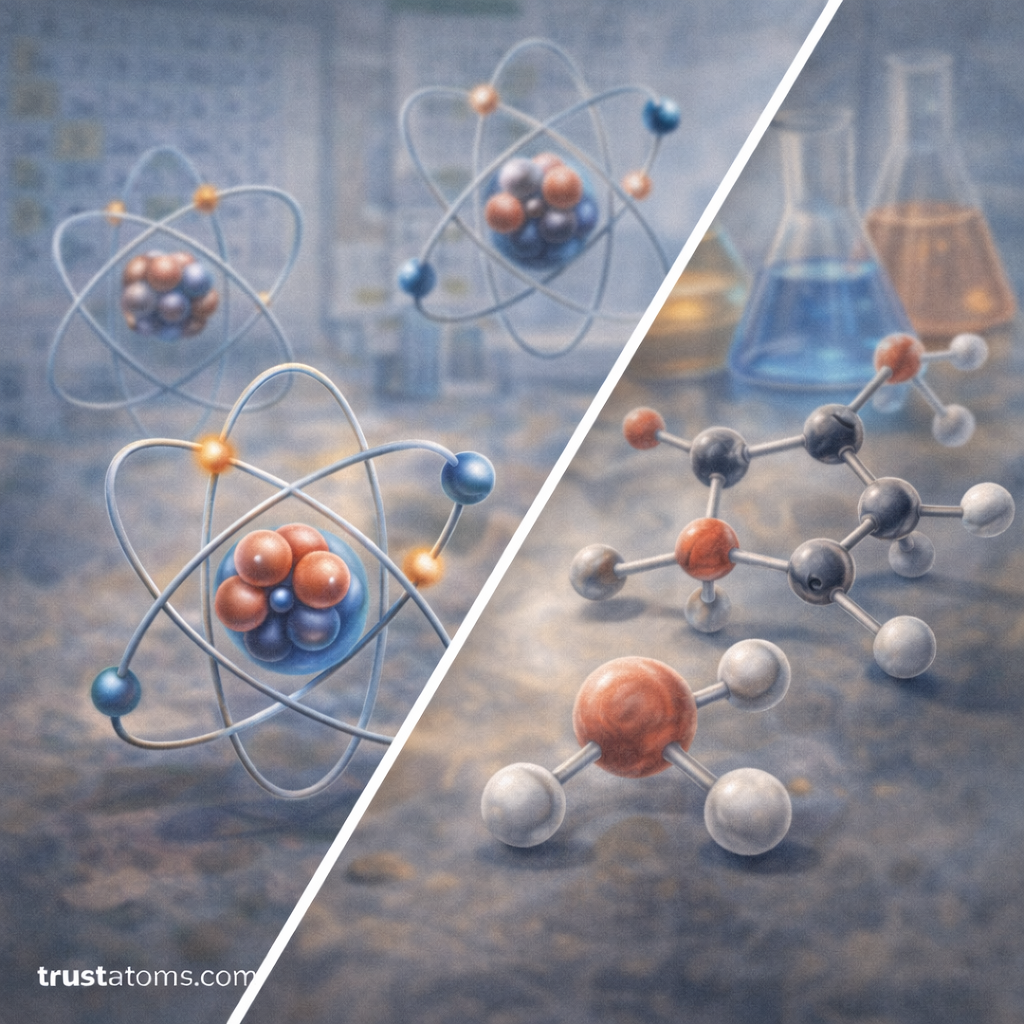
Understanding chemistry begins with atoms and molecules.
Atoms
Atoms are the smallest units of an element that retain the properties of that element.
Each atom consists of:
- Protons – positively charged particles in the nucleus
- Neutrons – neutral particles in the nucleus
- Electrons – negatively charged particles that move around the nucleus
Different elements contain different numbers of protons, which determine their identity.
Molecules
Molecules form when atoms bond together through chemical interactions.
Examples include:
- Water (H₂O)
- Carbon dioxide (CO₂)
- Oxygen (O₂)
- Glucose (C₆H₁₂O₆)
The arrangement of atoms within molecules determines the properties and behavior of substances.
Major Branches of Chemistry
Chemistry is divided into several major branches that focus on different aspects of matter and chemical processes.
Organic Chemistry
Organic chemistry studies compounds that contain carbon.
This branch includes the chemistry of:
- Fuels
- Plastics
- Pharmaceuticals
- Natural biological molecules
Because carbon can form many different structures, organic chemistry is one of the largest areas of chemical research.
Inorganic Chemistry
Inorganic chemistry focuses on substances that are not primarily based on carbon.
Examples include:
- Metals
- Minerals
- Salts
- Ceramics
This field plays an important role in materials science and industrial manufacturing.
Physical Chemistry
Physical chemistry examines the physical principles that govern chemical systems.
Topics often include:
- Thermodynamics
- Reaction rates
- Quantum chemistry
- Energy changes during reactions
Physical chemistry helps scientists understand why chemical reactions occur and how fast they happen.
Analytical Chemistry
Analytical chemistry focuses on determining the composition of substances.
Chemists in this field identify:
- What chemicals are present
- How much of each substance exists
This branch is essential in medicine, environmental monitoring, and quality control.
Biochemistry
Biochemistry studies the chemistry of living organisms.
It explores the chemical processes that occur within cells, including:
- DNA replication
- Protein synthesis
- Metabolism
- Cellular energy production
Biochemistry connects chemistry with biology and medicine.
Why Chemistry Is Important
Chemistry helps scientists understand the natural world and develop technologies that improve human life.
Some of the most important applications of chemistry include:
Medicine and Pharmaceuticals
Chemists design and produce medications that treat diseases and improve health.
Examples include:
- Antibiotics
- Vaccines
- Pain relievers
- Cancer therapies
Energy Production
Chemistry helps develop energy sources such as:
- Fossil fuels
- Batteries
- Solar cells
- Hydrogen fuel technologies
Understanding chemical reactions is essential for improving energy efficiency.
Materials Science
Many modern materials are developed using chemical research.
Examples include:
- Plastics
- Synthetic fibers
- Electronic materials
- Nanomaterials
These materials support technologies ranging from smartphones to aerospace engineering.
Environmental Protection
Chemistry helps scientists monitor pollution and develop solutions to environmental problems.
This includes studying:
- Air quality
- Water contamination
- Climate-related chemical processes
- Sustainable materials
Environmental chemistry helps protect ecosystems and human health.
Chemistry in Everyday Life
Chemistry affects nearly every aspect of daily life, often in ways people may not immediately notice.
Common examples include:
- Cooking and baking reactions
- Cleaning products and detergents
- Cosmetics and personal care products
- Batteries in electronic devices
- Fertilizers used in agriculture
Even simple activities such as rusting metal or dissolving sugar in water involve chemical principles.
Understanding these processes helps scientists design safer and more effective products.
How Chemists Study Matter
Chemists use a variety of methods and instruments to study chemical substances and reactions.
Common tools include:
- Spectrometers
- Chromatography systems
- Microscopes
- Chemical sensors
- Computational modeling software
These tools allow researchers to analyze substances at extremely small scales, sometimes even at the level of individual atoms.
Laboratory experiments and computer simulations often work together to improve scientific understanding.
The Role of Chemistry in Scientific Research
Chemistry plays a central role in many areas of scientific discovery.
It helps scientists:
- Understand biological processes
- Develop new medical treatments
- Improve materials and manufacturing methods
- Study atmospheric and environmental systems
- Explore chemical reactions occurring in space
Because matter is involved in nearly every natural process, chemistry provides a foundation for many scientific breakthroughs.
Final Thoughts
Chemistry is the scientific study of matter and the transformations it undergoes. By examining atoms, molecules, and chemical reactions, chemists gain insight into how the physical world works.
From medicine and energy production to environmental protection and advanced materials, chemistry supports countless technologies that shape modern life.
As scientific research continues to advance, chemistry will remain essential for understanding nature and developing innovations that improve human health, sustainability, and technological progress.