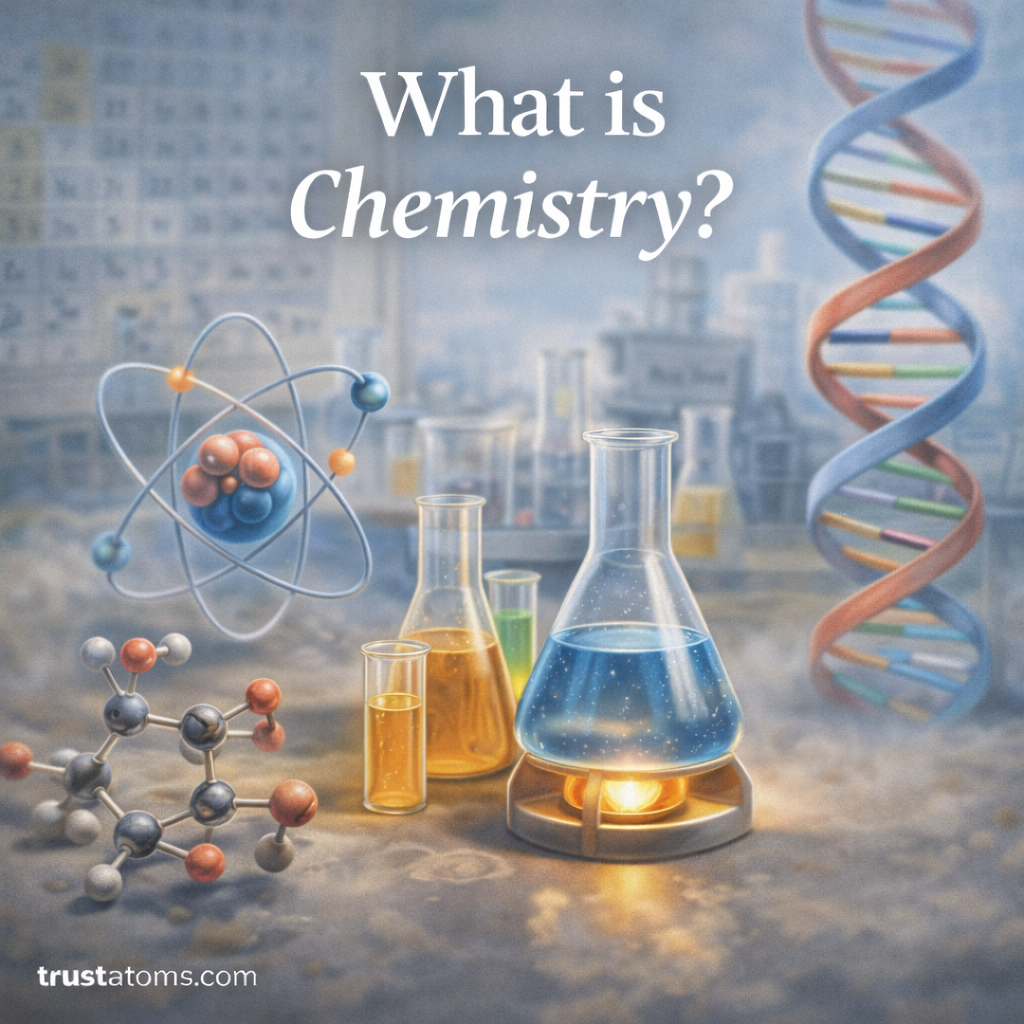
Chemistry is the scientific study of matter—what substances are made of, how they behave, and how they change through chemical reactions. It examines atoms, molecules, energy, and interactions that shape everything in the physical world.
Often called the “central science,” chemistry connects many scientific disciplines. It overlaps heavily with What Is Biology? when studying molecules involved in living organisms, and with What Is Physics? when exploring energy, forces, and atomic behavior.
Whether studying medicines, fuels, food, or materials, chemistry provides the tools needed to understand how matter transforms and interacts.
Understanding Matter and Chemical Change
At its core, chemistry focuses on matter and the changes matter undergoes.
Matter is anything that has mass and occupies space. Chemists study:
- The structure of atoms and molecules
- Physical and chemical properties
- Chemical reactions
- Energy changes during reactions
- Interactions between substances
Chemical reactions happen when atoms rearrange to form new substances.
Examples include:
- Burning fuel releasing energy
- Digestion breaking down food molecules
- Photosynthesis converting carbon dioxide into sugars
- Rust forming on metal surfaces
Many foundational chemistry concepts begin with understanding matter itself. Continue with related topics such as States of Matter Explained, Physical vs Chemical Properties, and Physical vs Chemical Changes.
The Basic Building Blocks of Chemistry
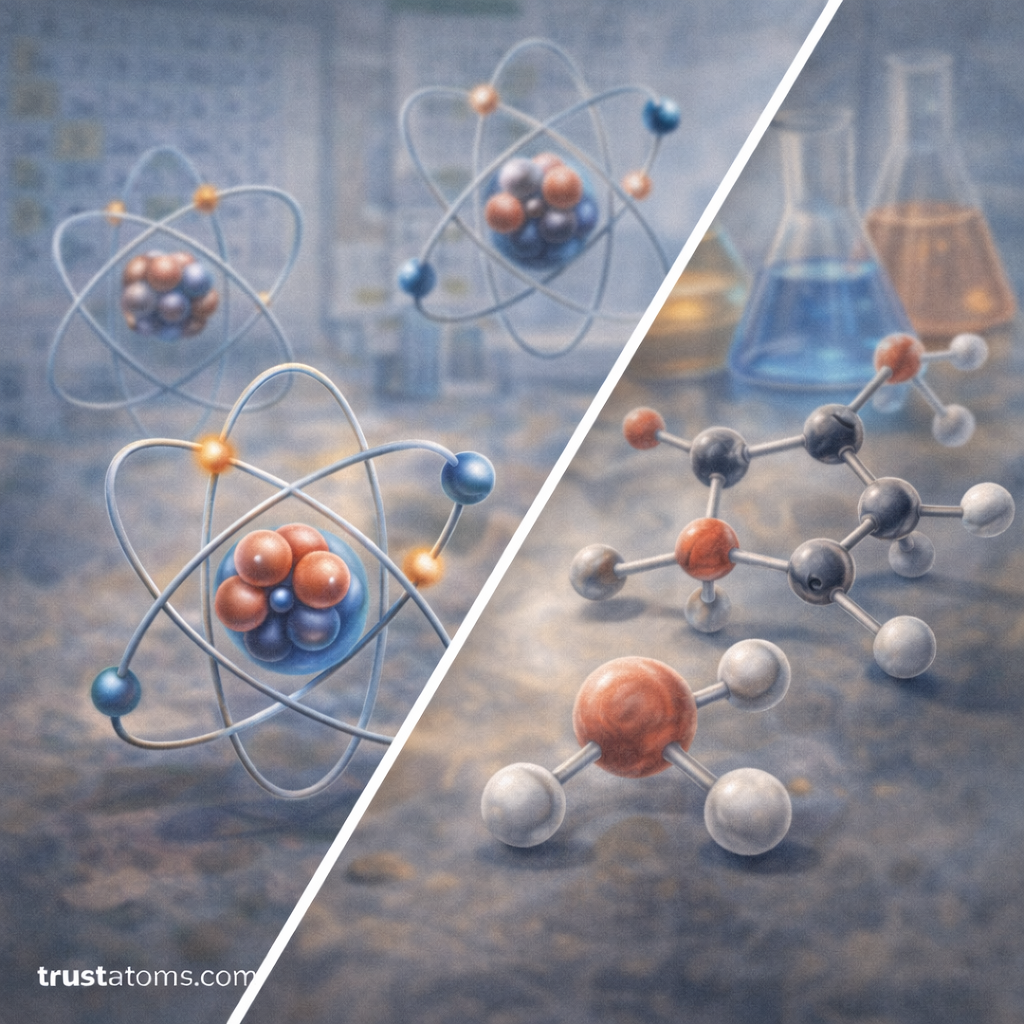
Understanding chemistry begins with atoms and molecules.
Atoms
Atoms are the smallest units of elements that retain chemical properties.
Each atom contains:
- Protons
- Neutrons
- Electrons
Different numbers of protons create different elements.
Readers can continue with:
Molecules
Molecules form when atoms chemically bond together.
Examples include:
- Water (H₂O)
- Oxygen (O₂)
- Carbon dioxide (CO₂)
- Glucose (C₆H₁₂O₆)
The way atoms combine affects a substance’s properties and behavior.
Related chemistry guides:
Major Branches of Chemistry
Chemistry includes several specialized areas.
Organic Chemistry
Organic chemistry studies carbon-containing compounds.
This field helps explain:
- Fuels
- Pharmaceuticals
- Plastics
- Biological molecules
Many biological systems rely heavily on organic chemistry concepts discussed in What Is Biology?.
Continue with:
Inorganic Chemistry
Inorganic chemistry studies substances not primarily based on carbon.
Examples include:
- Metals
- Minerals
- Salts
- Ceramics
Related articles:
Physical Chemistry
Physical chemistry examines the physical laws governing chemical systems.
Topics include:
- Thermodynamics
- Reaction rates
- Quantum chemistry
- Energy transfer
This branch strongly overlaps with concepts discussed in What Is Physics?.
Related reading:
Analytical Chemistry
Analytical chemistry focuses on identifying and measuring substances.
Examples include:
- Chemical testing
- Environmental monitoring
- Laboratory analysis
- Medical diagnostics
Continue with:
Biochemistry
Biochemistry studies chemical processes inside living systems.
This field bridges chemistry and biology and frequently overlaps with What Is Biology?.
Topics include:
- DNA replication
- Protein synthesis
- Cellular metabolism
- Enzymes and energy production
Explore:
Why Chemistry Matters
Chemistry influences nearly every part of modern life.
Chemistry contributes to:
- Medical treatments
- Energy production
- Materials science
- Environmental research
- Agriculture
- Biotechnology
Many scientific discoveries involve chemistry working alongside biology and physics.
For example, understanding chemical reactions inside living organisms naturally connects with What Is Biology?, while atomic interactions often rely on principles from What Is Physics?.
Chemistry in Everyday Life
Chemistry appears constantly in daily life.
Examples include:
- Cooking and baking reactions
- Cleaning products
- Batteries
- Cosmetics
- Agriculture
- Food preservation
Even dissolving sugar in water or rust forming on metal involves chemical principles.
Related topics:
Continue Exploring Chemistry
Build your understanding with:
- Periodic Table Basics
- Chemical Bonds Explained
- Atomic Structure Explained
- States of Matter Explained
- Reaction Rates and Collision Theory
Related science guides:
Final Thoughts
Chemistry is the study of matter and the changes it undergoes. By examining atoms, molecules, and reactions, chemistry helps explain the behavior of the physical world.
From medicine and energy production to environmental science and technology, chemistry remains one of the most important sciences for understanding nature and improving everyday life.