Introduction
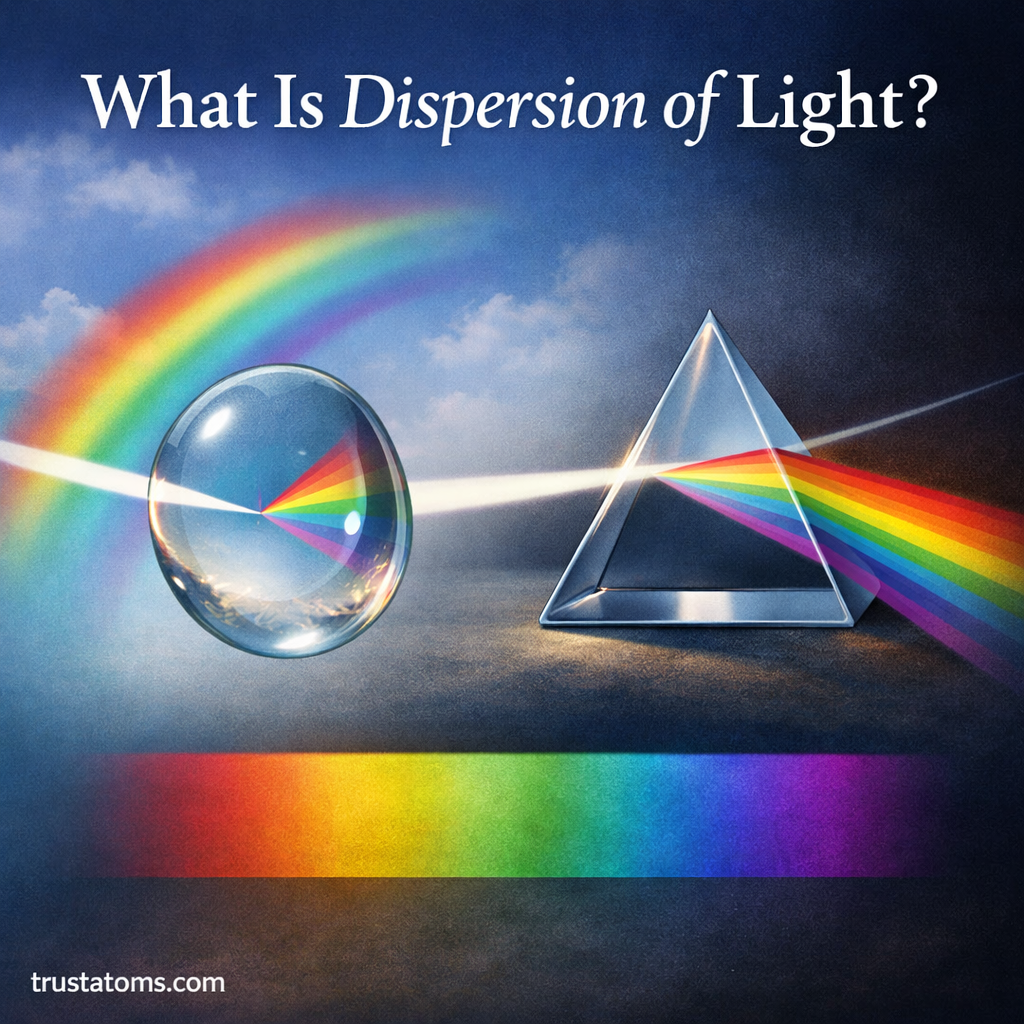
Dispersion of light is a fascinating optical phenomenon where white light separates into its individual colors when it passes through certain materials. This effect occurs because different wavelengths of light travel at different speeds when entering a new medium, such as glass or water.
The most familiar example of dispersion is the rainbow, where sunlight is split into a spectrum of colors by water droplets in the atmosphere. Dispersion helps scientists understand the nature of light and plays an important role in optics, spectroscopy, and many scientific instruments.
Understanding White Light
White light, such as sunlight, might appear uniform, but it is actually a mixture of many different colors. Each color corresponds to a specific wavelength within the visible spectrum.
The visible spectrum includes:
- Red
- Orange
- Yellow
- Green
- Blue
- Indigo
- Violet
These colors combine to form the white light we normally see.
When light is separated into these individual colors, it forms what is called a spectrum.
What Is Dispersion?
Dispersion occurs when different wavelengths of light bend by different amounts as they pass through a material.
This bending happens because the speed of light changes when it moves from one medium to another. Different colors travel at slightly different speeds in materials like glass or water, causing them to spread apart.
In simple terms:
- White light enters a transparent material.
- Each wavelength slows down differently.
- The light bends at slightly different angles.
- The colors separate into a spectrum.
How Dispersion Works
Dispersion is closely related to refraction, which is the bending of light when it enters a new medium. However, dispersion specifically refers to the separation of light into colors due to different refraction angles.
Shorter wavelengths bend more than longer wavelengths.
For example:
- Violet light bends the most.
- Blue and green light bend moderately.
- Red light bends the least.
This difference causes the visible spectrum to spread out.
Dispersion in a Prism
A classic demonstration of dispersion involves a glass prism.
When a beam of white light enters a prism:
- The light refracts as it enters the prism.
- Each wavelength bends slightly differently.
- The colors spread apart inside the prism.
- When the light exits, the colors form a visible spectrum.
The prism essentially acts like a device that separates white light into its component colors.
Dispersion and Rainbows
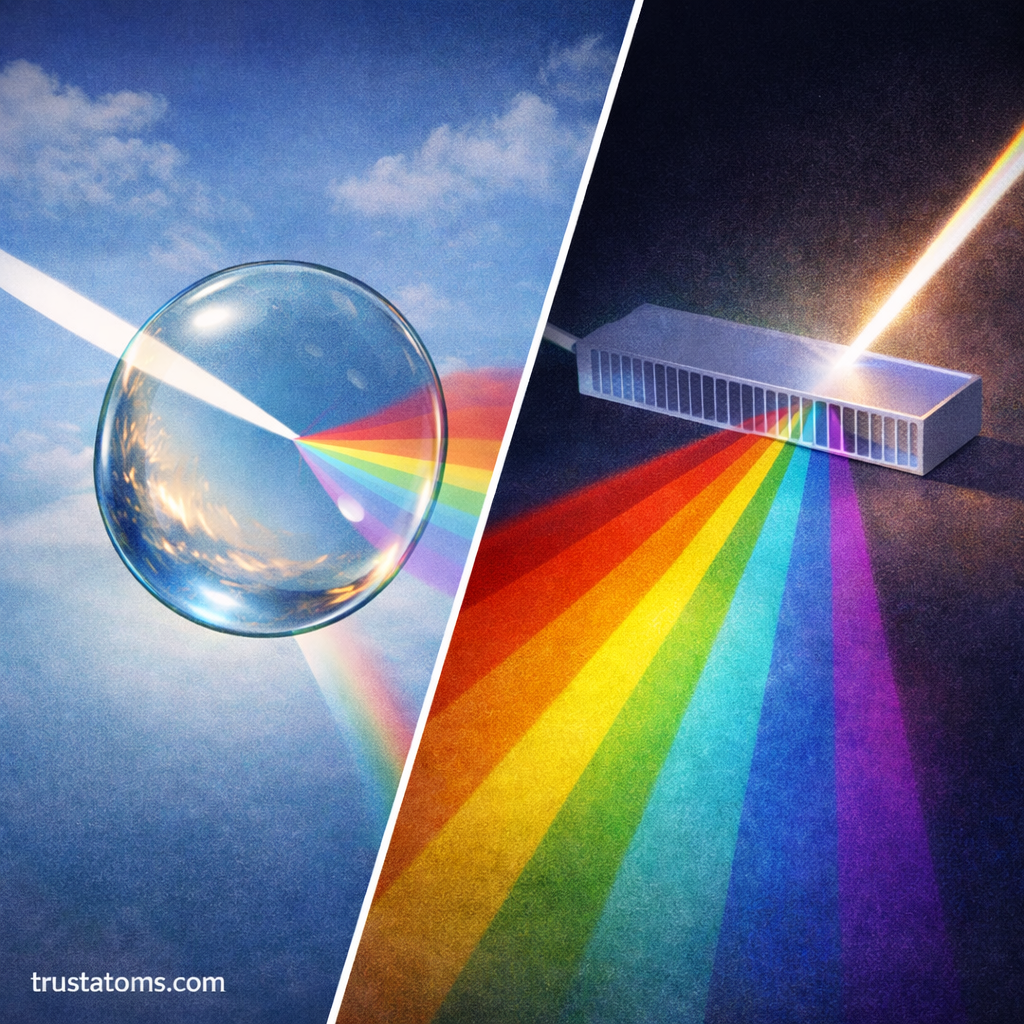
Rainbows are natural examples of dispersion occurring in the atmosphere.
Rainbows form when sunlight interacts with water droplets in the air. Several processes occur inside each droplet:
- Light enters the droplet and refracts.
- The light disperses into different colors.
- It reflects off the inside surface of the droplet.
- The light exits the droplet and refracts again.
Because each color leaves the droplet at a slightly different angle, the observer sees a circular arc of colors in the sky.
The Visible Spectrum
The order of colors produced by dispersion is always the same, from longest wavelength to shortest:
- Red
- Orange
- Yellow
- Green
- Blue
- Indigo
- Violet
A common way to remember this order is the acronym ROYGBIV.
Each color represents a different wavelength of light:
- Red: longest wavelength
- Violet: shortest wavelength
The differences in wavelength are what cause dispersion.
Why Different Colors Bend Differently
Materials like glass have a property called the refractive index, which determines how much light slows down in that medium.
The refractive index varies slightly depending on the wavelength of light. Because of this:
- Short wavelengths slow down more.
- Long wavelengths slow down less.
This difference causes the light rays to spread apart when refracted.
Applications of Dispersion
Dispersion is not just a natural phenomenon—it has important scientific and technological applications.
Spectroscopy
Scientists use dispersion to analyze the light emitted by substances. By separating light into its wavelengths, researchers can identify the chemical composition of materials, stars, and gases.
Optical Instruments
Dispersion is used in devices such as:
- Spectrometers
- Monochromators
- Optical sensors
These instruments rely on separating wavelengths of light to measure specific properties.
Astronomy
Astronomers analyze dispersed light from stars and galaxies to determine:
- Chemical composition
- Temperature
- Motion
- Distance
The spectral lines created by dispersion reveal detailed information about celestial objects.
Dispersion vs Refraction
Although they are related, dispersion and refraction are not the same.
Refraction refers to:
- The bending of light when entering a different medium
Dispersion refers to:
- The separation of light into colors because different wavelengths refract differently
In other words, dispersion is a special case of refraction involving multiple wavelengths.
Everyday Examples of Dispersion
Dispersion appears in many situations in daily life, including:
- Rainbows in the sky
- Light passing through glass prisms
- Color patterns from crystal decorations
- Spectral effects in lenses or optical instruments
Even small glass objects can create miniature rainbows when sunlight passes through them.
Why Dispersion Matters in Physics
Dispersion helps scientists understand fundamental properties of light and matter.
Studying dispersion reveals:
- The wave nature of light
- How light interacts with materials
- The structure of atoms and molecules
- Information about distant stars and galaxies
Because of this, dispersion remains an essential concept in optics, physics, chemistry, and astronomy.
Final Thoughts
Dispersion of light occurs when white light separates into its component colors due to differences in how each wavelength refracts through a material. This phenomenon explains beautiful natural events like rainbows and also supports powerful scientific tools used in laboratories and astronomy.
By studying dispersion, scientists gain deeper insight into the behavior of light and the composition of the universe.