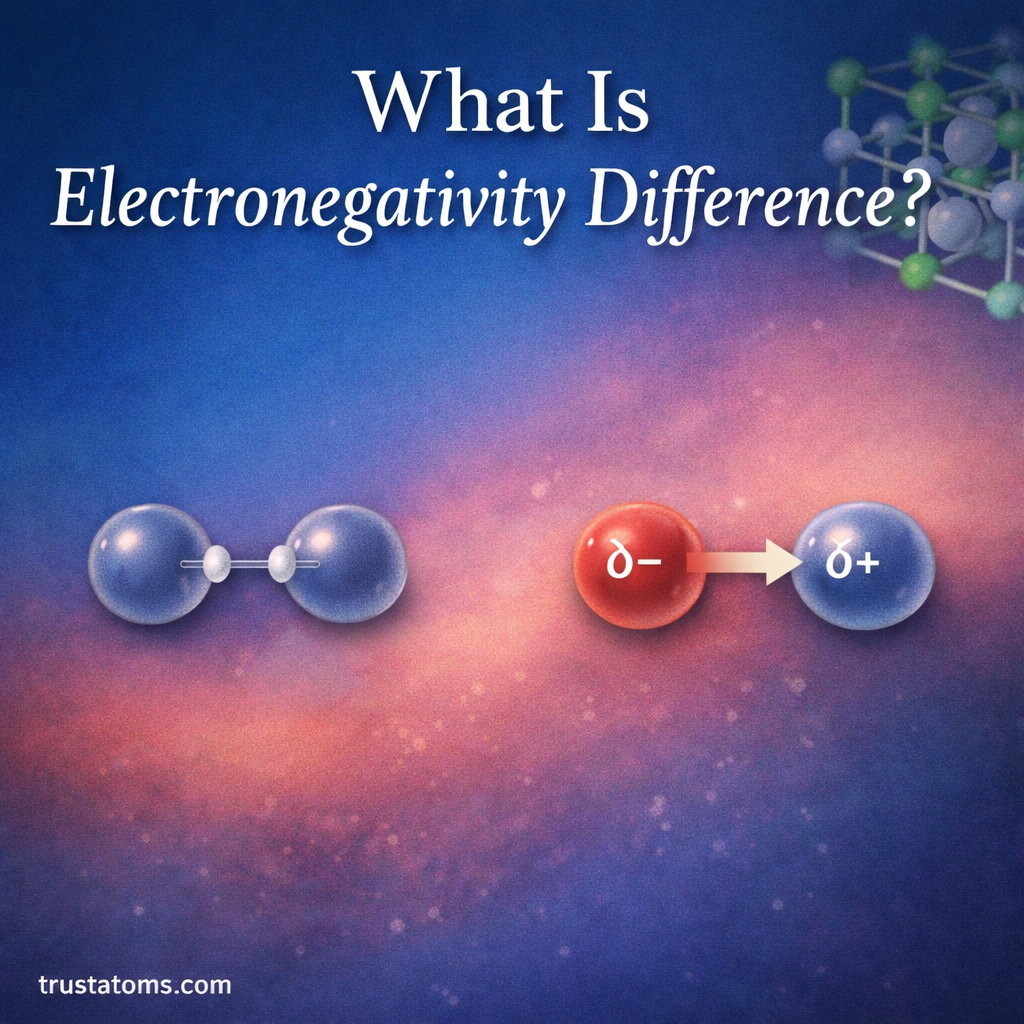
Electronegativity difference is one of the most important ideas in chemistry for understanding how atoms bond together. It helps explain why some molecules share electrons evenly, while others pull electrons toward one atom more strongly.
This concept plays a major role in predicting bond type, molecular polarity, and chemical behavior. From water molecules to salts like sodium chloride, electronegativity differences influence how substances form and interact.
In this guide, we’ll explore what electronegativity difference means, how it works, and why it matters in chemistry.
What Is Electronegativity?
Electronegativity is the ability of an atom to attract electrons toward itself when forming a chemical bond.
When two atoms bond together, they share electrons. However, the sharing is not always equal. Some atoms pull harder on the shared electrons than others.
Atoms with higher electronegativity:
- Attract bonding electrons more strongly
- Pull electron density closer to themselves
- Often become slightly negative in a bond
Atoms with lower electronegativity:
- Attract electrons less strongly
- Lose control of shared electrons more easily
- Often become slightly positive in a bond
The concept was first formalized by chemist Linus Pauling, who created the widely used Pauling electronegativity scale.
What Is Electronegativity Difference?
Electronegativity difference refers to the numerical difference between the electronegativity values of two bonded atoms.
It tells us how unevenly electrons are shared in a chemical bond.
Formula
Electronegativity Difference = | EN₁ − EN₂ |
Where:
- EN₁ = electronegativity of atom 1
- EN₂ = electronegativity of atom 2
- The vertical bars mean absolute value (ignore negative signs)
Example
Hydrogen electronegativity: 2.20
Oxygen electronegativity: 3.44
Electronegativity difference:
3.44 − 2.20 = 1.24
This value indicates that oxygen pulls the shared electrons more strongly than hydrogen.
Why Electronegativity Difference Matters
Electronegativity difference helps chemists determine what type of bond forms between atoms.
The greater the difference, the more unevenly electrons are shared.
This leads to different bonding behaviors.
Key chemical properties influenced by electronegativity difference include:
- Bond type
- Molecular polarity
- Chemical reactivity
- Solubility
- Intermolecular forces
Understanding this difference allows chemists to predict how molecules behave in reactions and in nature.
Electronegativity Difference and Bond Types
Chemists use electronegativity difference to classify chemical bonds into three main categories.
Nonpolar Covalent Bonds
Electrons are shared equally between atoms.
Electronegativity difference:
- Usually 0.0 – 0.4
Characteristics:
- No significant charge separation
- Symmetrical electron sharing
- Common in molecules made of similar atoms
Examples:
- H₂ (hydrogen gas)
- Cl₂ (chlorine gas)
- O₂ (oxygen gas)
These molecules tend to be nonpolar.
Polar Covalent Bonds
Electrons are shared unequally between atoms.
Electronegativity difference:
- Roughly 0.5 – 1.7
Characteristics:
- One atom pulls electrons more strongly
- Partial charges form
- Molecule becomes polar
Examples:
- H₂O (water)
- NH₃ (ammonia)
- HCl (hydrogen chloride)
In these bonds:
- One atom becomes δ− (partially negative)
- The other becomes δ+ (partially positive)
Ionic Bonds
Electrons are transferred rather than shared.
Electronegativity difference:
- Usually greater than 1.7
Characteristics:
- One atom loses electrons
- Another atom gains electrons
- Charged ions form
Example:
Sodium (Na) + Chlorine (Cl)
Electronegativity values:
- Na = 0.93
- Cl = 3.16
Difference:
3.16 − 0.93 = 2.23
This large difference causes sodium to transfer an electron to chlorine, creating the ionic compound NaCl (table salt).
How to Calculate Electronegativity Difference
Calculating electronegativity difference is simple.
Step 1: Find electronegativity values
Use the Pauling electronegativity scale, which assigns numbers to elements.
Example values:
- Hydrogen: 2.20
- Carbon: 2.55
- Nitrogen: 3.04
- Oxygen: 3.44
- Fluorine: 3.98
Step 2: Subtract the values
Always subtract the smaller value from the larger one.
Example:
Carbon (2.55) and Oxygen (3.44)
3.44 − 2.55 = 0.89
Step 3: Interpret the result
Compare the value to bond categories:
| Electronegativity Difference | Bond Type |
|---|---|
| 0.0 – 0.4 | Nonpolar covalent |
| 0.5 – 1.7 | Polar covalent |
| 1.7+ | Ionic |
These ranges are approximate but widely used in chemistry.
Periodic Table Trends in Electronegativity
Electronegativity values follow clear trends on the periodic table.
Across a Period (Left to Right)
Electronegativity increases.
Reason:
- Nuclear charge increases
- Atoms pull electrons more strongly
Example trend:
Na → Mg → Al → Si → P → S → Cl
Each element attracts electrons more strongly than the previous one.
Down a Group (Top to Bottom)
Electronegativity decreases.
Reason:
- Atomic size increases
- Valence electrons are farther from the nucleus
- Attraction for bonding electrons weakens
Example:
Fluorine > Chlorine > Bromine > Iodine
Fluorine is the most electronegative element.
The Most and Least Electronegative Elements
Understanding the extremes helps visualize electronegativity differences.
Most Electronegativity
Fluorine (F)
Electronegativity value:
3.98
Fluorine strongly attracts electrons in almost every bond it forms.
Least Electronegativity
Cesium (Cs) and Francium (Fr)
Electronegativity values:
- Cs ≈ 0.79
- Fr ≈ 0.70
These elements easily lose electrons and form positive ions.
Electronegativity Difference and Molecular Polarity
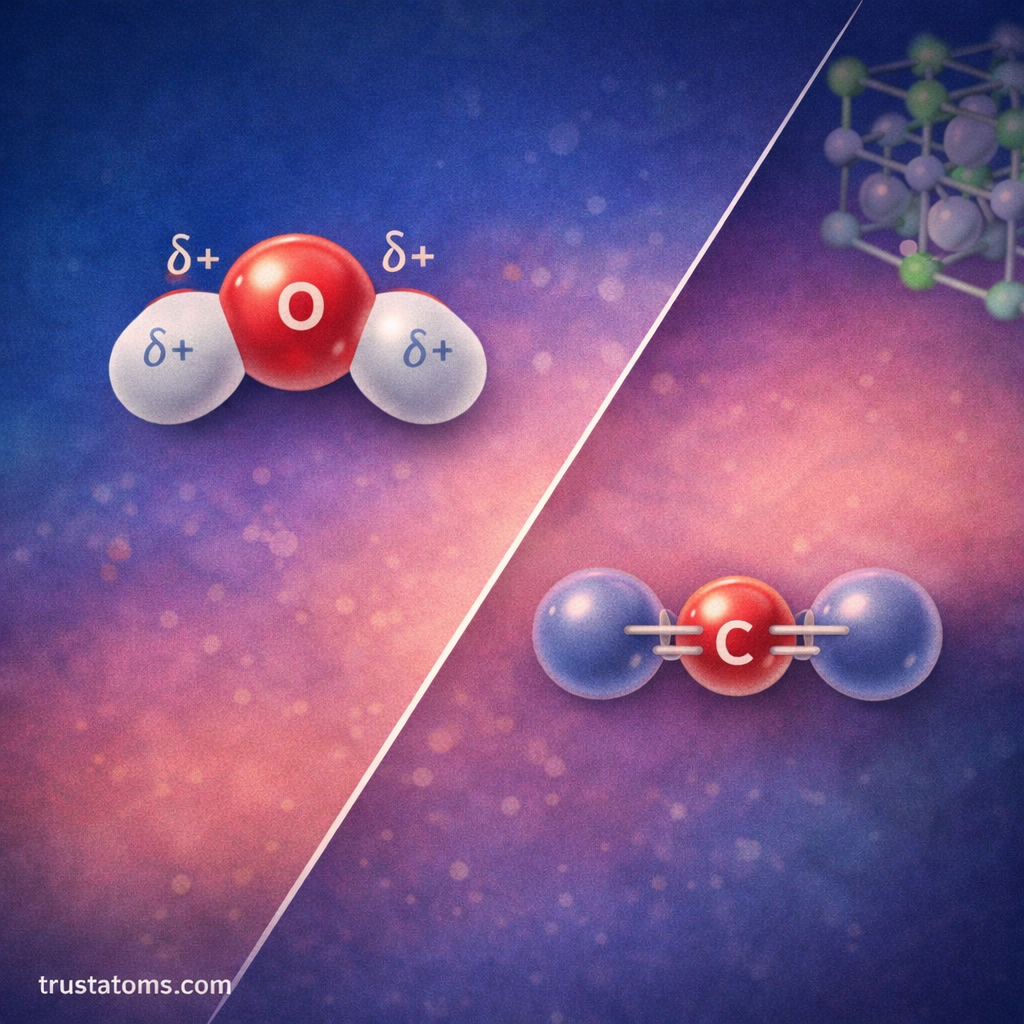
Electronegativity difference influences molecular polarity, but it is not the only factor.
Molecular shape also matters.
Example: Water (H₂O)
Oxygen pulls electrons strongly due to higher electronegativity.
Because water has a bent molecular shape, the polar bonds do not cancel out.
Result:
Water becomes a polar molecule.
This polarity explains many important properties:
- High boiling point
- Excellent solvent ability
- Strong hydrogen bonding
Example: Carbon Dioxide (CO₂)
C–O bonds are polar because oxygen is more electronegative.
However, CO₂ has a linear shape, so the bond dipoles cancel.
Result:
CO₂ is nonpolar overall.
Real-World Importance of Electronegativity Difference
Electronegativity difference helps explain many everyday chemical phenomena.
1. Solubility
Polar molecules dissolve in polar solvents.
Example:
- Salt dissolves in water
- Oil does not mix with water
2. Chemical Reactions
Electron attraction influences reaction behavior.
More electronegative atoms:
- Pull electron density
- Affect reaction mechanisms
3. Material Properties
Bond type affects physical characteristics such as:
- Melting points
- Conductivity
- Hardness
Examples:
- Ionic compounds form crystalline solids
- Covalent molecules may be gases or liquids
4. Biological Chemistry
Electronegativity differences shape biological molecules like:
- DNA
- Proteins
- Enzymes
These interactions control hydrogen bonding, molecular folding, and biochemical reactions.
Common Misconceptions About Electronegativity Difference
Understanding the concept correctly helps avoid confusion.
Misconception 1: Large Difference Always Means Ionic
In reality, many bonds fall between polar covalent and ionic.
Bonding often exists on a spectrum rather than strict categories.
Misconception 2: Electronegativity Only Applies to Two Atoms
Electronegativity differences also affect entire molecules and their polarity.
Molecular geometry must be considered.
Misconception 3: Electronegativity Determines Everything
Other factors also influence bonding:
- Atomic size
- Orbital overlap
- Molecular structure
Electronegativity difference is important, but not the only factor.
Key Takeaways
Electronegativity difference is a fundamental concept for understanding chemical bonds.
Important points to remember:
- Electronegativity measures an atom’s ability to attract electrons.
- Electronegativity difference is the numerical difference between two atoms’ values.
- It predicts whether bonds are nonpolar covalent, polar covalent, or ionic.
- Larger differences lead to more unequal electron sharing.
- Molecular shape also influences whether a molecule is polar.
By learning how electronegativity difference works, chemists can better understand molecular structure, chemical reactions, and material properties.