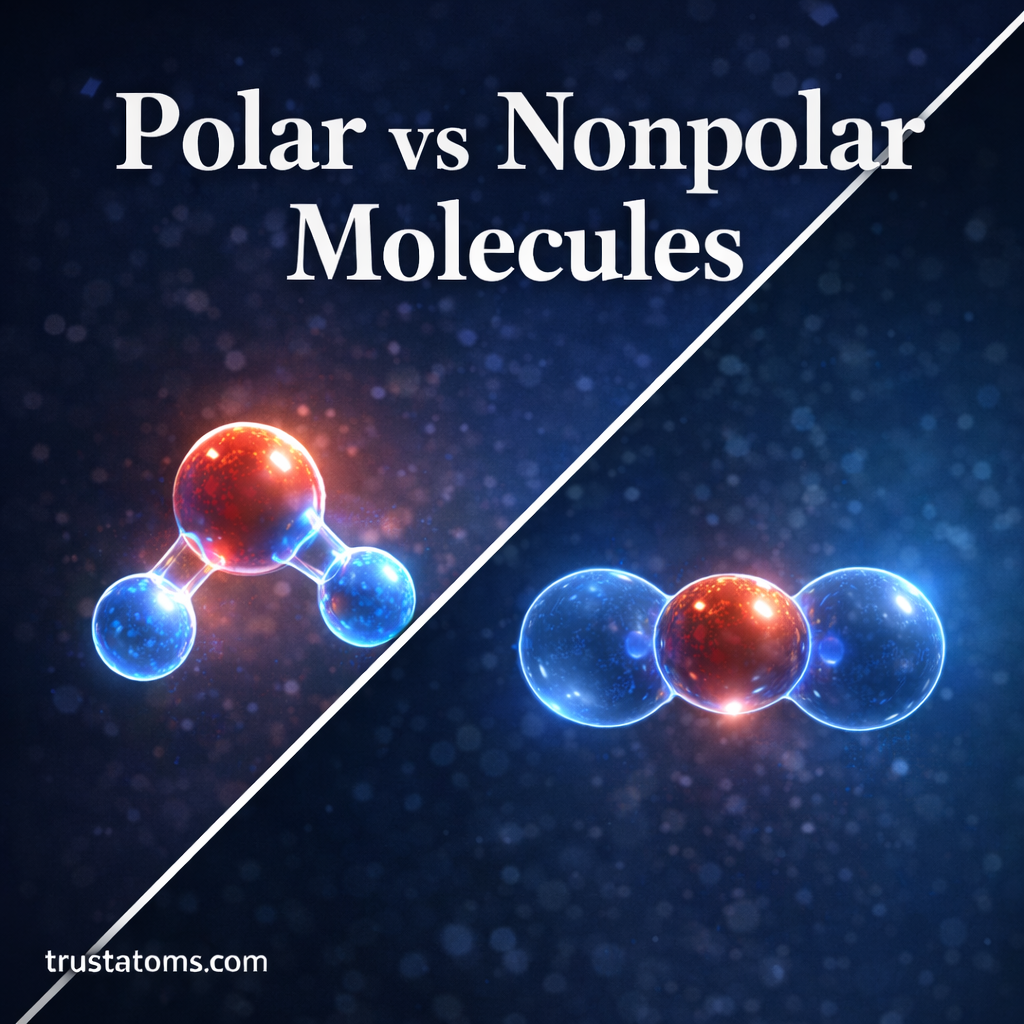
Polar molecules have an uneven distribution of electrical charge that creates a permanent molecular dipole, while nonpolar molecules have no permanent overall dipole. The difference depends on how electrons are distributed within chemical bonds and whether the molecule’s three-dimensional shape allows individual bond dipoles to cancel.
Understanding molecular polarity is a fundamental part of chemistry and chemical bonding. It helps explain many chemical properties, including solubility, intermolecular forces, and how substances interact with one another. From water dissolving sugar to oil separating from water, polarity influences familiar materials.
However, a molecule does not become polar simply because it contains different elements. Carbon dioxide, for example, contains polar bonds but is nonpolar overall because its symmetrical structure causes the bond dipoles to cancel.
What Are Polar Molecules?
A polar molecule has an uneven distribution of electrical charge, producing regions of partial positive and partial negative charge. These regions arise when electrons are attracted more strongly toward certain atoms and the resulting charge separation does not cancel across the molecule.
This unequal attraction is related to bond polarity, which describes how electrons are shared within an individual chemical bond. Molecular polarity considers the combined effect of all bond dipoles and the molecule’s geometry.
The overall separation of positive and negative charge is represented by a dipole moment. Understanding molecular dipole moments helps explain why some molecules align with electric fields and interact strongly with neighboring polar molecules.
Common polar molecules include:
- Water (H₂O): Its bent geometry prevents the two O–H bond dipoles from canceling.
- Ammonia (NH₃): Its trigonal pyramidal shape produces a net dipole.
- Hydrogen fluoride (HF): Fluorine attracts bonding electrons much more strongly than hydrogen.
- Sulfur dioxide (SO₂): Its bent molecular structure produces an overall dipole.
What Are Nonpolar Molecules?
A nonpolar molecule has no permanent overall electric dipole. This can happen when its bonds are nonpolar or when polar bond dipoles cancel because of molecular symmetry.
Even if a molecule contains polar bonds, the overall structure may balance the charges, resulting in a nonpolar molecule.
Examples include:
- Oxygen (O₂): Identical oxygen atoms share electrons equally.
- Nitrogen (N₂): Its two identical atoms form a nonpolar bond.
- Methane (CH₄): Its symmetrical tetrahedral structure produces no net dipole.
- Carbon dioxide (CO₂): Its two polar C=O bonds cancel because the molecule is linear.
Nonpolar molecules still experience electrical attractions. Temporary fluctuations in their electron distributions create London dispersion forces, which occur in all atoms and molecules.
How Molecular Shape Determines Polarity
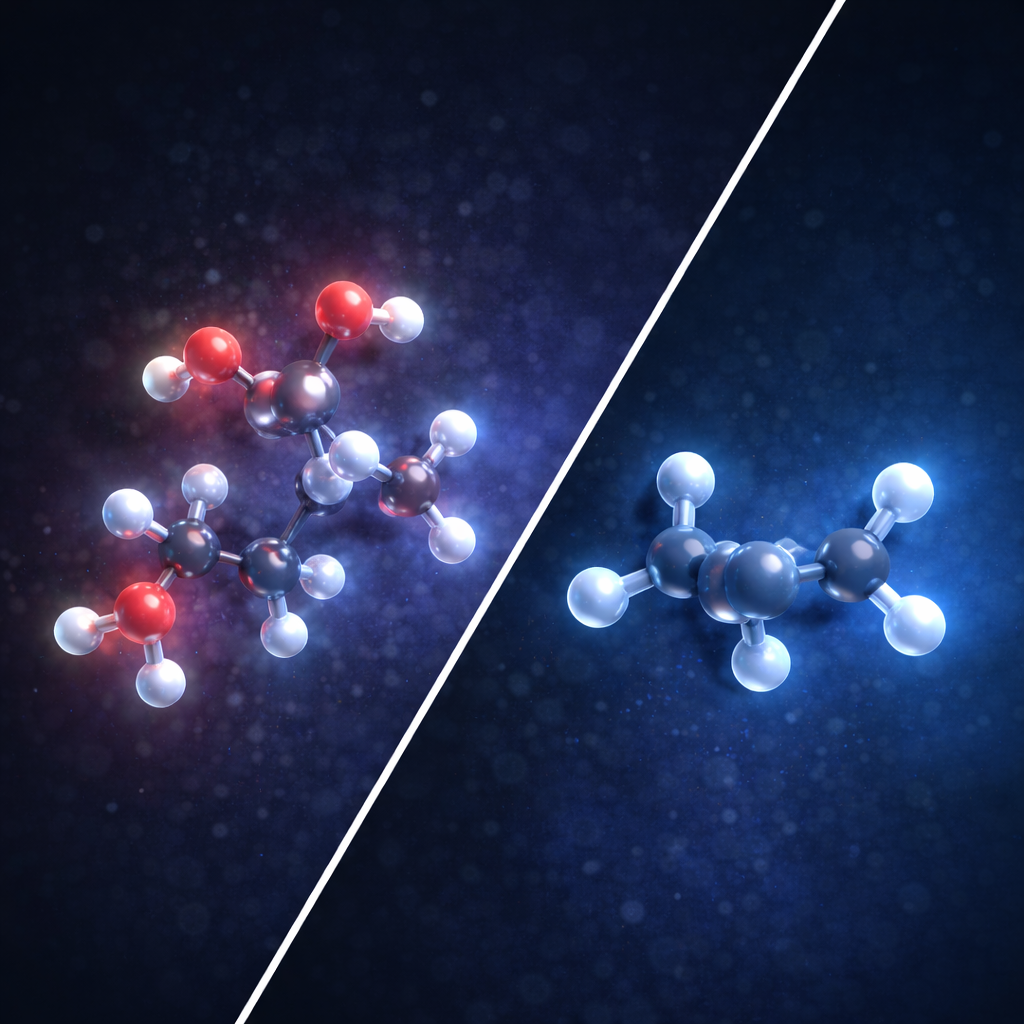
Bond polarity alone cannot determine whether an entire molecule is polar. Bond dipoles have both magnitude and direction, so chemists treat them as vectors when considering the overall molecular dipole.
Carbon Dioxide: Polar Bonds, Nonpolar Molecule
Carbon dioxide contains two polar carbon–oxygen double bonds. However, its O=C=O structure is linear, with a bond angle of 180 degrees. The two equal bond dipoles point in opposite directions and cancel.
Water: Polar Bonds and a Bent Shape
Water also contains polar bonds, but its H–O–H bond angle is approximately 104.5 degrees. Because the molecule is bent, the O–H bond dipoles do not cancel. Water has a permanent molecular dipole of approximately 1.85 debye in the gas phase.
This comparison shows why molecular geometry matters as much as the electronegativity of the bonded atoms. Two molecules can contain polar bonds yet have completely different overall polarities.
Polar vs Nonpolar Molecules: Comparison Table
| Property | Polar Molecules | Nonpolar Molecules |
|---|---|---|
| Overall dipole | Permanent net dipole | No permanent net dipole |
| Charge distribution | Asymmetrical overall | No permanent overall charge separation |
| Common attractions | Dipole–dipole and dispersion forces | London dispersion forces |
| Water solubility | Often greater, depending on structure | Often limited |
| Examples | H₂O, NH₃, HF | O₂, CH₄, CO₂ |
Polarity does not automatically determine boiling point or the strength of all intermolecular attractions. Large nonpolar molecules can experience substantial dispersion forces, while smaller polar molecules may have weaker overall attractions.
Why Oil and Water Separate
The phrase “like dissolves like” summarizes a useful tendency: polar solvents often dissolve polar or ionic substances, while nonpolar solvents tend to dissolve nonpolar substances.
Water is polar and forms an extensive hydrogen-bonding network. Cooking oil consists mainly of triglyceride molecules with large nonpolar hydrocarbon regions. Mixing oil into water would disrupt many favorable water–water interactions without replacing them with sufficiently favorable water–oil interactions.
For a concrete example, pour 100 milliliters of water and 20 milliliters of cooking oil into a transparent container. Shaking temporarily disperses the oil into droplets, but the liquids gradually separate into layers. Most cooking oils are less dense than water, so the oil generally forms the upper layer.
Dish soap helps because its molecules contain both water-attracting and oil-attracting regions. These molecules stabilize small oil droplets in water, making grease easier to remove.
How Polarity Affects Solubility and Molecular Attractions
Polar molecules can attract one another through dipole–dipole interactions. Some molecules, including water, can also form hydrogen bonds when suitable hydrogen donors and electron-rich acceptors are present.
Nonpolar molecules primarily interact through dispersion forces. These attractions become stronger as molecular size, electron-cloud polarizability, and contact area increase.
Solubility depends on the balance of interactions among solute and solvent particles, along with entropy. Salt dissolves in water because favorable ion–dipole interactions and other thermodynamic contributions can support dissolution. Sugar dissolves because its many hydroxyl groups interact favorably with water.
These examples also show why polarity is a useful prediction tool rather than an absolute rule. Molecular size, temperature, and the presence of charged groups can change how readily substances dissolve.
How Polarity Influences Biological Molecules
Cell membranes illustrate how polar and nonpolar regions can work together. Phospholipids contain polar, water-attracting head groups and largely nonpolar hydrocarbon tails.
In water, these molecules can organize into a bilayer, with their polar heads facing the surrounding water and their nonpolar tails pointing inward. This arrangement helps form the selective barrier surrounding cells.
Polarity also affects protein folding, drug solubility, and interactions between biological molecules. However, proteins and many medicines contain both polar and nonpolar regions, so describing an entire large molecule with a single label may oversimplify its behavior.
How to Identify Polar and Nonpolar Molecules
Use the following process to predict molecular polarity:
- Draw the molecule’s Lewis structure, including bonds and lone electron pairs.
- Determine if the bonds are polar using electronegativity differences.
- Determine the three-dimensional molecular geometry, accounting for lone pairs on the central atom.
- Check whether the bond dipoles cancel when their directions are considered.
- Classify the molecule as polar if it has a permanent net dipole, or nonpolar if the overall dipole is zero.
For simple molecules, this method is usually sufficient. For more complex structures, electron distribution and molecular conformation may require additional analysis.
Frequently Asked Questions
Can a molecule have polar bonds but be nonpolar?
Yes. Carbon dioxide has polar carbon–oxygen bonds, but its linear structure causes their dipoles to cancel. Symmetrical molecules such as carbon tetrachloride can also be nonpolar despite containing polar bonds.
Is water polar or nonpolar?
Water is polar because oxygen attracts bonding electrons more strongly than hydrogen and the molecule has a bent shape. These factors produce a permanent net dipole.
Do nonpolar molecules have intermolecular forces?
Yes. Nonpolar molecules experience London dispersion forces caused by temporary fluctuations in electron distribution. These forces help explain why nonpolar substances can condense into liquids and solids.
The difference between polar and nonpolar molecules depends on both bond polarity and molecular geometry. Comparing bent water with linear carbon dioxide demonstrates how molecular shape determines whether bond dipoles cancel, while the separation of oil and water shows the practical effects of polarity on solubility. Examining electron attraction and three-dimensional structure together provides a reliable starting point for predicting molecular behavior.
Sources: Chemistry 2e, OpenStax; Chemistry: The Central Science, Pearson; IUPAC Gold Book, International Union of Pure and Applied Chemistry.