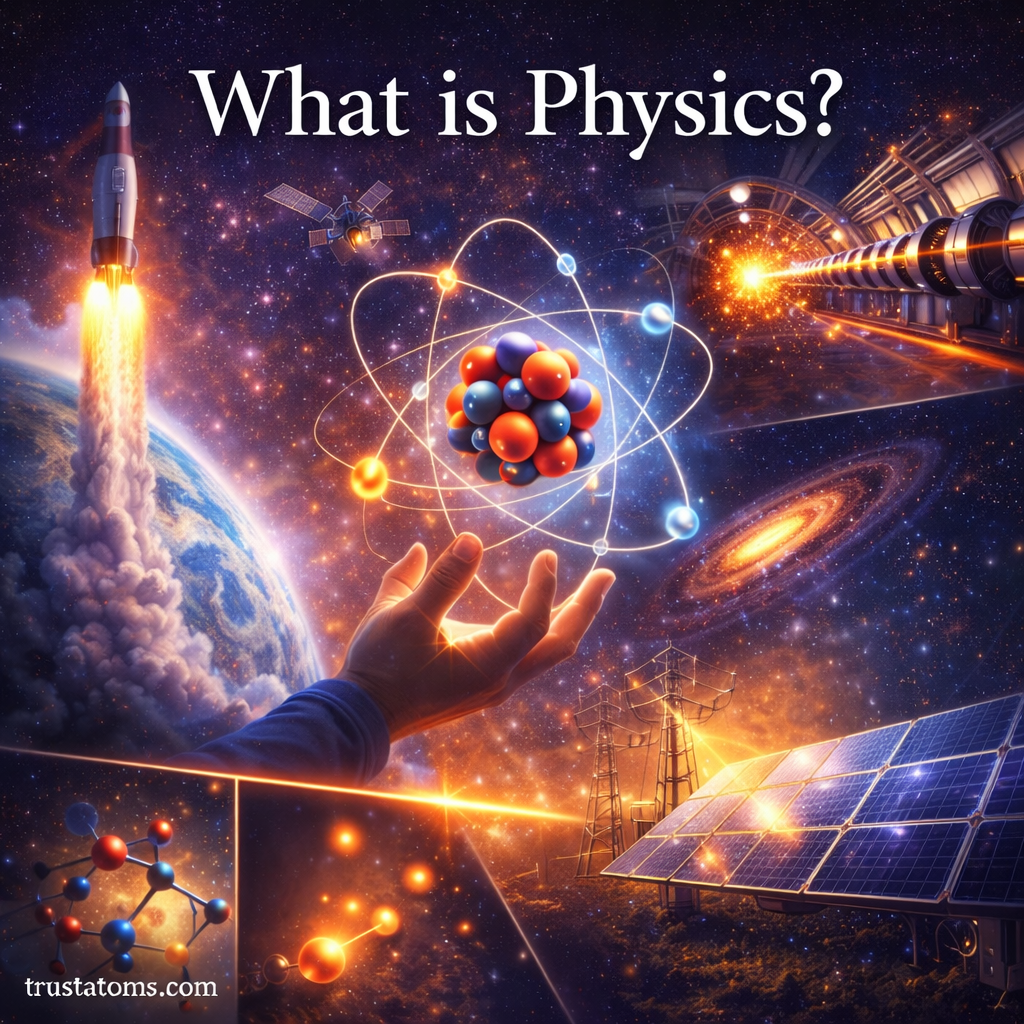
Physics is the branch of science that studies matter, energy, motion, and the fundamental forces of the universe. It seeks to understand how the natural world works—from the smallest subatomic particles to the largest galaxies.
At its core, physics aims to answer questions such as:
- Why do objects move?
- How does energy transfer?
- What are the fundamental laws that govern the universe?
By studying these principles, physics forms the foundation for many other scientific fields, including chemistry, astronomy, engineering, and modern technology.
The Basic Idea Behind Physics
Physics focuses on the laws that describe how the universe behaves. These laws explain how objects interact with each other and how energy moves through space and matter.
Physicists use observation, experimentation, and mathematical models to understand these relationships.
Some key concepts studied in physics include:
- Motion
- Forces
- Energy
- Gravity
- Light
- Electricity and magnetism
By uncovering the rules that govern these phenomena, physics helps explain everything from falling apples to the motion of planets.
Major Branches of Physics
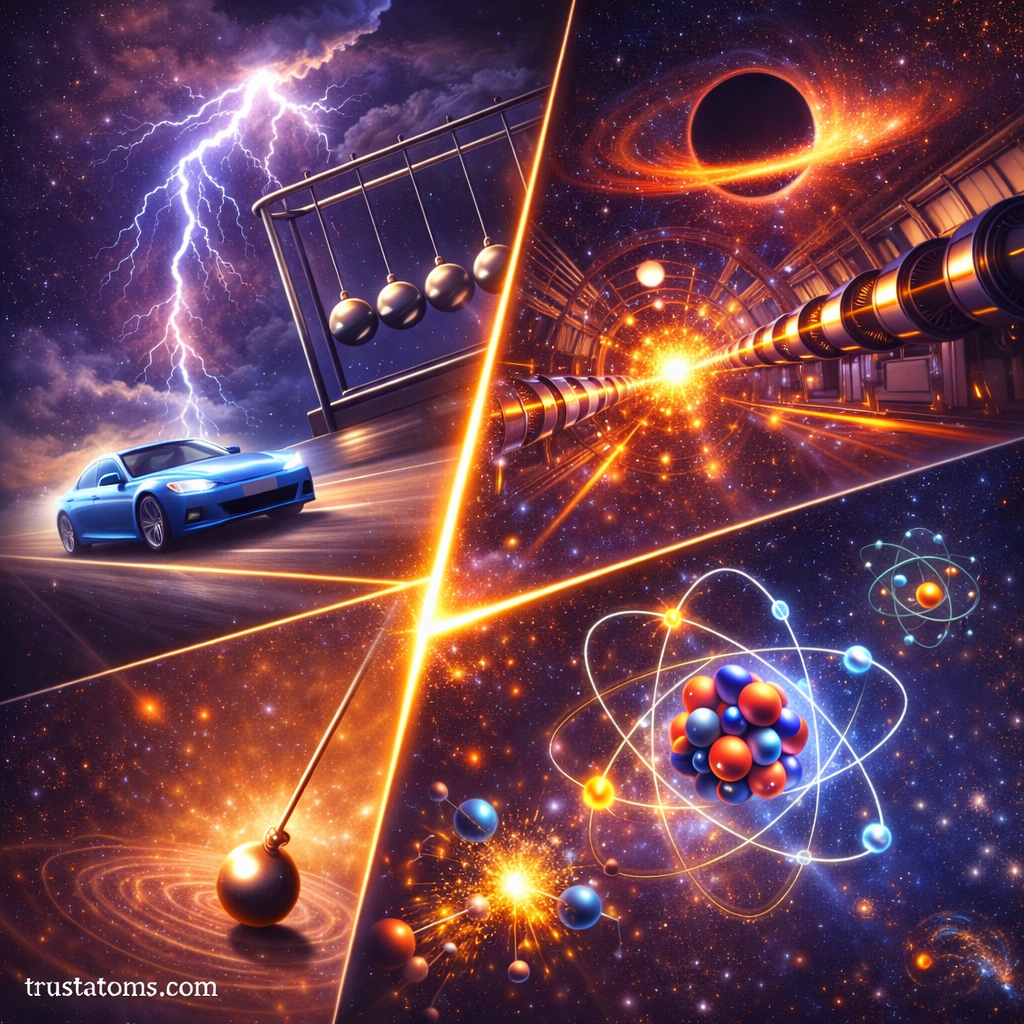
Physics is a large field with several specialized areas that focus on different aspects of the universe.
Classical Physics
Classical physics studies the motion of objects and forces in everyday situations. It includes ideas developed before the 20th century.
Key topics include:
- Mechanics (motion and forces)
- Thermodynamics (heat and energy transfer)
- Electromagnetism (electric and magnetic forces)
- Optics (light and vision)
Classical physics explains many common experiences, such as how cars move or why objects fall to the ground.
Modern Physics
Modern physics explores phenomena that classical physics cannot fully explain.
It includes fields such as:
- Quantum mechanics
- Particle physics
- Relativity
- Nuclear physics
These areas study extremely small particles, high speeds, and powerful forces that occur in extreme environments like stars or particle accelerators.
Astrophysics
Astrophysics applies the laws of physics to space and the universe.
It investigates topics such as:
- Stars and galaxies
- Black holes
- Planetary systems
- The origin and evolution of the universe
Astrophysics helps scientists understand how the cosmos formed and how it continues to change over time.
The Four Fundamental Forces
Physics identifies four fundamental forces that control how matter interacts in the universe.
1. Gravity
Gravity is the force that attracts objects with mass toward one another.
It governs:
- Planetary orbits
- The motion of galaxies
- The structure of the universe
Although gravity is relatively weak compared to other forces, it dominates on large cosmic scales.
2. Electromagnetic Force
The electromagnetic force acts between electrically charged particles.
It is responsible for:
- Electricity
- Magnetism
- Light
- Chemical bonding
This force is essential for many everyday technologies, from electronics to communication systems.
3. Strong Nuclear Force
The strong nuclear force holds atomic nuclei together by binding protons and neutrons.
Without this force:
- Atomic nuclei would break apart
- Matter would not remain stable
It is one of the most powerful forces in nature but acts only at extremely small distances.
4. Weak Nuclear Force
The weak nuclear force governs certain types of radioactive decay and nuclear reactions.
It plays a major role in processes such as:
- Nuclear fusion in stars
- Particle transformations
This force is essential for the production of energy inside the Sun.
Why Physics Is Important
Physics helps explain many aspects of the natural world and supports advances in technology and engineering.
Some important contributions of physics include:
- Understanding electricity and power generation
- Developing modern electronics
- Advancing medical imaging technologies
- Improving transportation systems
- Enabling space exploration
Many innovations that shape modern life are rooted in discoveries made by physicists.
How Physicists Study the Universe
Physicists use several methods to explore how the universe works.
Observation
Scientists observe natural phenomena to identify patterns and behaviors.
Examples include:
- Tracking planetary motion
- Measuring light from distant stars
Experiments
Experiments allow physicists to test ideas and confirm theories.
Laboratories and research facilities use advanced equipment such as:
- Particle accelerators
- Telescopes
- Lasers
- High-precision sensors
Mathematical Models
Mathematics plays a key role in physics.
Equations help physicists describe natural laws and predict outcomes in experiments and real-world systems.
Physics in Everyday Life
Although physics may seem abstract, it influences many everyday experiences.
Examples include:
- Smartphones and computers
- GPS navigation
- Solar panels
- Medical imaging machines
- Transportation systems
Even simple activities such as throwing a ball or heating food involve physical principles like motion, energy transfer, and thermodynamics.
The Future of Physics
Physics continues to evolve as scientists explore unanswered questions about the universe.
Some of the biggest challenges in modern physics include:
- Understanding dark matter
- Explaining dark energy
- Unifying quantum mechanics and gravity
- Exploring the earliest moments of the universe
New discoveries in physics may reshape our understanding of reality and lead to technologies that do not yet exist.
Final Thoughts
Physics is the science that studies the fundamental laws of nature. By exploring matter, energy, forces, and motion, physicists reveal how the universe works at both the smallest and largest scales.
From explaining everyday phenomena to uncovering cosmic mysteries, physics plays a central role in scientific discovery and technological innovation.
As research continues, physics will remain one of the most important fields for understanding the universe and advancing human knowledge.