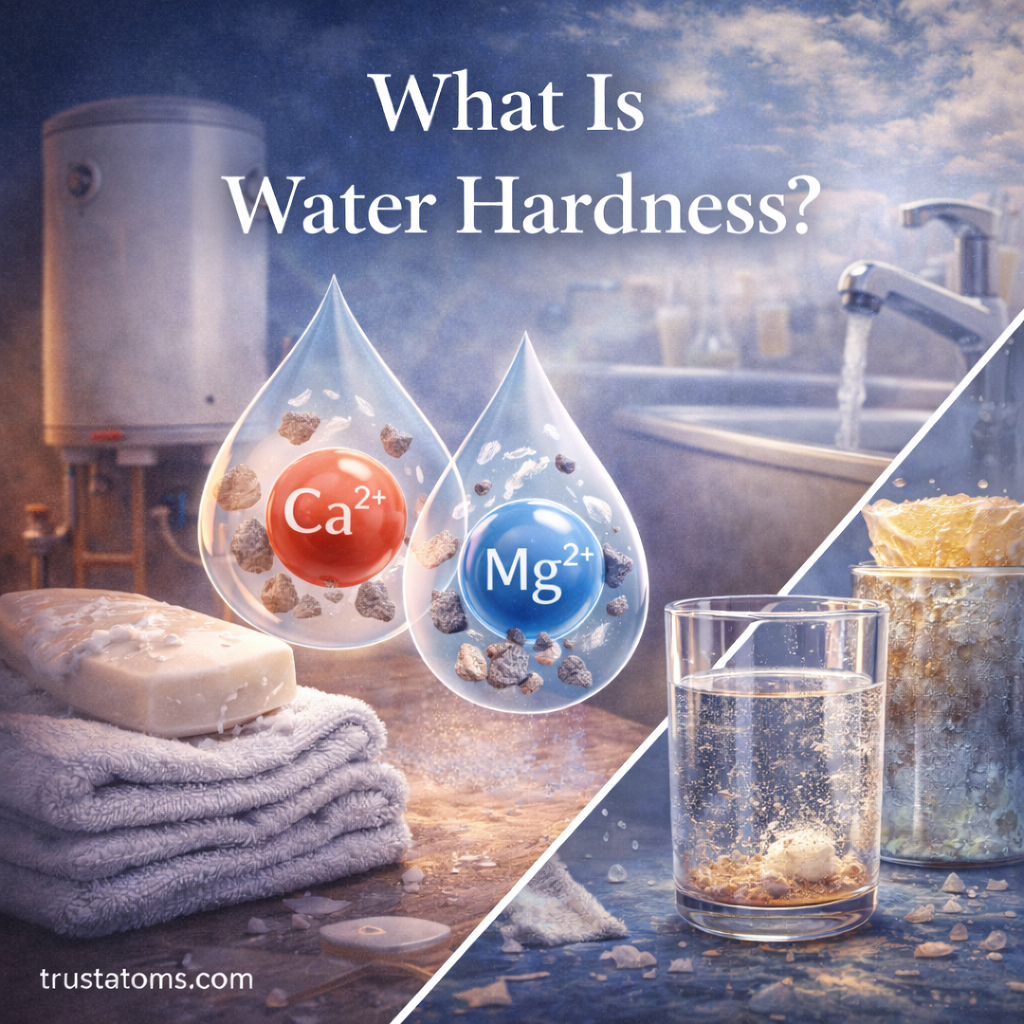
Water hardness refers to the concentration of dissolved minerals in water, mainly calcium and magnesium ions. These minerals enter water naturally as it moves through soil and rock formations, dissolving small amounts of minerals along the way.
Hard water is common in many parts of the world and is not harmful to human health. However, it can affect cleaning efficiency, plumbing systems, appliances, and industrial processes.
Understanding water hardness is important in chemistry, environmental science, and water treatment because it influences how water behaves in both household and industrial settings.
What Causes Water Hardness?
Water hardness occurs when groundwater or surface water passes through mineral-rich rocks, especially limestone and dolomite.
As water flows through these rocks, it dissolves minerals such as:
- Calcium carbonate
- Magnesium carbonate
- Calcium sulfate
- Magnesium sulfate
These dissolved minerals increase the mineral content of the water, leading to hardness.
Areas with limestone geology often have naturally harder water than regions with granite or other less soluble rock types.
Types of Water Hardness
Chemists generally divide water hardness into two main categories.
Temporary Hardness
Temporary hardness is caused by dissolved bicarbonate minerals, such as calcium bicarbonate and magnesium bicarbonate.
This type of hardness can be removed by boiling the water, which causes the minerals to precipitate out of solution.
Temporary hardness is sometimes called carbonate hardness.
Permanent Hardness
Permanent hardness results from minerals such as:
- Calcium sulfate
- Magnesium sulfate
- Calcium chloride
Unlike temporary hardness, permanent hardness cannot be removed by boiling. Instead, it requires chemical treatment or water-softening systems.
How Water Hardness Is Measured
Water hardness is usually measured by the concentration of calcium carbonate equivalent in water.
Common units include:
- Milligrams per liter (mg/L)
- Parts per million (ppm)
- Grains per gallon (gpg)
General Hardness Categories
Water is often classified using the following scale:
| Hardness Level | Calcium Carbonate Concentration |
|---|---|
| Soft | 0–60 mg/L |
| Moderately hard | 61–120 mg/L |
| Hard | 121–180 mg/L |
| Very hard | Above 180 mg/L |
These ranges help water treatment professionals determine whether softening treatment is needed.
Effects of Hard Water
Hard water affects many everyday activities, especially cleaning and plumbing.
Reduced Soap Efficiency
Minerals in hard water react with soap to form insoluble compounds, often called soap scum.
This reaction:
- Reduces soap lather
- Leaves residue on surfaces
- Makes cleaning less effective
Scale Formation
Hard water can leave mineral deposits, known as scale, on surfaces and inside pipes.
Scale commonly forms in:
- Water heaters
- Boilers
- Pipes
- Coffee makers
- Dishwashers
Over time, scale buildup can reduce efficiency and increase energy costs.
Laundry and Cleaning Issues
Hard water may cause:
- Dull or stiff fabrics
- Spots on dishes and glassware
- Residue on bathroom surfaces
These effects occur because mineral ions interfere with cleaning products.
Hard Water and Human Health
Despite its effects on cleaning and appliances, hard water is generally safe to drink.
In fact, calcium and magnesium in hard water are essential minerals that contribute to dietary intake.
Some studies suggest that moderate levels of mineral content in water may even support bone health and cardiovascular function, although the effects vary depending on overall diet.
How Hard Water Is Treated
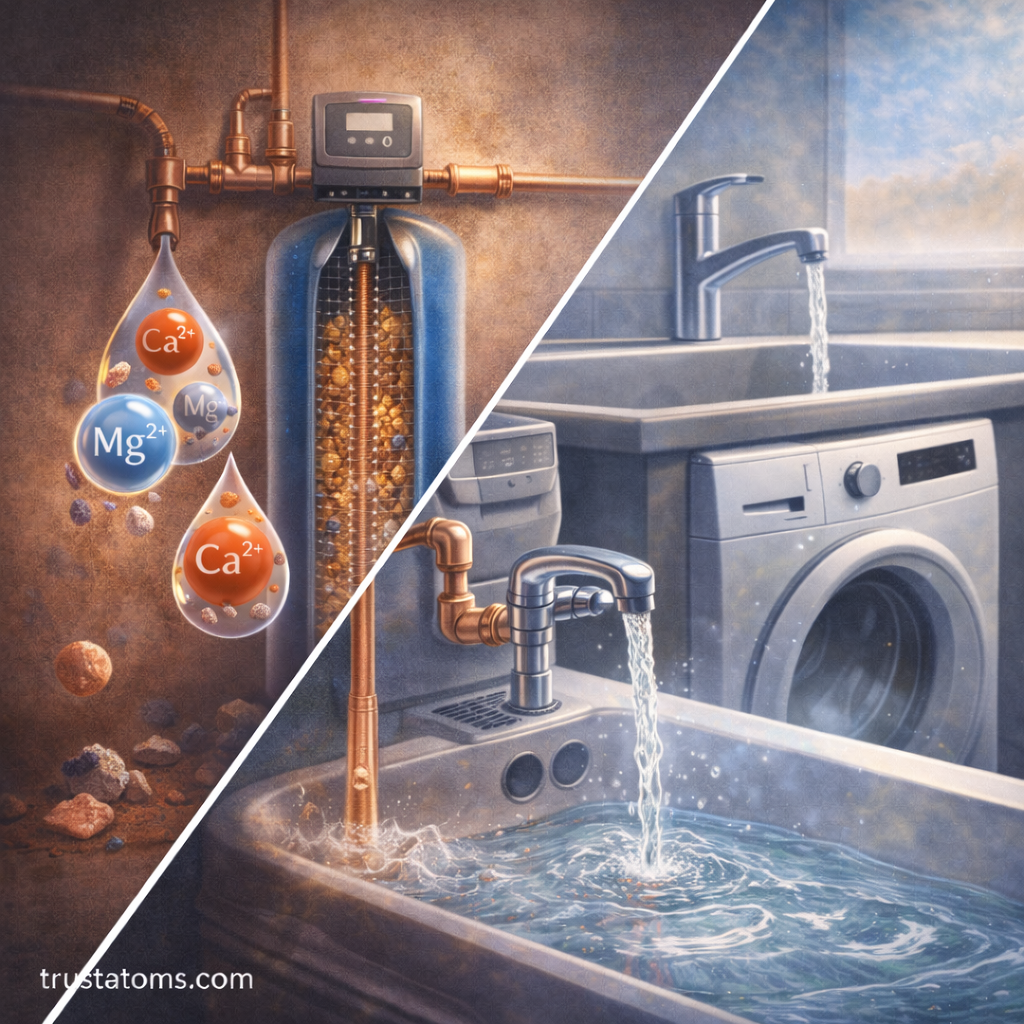
Several methods can reduce or remove water hardness.
Ion Exchange Water Softeners
The most common method is ion exchange softening.
In this process:
- Hard water passes through a resin containing sodium ions.
- Calcium and magnesium ions attach to the resin.
- Sodium ions are released into the water.
This exchange removes hardness minerals and softens the water.
Reverse Osmosis
Reverse osmosis systems remove many dissolved minerals by pushing water through a semi-permeable membrane.
This method is commonly used for:
- Drinking water purification
- Industrial water treatment
Lime Softening
In large-scale water treatment plants, lime (calcium hydroxide) may be added to precipitate hardness minerals.
This method is often used for municipal water treatment.
Hard Water in Industry
Water hardness is a major concern in many industrial processes.
Industries that rely on boilers, cooling systems, or chemical reactions must carefully control mineral content in water.
Industrial Problems Caused by Hard Water
Hard water can lead to:
- Equipment scaling
- Reduced heat transfer efficiency
- Increased maintenance costs
- Chemical reaction interference
Because of these issues, many industries treat water before using it in manufacturing or energy production.
Hard Water vs Soft Water
Soft water contains very low concentrations of calcium and magnesium ions.
Differences Between Hard and Soft Water
Hard water:
- Contains higher mineral content
- Forms soap scum
- Leaves scale deposits
Soft water:
- Lathers easily with soap
- Leaves fewer mineral deposits
- Is often preferred for cleaning and appliances
However, some people prefer the taste of hard water due to its mineral content.
Why Water Hardness Matters
Water hardness is an important concept in environmental chemistry and water management.
Understanding water hardness helps scientists and engineers:
- Improve water treatment systems
- Protect plumbing and industrial equipment
- Maintain water quality
- Study mineral cycles in natural ecosystems
Because water is essential to everyday life and industry, controlling its chemical composition is a key aspect of modern water management.
Final Thoughts
Water hardness refers to the amount of dissolved minerals—mainly calcium and magnesium—present in water. These minerals enter water naturally as it flows through rock formations and soil.
Although hard water is safe to drink, it can cause issues such as soap inefficiency, mineral scale buildup, and appliance wear. Through water treatment methods like ion exchange, reverse osmosis, and chemical softening, these effects can be reduced.
By understanding water hardness, chemists and environmental scientists can better manage water quality and ensure efficient use in homes, industries, and public water systems.