Earth’s atmosphere is not a single uniform layer—it is a structured system made up of distinct regions, each with its own properties and functions. From the air we breathe to the edge of space, these layers work together to support life, regulate climate, and protect the planet.
In this guide, we’ll explore the troposphere, stratosphere, and beyond, breaking down how each atmospheric layer behaves and why it matters.
Understanding Atmospheric Layers
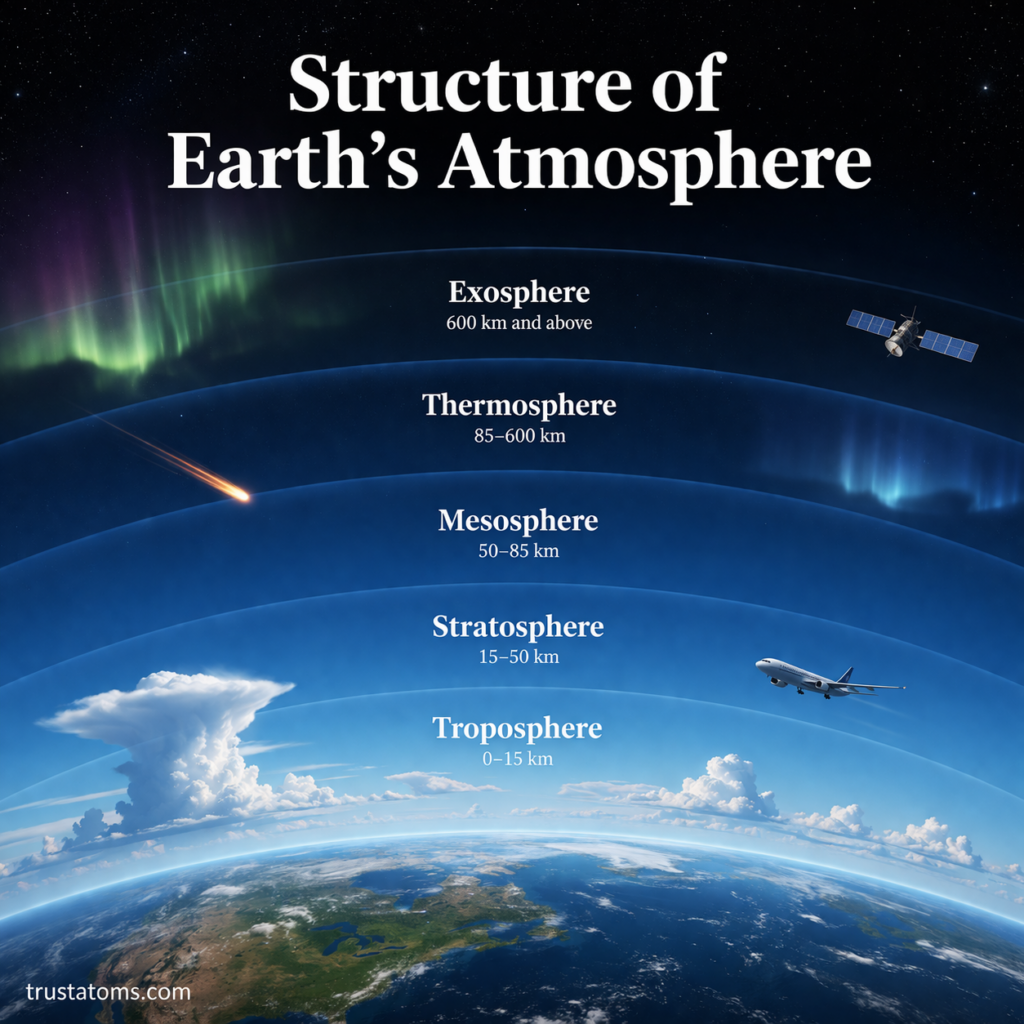
The atmosphere is divided into layers based on how temperature changes with altitude. These changes affect air movement, pressure, and the behavior of gases.
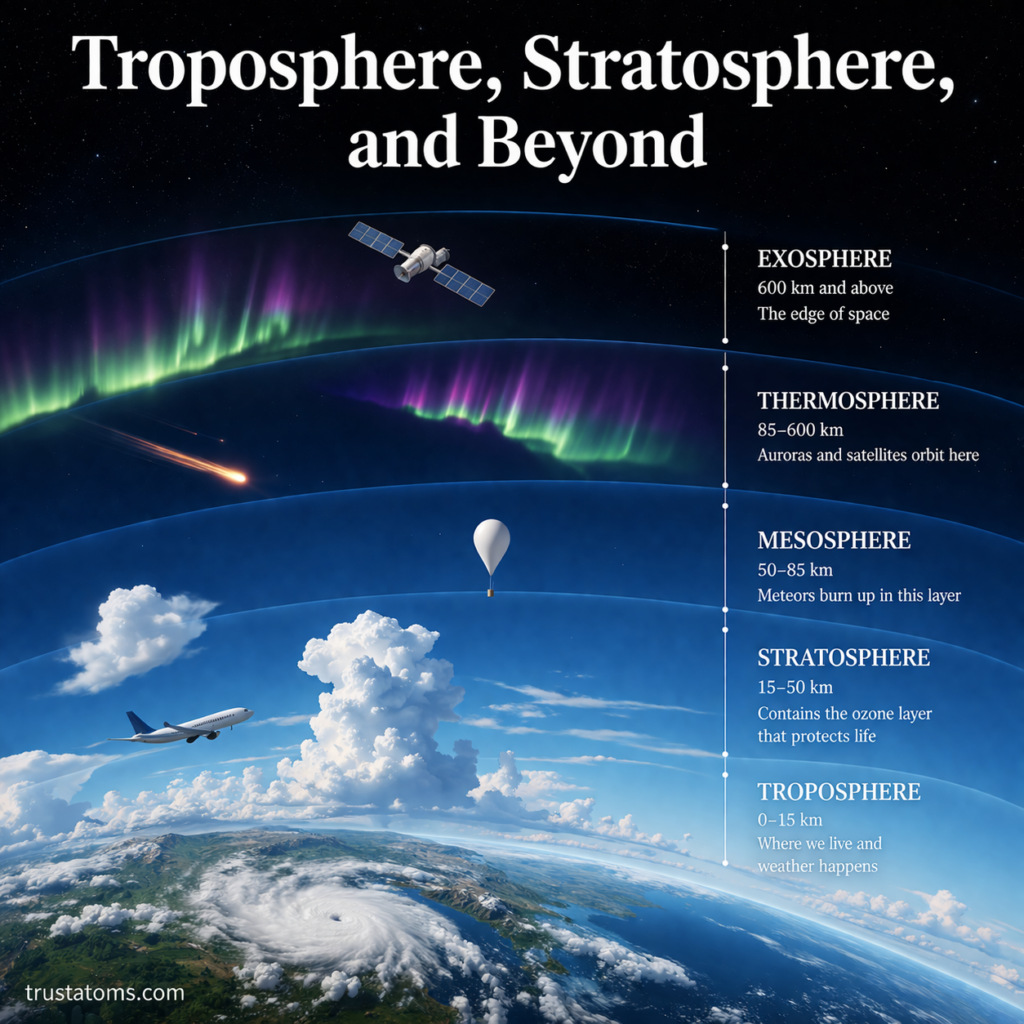
The five main layers are:
- Troposphere
- Stratosphere
- Mesosphere
- Thermosphere
- Exosphere
Each layer becomes thinner as altitude increases, with fewer gas molecules and lower air pressure.
The Troposphere: Where Life and Weather Exist
The troposphere is the lowest layer and the most important for life on Earth.
Key Characteristics
- Extends from the surface up to about 8–15 km (5–9 miles)
- Contains most of the atmosphere’s mass
- Temperature decreases with altitude
- Air is dense and full of water vapor
What Happens Here
- Weather systems form (clouds, rain, storms)
- Wind patterns circulate heat and moisture
- Human activities and ecosystems exist
Why It Matters
The troposphere is essential because it:
- Provides breathable oxygen
- Supports the water cycle
- Drives daily weather and long-term climate
Without it, life as we know it would not exist.
The Stratosphere: Home of the Ozone Layer
Above the troposphere lies the stratosphere, a more stable and less turbulent region.
Key Characteristics
- Extends from about 15 km to 50 km (9–31 miles)
- Temperature increases with altitude
- Contains the ozone layer
What Happens Here
- Ozone absorbs harmful ultraviolet (UV) radiation
- Air is dry and layered, with minimal mixing
- Jet aircraft often fly in the lower stratosphere
Why It Matters
The stratosphere protects life by:
- Blocking most UV radiation from the Sun
- Stabilizing atmospheric conditions above weather systems
The Mesosphere: Earth’s Protective Shield
The mesosphere is the middle layer, often overlooked but critically important.
Key Characteristics
- Extends from 50 km to 85 km (31–53 miles)
- Temperature decreases with altitude
- Extremely low air pressure
What Happens Here
- Meteors burn up due to friction with atmospheric particles
- Some of the coldest temperatures in the atmosphere occur here
Why It Matters
The mesosphere acts as a protective barrier, preventing most meteoroids from reaching Earth’s surface.
The Thermosphere: Where Space Begins
The thermosphere is a high-energy region influenced by solar activity.
Key Characteristics
- Extends from 85 km to about 600 km (53–373 miles)
- Temperature increases dramatically with altitude
- Contains ionized particles
What Happens Here
- Auroras (Northern and Southern Lights) occur
- Satellites orbit within this layer
- Radio signals are influenced by ionized gases
Why It Matters
The thermosphere plays a role in:
- Space communication systems
- Protecting Earth from high-energy solar radiation
The Exosphere: The Edge of Space
The exosphere is the outermost layer, gradually transitioning into outer space.
Key Characteristics
- Extends from about 600 km to 10,000 km (373–6,200 miles)
- Extremely thin, with very few particles
- Dominated by hydrogen and helium
What Happens Here
- Particles can escape Earth’s gravity
- Satellites orbit in high-altitude paths
Why It Matters
The exosphere represents the boundary between Earth and space, marking the limits of the atmosphere.
How the Layers Work Together
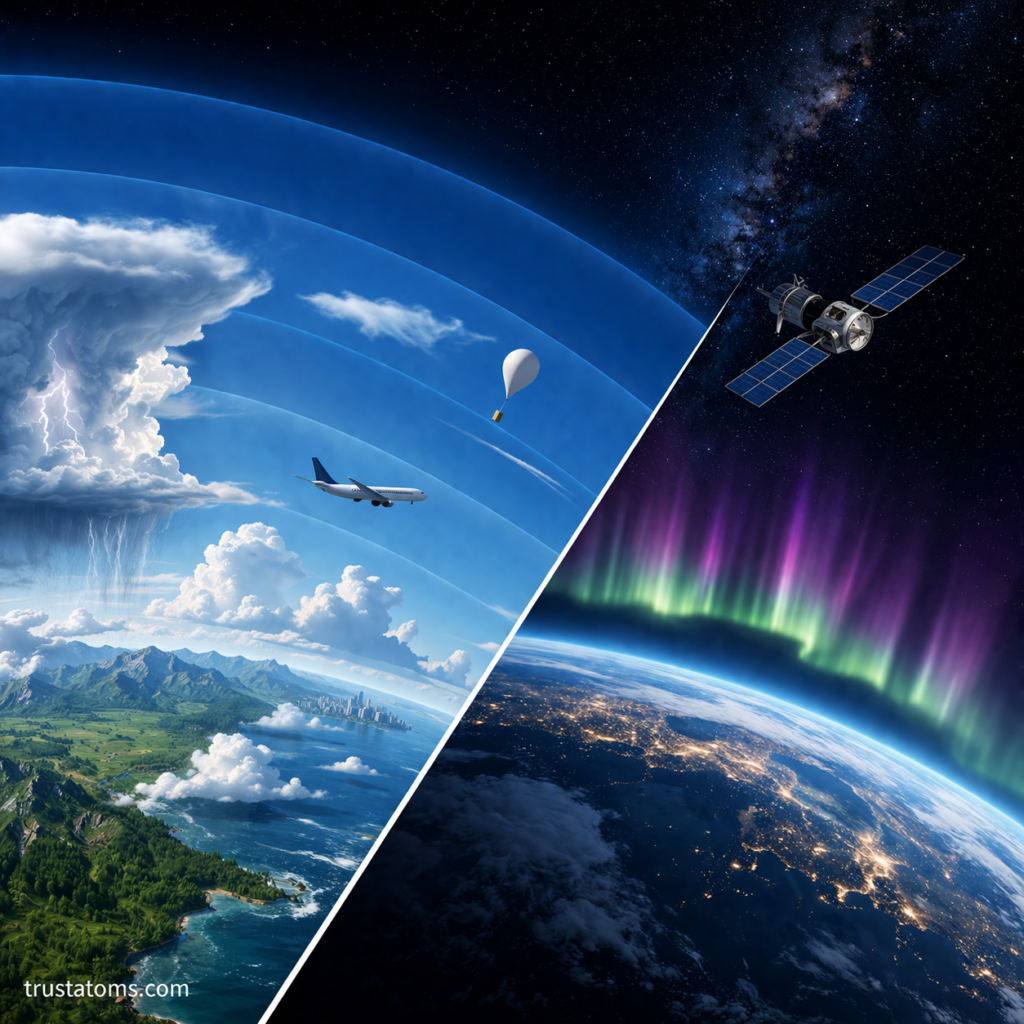
Although each layer has unique properties, they function as a connected system.
Key Interactions
- Energy from the Sun heats different layers unevenly
- Gases absorb and reflect radiation at various altitudes
- Air movement in lower layers influences global climate
This interaction helps regulate temperature, distribute energy, and maintain conditions suitable for life.
Temperature Trends Across Layers
One of the defining features of atmospheric layers is how temperature changes with altitude:
- Troposphere: temperature decreases
- Stratosphere: temperature increases
- Mesosphere: temperature decreases
- Thermosphere: temperature increases
These alternating patterns are caused by how different gases absorb solar radiation.
Why Understanding the Atmosphere Matters
Learning about the troposphere, stratosphere, and beyond helps explain many real-world phenomena:
- Why airplanes fly at certain altitudes
- How weather forms and changes
- Why the sky appears blue
- How Earth is protected from harmful radiation
It also plays a key role in understanding climate change, environmental science, and space exploration.
Final Thoughts
From the weather-filled troposphere to the near-vacuum of the exosphere, Earth’s atmosphere is a finely tuned system that supports and protects life. Each layer contributes something essential, whether it’s shielding us from radiation, burning up meteors, or enabling communication systems.
By exploring the troposphere, stratosphere, and beyond, we gain a deeper appreciation for the invisible layers that make Earth habitable.