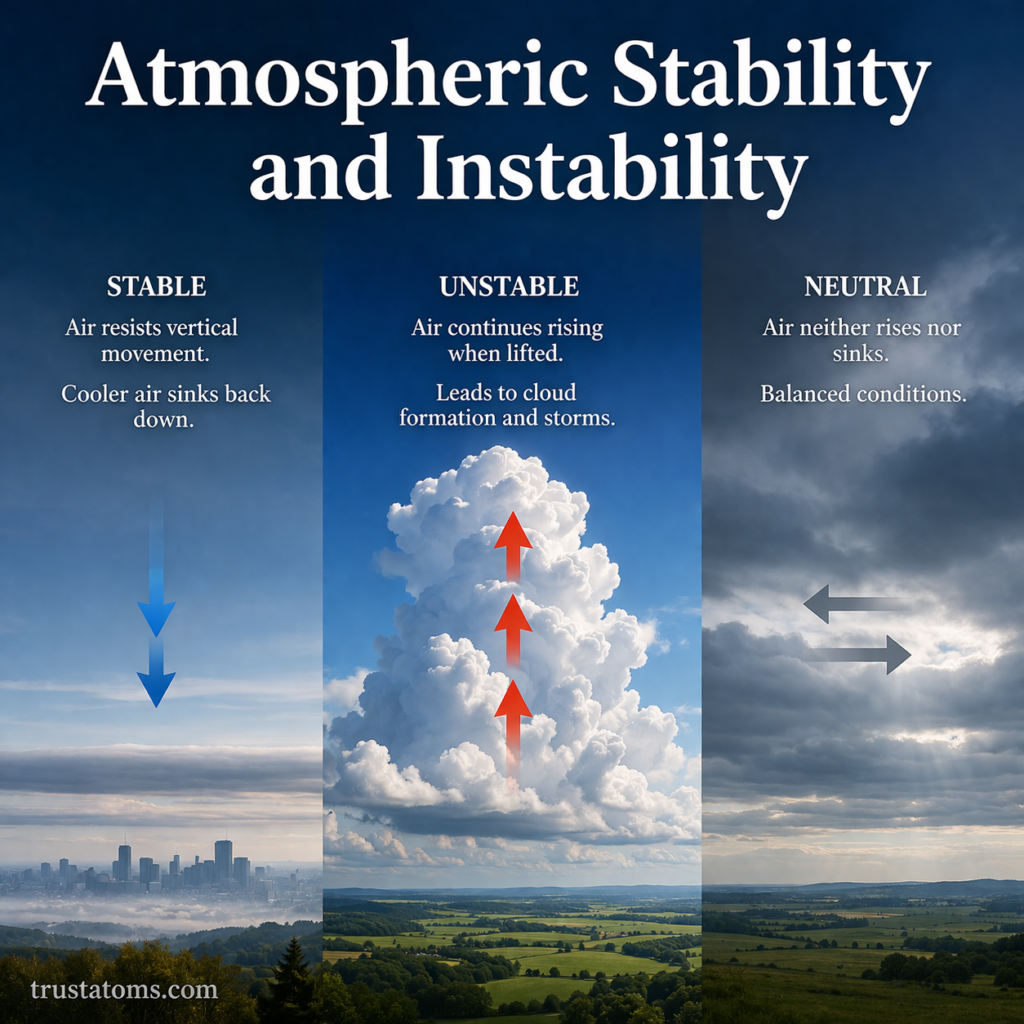
The atmosphere is constantly in motion, driven by temperature differences, pressure gradients, and moisture. One of the most important concepts in understanding weather patterns is atmospheric stability.
Atmospheric stability determines whether air will rise, sink, or remain in place—directly influencing cloud formation, storms, and even air quality. From calm, clear skies to severe thunderstorms, stability plays a central role in shaping what we experience day to day.
What Is Atmospheric Stability?
Atmospheric stability refers to the tendency of an air parcel (a small volume of air) to either return to its original position or continue moving when it is displaced vertically.
There are three main states:
- Stable atmosphere – air resists vertical movement
- Unstable atmosphere – air continues rising when lifted
- Neutral atmosphere – air neither accelerates nor resists vertical motion
These behaviors depend largely on temperature differences between the air parcel and its surrounding environment.
How Air Parcels Move
To understand stability, it helps to think of air parcels like balloons:
- Warm air is less dense and rises
- Cool air is denser and sinks
When an air parcel is lifted:
- It expands as pressure decreases with altitude
- It cools as it expands (adiabatic cooling)
- Its temperature is compared to the surrounding air
The key question becomes:
Is the air parcel warmer or cooler than its environment?
- Warmer → continues rising (unstable)
- Cooler → sinks back down (stable)
Stable Atmosphere
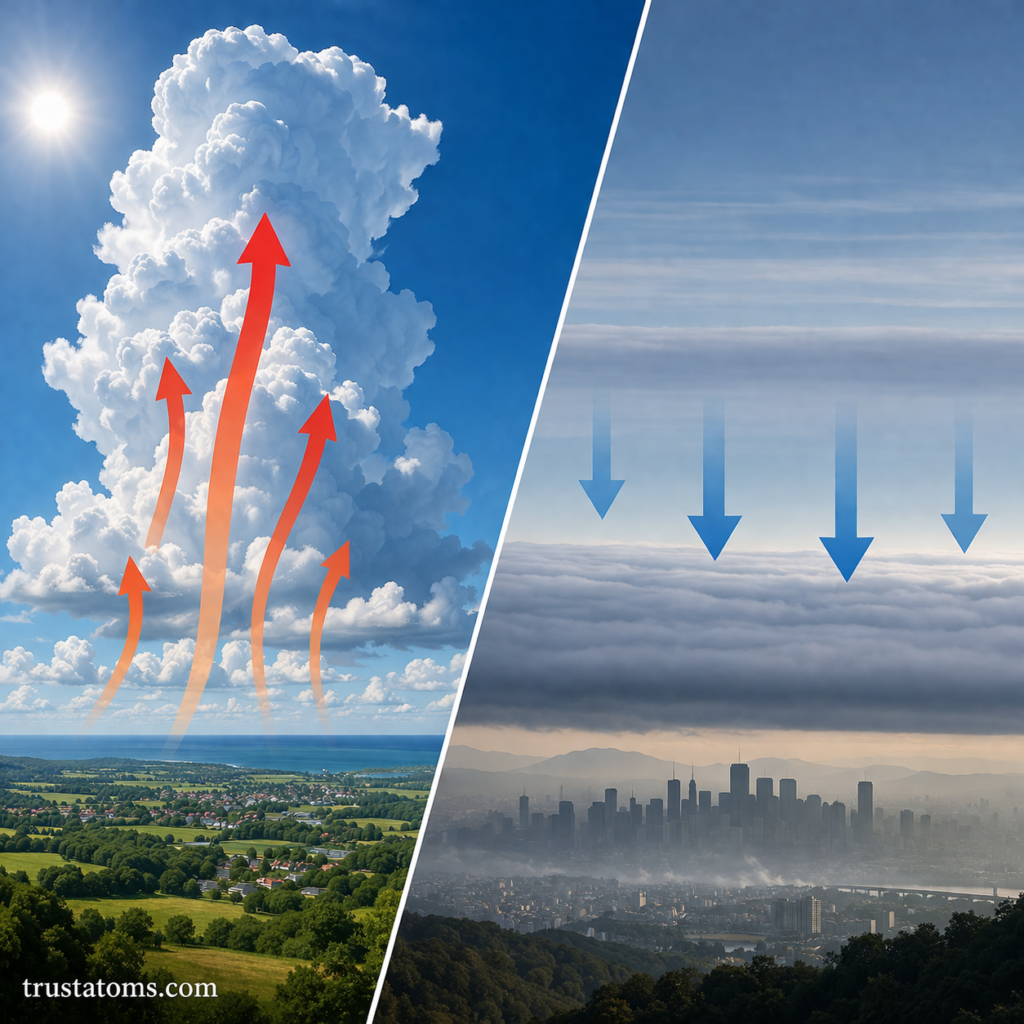
A stable atmosphere suppresses vertical motion.
Key Characteristics
- Air parcels that rise become cooler than surrounding air
- They sink back to their original position
- Vertical mixing is weak
Common Weather Conditions
- Clear skies or layered clouds (stratus)
- Light winds
- Limited cloud development
- Poor air dispersion (pollution can build up)
Temperature Inversions
A strong example of stability is a temperature inversion:
- Normally, temperature decreases with height
- In an inversion, temperature increases with height
This creates a “lid” that traps air near the surface, preventing upward motion.
Unstable Atmosphere
An unstable atmosphere promotes vertical motion and rising air.
Key Characteristics
- Rising air parcels remain warmer than surrounding air
- They continue to rise freely
- Strong vertical mixing occurs
Common Weather Conditions
- Puffy cumulus clouds
- Thunderstorms
- Heavy rain or severe weather
- Turbulence in the atmosphere
Unstable conditions are often associated with warm surface temperatures and cooler air aloft.
Neutral Atmosphere
A neutral atmosphere is balanced:
- Air parcels that rise match the temperature of their surroundings
- They neither accelerate upward nor sink
This condition is less common but can occur during overcast conditions or in well-mixed air layers.
The Role of Lapse Rates
Lapse rates describe how temperature changes with altitude and are crucial in determining stability.
Types of Lapse Rates
- Environmental lapse rate (ELR)
- Actual temperature change in the atmosphere
- Dry adiabatic lapse rate (DALR)
- Rate at which dry air cools as it rises (~10°C per km)
- Moist adiabatic lapse rate (MALR)
- Rate at which saturated air cools (~5–6°C per km)
How They Determine Stability
- ELR < MALR → Stable atmosphere
- ELR > DALR → Unstable atmosphere
- ELR between MALR and DALR → Conditionally unstable
Conditional Instability
Conditional instability occurs when:
- Air is stable when dry
- Becomes unstable when saturated
This is common in the real atmosphere and plays a major role in storm development.
Why It Matters
- Moist air releases heat when condensation occurs
- This added heat makes the air parcel warmer
- The parcel rises more rapidly
This process fuels cloud growth and thunderstorms.
Real-World Examples
Stable Conditions
- Early morning calm air
- Fog formation
- Smog trapped in cities
Unstable Conditions
- Hot summer afternoons
- Thunderstorm development
- Rising thermals used by birds and gliders
Neutral Conditions
- Overcast skies with steady, light rain
- Minimal vertical movement
Why Atmospheric Stability Matters
Understanding stability helps meteorologists and scientists predict:
1. Weather Patterns
- Will clouds form or dissipate?
- Is severe weather likely?
2. Aviation Safety
- Turbulence is often linked to instability
- Stable air provides smoother flights
3. Air Pollution
- Stable air traps pollutants near the ground
- Unstable air disperses pollutants more effectively
4. Climate and Energy Transfer
- Stability affects how heat and moisture move through the atmosphere
Key Takeaways
- Atmospheric stability controls vertical air movement
- Stable air resists motion and leads to calm conditions
- Unstable air enhances rising motion and storm development
- Lapse rates are essential for determining stability
- Conditional instability is a key driver of thunderstorms
Final Thoughts
Atmospheric stability is one of the foundational concepts in Earth science and meteorology. It explains why some days remain calm and clear, while others erupt into towering storms.
By understanding how temperature, moisture, and altitude interact, we gain insight into the invisible forces shaping our weather—and the dynamic nature of the atmosphere itself.