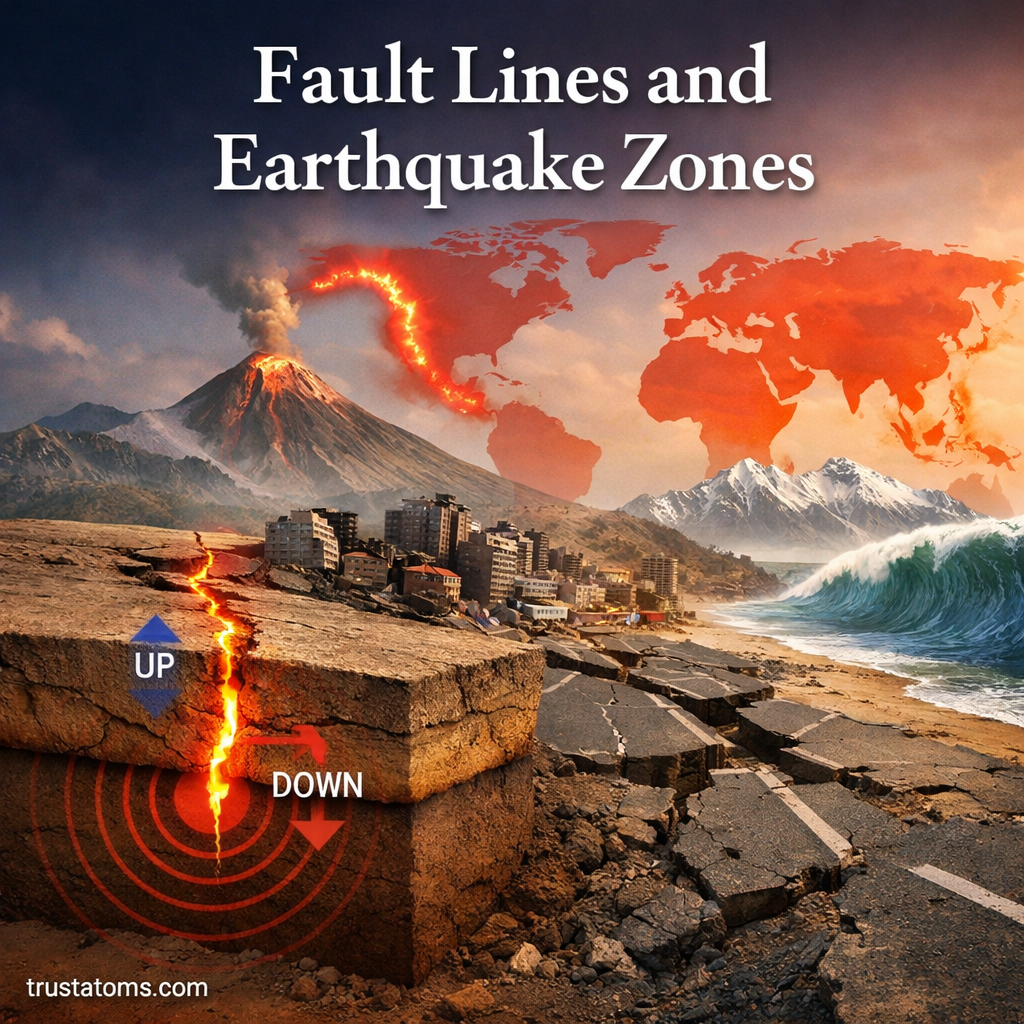
Earthquakes can seem sudden and unpredictable, but they’re usually the result of long-building stress along fault lines deep beneath the surface. Understanding where and why these movements occur helps scientists assess risk—and helps us better prepare for future seismic events.
In this guide, we’ll break down what fault lines are, how earthquake zones form, and where the most active regions on Earth are located.
What Is a Fault Line?
A fault line is a fracture or break in the Earth’s crust where blocks of rock move relative to each other. These movements can be slow and continuous—or sudden and violent, causing earthquakes.
Fault lines form due to the constant motion of tectonic plates, which are massive sections of Earth’s crust floating on the semi-fluid mantle below.
Key Characteristics of Fault Lines
- They can stretch for miles or even thousands of miles
- Movement occurs due to built-up stress between tectonic plates
- Not all faults produce earthquakes frequently
- Some faults remain “locked” for years before releasing energy suddenly
Types of Fault Lines
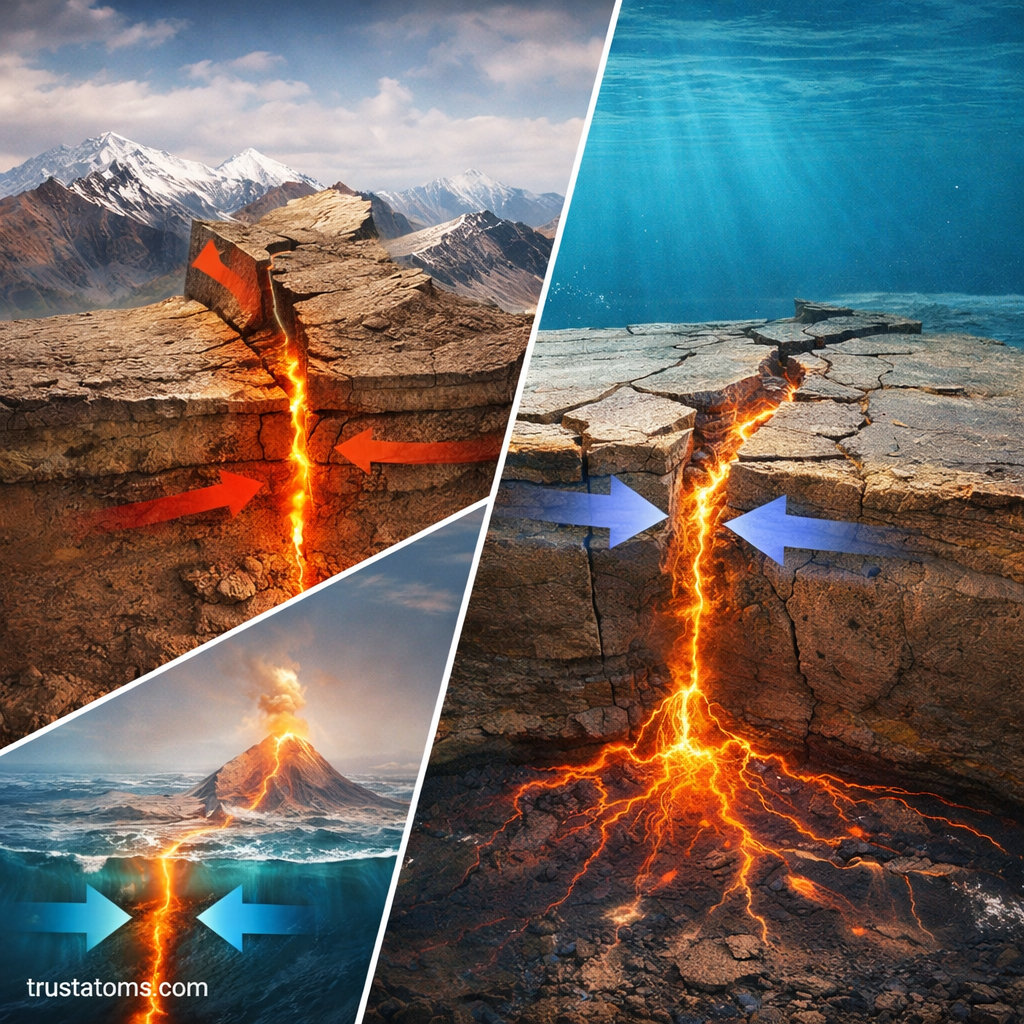
Fault lines are classified based on how the rocks move along them.
1. Normal Faults
- Occur when the crust is being pulled apart (tension)
- One block moves downward relative to the other
- Common in regions where the Earth’s crust is thinning
2. Reverse (Thrust) Faults
- Form when the crust is being compressed
- One block is pushed upward over another
- Often found in mountain-building regions
3. Strike-Slip Faults
- Occur when blocks slide horizontally past each other
- Movement is side-to-side rather than vertical
- Responsible for many major earthquakes
One of the most famous examples is the San Andreas Fault, a massive strike-slip fault running through California.
What Causes Earthquakes?
Earthquakes occur when stress along a fault exceeds the strength of the rocks, causing a sudden release of energy.
This process is explained by the concept of elastic rebound:
- Tectonic plates slowly move and become stuck due to friction
- Stress builds up over time
- The fault suddenly slips
- Energy is released as seismic waves
These waves travel through the Earth and cause the ground shaking we feel.
What Are Earthquake Zones?
Earthquake zones are regions where seismic activity is more frequent due to active fault systems and tectonic plate boundaries.
These zones are not random—they closely align with the edges of tectonic plates.
Why Earthquake Zones Form
- Tectonic plates are constantly moving
- Stress accumulates along plate boundaries
- Fault lines act as release points for that stress
Major Earthquake Zones Around the World
Certain regions experience significantly more earthquakes due to their tectonic setting.
The Pacific Ring of Fire
- The most active earthquake zone on Earth
- Surrounds the Pacific Ocean
- Includes countries like Japan, Indonesia, and Chile
- Responsible for about 75% of the world’s earthquakes
The Alpide Belt
- Extends from southern Europe through Asia
- Includes regions like Turkey, Iran, and the Himalayas
- Known for powerful continental collisions
Mid-Ocean Ridges
- Underwater mountain ranges where plates are spreading apart
- Frequent but usually less destructive earthquakes
- Often go unnoticed due to remote locations
Fault Lines vs Plate Boundaries
While closely related, fault lines and plate boundaries are not exactly the same.
Plate Boundaries
- Large-scale edges of tectonic plates
- Can be divergent, convergent, or transform
Fault Lines
- Smaller fractures within or between plates
- Can exist far from plate boundaries
- Still capable of producing earthquakes
How Scientists Monitor Fault Lines
Modern technology allows scientists to track fault activity and better understand earthquake risks.
Tools Used in Monitoring
- Seismographs to detect ground movement
- GPS systems to measure plate motion
- Satellite imaging to observe surface changes
- Geological mapping to identify active faults
Despite advances, predicting the exact time of an earthquake remains extremely difficult.
Can Earthquakes Be Predicted?
Short answer: not reliably.
Scientists can:
- Identify high-risk areas
- Estimate probabilities over time
- Monitor stress buildup
But they cannot yet predict:
- The exact date or time
- The precise magnitude of a future quake
This makes preparedness and building safety critical in earthquake-prone regions.
Why Understanding Fault Lines Matters
Knowing where fault lines and earthquake zones exist can save lives.
Benefits of Understanding Seismic Activity
- Improved building codes and infrastructure
- Better emergency preparedness plans
- Safer land-use planning
- Increased public awareness
Regions like California, Japan, and Chile invest heavily in earthquake-resistant design because of their proximity to active fault systems.
Common Misconceptions About Fault Lines
“Earthquakes only happen on visible cracks”
False—many faults are buried deep underground and invisible at the surface.
“Small earthquakes prevent big ones”
Not necessarily. Small quakes release some stress, but not always enough to prevent larger events.
“We can predict earthquakes accurately”
Current science does not allow precise prediction, only risk assessment.
Final Thoughts
Fault lines and earthquake zones are a natural result of Earth’s dynamic structure. While earthquakes can’t be prevented, understanding where and why they occur gives us the tools to reduce their impact.
As research and technology improve, our ability to monitor seismic activity continues to advance—but preparedness remains our most powerful defense.